
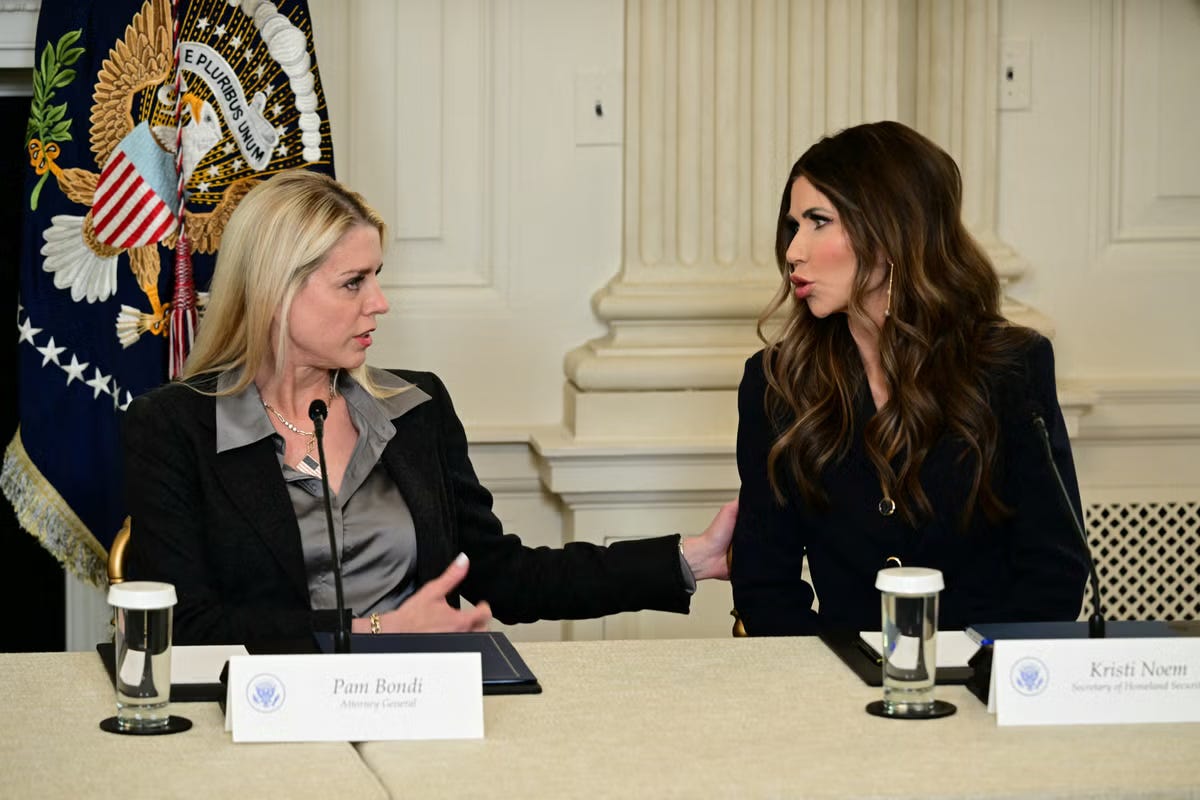
Two cabinet secretaries fired in a month. A third on the chopping block. The Army’s top general pushed out mid-war. And a president who keeps saying everything is fine.
This is what the beginning of a collapse looks like. Not a sudden implosion — but a slow, structural unraveling. The kind where the cracks appear first at the edges and then, before anyone’s quite ready to say it, reach the centre.
Donald Trump spent the first year of his second term projecting discipline. Fewer firings than term one. Fewer leaks. A cabinet that, for the most part, stayed in its lane. That period is over.
In the space of thirty days, Trump has fired his Homeland Security Secretary, his Attorney General, and is now reportedly polling his own cabinet on whether to sack his Director of National Intelligence.
This is not normal turnover. This is a president at war — literally, in Iran — who cannot trust the people he appointed. That is not strength. That is a problem.
The official line on both firings was warm. ‘Great American Patriot.’ ‘Served us well.’ Trump’s dismissals always come wrapped in praise. But the reality, in both cases, was the same: these were loyalists who could not deliver.
Kristi Noem was fired in early March. The proximate cause was a disastrous run of congressional hearings — including revelations about a $220 million advertising campaign featuring her own image, which she reportedly claimed Trump was aware of. He wasn’t, or at least didn’t want to be. Two days later, she was gone.
Pam Bondi lasted fourteen months as Attorney General. Her tenure was defined by two failures. First, the Epstein files: she repeatedly stumbled, suggesting a ‘client list’ existed before walking it back, then releasing documents that turned out to be largely public material already.
The chaos cost the administration politically and enraged Trump’s own base. Second, and more fundamentally, she couldn’t deliver the prosecutions Trump wanted. James Comey. Letitia James. Both indicted. Both thrown out by a judge. Trump was not interested in the legal system’s constraints. He wanted scalps.
Trump didn’t fire Bondi because she failed to be loyal enough. He fired her because the legal system stopped her from being loyal enough. That distinction matters enormously.
One source close to the White House told CNN that the Noem firing ‘went smoothly’ — and that this made Trump less wary of future removals. In other words: the first firing lowered the threshold for the next one. That is how administrations unravel. Not with a single dramatic break, but with each departure making the next one easier to justify.
The Guardian reported yesterday that Trump has privately been asking cabinet officials whether he should fire Tulsi Gabbard, his Director of National Intelligence. The White House denied it, just as they denied the Bondi reports hours before she was fired.
The reason Trump is furious with Gabbard is revealing. Joe Kent — the former director of the National Counterterrorism Center and a Gabbard ally — resigned in March. In his resignation letter, he stated bluntly that Iran ‘posed no imminent threat’ to the United States. He directly undercut the administration’s justification for war.
Gabbard, testifying before the House Intelligence Committee, declined to condemn Kent. She said he ‘said a lot of things.’ For Trump, this was a betrayal. It wasn’t just disloyalty — it was evidence that his own intelligence chief harboured doubts about a war he had already launched.
Worth noting: Gabbard herself sold ‘NO WAR WITH IRAN’ shirts in 2020. She has spent her political career opposing exactly the kind of intervention she is now required to defend. Trump knew this when he appointed her. The contradiction was always there — it just didn’t matter until the bombs started falling.
While the cabinet drama has dominated the headlines, something arguably more serious is happening at the Pentagon. Pete Hegseth has been conducting what Reuters and multiple defence officials are now calling ‘the latest purge’ of the military’s senior ranks — and it is accelerating during wartime.
On the same day Bondi was fired, Hegseth pushed out General Randy George, the Army’s Chief of Staff. Two other senior generals were also removed. This came after Hegseth had already fired the Joint Chiefs chairman, the Navy’s top officer, and the Air Force’s second-in-command.
Multiple Black officers and female officers have been removed from promotion lists. Five former defence secretaries — including Trump’s own first-term pick, Jim Mattis — wrote a joint letter to Congress calling the purges ‘reckless.’
Firing a serving Army Chief of Staff mid-war is, as Reuters noted, ‘nearly without precedent.’ It is being done for the same reason as all the other firings: ideological compliance. Trump and Hegseth want a military that does not question, does not push back, and does not produce figures like Joe Kent who resign and tell the truth in public.
The administration is not purging incompetence. It is purging independence. That is a much more dangerous thing to do.
Here is the thing about Trump’s retribution agenda — the mass prosecutions of political enemies, the Epstein transparency, the aggressive immigration crackdown: these things are harder to deliver than they sound. Not because of bad personnel, but because the legal system, the courts, and the Constitution keep getting in the way.
Bondi’s allies were explicit about this. She was willing to pursue the prosecutions Trump wanted. The courts stopped her. Trump’s answer is to fire Bondi and find someone more aggressive. But the next attorney general will face the same courts. The indictments will still get thrown out. The problem isn’t personnel. The problem is that what Trump wants is, in significant part, not legally possible.
The same logic applies to immigration. Noem faced ‘hundreds of court orders for unconstitutional immigration actions,’ according to multiple reports. She didn’t lose those cases because she was insufficiently loyal. She lost them because federal judges kept ruling the actions unconstitutional.
You can replace Noem with Mullin, Bondi with Zeldin, Gabbard with whoever is next. None of it changes the underlying reality: an agenda built substantially on the premise that Trump can override the courts, the law, and institutional constraints is going to keep running into those constraints. Firing the messenger doesn’t change the message.
Not yet — in the traditional sense. Trump still controls Congress. His approval among Republicans remains high. The Democratic opposition is fragmented. He is prosecuting a war that, rhetorically at least, he is claiming to be winning.
But the signs of structural decay are unmistakable. A president who cannot trust his own Attorney General, his own DNI, or his own Army Chief of Staff during wartime is a president governing in a permanent crisis of confidence. Each firing is an admission that the previous appointment was wrong. Each replacement inherits the same impossible brief.
And there is something else. Alex Jones — hardly a Trump critic — has now publicly said Trump is ‘done.’ Polling shows nearly all of Trump’s second-term appointees are net-unpopular. The midterms are coming. House Democrats raised $69 million in the first quarter of 2026 — nearly double their haul at the same point in 2024.
What we are watching is not a sudden collapse. It is the slow, grinding failure of a project built on the idea that enough personal loyalty could substitute for institutional competence, legal constraint, and political reality.
Thanks for reading Agendapedia! This post is public so feel free to share it.
Noem couldn’t deliver. Bondi couldn’t deliver. The courts wouldn’t let them. So Trump fires them and tries again.
He will keep firing. And the problem will remain.
Comments
Nothing yet. Say the first thing.
Sign in to join the conversation.