
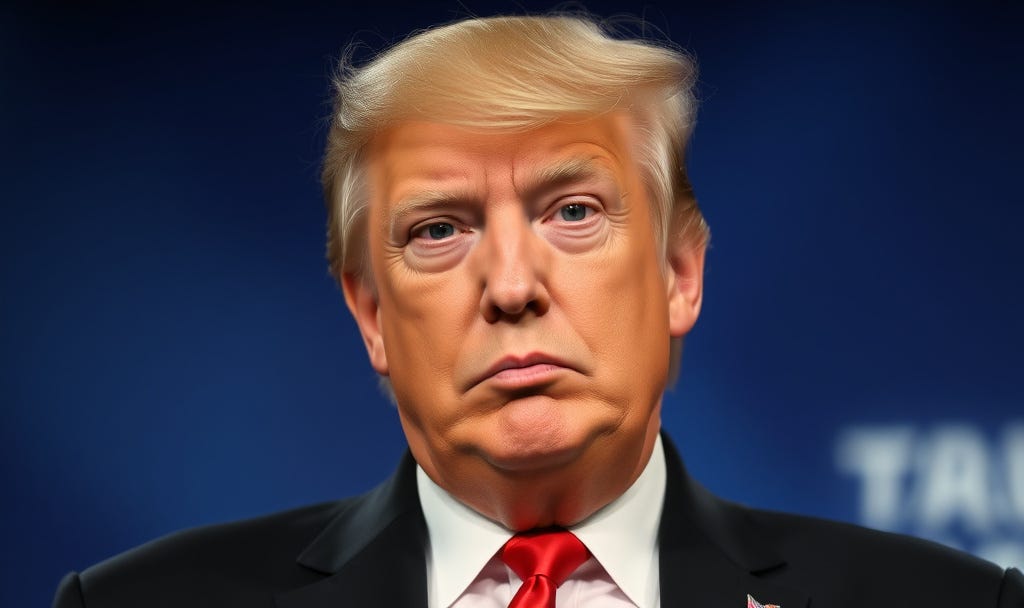
On February 28, 2026, the United States and Israel launched Operation Epic Fury — a sweeping air campaign against Iran that killed Supreme Leader Ali Khamenei and dozens of senior military commanders in a matter of hours. Washington declared it a triumph of precision power projection. It was nothing of the sort.
Three months on, the Strait of Hormuz remains contested, 13 American military bases have been struck by Iranian retaliatory fire, global oil markets are in historic disruption, and the Trump administration is quietly searching for a way to end a war it has no idea how to win. What looked like a lightning strike has become a strategic quagmire — and it tells us two things simultaneously: that the American empire is in accelerating decline, and that the man steering it is catastrophically unfit for the moment.
What looked like a lightning strike has become a strategic quagmire — and it tells us two things simultaneously: that the American empire is in accelerating decline, and that the man steering it is catastrophically unfit for the moment.
Commentators across the political spectrum have reached for the Suez Crisis of 1956 to make sense of what’s unfolding. The parallel is apt. In 1956, Britain and France launched a military intervention to reclaim the Suez Canal from Gamal Abdel Nasser — and won every battle while losing the war.
The operation exposed imperial overstretch, shattered allied confidence, and accelerated the end of British global power. Washington, then at the peak of its own hegemonic authority, forced London and Paris to stand down.
The difference in 2026 is that there is no external hegemon capable of forcing Washington to stop. The United States is not being disciplined by a rival — it is disciplining itself, through the compounding consequences of its own strategic recklessness. That is arguably more dangerous than Suez. Britain had Eisenhower to save it from itself. America has no one.
Historian Alfred McCoy frames the Iran war through the concept of “micro-militarism” — the pattern by which declining empires mount increasingly reckless military adventures in a desperate bid to recapture fading glory, only to accelerate their own unraveling.
The pattern fits with uncomfortable precision. With his tariff gambit faltering and his Greenland fantasy checkmated, Trump reached for a war — a war of choice, launched on the premise that Iran would fold the way Venezuela did.
America is not being disciplined by a rival — it is disciplining itself. That is more dangerous than Suez. Britain had Eisenhower to save it from itself. America has no one.
Strip away the military spectacle and what emerges is a portrait of decision-making that should alarm anyone who studies how wars begin.
According to officials who spoke to the press in the conflict’s first week, the decision to launch was made over a single weekend, by a small group of principals whose defining qualification was personal loyalty to the president, not strategic expertise.
There was no endgame. There was no post-decapitation plan. There was no serious modelling of Iranian resilience.
One Substack analyst captured it precisely: Operation Epic Fury was “the structure of an opportunity seized, not a strategy executed.” An intelligence window opened — Iranian leadership was gathered in a rare configuration.
The temptation was overwhelming. Trump seized it. The question of what came next apparently never received a satisfactory answer before the bombs fell.
This is not the failure of a plan that went wrong. It is the failure to have a plan at all. And that distinction matters enormously, because it points not to bad luck but to structural unfitness for command.
To understand why Trump made the call he did, you need to understand the Venezuela precedent. In January 2026, a coordinated CIA-backed operation removed Nicolas Maduro from power in Caracas with minimal friction. Trump concluded — apparently without serious challenge from his advisors — that Iran would follow the same script.
It was a category error of staggering proportions. Iran is not Venezuela. Iran has a population of 90 million. It commands an extensive network of regional proxies stretching from Lebanon to Iraq to Yemen. Its Revolutionary Guard Corps is one of the most battle-hardened military organisations in the world. And it controls the Strait of Hormuz — through which roughly 20% of global oil trade flows every day.
As Al Jazeera’s analysis noted, the IRGC did not fracture under the decapitation strikes. It consolidated. The regime did not collapse — it hardened. The regional proxies did not scatter — several of them, Hezbollah chief among them, emerged from the war’s early phase in stronger positions than they entered it. Every assumption the operation rested upon turned out to be wrong.
Every assumption the operation rested upon turned out to be wrong. This is not the failure of a plan that went wrong. It is the failure to have a plan at all.
The New York Times columnist Jamelle Bouie identified what may be the most important diagnosis of Trump’s Iran failure. The president’s cascading miscalculations — from the Strait closure to the collapse of his regime-change fantasy — stem from a single psychological blind spot: Donald Trump does not actually believe that other people have agency.
This is not a minor character flaw in a president. It is a disqualifying one. A commander-in-chief who cannot model adversary decision-making — who cannot seriously ask “what will Tehran do when we kill their supreme leader?” — is structurally incapable of conducting foreign policy. He can project force. He cannot anticipate consequences. And in international affairs, the consequences are almost always the point.
The result is a president who mistakes dominance for strategy, television optics for statecraft, and the momentary rush of a successful decapitation strike for the achievement of a political objective. Trump demanded Iran’s unconditional surrender on March 6. Iran struck 13 American bases. That gap between demand and reality is the measure of his failure.
Perhaps the most damning detail to emerge from the war’s first weeks is what Trump’s own allies are saying privately. Multiple figures close to the president have described him as having been “bamboozled” into catastrophic decisions — a word that carries the distinct implication that someone did the bamboozling.
That someone, by all available evidence, is Benjamin Netanyahu. The war plan — a decapitation strike premised on regime collapse — was sold to Trump by Netanyahu and Mossad director David Barnea. John Mearsheimer put it directly: even Joe Biden, whose deference to Israeli preferences was remarkable by any historical standard, had the strategic common sense to resist Israeli pressure to strike Iran in April and October 2024. Trump could not.
This is itself a symptom of imperial dysfunction. A hegemon at the peak of its power does not subordinate its grand strategy to a client state. The degree to which Netanyahu has functioned as a co-author of American military policy in this conflict — dragging a nuclear-armed superpower into a war with foreseeable strategic costs — is itself evidence of how far American statecraft has decayed.
A hegemon at the peak of its power does not subordinate its grand strategy to a client state. The degree to which Netanyahu has co-authored American military policy is itself evidence of how far American statecraft has decayed.
What makes the Iran war a signature Trump disaster — as opposed to merely a generic policy failure — is the way his own psychological needs have foreclosed the exits. He cannot declare defeat: his entire political identity is built on dominance and winning.
He cannot declare victory: Iran controls the Strait, its proxies are operational, and its nuclear knowledge survives. He cannot negotiate from strength: the Islamabad Talks collapsed, and Iran has demonstrated it can impose costs Washington cannot indefinitely absorb.
The expert assessment is bleak. The administration must either escalate — risking the destruction of Gulf oil and desalination infrastructure and a global economic catastrophe — or retreat, declaring some hollow “victory” that fools no one and exposes the emptiness of every threat Trump has made. As one security analyst put it: “For a man who built his image on dominance, this is the ultimate trap.”
And the trap is of his own construction.
The final indictment is the most damning precisely because it is the most structural. The Iran war is not simply the product of bad decisions made in February 2026. It is the terminal expression of a chain of bad decisions stretching back nearly a decade.
In 2018, Trump unilaterally withdrew from the JCPOA — the nuclear deal that had successfully constrained Iran’s enrichment programme under international inspection. Barack Obama had been clear about the stakes at the time: “The choice we face is ultimately between diplomacy or some form of war.” Eleven years later, that prophecy has been vindicated with brutal precision.
Trump destroyed the diplomatic architecture, spent years escalating pressure, watched Iran advance its nuclear programme in response, and then appeared genuinely surprised when Iran refused to capitulate on demand. The Center for American Progress described the conflict as “a quagmire entirely of his own making.” That is the verdict of the historical record — not partisan commentary, but the logical endpoint of a policy that had no endpoint.
Empires do not fall in a day. They are hollowed out — through accumulated strategic failures, eroding credibility, and the slow withdrawal of allied confidence that once made their guarantees mean something. What the Iran war has done is make that hollowing visible.
Gulf states that hosted American bases discovered those bases could not protect them. The dollar’s reserve currency status, already under slow erosion, faces accelerated pressure as the war disrupts the petrodollar architecture. The sanctions regime — Washington’s primary coercive instrument — has been undermined by Trump’s own waivers, issued to manage oil prices his war created. And Iran, by weaponising control of the Strait of Hormuz, has demonstrated that a middle power can impose costs on the American-led global economy that Washington has no clean answer to.
The International Crisis Group’s Ali Vaez put it as sharply as anyone: in trying to prevent Iran from developing a weapon of mass destruction, the United States handed it a weapon of mass disruption.
That sentence will be quoted in history books.
In trying to prevent Iran from developing a weapon of mass destruction, the United States handed it a weapon of mass disruption. That sentence will be quoted in history books.
Two things are true simultaneously, and understanding their relationship is the analytical task of this moment.
First: the United States was already in structural decline before February 28, 2026. The erosion of alliance credibility, the dollar’s diminishing reserve share, the failure of post-9/11 military adventurism — these were long-term trends that predated Trump’s second term. The Iran war did not create American decline. It accelerated and exposed it.
Second: the specific shape of this disaster — its recklessness, its absence of planning, its subordination to Netanyahu’s agenda, its psychological roots in a president who cannot model adversary agency — is distinctly Trumpian. A more competent administration might have made errors in Iran. It would not have made these errors, in this sequence, with this degree of strategic vacancy at the top.
The convergence of structural decline and personal unfitness is what makes 2026 genuinely dangerous. Declining empires with competent leadership can manage their transitions. Declining empires led by men who confuse aggression with strategy, and television moments with geopolitical victories, cannot.
Operation Epic Fury was named for the wrong thing. The fury was not epic. The failure was.
Comments
Nothing yet. Say the first thing.
Sign in to join the conversation.