
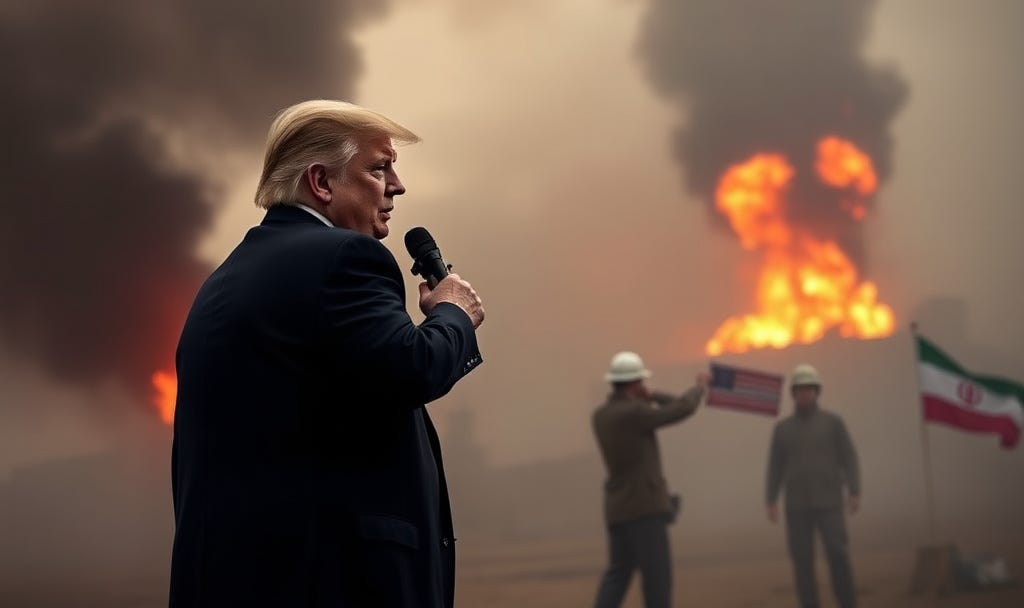
Let’s be clear about what the World Bank said this week, and what it means.
Global growth is projected to slow to 2.5% in 2026, down from 2.9% in 2025 — the lowest rate since the Covid-19 pandemic. The cause isn’t a virus this time. It isn’t a natural disaster. It’s a war. A war of choice. A war launched by Donald Trump and Benjamin Netanyahu on February 28th, without a congressional declaration, without a UN mandate, and without the consent of the American people. Common Dreams
The economic wreckage is now impossible to ignore.
THE NUMBERS DON’T LIE
The World Bank’s Global Economic Prospects report expects Brent crude to average $94 a barrel this year — up roughly 36% from 2025 levels and 50% higher than the Bank had projected as recently as January. That price spike is the direct consequence of Operation Epic Fury and what followed: Iran’s closure of the Strait of Hormuz. HNGN
A complete cessation of oil exports from the Gulf region amounts to removing close to 20% of global oil supplies from the market, about 80% of which is shipped to Asia. This isn’t some abstract geopolitical variable. It’s food prices. Fuel costs. Heating bills. The cost of shipping a container from Shanghai to Rotterdam. Dallas Fed
The World Bank warns that if energy supply disruptions prove more severe than current assumptions and are accompanied by financial stress, global growth could fall to just 1.3% in 2026, with inflation rising to 4.4%. That’s not a recession. That’s a collapse. Yahoo Finance
WHO PAYS THE PRICE?
Not Donald Trump. Not Pete Hegseth. Not the defence contractors cashing in on every sortie.
Gulf economies directly affected by the conflict are expected to take the biggest hit, with growth collapsing to close to zero this year, after 3.9% in 2025. Countries that had nothing to do with this war — that built their futures around regional stability — are now watching their economies crater because two governments decided to act unilaterally. The National
And it gets worse the further down the income ladder you go. The Kiel Institute has been blunt: the Hormuz closure transmits directly into food prices and household welfare, with severe welfare losses in energy-dependent developing countries worldwide. Every week the strait remains closed, developing countries lose real income that cannot be recovered through subsequent market adjustment. Kielinstitut
Read that again. Cannot be recovered. This isn’t a dip. For the world’s poorest households, this is permanent damage.
The World Bank has said it is making up to $60 billion immediately available to developing countries hit hardest by the crisis, with that number potentially rising to $100 billion over 15 months. That’s the international community scrambling to contain the blowback from a decision made by one man in the Oval Office. RTÉ
THE COMPOUNDING CATASTROPHE
Here’s what makes this moment so infuriating. The Iran war didn’t arrive in a vacuum. World Bank Chief Economist Indermit Gill has pointed to a cascade of shocks that have eroded global economic resilience over recent years: the pandemic, climate change, Russia’s invasion of Ukraine, Trump’s tariff wars — and now the Iran war. Each shock depleting the buffers countries need to absorb the next one. RTÉ
Trump’s tariff wars weakened global trade frameworks. His gutting of multilateral institutions reduced the capacity for coordinated response. And then he lit the fuse in the Persian Gulf.
The impact of the Iran conflict is now offsetting what would otherwise have been stronger underlying growth, consumer spending, and AI investment spending. The macro fundamentals were, by most accounts, improving. The war wiped that out. Yahoo Finance
Meanwhile, growth in the euro zone is projected to slow to 0.8% this year, as elevated energy prices restrain consumer spending and investment. European families will pay more to heat their homes this winter because of a war they had no vote on and no hand in starting. Yahoo Finance
THE ACCOUNTABILITY GAP
This is the part that should make you angry.
Congress never voted for this war. The War Powers Resolution was ignored. The legal architecture designed to prevent exactly this kind of executive adventurism was simply bypassed. And the press — those who were still allowed access after Pete Hegseth’s journalist bans — were largely kept away from the operational details until the bombs were already falling.
Now the World Bank is forecasting the worst global growth since Covid. The IMF is downgrading. IMF Managing Director Kristalina Georgieva has said that had it not been for this shock, the Fund would have been upgrading global growth. “But now, even our most hopeful scenario involves a growth downgrade.” barchart
This is what impunity costs. Not just in lives — though the human cost of Operation Epic Fury is its own reckoning — but in the living standards of billions of people who never got a say.
WHAT COMES NEXT
Recovery is expected as trade normalises, with Gulf growth rebounding to about 5% in 2027-28 following reconstruction. The World Bank’s baseline assumes the worst of energy disruptions ease by July. But that baseline rests on a fragile ceasefire holding — and the report itself warns the outlook could decline further if supply disruptions worsen, as the ceasefire between the US and Iran remains under pressure from both sides. The NationalAl Jazeera
Trump has, characteristically, offered contradictory signals. He has ranged from threatening imminent peace deals to promising full-scale military attacks that would leave the strait closed for months. Markets hate uncertainty. The world’s poor can’t afford it. Yahoo Finance
Here’s the bottom line: a war of choice is never just paid for by the countries fighting it. The cost is distributed — across commodity chains, supply routes, inflation indices, and household budgets — to people who never voted for it, never benefited from it, and will never be compensated for it.
The World Bank has now put a number on what this war costs the world. The question is whether anyone in Washington is listening.
I wouldn’t hold your breath.
Comments
Nothing yet. Say the first thing.
Sign in to join the conversation.