
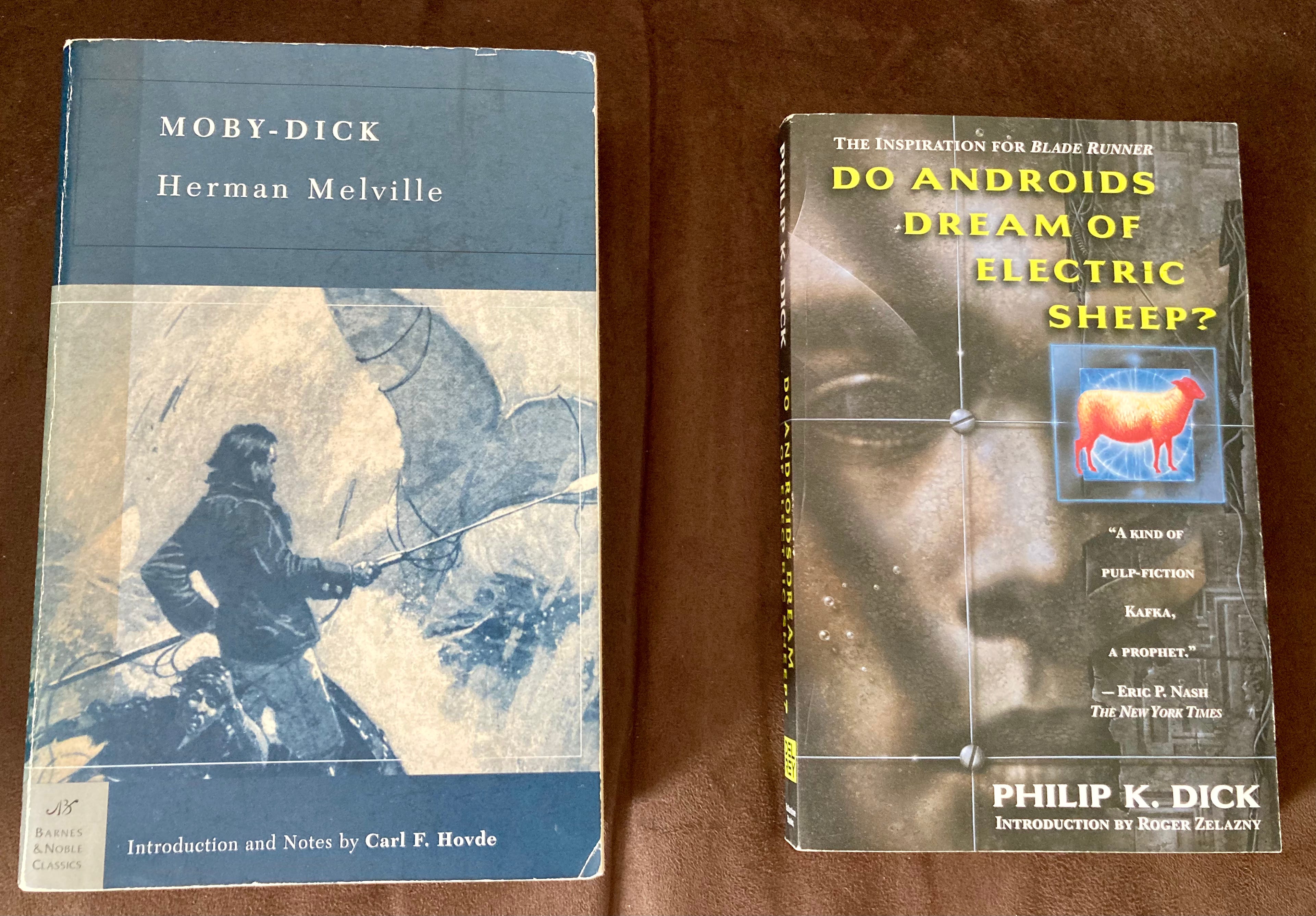
ChatGPT, the artificially intelligent chatbot, can tell me about whales and whaling. It can produce a more succinct and accurate version of Moby Dick, chapter 103, “Measurement of The Whale’s Skeleton.” (Per the bot, “The measurements of a sperm whale's skeleton can vary depending on the individual, but on average, the skull of a mature male can be up to 20 feet long and the vertebral column can be up to 60 feet long. The flippers are typically about 4-6 feet long and the tail can be up to 15 feet long.”) But can it write, as Herman Melville did:
All that most maddens and torments; all that stirs up the lees of things; all truth with malice in it; all that cracks the sinews and cakes the brain; all the subtle demonisms of life and thought; all evil, to crazy Ahab, were visibly personified, and made practically assailable in Moby Dick. He piled upon the whale’s white hump the sum of all the general rage and hate felt by his whole race from Adam down; and then, as if his chest had been a mortar, he burst his hot heart’s shell upon it.
To write sentences like these requires having felt “the general rage and hate” that we, whether due to original sin or evolutionary maladaptation, have inherited from Adam down. It requires having slept with the succubi of failure and frustration that are “the subtle demonisms of life and thought.” It requires having once imagined, and then relished the thought, that “all that most maddens and torments” could be visibly personified, and made practically assailable, in the Leviathanic body of a white whale. In sum, it requires possessing that crooked timber of humanity out of which no straight thing was ever made (Kant).
ChatGPT makes straight things: answers and essays with facts (or, at least, a factual aura) but without humanity. It can even fake crooked and write in the style of a human. But can ChatGPT “fake it so real it’s beyond fake” (Hole)? No, at least not yet. Here’s what ChatGPT produced when I asked it to rewrite the above paragraph by Melville:
For Ahab, the white whale, Moby Dick, embodied all that was maddening and tormenting. It represented all that stirred the bitter depths of humanity, all that was maliciously true, all that harmed the mind and body. It symbolized the subtle evil in life and thought. All of these things, to Ahab, were personified and made tangible in the form of the whale. He channeled the anger and hatred of his entire lineage, from Adam to himself, onto the creature's white hump, and with all the strength of his fervent heart, he aimed to destroy it.
As Roger Waters said of the first David Gilmour-led Pink Floyd album, “a pretty fair forgery.” But “subtle evil” lacks the multifariousness of “subtle demonisms”; “made tangible” lacks the bellicosity of “made practically assailable”; “with all the strength of his fervent heart, he aimed to destroy it” lacks the fervency, the heart of “as if his chest had been a mortar, he burst his hot heart’s shell upon it.” In Moby Dick, we are faced with an abstraction (“all evil”) made flesh, and thus conquerable (with the right crew and harpoon), as a gargantuan sperm whale. ChatGPT takes this abstraction made flesh and drains it of blood and semen, turning it into an abstraction again.
To write Moby Dick, one must have led the inner and outer lives of Melville. Per DH Lawrence’s psychoanalysis: “Melville at his best invariably wrote from a sort of dream-self, so that events which he relates as actual fact have indeed a far deeper reference to his own soul.” The whale is more than just a whale, but also more than just a metaphor: it is based on real accounts of aggressive leviathans and equally real reflections on our corresponding bloodlust. “To be enraged with a dumb thing, Captain Ahab, seems blasphemous,” says his first mate, quite reasonably. To which Ahab, quite humanly, replies, “Talk not to me of blasphemy, man; I'd strike the sun if it insulted me.”
Moby Dick is based, in part, on survivors’ accounts of the Essex, a ship that was rammed and sunk by an unusually large whale. But its deepest strata are a product of Melville’s own circumnavigation: going off to sea then deserting ship in the South Pacific; living and making love with Polynesian cannibals; sailing for home while he “sighed for the Paradise he had just escaped from in such a fever” (Lawrence). To turn a phrase like Melville, one must have known his visions of the deep and travails with humanity. One must have experienced what he experienced and known how he interpreted, internalized, and transmuted those experiences. One must have inputs far more sublime, esoteric, and quotidian (inspiration lurks everywhere) than ChatGPT’s trawling of the internet.
Again, quoting Lawrence: “Never man instinctively hated human life, our human life, as we have it, more than Melville did. And never was a man so passionately filled with the sense of vastness and mystery of life which is non-human.” Robots—outside of fiction created by humans—don’t know the hatred for humanity that is inseparable from self-awareness. Nor are they passionately filled with the sense of vastness and mystery that we humans also feel, when we transcend self-awareness. As Melville put it, “through all the thick mists of the dim doubts in my mind, divine intuitions now and then shoot, enkindling my fog with a heavenly ray.” Great art requires both “doubts of all things earthly, and intuitions of some things heavenly”; experience of the highs and lows that are above and below the ken of any artificial mind.
Artificial intelligence may become the universal author of college essays, advertising copy, business communications, and how-to guides. If a bot can save me time by drafting a work email, I’ll sincerely thank it with best regards. If a bot can teach me to fish better than any human can, I’ll accept its tutelage: hook, line, and sinker. But to write the great novel of the sea, to produce art that reflects yet transcends experience and emotion: that requires a human, all too human, consciousness. To ChatGPT and its successors, I say with Melville: “You’ll do to give us the bare words and facts, but we come in to supply the thoughts.”
Comments
Nothing yet. Say the first thing.
Sign in to join the conversation.