
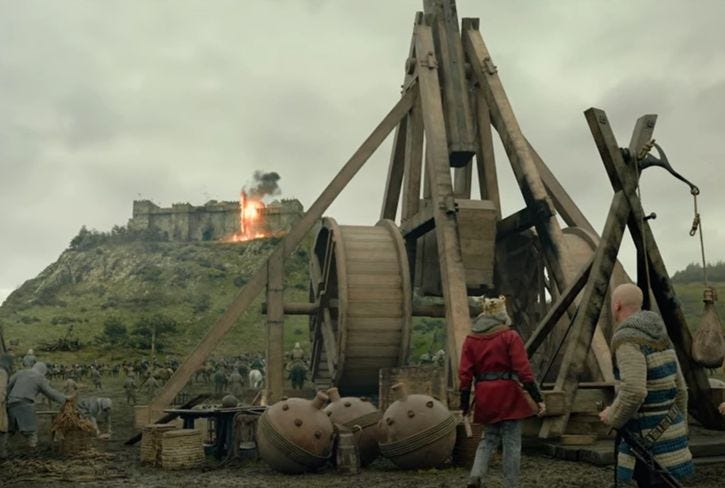
In July 1304 the Stirling garrison surrendered to Edward I. This siege is famous for the War-Wolf melodrama, in which Edward insisted on deploying his new toy against the castle before the Scots were allowed to surrender.
The ‘instrument’ or surrender agreement survives. Below is a translation of the Latin; this is from the actual document drawn up and sealed at the time, not chronicle accounts or later histories. Quote:
‘The following nobles and lords were present:
Ralph de Monthermer, of Gloucestershire,
Richard de Burgh, Earl of Ulster,
The newly elected Bishop of Exeter,
John Botetourt, knight,
John de Mowbray, knight,
John de Benstede, clerk, and others.
Concerning the Council held regarding Stirling Castle and the Persons therein.
By the counsel of the most excellent prince, Lord Edward, illustrious King of England:
Among whom, after the council had been held, the Earls of Gloucestershire and Ulster were instructed to send Lords Eustace [le Poer] and John de Mowbray to the gate of the said castle, with the following intent:
That they, in the name of the King, might summon Sir William Olyfard, who was then acting as constable of the castle, and others inside the castle, to learn whether he and the rest were willing to surrender the said castle to our lord the King freely and unconditionally.
They were to do this in such a way that if he, with the others, would not obey, then by proclamation, the King’s banner should be raised and military proceedings undertaken.
So it was done. After the proclamation was made, the said constable, with Lord William de Duplin (his constable), Thomas Lillay, and others, departed from the gate of the said castle.
Some of the castle’s inhabitants also came down to the aforementioned earls, seeking counsel. These people declared, both on their own behalf and for the rest within the said castle, that they remained of the same mind—that they wished to surrender themselves and the castle into the King’s hand, freely and without condition.
They claimed they did so in trust of the King’s mercy and justice, and they cited that the noble Lord Henry de Lacy, Earl of Lincoln, had promised them pardon for their submission.
And so, the earls said they would consult with the King.
Later, as Lord Eustace and the others returned to the King, they declared his pleasure to the castle’s men, and the King, showing mercy and clemency, graciously accepted their surrender and ordered the royal constables to take them into custody—though not with iron chains, but safely.
The names of those who surrendered themselves to the King, as above, and who were thus accepted, are these:
Sir William Olyfard
William de Duplin, knight
Fergus de Ardrossan
Robin de Ardrossan, his brother
William de Ramsay
Hugh de Ramsay
Ralph de Haliburton
Thomas de Knelthulle
Patricius de Pollework
Hugh Olyfard
Walter Olyfard
William Gyffard
Alan de Vipont
Andrew Wychard
Geoffrey le Botiller
John le Naper
William le Scherere
Hugh le Botiller
John de Kulgas
William de Anant
Robert de Ranfru
Walter Taylleu
Simon the Armourer
Brother William de Keth, of the Order of St. Dominic
And also two clerics from the house of Kelso, namely:
Master Benedict
A certain companion of his
All these surrendered themselves at Strivelyn [Stirling], in the month of July.’
The scribe was clearly not bothered about Master Benedict’s ‘companion’. Of those who surrendered, none were killed save an Englishman who had joined the Scots, who was hanged.
No posts
Comments
Nothing yet. Say the first thing.
Sign in to join the conversation.