
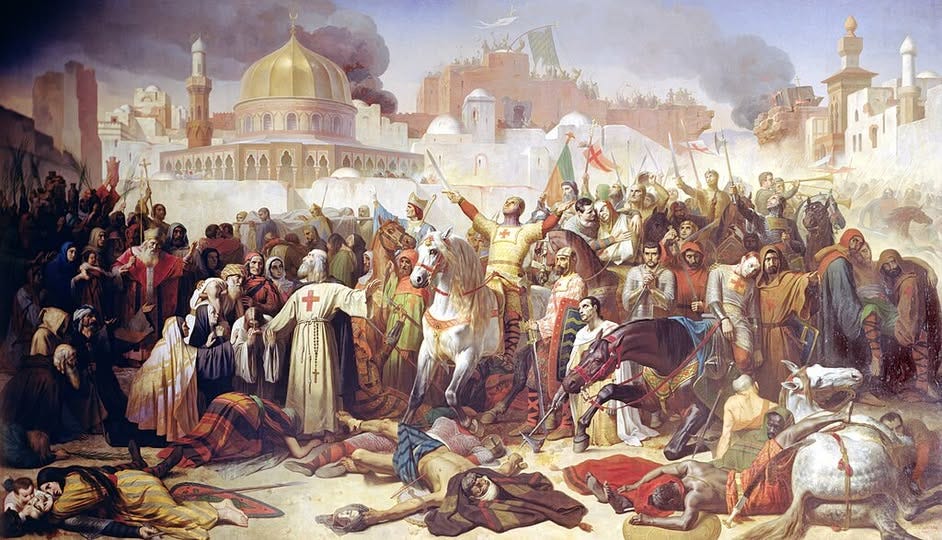
In July 1099 Jerusalem fell to the First Crusade. The city was sacked with a degree of brutality described in striking terms even by contemporary Christian chroniclers. This can make for unpleasant reading, so I will just quote a couple of samples from Peter Frankopan’s The Call from the East.
One Latin source wrote:
“Some of the pagans were mercifully beheaded, others pierced by arrows from the towers, and yet others, tortured for a long time, were burned to death in searing flames. Piles of heads, hands and feet lay in the homes and streets, and men and knights were running to and fro over corpses.”
Another eyewitness wrote:
“Almost the whole city was filled with their dead bodies so the survivors dragged the dead ones out in front of the gates and piled them up in mounds as big as houses outside the city gates. No one has ever heard of such a slaughter of pagans, for they were burned up on pyres like pyramids and no one save God knows how many of them there are.”
And so on. Later Muslim chroniclers claimed that as many as 70,000 people were slaughtered in and around the al-Aqsa mosque, although modern historians generally regard that figure as an exaggeration. What is beyond serious dispute is that thousands of the city’s Muslim inhabitants were killed. Many Jews were also massacred during the sack, reflecting the anti-Jewish violence that had already accompanied the First Crusade elsewhere in Europe.
Along with the killing came widespread looting. According to contemporary accounts, crusaders even split open corpses after rumours spread that some Muslims had swallowed gold to conceal it. Afterwards, many of the bodies were gathered together and burned.
After two days, the Frankish leaders ordered the corpses cleared from the streets, both to restore order and, presumably, to reduce the risk of disease. There is also evidence that, once the initial slaughter had subsided, attempts were made to restrain further indiscriminate killing.
The First Crusade had ended in bloodstained triumph. To quote Raymond of Aguilers, who was present at the fall of the city:
“…it was rewarding to see the worship of the pilgrims at the Holy Sepulchre, the clapping of hands, the rejoicing and singing of a new song to the Lord. Their souls offered to the victorious and triumphant God prayers of praise which they could not explain in words. A new day, new gladness, new and everlasting happiness, and then fulfilment of our toil and love brought forth new words and song for all...this is the day which the Lord has made; we shall rejoice and be glad in it.”
The capture of Jerusalem was one of the defining events of the medieval world. By the standards of the age, massacres following the storming of a city were not unusual. Even so, the scale of the bloodshed in Jerusalem in July 1099 left a deep impression on contemporaries, whether they celebrated it or mourned it.
No posts
Comments
Nothing yet. Say the first thing.
Sign in to join the conversation.