
I am currently researching and writing a new biography of Gráinne O’Malley and, as you can imagine, the period she is active in (the later sixteenth century) provides more than its fair share of characters. One of them, Murrough na dTuadh (of the battle axes) O’Flaherty, is most definitely one of the more unforgettable ones. Just for the sheer amount of trouble he caused for most of his life. He springs out of the records we have as one of the most egregiously ambitious people I have ever read about. What Murrough wanted, Murrough set out to get, and it didn’t matter who or what stood in his way. Audacious doesn’t even begin to describe this one.
To an observer, his life is a weird mix of a sort of walking fable, a warning against greed and hubris, as well as an almost textbook example of the fluidity of relations between Irish and English during the Tudor (and earlier periods). Even in the worst of times, we find people like Murrough who thought, no matter how bad it got, deals could be done and rules could be broken to serve their own interests. This was a man who nobody could trust. Not the English who backed him, not the cousins whose castle he took, not the rival O’Flaherty septs he stepped on to get what he wanted, and in the end not even the Crown he’d served when it suited him.
He’s barely known now outside a handful of specialists, which seems a shame, because as a personality he’s enormous.
Scion of the lesser branch
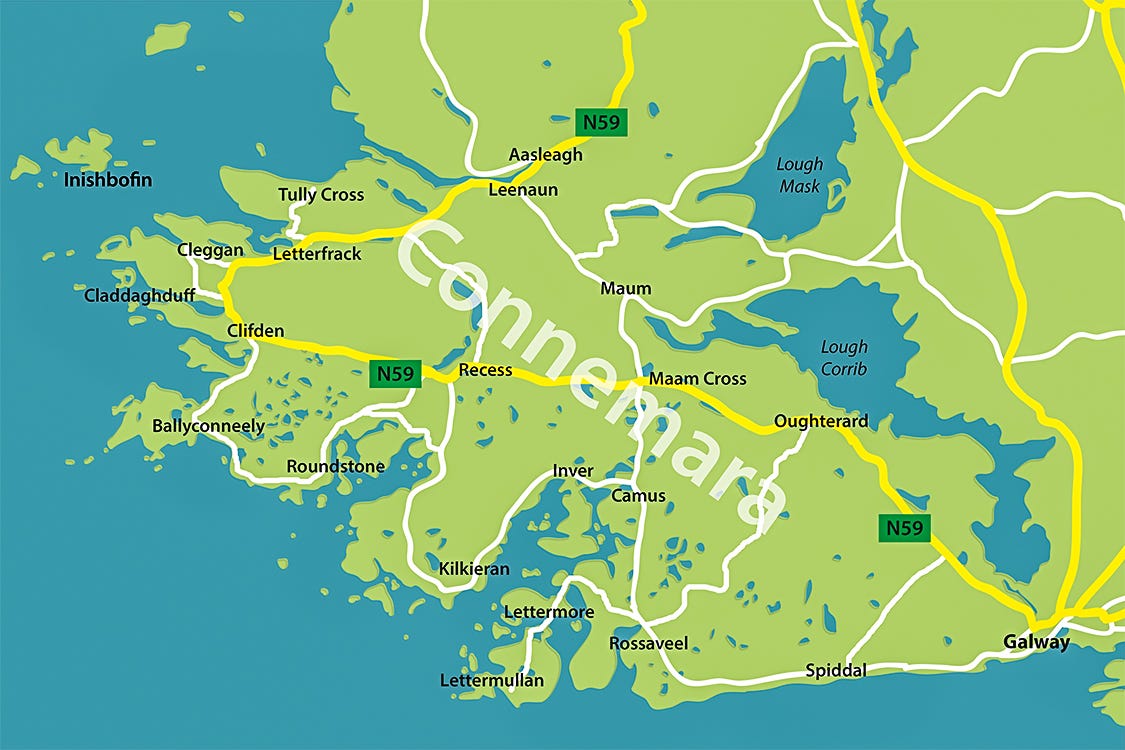
Something to understand before I take you through the rollercoaster that was his life is that he was part of the O’Flaherty family that ruled over lands called Iar Chonnacht (basically, Connemara in Co. Galway). They had split the lands between different branches (septs), but there was an overall chieftain, the O’Flaherty.1 Murrough was not a member of the branch that provided the present chieftain, Donal Crón, who was dismissed in English paperwork as ‘unfit and disobedient.’2 Murrough came up from a different, eastern part of the family, an ambitious and, by every account we have, spectacularly difficult man. He was causing trouble in the 1560s, resisting the much more powerful Earl of Clanricard’s attempts to impose tribute, and generally making himself felt across the western marches of Galway. Gaelic succession was contested and not a matter of automatic inheritance, unlike under English law, so there was room for a man like him to push and make a name for himself. That’s all acceptable for a young and warlike man to do. Murrough went a bit further with it all though.
Forty fat cows
His troublemaking was rewarded when the Tudor administrators of Ireland saw in him a way to get some purchase on the west. In 1569 the Queen’s government recognised Murrough as captain (i.e. chieftain) of Iar Chonnacht over the head of Donal Crón (remember him, ‘unfit and disobedient’). Murrough paid ‘forty fat cows’ for the privilege. A reminder that cattle were still currency even in dealing with the English government. This transaction did not, it’s fair to say, go down well with the rest of the O’Flahertys. Murrough had trodden on Gaelic custom and legal practice to get what he wanted. You should not be able to be either appointed by an English administration to be chieftain and you shouldn’t be seen to have bought it.
Why did the Tudor administrators back the firebrand that was Murrough? Well, in 1569 they had set up the presidency of Connacht, part of a wider effort to plant Crown authority in a province that largely ran itself on Gaelic terms. Recognising an ambitious rival over the established chief worked to weaken social bonds, create distrust within ruling families and weaken existing Gaelic lordships. Thus extending the Crown’s reach because if they are fighting each other then they are not focused on fighting you. Also, canny Tudor administrators knew that if you back a man who has no secure right to the title, then his authority depends on you, and a chief who depends on you is a chief you can use. It also suited Murrough, so it worked for both sides.
To the rival O’Flaherty septs he was an enraging usurper wearing a borrowed English hat. His acceptance of a position he had no clear right to, and his hunger to expand at the expense of the other branches, lit a family feud that ran for more than a decade. Murrough embraced the chaos and turmoil and thrived. He got busy seizing castles and lands from his cousins and made himself the dominant power across much of western Galway.
The taking of Aughnanure
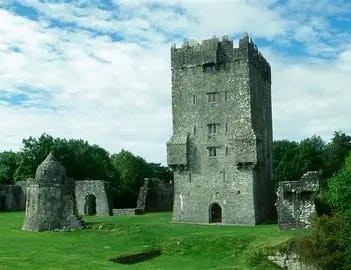
In 1572 Sir Edward Fitton, the English president of Connacht, marched on the major O'Flaherty castle of Aughnanure, which the Four Masters describe as ‘the castle of the sons of Donnell O’Flaherty.’ Fitton wrecked part of the castle and then handed what remained to Murrough.3 To have a senior Tudor official assist in your own power schemes was surely a bit of a triumph for Murrough. Generally, Gaelic lords working with or against English forces were often wholly dependent on local power politics. One elite group helping out another is nothing new in Irish history – the medieval period is littered with examples of co-operation. If anything, it all heats up in the sixteenth century as Gaelic Ireland comes under increased pressure to conform to English modes of life and landholding, a change which Murrough was perhaps quick to grasp. After this, Aughnanure Castle became the principal seat of his branch for the rest of his life, the place he governed from and the place he died in. In a succinct demonstration of how right could follow might in that world, he’d ended up with the strongest house in Iar Chonnacht.
‘The wildest man in all Connaught’
Comments
Nothing yet. Say the first thing.
Sign in to join the conversation.