
Part of my motivation in writing this Substack is to share the more obscure people and personalities of medieval and early modern Ireland with a wider audience. Sometimes it’s because the life itself is extraordinary (which this one quietly is), but also it’s because these people sometimes exemplify certain aspects of medieval history. Like the man I am writing about here whose life story tells of the international nature of lordship, especially in the unsettled twelfth and thirteenth centuries. So international was it, it can be hard to ascribe a cultural background to some lords. That complexity makes us think about the nature of belonging, and how to define identity (I think).
And so we turn to my subject today - a man familiar with places as different from each other as the English royal court, Dundalk in county Louth and Outremer.
In August 1192, this man, named Bertram de Verdon, died at Jaffa (now part of modern-day Tel Aviv), on the coast of what the crusaders called the Holy Land. He was probably in his sixties by then, and he had come a very long way to end his days there.1 And by a very long way I mean right from the western edge of Europe. From Ireland and, to be specific, Dundalk.
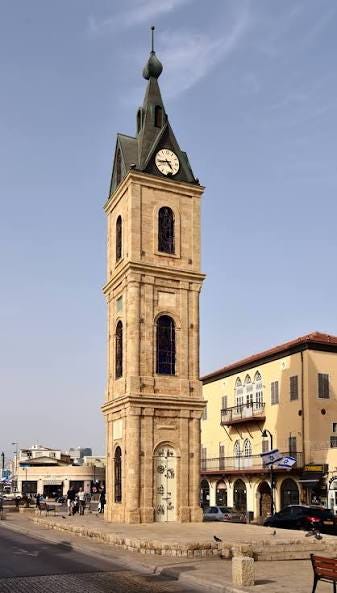
He died in the middle of an epidemic, in the heat and the dust of Outremer.2 Maybe he was longing for the English estates he left behind with their damp stones and crisp coldness. Or maybe he was thinking of the new Irish lands he had been given following the Anglo-Norman incursions into Ireland from the 1170s on. No doubt (like all Irish land) rain-lashed and impossibly green.
A quick explainer on the the Normans in Ireland - The arrival of the Normans in Ireland was less an invasion as used to be thought than a slow process, beginning in 1167 when a handful of Cambro-Norman mercenaries crossed the Irish Sea at the invitation of Diarmait Mac Murchada*, the ousted king of Leinster. He wanted his kingdom back and did not much care who helped him get it. It was led by the lords who accompanied him until Henry II landed in 1171 and claimed the whole business as the Crown’s. Ireland became a lordship owned by England. Think of it as an untidy, lord-driven opportunistic expansion.
* I wrote about Diarmait here
Jaffa was not a place of cool and damp but one of endless, glaring light. Of oppressive heat pressing down through clothes of wool and mail more suited to Northern Europe. It was a place of dust rising off too-hot roads and the smells of a captured port packed with too many people and animals. One can only imagine the sights and sounds and smells of it all. On top of all of that, the Crusader army Bertram was part of was dying. Serious illness (perhaps dysentery or malaria or any number of other sicknesses) moved relentlessly through the camp.3 He had travelled from the wet edge of the Atlantic world into white heat and dry dust, and there he caught something that killed him. The story of many a Crusader really.
So who was he, and why does an old crusader dying in a city far from home belong in a substack about Ireland?
A man who belonged nowhere in particular
Bertram was the son of Norman de Verdon and Lecelina, the daughter of Geoffrey de Clinton who was chamberlain to Henry I. They held lands in England and Normandy4 and, eventually, via Bertram, across the Irish Sea.
Quick note: In the late twelfth century Normandy was ruled by the English king, who was duke of Normandy, and it sat apart from the French royal domain.5
His first marriage, to Maud de Ferrers, gave him no children. His second wife, Rohese, was the mother of his sons Thomas and Nicholas.6
His English life was administrative. He was sheriff of Warwickshire and Leicestershire for fifteen years, rode the circuit as an itinerant justice, and turned up regularly at the king’s court. In 1177 Henry II sent him to Ferdinand of León to help arrange the king’s proposed pilgrimage to Santiago. This man was a royal official trusted to carry the king’s business into other people’s kingdoms. A consummate servant of the Crown. Trusted, methodical, possibly even a bit boring. But in a dependable servant of the Crown, boring is good. Turbulent twelfth-century kings liked boring.
Ireland, and the making of a frontier
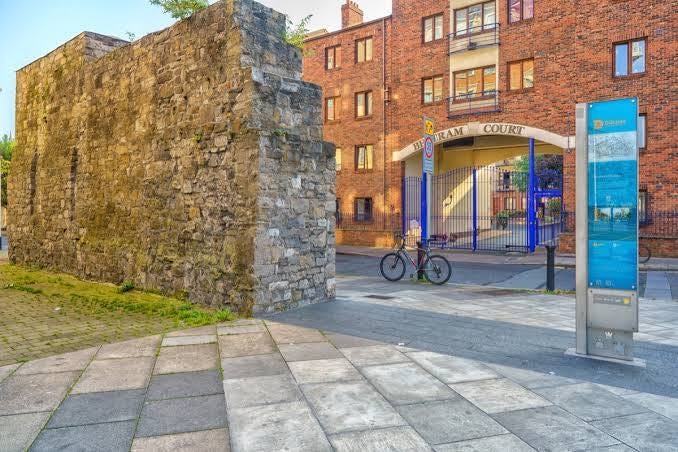
His life was about to get possibly a bit less boring as Ireland moved to the centre of this ordered existence in the 1180s. He was sent there, a professional dispatched to help organise a new acquisition of the Crown. He was seneschal from 1184 to 1186, and he even hosted Gerald of Wales, that famously opinionated cleric and writer. So Bertram kept an Irish household substantial enough to lodge a snob like Gerald. The antiquarian Denis Murphy later placed Bertram’s house, “Bertram’s Court,” possibly just outside the Dublin walls between New Gate and St Nicholas’ Gate. That’s a glimpse of a life, near the under-construction Christ Church cathedral in the early days of the switchover to a colonial capital.7
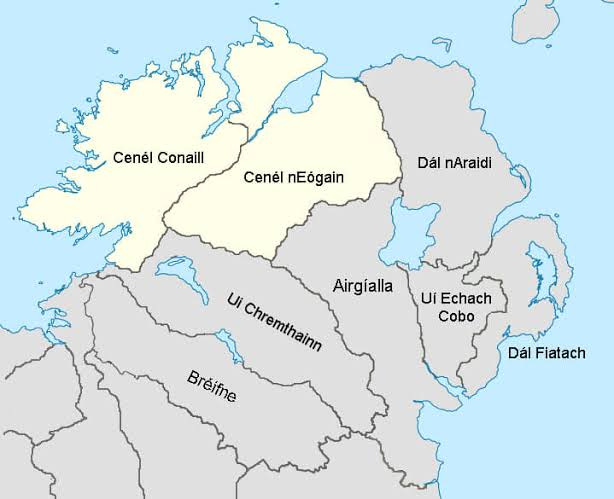
He was granted lands in Ireland to support him, but these lay further north, around Dundalk, in the territory the English called Oriel or Uriel. That’s actually Airgialla, a Gaelic kingdom covering much of what became County Louth and reaching into south Armagh and Monaghan. In 1185 Prince John carved up much of Airgialla between Bertram and Gilbert Pipard, and at a stroke turned a Gaelic kingdom into two lordships. The native lords were not consulted.8
Bertram also handed out church livings and tithes in and around Dundalk, for the good of his soul and Rohese’s.9 Some of it was piety, but lords also had political aims, and those sorts of gifts did political work. They not only bound the new lords to the local Church but gave the holding of Irish land a spiritual blessing it hadn’t previously had.
The last crossing
Bertram’s last journey would have taken him back across the Irish Sea one more time, and then far beyond it. Henry II died in 1189 and was succeeded by Richard I who almost immediately set off as part of the Third Crusade. Bertram was in the middle of the action too - well, the administrative action. In January 1191 he witnessed a charter at Messina and stood as guarantor for Richard’s treaty with Tancred of Sicily.10 He operated at the highest political levels and was trusted by more than one king of England, but his death over there left his family a bit exposed. When he died, his children were still minors. And a man named Gilbert Bassett swooped in and spent £200 to become the ward of Bertram’s young son and heir, Thomas. Gilbert wanted to eventually marry him to his daughter Eustacia. Transactional but pretty standard around lord’s heirs back then.
Thomas later died childless in Ireland in 1199, and so everything passed to his brother Nicholas, and then on to Nicholas’s daughter Roesia, the great heiress of the next generation. In 1225 she married Theobald Butler of the Ormond family as his second wife, which meant her children stood to inherit her lands rather than his, so she and they kept the de Verdon name and carried the dynasty on.11
What was left
After Roesia died in 1247, the line ran on through her son John and then through her grandson Theobald. It finally ended in 1317, when Theobald de Verdon died leaving four daughters and no male heir.12 Their marriages scattered the inheritance into the English Furnivall, Burghersh, Blunt, and Ferrers families, and eventually the old de Verdon lands in Louth were carved up and sold off across the middle decades of the fourteenth century. Thus ended the de Verdon adventures in Ireland.
Bertram’s life began in an English county, took a detour to Ireland and ended under the sun of Outremer. His life stitched together a great span of places, including Westminster, Dublin, Dundalk, Normandy and Acre to name but a few of his pit stops. Where did such a man belong? This man who carried his lordship across several seas.
He was anything but boring, really.
Roesia de Verdon, Bertram’s granddaughter and the first woman known to have built a castle in Ireland, has her own story. You can read it here.
Thanks for reading Unruly Ireland! This post is public so feel free to share it.
Bertram’s birth date isn’t documented. Given a public career running from the late 1160s and a father active under Henry I, a birth in the 1120s or early 1130s is the reasonable estimate, which would put him in his sixties at Jaffa. “Verdon or Verdun, Bertram de,” in Dictionary of National Biography, 1885–1900, vol. 58 (London: Smith, Elder, 1899), 225–26; Mark S. Hagger, The Fortunes of a Norman Family: The de Verduns in England, Ireland and Wales, 1066–1316 (Dublin: Four Courts Press, 2001).
The medieval French name meaning ‘overseas’ that was used as a collective term for the Crusader states.
Verdon, Bertram de,” DNB, 225–26
Denis Murphy, “The De Verdons of Louth,” Journal of the Royal Society of Antiquaries of Ireland, 5th ser., 5, pt. 4 (1895): 317–28.
Brendan Smith, Colonisation and Conquest in Medieval Ireland: The English in Louth, 1170–1330 (Cambridge: Cambridge University Press, 1999).
Charles McNeill, “The De Verdons and the Draycots: Norman Grants in County Louth,” Journal of the County Louth Archaeological Society 5, no. 3 (1923): 166–72.
Stephen J. Spencer, “The Third Crusade in Historiographical Perspective,” History Compass 19, no. 7 (2021). On the epidemic that swept the crusader army in the summer of 1192, when Richard himself fell dangerously ill with a fever the chroniclers called febris emitritea, see Thomas G. Wagner and Piers D. Mitchell, “The Illnesses of King Richard and King Philippe on the Third Crusade,” Crusades 10 (2011): 23–44. The chronicles record only that Bertram died at Jaffa in August 1192 and was buried at Acre; no source names his illness.
A. J. Otway-Ruthven, “The Partition of the de Verdon Lands in Ireland in 1332,” Proceedings of the Royal Irish Academy, section C, 66, no. 5 (1968): 401–55.
Comments
Nothing yet. Say the first thing.
Sign in to join the conversation.