
Key Takeaways
Trust in American news is collapsing while ownership consolidates — but the appetite for credible information has never been higher.
Ordinary people filming ICE raids, police violence, and the deaths of neighbors like Renée Good, Alex Pretti and George Floyd at the hands of federal agents or police are doing democratic work the press alone can’t do.
This citizen witnessing is largely treated as episodic activism. It should be treated as civic infrastructure — public, sustained, built to last beyond the viral moment.
India shows where unchecked media capture leads. It also acts as a mirror: looking at how Indian civil society has confronted the invisibility of the poor reveals blind spots Americans rarely name about their own media.
The missing piece in US media reform isn’t more speech. It’s listening infrastructure — public systems built to receive lived experience and route it into journalism, policy, and governance. When people can tell their own stories and see those stories shape news and policy, they stop being subjects of coverage and become participants in democracy — and the decisions made about their lives start to reflect the realities they actually live.
Join us! On August 25th at 8pm EST! An event discussing why citizen witnessing isn’t enough — and how listening infrastructure could revitalize local news.
Sign up here: https://www.mobilize.us/mediademocracyproject/event/957146/
When Citizens Become Witnesses
The American media landscape is being reshaped not just by technological change, but by the democratic power of citizens with cameras. Ordinary people are documenting how power is exercised in everyday life — residents recording police violence, neighbors filming ICE raids, witnesses capturing the fatal shootings of people like Renée Good and Alex Pretti by federal agents in Minneapolis. These acts have shaped public understanding, supported journalism, and disrupted official narratives in moments when institutional reporting was absent or slow. They have also come at real personal cost to those holding the cameras.
What does it take to make this kind of witnessing durable instead of episodic? To answer that, it helps to look beyond the United States — at how other democracies have wrestled with the same question. India, where we have worked for two decades, offers neither a template nor an ideal. What it offers is a mirror: a society that has confronted the invisibility of its poorest citizens in mainstream media differently than the US has, and that has built grassroots responses worth examining. Holding the American situation up against the Indian one reveals things about both that neither shows on its own.
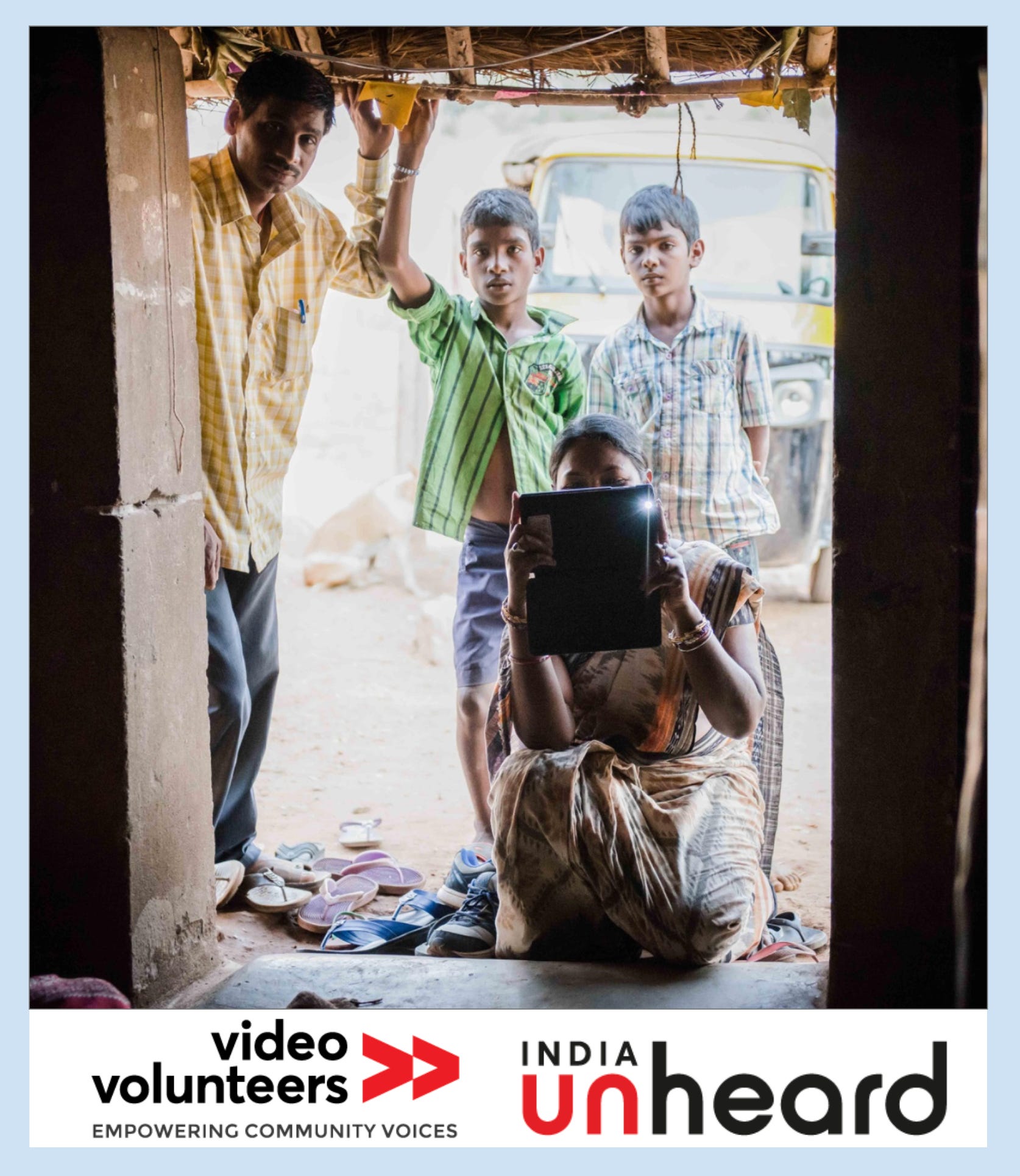
India’s Warning—and Its Lessons
Let us start with what India makes visible. In India, the erosion of press independence is impossible to miss — and so is the absence of the country’s poor from mainstream coverage. A major study found that on any given day, only 1% of English-language news coverage in the two biggest daily newspapers related to rural India, where the majority of the population lives. Media ownership has consolidated rapidly. Much of the country’s news media is now controlled by a handful of corporations, many of whom view media ownership less as a public trust than as a means of exerting political and economic influence.
Since 2014, media freedom in India has sharply deteriorated, with the country falling into the “very serious” category of press freedom threats in the global World Press Freedom Index. In the 2025 Reporters Without Borders ranking, India placed 151st out of 180 countries, reflecting sustained constraints on journalistic independence and pluralism.
A key factor is the economic and political pressure on news outlets. Most media organisations in India depend heavily on government and corporate advertising revenue, which can be used as a lever to reward compliant coverage and withhold funds from critical reporting. This financial dependency creates a form of soft censorship where editorial lines are influenced by economic incentives rather than journalistic norms.
Political influence has also shaped editorial narratives. The widely used term “Godi media” (literally lapdog media, a pun on Prime Minister Narendra Modi’s name) describes outlets perceived to be aligned with the ruling Bharatiya Janata Party (BJP), amplifying government messaging and avoiding robust scrutiny of powerful interests.
Legal and regulatory pressures further compound these challenges. Journalists critical of government policies often face harassment, intimidation, arbitrary arrests, and charges under broad national security and defamation laws, contributing to a climate of self-censorship. An example of this is the Indian government’s case against Newsclick.
The result is a media environment in which a free press is effectively choked by a combination of political alignment, economic dependency, concentrated corporate ownership, and regulatory constraints — undermining the watchdog role of journalism in the world’s largest democracy.
This trajectory should serve as both a warning and a call to action in the United States. What has unfolded in India is not unique. Versions of these trends are already visible in the U.S., from the silencing of dissent to growing concentration of media ownership and political pressure on the owners of news organizations.
So what is the response when institutional media weakens? We argue that media reform must include not only institutional reform, but representation reform — a rethinking of whose knowledge counts and how it enters public discourse. As co-founder of Video Volunteers, a community media organization, we have spent twenty years experimenting with how grassroots stories can drive systemic change. We share our experience here not as a template, but as one set of ideas from the Global South that may help inform what the US builds next. The network we have helped build includes roughly 3,000 trained volunteers and 180 paid Community Content Creators from marginalized backgrounds, and has contributed to real, measurable improvements in the lives of more than 50 million people.
Here is one example of our work in India (for additional insights visit our YouTube channel: https://www.youtube.com/@videovolunteers)
Why Voice Became Non-Negotiable
Across India, a range of grassroots and nonprofit media organizations, including Video Volunteers, have emerged in response to a widely recognized problem: the near-total invisibility of the poor in mainstream media. Awareness of marginalized communities’ invisibility in mainstream media extends well beyond media activists. An average news consumer would probably agree that large segments of the population are missing from public narratives — and that this absence matters.
This awareness exists in part because of conditions that are relatively distinctive to India. One is linguistic diversity: dozens of widely spoken languages coexist alongside English, making it immediately visible who the mainstream media is — and is not — addressing. Another is the scale and visibility of inequality and poverty. When middle-class, urban media broadcasts advertisements for cars and microwave ovens into regions where people are struggling to buy their first scooter, the exclusion is not subtle. The gap between who the media speaks to and who actually lives in the country is impossible to ignore.
A third reason is the strength of India’s civil society, particularly the women’s movement. For decades, feminist organizing has foregrounded questions of voice, invisibility, and self-representation. These ideas have helped normalize the notion that lived experience matters, that voice is political, and that people closest to a problem must be able to tell their own stories.
A final reason is India’s data systems for counting poverty. Poor people are often undercounted or invisible in the data, and this can lead to misallocation of funds and therefore deeper poverty. People understand that invisibility and lack of voice are strongly connected to poverty. The idea that people must be visible and heard, and must be able to tell their own stories, is therefore not just something activists or academics care about.
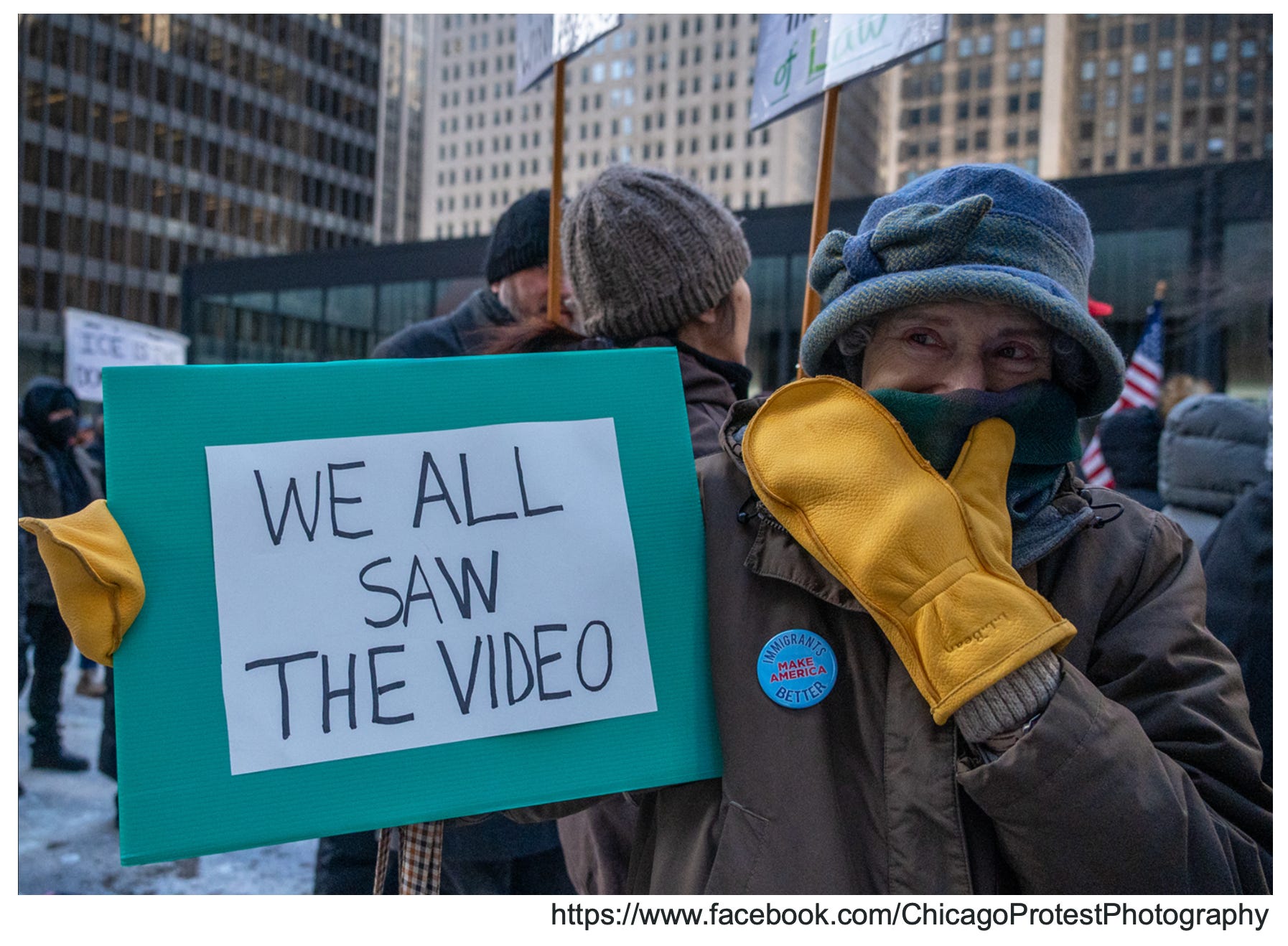
The United States: A Different Crisis, the Same Risk
Held against the Indian mirror, the American conversation about media reform looks oddly narrow. Discussions about what is wrong with mainstream media tend to focus less on inequality and exclusion, and more on political polarization, declining trust, and perceived bias. These are real and serious problems. But they often obscure another, equally consequential failure: the persistent inability of American media to meaningfully include the large number of voices and experiences of the poorest and most marginalized citizens.
This difference in emphasis reflects the broader context in which media reform debates are taking place. In India, the conversation unfolds amid extreme and visible inequality, where exclusion is difficult to ignore. In the United States, by contrast, media reform is happening within a wealthier society fragmented primarily along ideological lines. Though of course poverty exists in the US as well. As a result, debates about media reform tend to center on politics rather than on how our most marginalized citizens are missing from the conversation altogether.
Video of crowd empowered by their cameraphones mobilizing in Minnesota 2026 (credit: IG @BGonTHEscene https://linktr.ee/BGOnTheScene)
The language we use for this work is unsettled. “Citizen witnessing” and “citizen journalism” are the terms many Americans know — but it is a poor fit for the present moment. Many of the people doing this work in the United States today are not citizens. They are undocumented neighbors filming ICE raids, asylum seekers documenting detention, immigrants recording how federal agents treat their communities. Calling this work “citizen journalism” excludes them.
The term carries other limits too. “Citizen journalism” suggests one-off acts — a viral video, a single person acting or working alone. What we need is something larger: a sustained practice in which people from underrepresented communities represent themselves directly, over time, and at scale, and in a conscious collective effort or even movement. In our organization, we call this ‘community media’, a fairly common term in India, and also ‘community voice’. In this piece, I use citizen journalism for episodic witnessing, and community media or lived-experience storytelling for the sustained practice we need to build. Many Americans might use ‘civic media’.
Filming Power from the Ground Up
What does the mirror show America? The United States has seen extraordinary waves of citizen journalism, as ordinary people use cameras and phones to document how power is exercised in their neighborhoods. From the filming of police violence during the Black Lives Matter movement to the widespread recording of ICE actions across the country today, citizens are bearing witness in moments when institutional reporting is absent, constrained, or slow to respond. These acts of documentation have repeatedly shaped public understanding, supported investigative journalism, and disrupted official narratives — often at real personal cost to those holding the cameras, who face fear, retaliation, and long-term risk. Yet this work is still treated as episodic activism rather than as the emergence of a new kind of civic partner in the production of public knowledge. The people documenting these events are rarely supported as sustained contributors whose content could systematically inform news coverage over time.
Those of us who want to strengthen the media in America need to talk much more explicitly about this gap. The failure of mainstream media to connect at scale with the country’s poorest citizens is not a marginal issue; it is central to the crisis of trust. The evidence is visible in multiple domains. Election polling has famously failed to predict recent presidential outcomes — an error that reflects the difficulty of reaching and understanding large segments of the population. News organizations are frequently accused of unconscious bias and an inability to empathize with people outside elite or professional circles. The pipeline data backs this up: a 2018 survey of summer interns at seven of the country’s most influential newsrooms — The New York Times, The Wall Street Journal, The Washington Post, the Los Angeles Times, NPR, Politico, and the Chicago Tribune — found that 65% came from highly selective universities that make up just 13% of America’s four-year colleges. The pipeline into American journalism is narrower than the country it covers. Acknowledging these limitations is not an attack on journalism; it is an invitation to make it stronger. Even those who prioritize expert analysis can recognize that reporting becomes more accurate and representative when it is grounded in lived experience.
This blind spot has arisen partly because platforms like YouTube have successfully convinced us that social media “gives everyone a voice.” However, Video Volunteers’ own research on YouTube revealed that YouTube does little to support community or lived-experience storytellers. When researchers at Brown and Brigham Young University searched for videos on homelessness by homeless people, those stories appeared last — or not at all.
So yes, most people in the United States now carry a camera in their pocket and technically have the tools to tell their stories. But having the means to speak is not the same as being heard. The stories of marginalized people remain largely invisible — not because they are not being created, but because the platforms we rely on were never designed to surface them. Algorithms are full of bias. Would it be so wrong to ask that the algorithms be coded in such a way that they valued lived experience equally to expert experience?
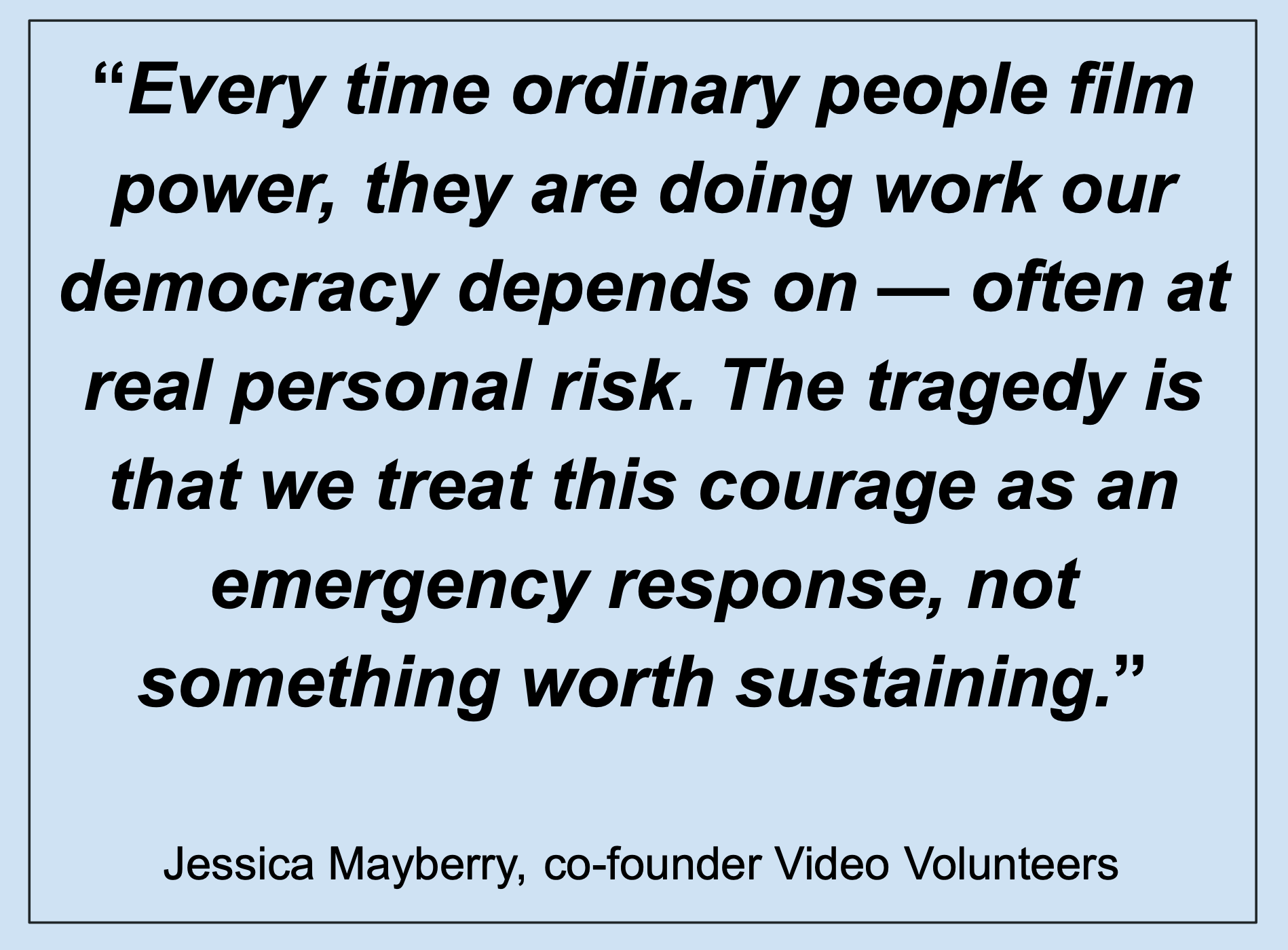
Beyond a Free Press: A Right to Be Heard
Defending a free press is essential, but it is not sufficient. Democracies need more than the right to speak; they need systems that can listen. Just as direct democracy allows citizens to vote without intermediaries, societies now need forms of direct voice — pathways for people to represent their own experiences in public life, not in place of journalism, but alongside it. This is possible in the United States, but we have not yet seized the opportunity to build it deliberately or at scale.
Progressive media is right now focused on resisting a takeover by the right. It needs to do this, of course. It’s critical. But it must do more: progressive media must also reimagine its relationship with the public. Citizens must be enabled to participate more meaningfully in the production of knowledge — to report, reflect, and frame issues in their own language and from their own standpoint. Diversity must be understood not only in demographic terms, but epistemic ones, recognizing lived experience as a legitimate and necessary source of insight.
We have seen time and again in our work that there are things no outside reporter — no matter how skilled, empathetic, or well-intentioned — can ever fully know about a community’s reality. That is why a truly democratic media ecosystem must do more than quote marginalized people; it must hand them the tools, platforms, and authority to tell their own stories directly. We should expect journalism on homelessness written by people experiencing homelessness, reporting on public housing reported by those who live there, and coverage of immigration produced by those who have endured raids, detention, and displacement. This is all technically possible today. The real question is what it will take to make unmediated, lived-experience storytelling a standard — rather than an exception — in American media.
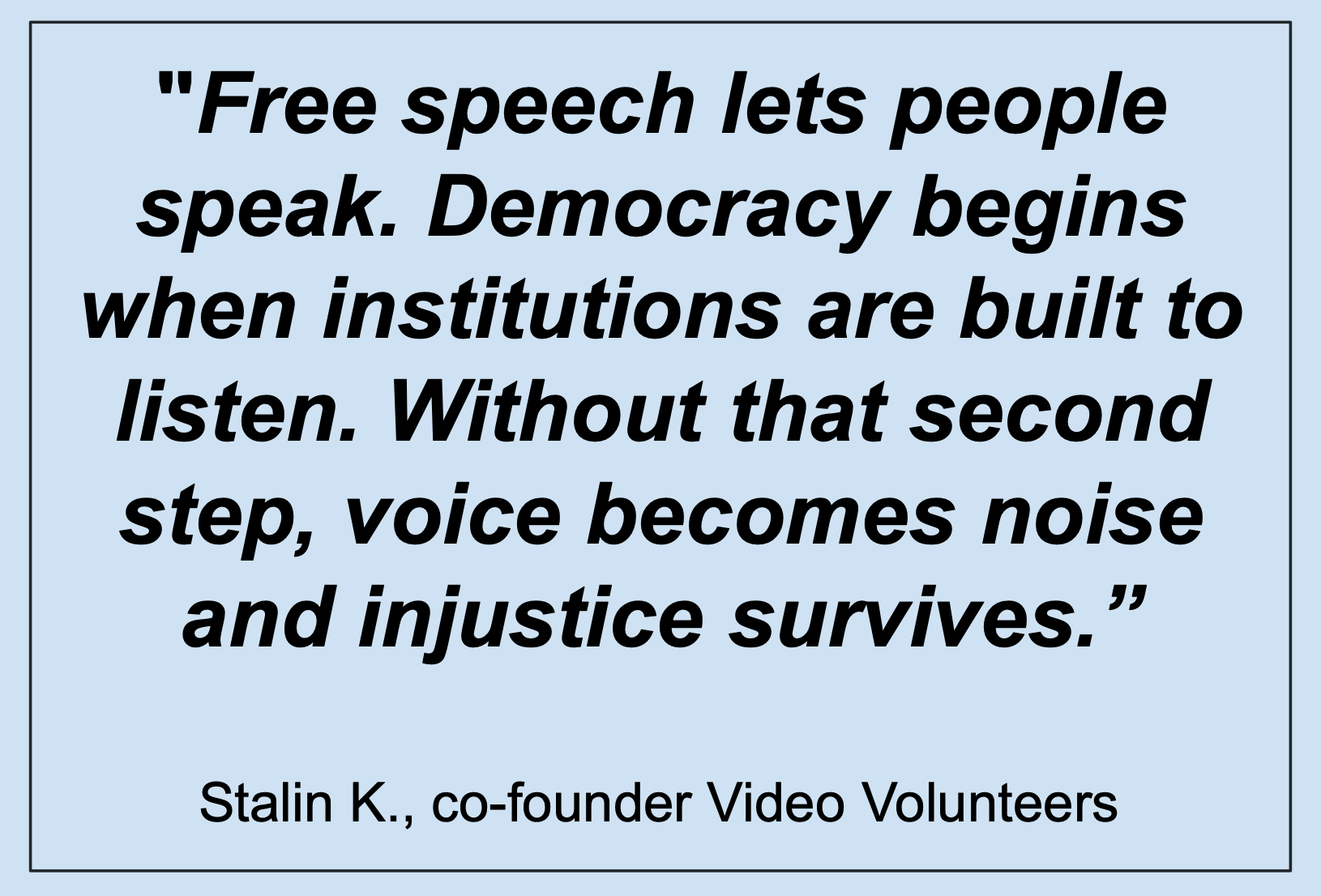
What follows are concrete recommendations for strengthening community media in the United States, which will require sustained support and institutional pathways.
Invest in community media. America needs a network of ‘hubs’ of citizen journalism, centered in local nonprofits that are themselves committed to amplifying the voices of the marginalized. These reporters should be paid. We can use the ‘digital rails’ described below to move content to those who need to hear it and we can use AI – with appropriate safeguards in place - to help make sense of the content. For over 50 years we have seen waves of initiatives that have democratized our media; today, we can very likely create a level playing field for community reporters at lower cost and greater scale than was ever possible before, because of the technology.
Journalists as Trainers. When journalists report stories, they should also train community members to tell their own stories. They should remind interviewees that, even if the reporter never returns, they can continue documenting issues with their own phones and voices.
Address Class Bias. We must confront class bias in American journalism. The profession still privileges the voices and perspectives of the educated elite.
Public Awareness. Readers and viewers should be encouraged to include lived-experience stories in their own media diets — reading expert analysis, yes, but also listening directly to those affected. This practice builds empathy and solidarity.
Celebrate Lived-Experience Storytellers. The ecosystem should identify, celebrate, and support storytellers from less visible communities both in the United States and globally.
Connect Media Reform to Future Technology. Media reform efforts must engage with where technology is headed. Reformers must ask: what kind of technological infrastructure will shape the media ecosystem in two, five, or ten years?
Civic Engagement Pilots. Media reform must be linked to civic engagement by helping community boards and local governments use technology to hear from more citizens, in every city. This is happening brilliantly in different places around the country, such as this example from Bowling Green, Kentucky, where 10% of the population submitted ideas for the city’s future that were analyzed with AI. Imagine local boards in every country receiving and reviewing resident input through simple digital tools — strengthening both participation and accountability.
Go Beyond Citizen Journalism. Citizen journalism has proven extraordinarily valuable. But the opportunity now is larger: to move from a few local reporters to thousands of people contributing narratives, videos, photos – whatever they are moved to share with a civic purpose. With the right tech platforms, training, and incentives, we can build a national listening network where everyday experiences flow into newsrooms, policymaking, and civic dialogue.
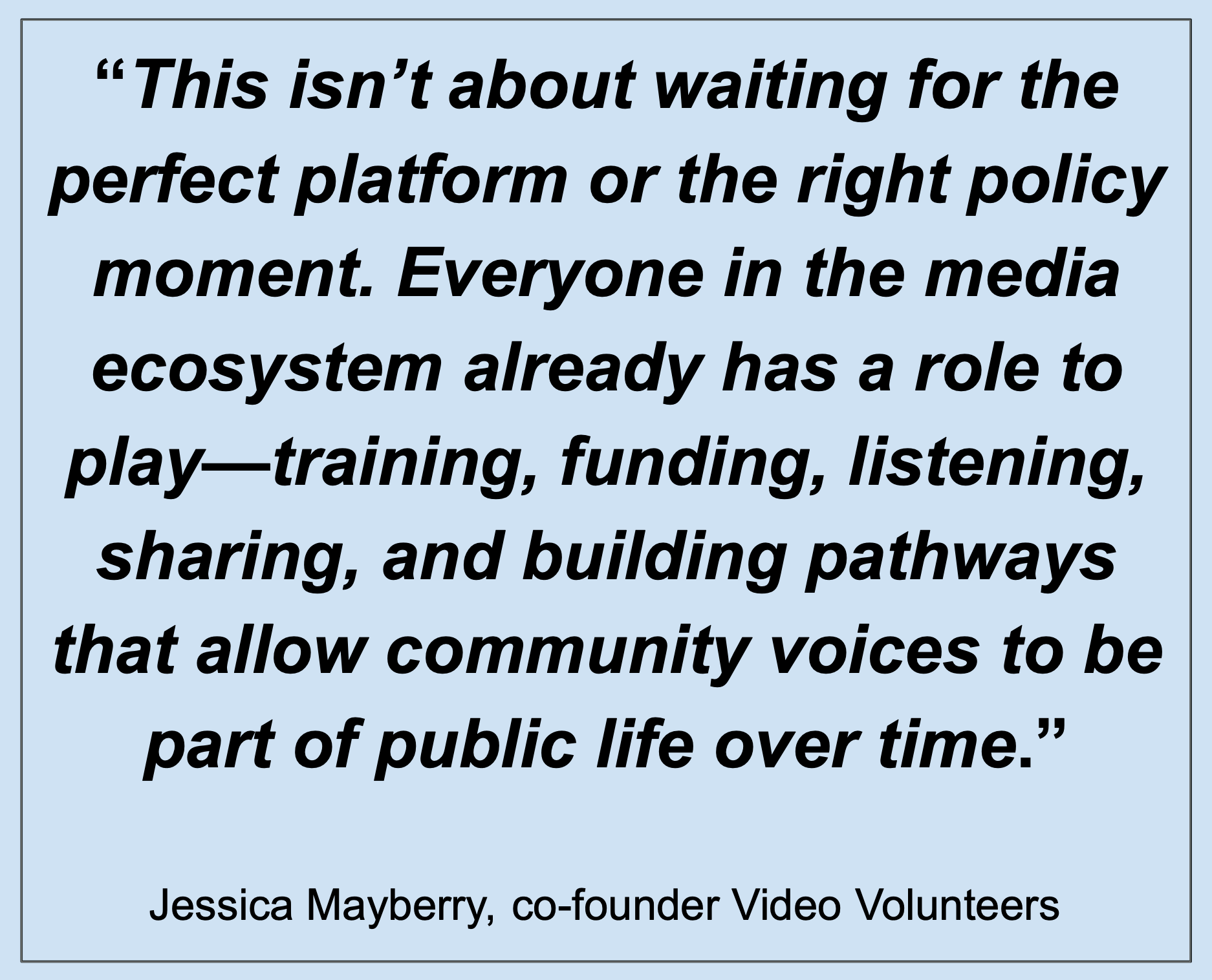
Building an Ecosystem for Listening
Thankfully, technology now makes it possible to surface lived-experience stories at scale and with integrity. In this area, too, the Global South offers instructive ideas. Around the world, new efforts are emerging to institutionalize voice — not just as expression, but as a legitimate input into governance, public decision-making, and data systems.
At the global level, citizen-generated data is increasingly being recognized as a legitimate source of knowledge, grounded in the understanding that communities produce vital insight about their own realities. Through the United Nations Statistical Division, governments are being encouraged to incorporate such data alongside official statistics. Video Volunteers is deeply engaged in this work and views it as a concrete way to make a core democratic principle real: that people have a right to voice, and that this right must be reflected in how institutions gather evidence and govern. The next frontier is to go further — recognizing voice itself — narrative, qualitative, lived experience — not as anecdote, but as a pillar of governance in the post-2030 Sustainable Development Goals.
A key concept emerging from this work is Digital Public Infrastructure (DPI). DPI refers to shared, open, and interoperable digital systems — like identity, payments, or data exchange — that are treated as public goods rather than proprietary platforms. Applied to democracy, this points toward a Digital Public Infrastructure for Voice: a public, trusted layer that enables citizen perspectives to flow systematically into institutions, rather than being trapped on private platforms optimized for attention and profit. Without shared civic infrastructure, citizen journalism remains trapped in moments of emergency — powerful enough to expose visible injustice, but too fragile to consistently inform institutions, policy, and public decision-making or to transform journalism in a positive way. Social sector actors in India, including our own organization, are beginning to explore what such an infrastructure might look like — building on the same rails as existing public systems, and aimed at ensuring that citizen voice reliably reaches decision-makers and informs public action.
Similar work is urgently needed in the United States. This is not a call to replace existing initiatives, but to connect and amplify them. Across the United States, networks like ICE Watch — alongside participatory and community-led media efforts like Unicorn Riot and Sahan Journal in Minneapolis, Documented in New York, City Bureau in Chicago, youth media projects like History Made By Us and broader infrastructure projects like New Public — are already advancing practices of community documentation, accountability, and civic storytelling that point toward what shared civic infrastructure could support more systematically. A shared civic listening infrastructure would allow the stories these initiatives generate to have a second life — circulating more widely, reaching institutions more consistently, and inviting broader participation beyond any single project.
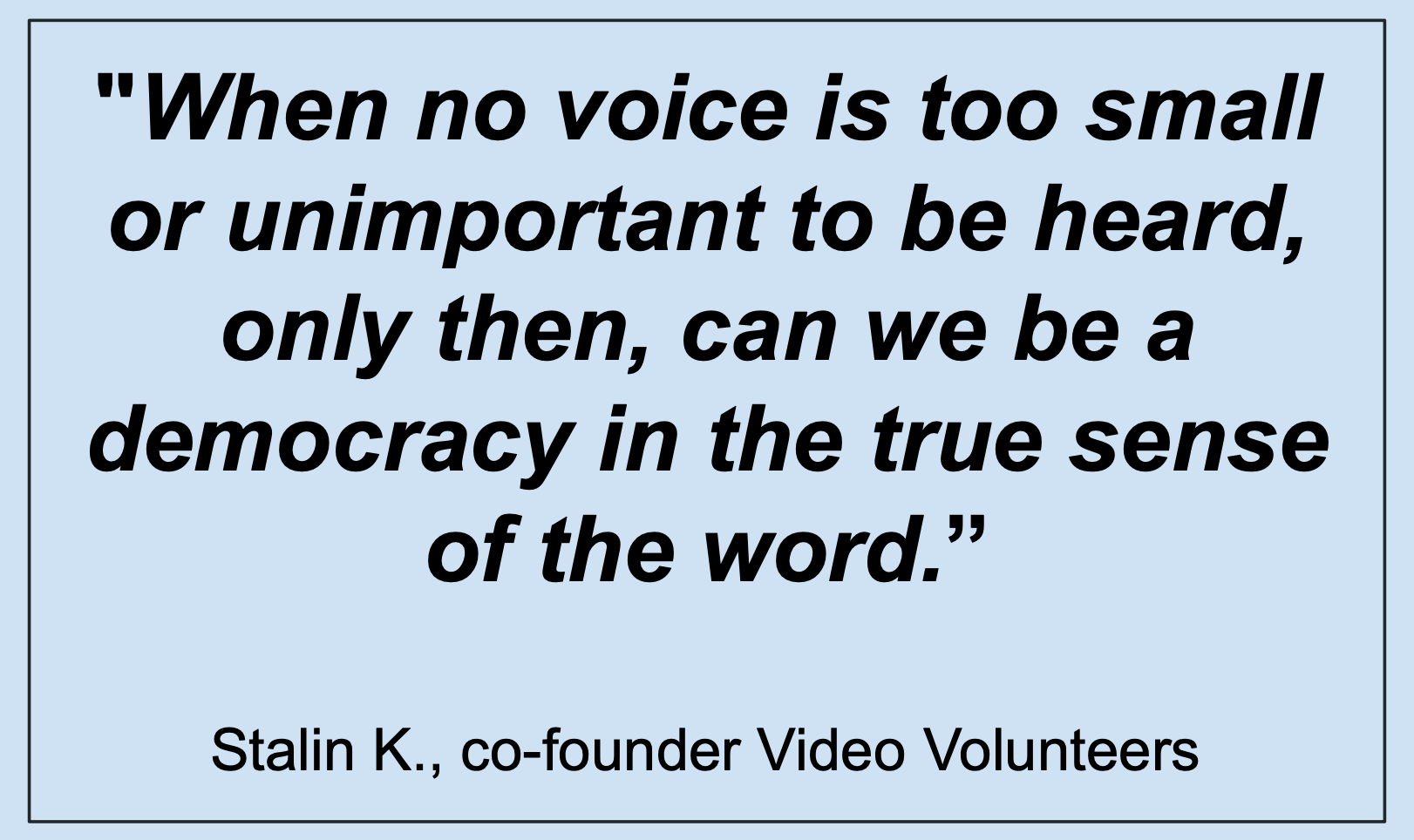
Toward a Listening Infrastructure for Democracy
Taken together, these developments point toward a new frontier for media and democracy policy. The future lies not only in defending journalists or reforming platforms, but in constructing a new kind of civic infrastructure — one that makes listening as central to democracy as voting or free speech.
At the conceptual level, this means treating voice as a public good: accessible, safe, and valued. Here, “voice” has both a civic and a technical meaning. Civically, it refers to the right of people — especially those historically marginalized — to have their lived experience count in public life. Technically, it requires systems that make that participation possible at scale: simple, trusted ways for people to share short stories, reflections, and testimony about their daily lives, and for those contributions to shape media narratives, policy debates, and institutional decisions.
At the technical level, this vision could take the form of civic listening infrastructure. Governments — starting locally — could establish low-barrier, official channels via text or voice through which residents submit short, multilingual audio testimony. With appropriate safeguards, this input could be tagged using lightweight AI, integrated into existing service systems such as 311 and other agency workflows, and paired with clear response requirements. Privacy protections, open-data standards, and public “You Said / We Did” reporting would be essential to building trust and accountability.
Compare this to current systems. Anyone who has ever called a congressional office knows how rare it is to receive a meaningful response. Messages accumulate, insights are lost, and citizen input overwhelms rather than informs decision-making. Civic listening infrastructure would reverse this dynamic and transform everyday experiences into actionable knowledge that strengthens policy rather than disappearing into a void.
The ultimate goal is not simply new tools, but a cultural shift: a democracy in which people expect to be listened to; where lived experience sits alongside expert analysis; and where listening itself becomes part of how democratic institutions function. Efforts to strengthen local journalism, protect press freedom, promote pro-democracy media, and improve regulation will all advance further and faster when built on this foundation. If democracy is to be renewed, it must learn not only how to speak — but how to listen. What comes next? That’s partially up to you. Help us imagine and do the work to build more democratized, trusted and meaningful American media.
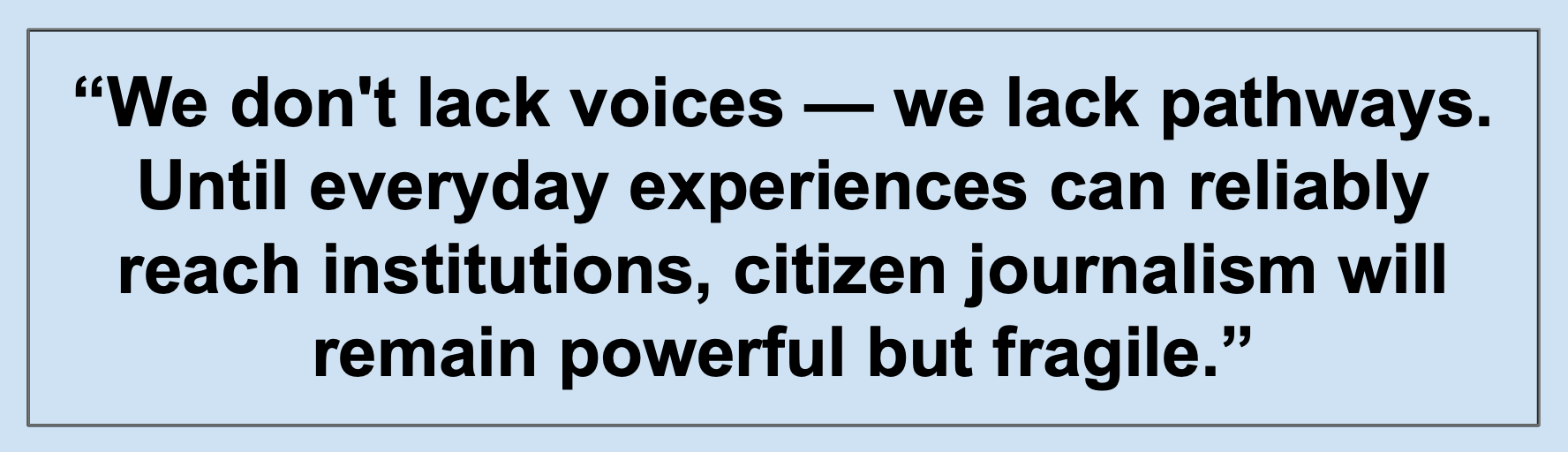
This piece is the beginning of a research and convening project, not its conclusion. Over the coming year, Video Volunteers and partners will be working in Minneapolis — to learn alongside the organizers, journalists, and community members who have been doing this work, and to ask, together, what civic listening infrastructure could look like, built from the ground up, in an American context. If this resonates, we’d love to hear from you.
Share your ideas with us. We value your feedback and ideas.
ABOUT THE AUTHORS
Jessica Mayberry is co-founder of Video Volunteers, an Indian NGO advancing the “right to voice” for marginalized communities. Under her and Stalin’s leadership, VV has become one of the world’s largest grassroots media organizations, training more than 3,000 community creators and reaching over 50 million people. Their work has been featured by the BBC, Al Jazeera, and The Economist, and won the Knight News Challenge and Google News Initiative awards. Jessica is a Fellow of Ashoka, TED, and Echoing Green. She studied at Oxford University and worked in US television news before moving to India in 2003. LinkedIn
Stalin K. is an internationally acclaimed documentary filmmaker and human rights activist, known for his work democratizing media and challenging caste discrimination. His films India Untouched and Lesser Humans are landmark works on caste, winning honors including the Golden Conch at the Mumbai International Film Festival and a Special Mention at the Amnesty International Film Festival in Amsterdam. He co-founded Drishti (1991) and Video Volunteers (2003), pioneering community video and citizen journalism models including IndiaUnheard, one of the world’s first community news networks. He has given lectures at Harvard, Yale, Stanford, MIT, Columbia, and IIT Bombay. Linkedin
Join us! On August 25th at 8pm EST! An event discussing why citizen witnessing isn’t enough — and how listening infrastructure could revitalize local news.
Sign up here: https://www.mobilize.us/mediademocracyproject/event/957146/
DISCLAIMER: Due to the Media and Democracy Project’s concerns about Substack’s leadership, ownership and agendas that conflict with our values, MAD is in the process of finding a new home for our blog. Please do subscribe for now and we will keep you posted.
Comments
Nothing yet. Say the first thing.
Sign in to join the conversation.