
Let’s be honest - most of us are still figuring out how medicine and tech actually fit together in real life. This issue gets a bit closer to the answer ⬇️
In this issue
we learn why we should stop using water cans when it comes to successfully implementing digital tools in healthtech,
find out how AI can be a resource to actually safe time in the clinic,
and see how ideas became real innovation during our med-dev hackathon (and how you can also be part of it 🤭).
Before we talk about building tools, let’s understand the reality they’re supposed to work in... 💪
In the world of medical device development, we often talk about “innovation” as a technical challenge. But for those on the front lines of patient care, innovation is a matter of practical implementation and data integrity. We sat down with Dr. Eder, a Resident in Psychiatry who recently completed her PhD in medical research. She represents a new generation of “physician-scientists” who are uniquely equipped to translate clinical needs into technical solutions. In this interview, she discusses the reality of the MD-PhD path, the necessity of patient stratification and longitudinal datasets.

🧪 You have been committed to research since the beginning of your career, staying the course even through challenging academic environments. What was the driver behind this persistence?
It stems from a fundamental interest in the “why” behind clinical symptoms. While clinical routine is essential, for me, it didn’t feel like enough. Psychiatry is a particularly compelling field because so many aspects of the human mind and its pathologies are still not fully understood. In a way, research feels like a “treasure hunt” for new knowledge. That drive to uncover these missing pieces and contribute to a more evidence-based version of psychiatry is what kept me focused, even during difficult periods. It is less about a single “eureka moment” and more about the long-term commitment to improving how we understand pathology.
👩⚕️ You completed a PhD while working as a resident. That’s a dual burden that few take on. How do you balance these roles?
It is a matter of clear priorities. There is no way to sugarcoat the effort required: It takes a lot of hard work and the decision to dedicate a significant portion of your personal time to science. For me, the intellectual progress was worth that investment.
🪴 You often mention that psychiatry currently operates on a “watering can” principle (Gießkannenprinzip). From a data perspective, why is this so difficult to change?
Our current diagnostic categories are based on phenotypic symptom clusters. However, from a biological standpoint, these groups are highly heterogeneous and build biotypes within the current diagnostic phenotypes. Especially diagnoses like depression which can also present themselves phenotypically very different and heterogeneously. To move away from a “watering can” or “one-size-fits-all” treatment, we need large-scale, longitudinal datasets that include clear interventions and biological parameters. Without this technical rigor, we cannot reliably identify whether a biomarker represents a stable “trait” or a temporary “state.” Or whether it is a response marker etc. Since psychiatry is also underfunded there need to be more collaborative efforts to gather this data in light of the lack of resources compared to other fields.
💻 You have a significant background in Computer Science. How does that technical training practically influence your clinical work and research?
My background is invaluable for research and statistics. It gives me the tools to handle messy data and complex models, which in turn sharpens my clinical reasoning. I find I’m more comfortable questioning my own intuitions with data, and I have a better sense of what statistical models can - and, crucially, cannot - tell us.
🏥 When looking at the Med-Dev industry, what is the biggest hurdle for implementing new tools in a clinical setting?
Developers must understand the high-pressure environment of a clinic. If a tool doesn’t offer an immediate gain in efficiency or a very clear clinical benefit, it won’t be used. Doctors simply don’t have the resources to learn complex “gadgets.” A successful device must be intuitive and seamlessly integrate into the workflow.
❗️What is the biggest challenge for Med-Dev companies trying to enter the psychiatric clinic?
Implementation. Developers must account for the high-pressure environment. If a tool doesn’t offer an immediate gain in efficiency or a very clear clinical benefit, it won’t be adopted. Clinicians don’t have the bandwidth for “gadgets” with steep learning curves. The technology must be intuitive and solve a concrete problem in the daily workflow.
Thank you for these insights!
So… what does all of this look like when it hits the real world? Let’s zoom out for a second!
If you’ve ever wondered why hospitals feel chaotic behind the scenes, this might explain more than you expect 🤫
7:45 Coffee. Outlook. 43 unread emails, half of them budget requests.
8:15 The CEO needs last quarter’s P&L by department. She sends a request to IT for a PDF export. The accounting software can’t produce Excel files. Now she waits.
9:40 The PDF arrives. 200 pages. Line items in some legacy format nobody outside this hospital would recognize, nowhere near IFRS (the international accounting standard). She starts scrolling, hunting for the relevant cost positions.
10:30 Still copying numbers into Excel. Row by row. This is the third spreadsheet today.
13:00 Lunch at her desk. A surgeon asks if his department is profitable. She doesn’t know. The cost data is in SAP, the revenue data is in the clinical system, and those two have never been connected.
15:00 The former CEO, her father, calls. He remembers a contract with a supplier that should have been renegotiated last year. It was never documented anywhere. She adds it to her list.
17:30 She leaves. The P&L is maybe 60% done. Tomorrow she’ll finish it. Probably.
Over 90% of this work is mechanical. Moving numbers between systems that refuse to talk to each other. And this is a normal day in most German hospitals.
The Structural Problem
Germany’s hospital sector is running an estimated €15 billion annual deficit. Three out of four hospitals are unprofitable, and roughly one in four has filed for insolvency over the past three decades. Germany’s demographic shift is compounding this: the workers of today are the patients of tomorrow, and the system isn’t financially equipped for either side of that equation.
What makes this worse is a problem that sounds almost trivial. Financial data (costs, staffing, materials) lives in ERP systems like SAP. Clinical data (treatments, diagnoses, revenues) lives in the hospital information system, or KIS. These systems were never designed to talk to each other. Controllers spend around 80% of their time exporting, reformatting, and reconciling data manually.
And in many smaller or family-run hospital groups, critical financial knowledge doesn’t live in systems at all. It lives in the heads of senior leaders. When leadership transitions happen (generational handovers, retirements, sudden departures), that knowledge disappears. The next generation inherits spreadsheets and guesswork.
What AI Could Change, and Where It Falls Short
Recent advances in AI, particularly in language models and autonomous agents, have started a conversation about what could change in hospital finance.
There are interesting early signals. AI agents can, in some cases, perform multi-step data tasks: querying ERP databases, cross-referencing them with clinical data, surfacing mismatches. On-premise deployment options address the data sovereignty concerns that European hospitals rightly care about. In theory, a controller could ask “Where did our material costs exceed DRG reimbursement last quarter?” and get a useful answer in minutes rather than days.
But we should be honest about where things actually stand.
Integration is the hard part. Hospital IT landscapes are deeply fragmented, and connecting new tools to legacy systems is as much an organizational challenge as a technical one.
Data quality is uneven. AI doesn’t fix bad data. It amplifies it.
Trust takes time. Controllers who’ve spent twenty years building their spreadsheets won’t hand over financial decisions to a black box overnight. A bad forecast in a hospital can mean closed wards.
Regulation is catching up. The KHVVG is pushing for financial transparency, but the regulatory framework around AI in healthcare finance is still being written.
What Comes Next
The technology is maturing, and the regulatory pressure is real. Germany’s KHVVG is explicitly demanding the kind of financial transparency that manual processes struggle to deliver. Whether AI will play a significant role in that remains to be seen.
What seems clear is that controllers spending 80% of their time on data plumbing is not sustainable. The controller from this morning deserves a system that lets her do what she was actually hired to do: think.
Raphael Kaiser is Co-Founder and CEO of Kontaris, a Munich-based startup working on AI-powered financial planning tools for European hospitals.
Enough theory! Let’s talk about people actually building things 💪
Our hackathon we did in cooperation with Wellster and Spira Lab didn’t end with the pitches. Instead, the teams are now working on their solution with experts from medicine and technology to bring their ideas to life. And - you have the option to support the teams on their way. While also connecting with investors and founders in healthtech!
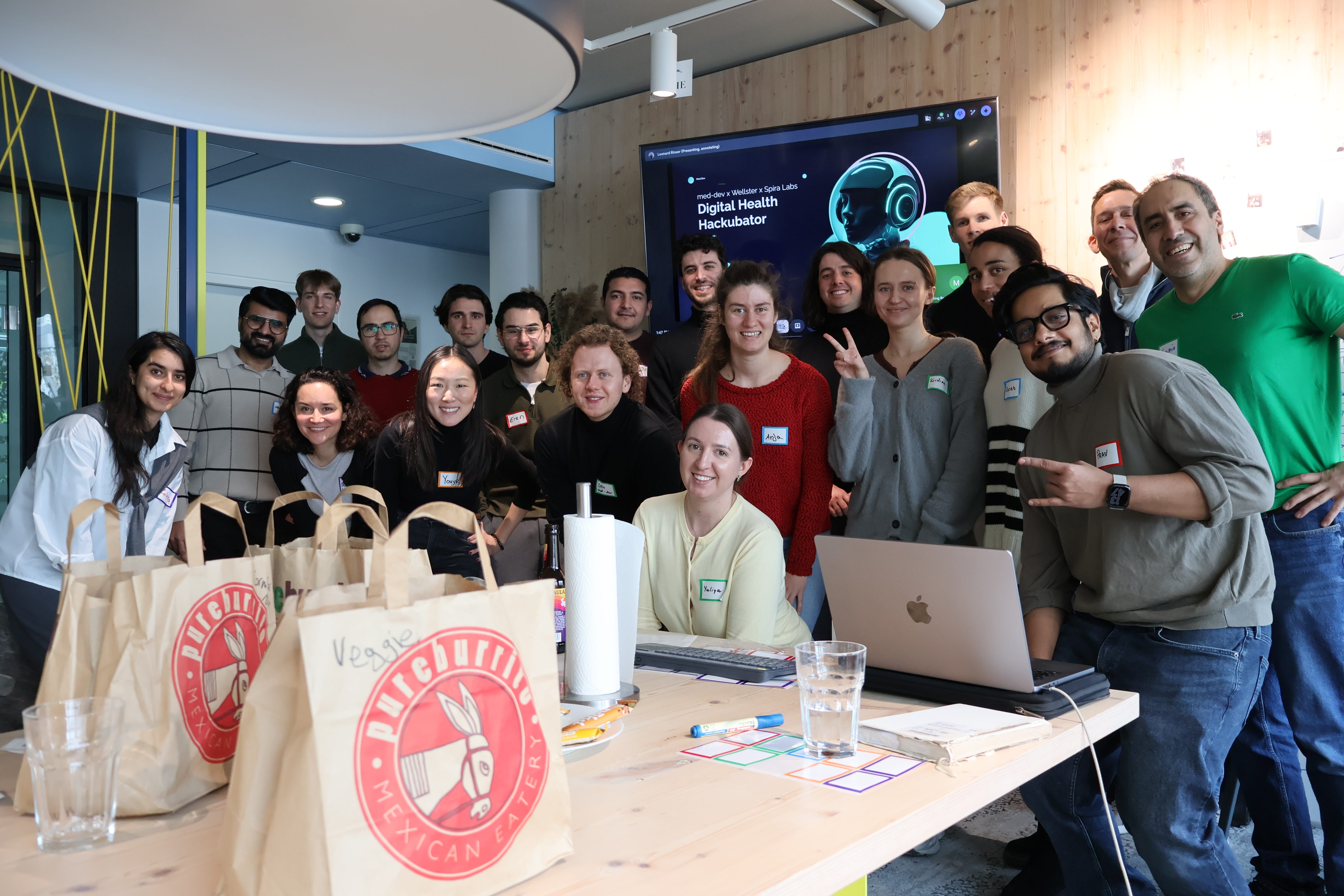
Let us introduce you to the teams:
🔬 UniQ
The team is tackling data structuring and categorization challenges in digital health. They were recognized for a highly feasible, scalable concept that directly addresses a real industry need.
🏥 ImpactInfo
This team is working on a solution around patient data visualization and health data aggregation. They were praised by the jury for their deep understanding of the problem space and strong visual approach.
🎯 FocusCare
This team is developing a smart approach to medical guideline application and risk profiling. Described by the jury as having a “powerful and revolutionary vision” they are an all-around performer!
⚡ MedHackers
The focus of this team is on improving telemedicine workflows for doctors. Their idea is built on solid research with real clinical insights, delivering actionable recommendations for better patient care.
Wanna learn more about their ideas?
Here’s your chance to go from passive reader to part of the scene 😏
You can now sign up for our big pitch night at Spira Lab! It is also possible to support your favorite team as there will be an audience price.
Date: Thursday, May 7, 6:30 PM - 10:00 PM
Location: St.-Martin-Straße 82
Sign up here!
We are really excited to see you all at the next events! 🤭
And if you made it this far — you’re definitely one of us!
Stay subscribed and tell your nerdy friends!
Until next time!
Your med-dev Newsletter Team (Marlene, Anja & Julia)
No posts
Comments
Nothing yet. Say the first thing.
Sign in to join the conversation.