
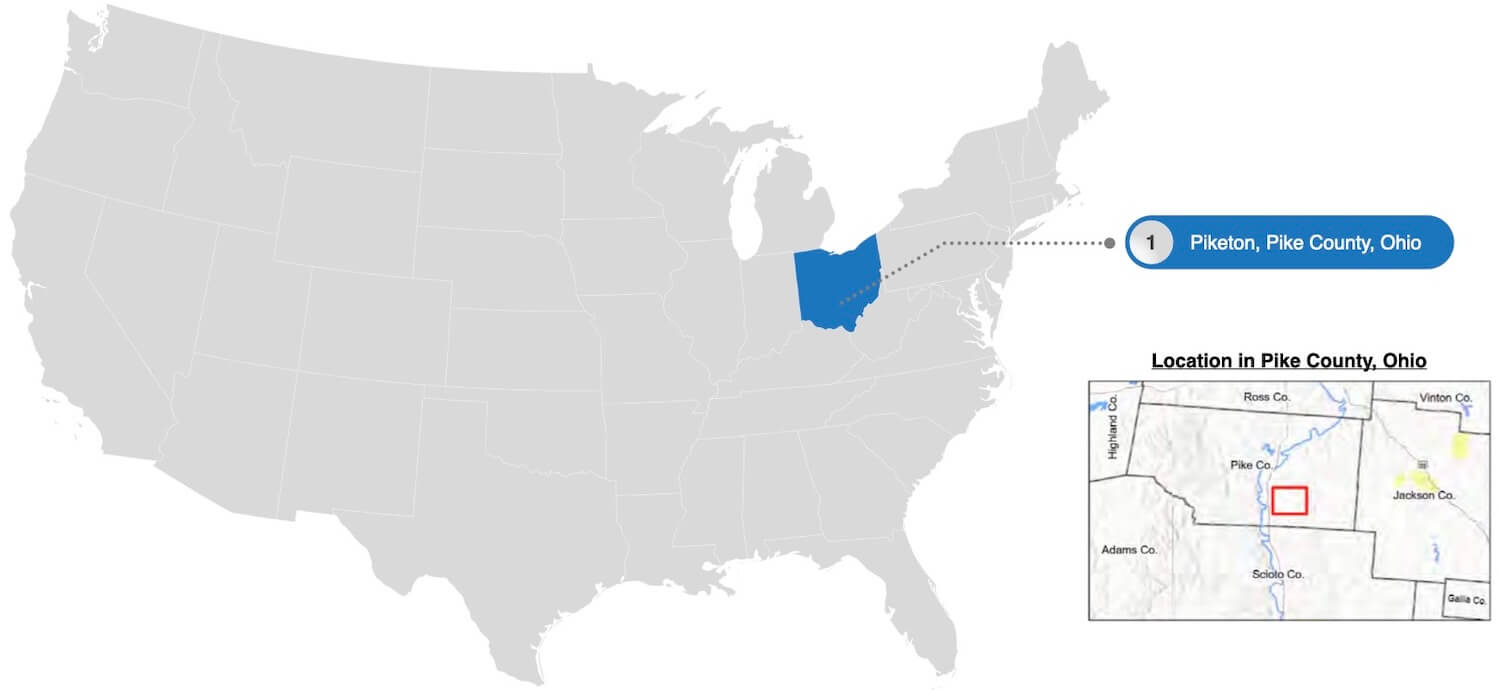
In 1952, the U.S. Atomic Energy Commission chose Piketon in Pike County, Ohio, for a uranium-enrichment plant on the strength of “access to reliable power, dependable water supply, and a strong regional labor force.” What followed was one of the largest power procurements in American history: 15 investor-owned utilities organized a new company — the Ohio Valley Electric Corporation (OVEC) — for the express purpose of feeding one federal plant, built two coal stations to do it, and signed a 25-year contract for 1.8 GW of firm power whose monthly demand charge was owed, in the words of the 1956 Comptroller General opinion that blessed it, “whether energy is used or not.”
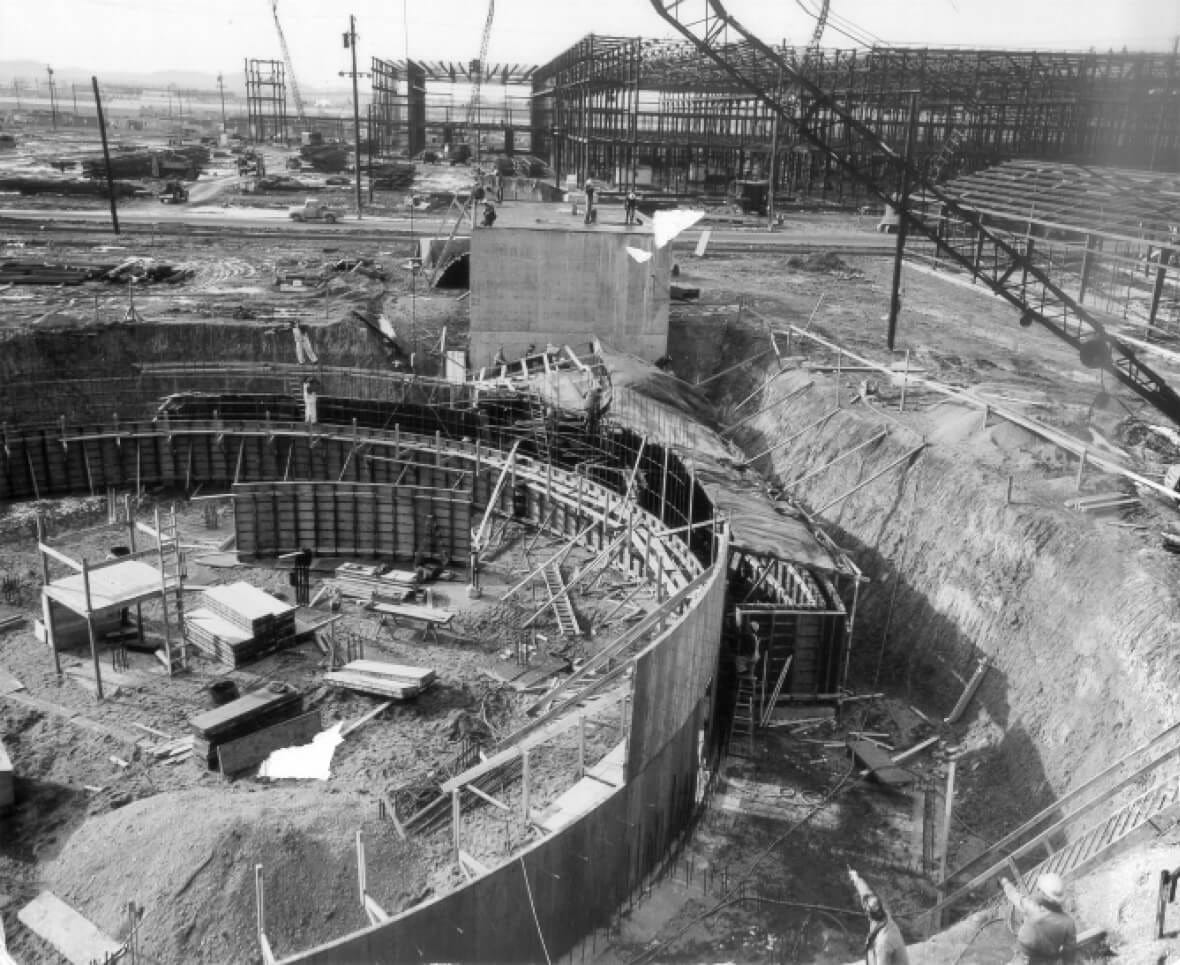
Source: U.S. Department of Energy.
The site’s own Department of Energy (DOE)-sponsored virtual museum recalls that the switchyards alone delivered “enough to light up New York City at the time the plant was constructed in the 1950s,” and at the campus’s 2026 groundbreaking, the old plant was described simply as “the largest power draw in the world when it was in operation.” Enrichment ended in 2001. Roughly 2,400 workers are still tearing the plant down and burying its debris on site.
On March 20, 2026, ground broke on that same reservation for the PORTS Technology Campus — 10 GW of new power generation, 9.2 GW of it natural gas that will be owned by the United States government and financed from Tokyo under a trade agreement that values the build at $33.3 billion, feeding an AI data center campus that the same 10 GW is sized to yield: 8 GW of AI compute capacity.
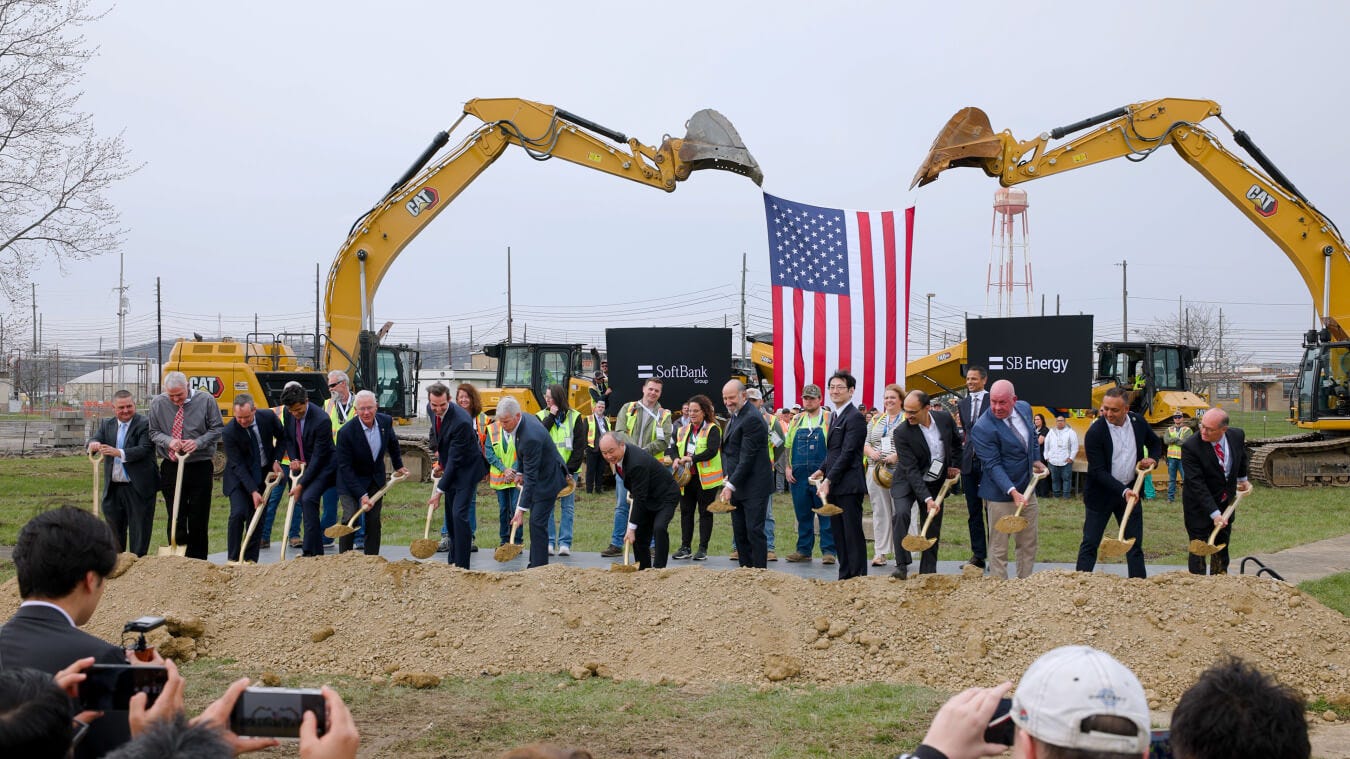
Source: U.S. Department of Energy.
The anchor tenant is OpenAI, on a 20-year lease — and on August 17, 2026, NVIDIA guaranteed the rent, capping its own exposure at $105 billion. And three months before the shovels, with no ceremony at all, the nuclear startup Oklo had bought 205.9 acres of the same former reservation: the land for a 1.2 GW nuclear reactor campus whose power Meta has already agreed to prepay.
The two projects share no owner and no contract — only a fence line, a common federal origin for their land, and a premise: compute follows firm power.
In the AI buildout, the scarce input is no longer land, building shells, or even chips; it is firm energy on a date certain, and the federal cleanup complex has turned out to be the one landlord in America holding power-ready land at gigawatt scale. Pike County, Ohio, is the industry’s power problem compressed into a single place — with Washington as the landlord and Tokyo as the financier.
This primer walks the two projects side by side: the scorecard and why two AI giants converged here; the Cold War power record being recycled; the gas campus built backwards — Japan’s money, Washington’s gas, and a chipmaker’s guarantee; the wires and the tariff that explain both projects’ shape; the reactor field Meta prepaid; and what one reservation says about the industry’s two theories of power.
Start with the scorecard: two projects on one former federal reservation, compared on who builds, who owns the generation, whose money is behind it, and when the power arrives.
The table is the article: same former reservation, same federal-land lineage, and opposite answers on ownership, technology, and time — with financing the one dimension where they are similar.
Neither OpenAI’s ecosystem nor Meta arrived at Piketon for the land. Ohio has cheaper farmland closer to Columbus, and the AI industry has never lacked for shells. What it lacks is firm power on a schedule, and in the Ohio territory served by American Electric Power (AEP), that scarcity is now codified: the utility spent a year and a half refusing new central-Ohio data center connections, then locked in minimum-demand terms over the hyperscalers’ objection, and its own load studies push reliable service for new data center load toward the next decade (Section IV). Any AI company that wants Ohio gigawatts this decade has to structure around the queue, not through it.
The two camps structured around these queues, and they split along the key question in industrial strategy: make your own power, or buy someone else’s. OpenAI’s ecosystem — SoftBank, SB Energy, NVIDIA, and the government partners they assembled — chose to make it: lease federal land through the door DOE opened for AI, and burn gas now, on Washington’s books rather than their own. Meta chose to buy it: prepay a nuclear developer that had quietly assembled recycled federal land, and lock in a claim on nuclear power that arrives later — a supply-side hedge layered on top of grid load that still pays the tariff, and on top of gas plants already rising at the load those reactors will serve (Section V). One is about speed at national-industrial scale; the other is about optionality at portfolio scale.
What they agree on is the premise: whoever solves power first gets to train and run AI models first. And they agree on the landlord, because the federal cleanup complex is the rare counterparty that can offer cleared land, existing transmission corridors, water rights, and a political mandate in one package.
Source: U.S. Department of Energy.
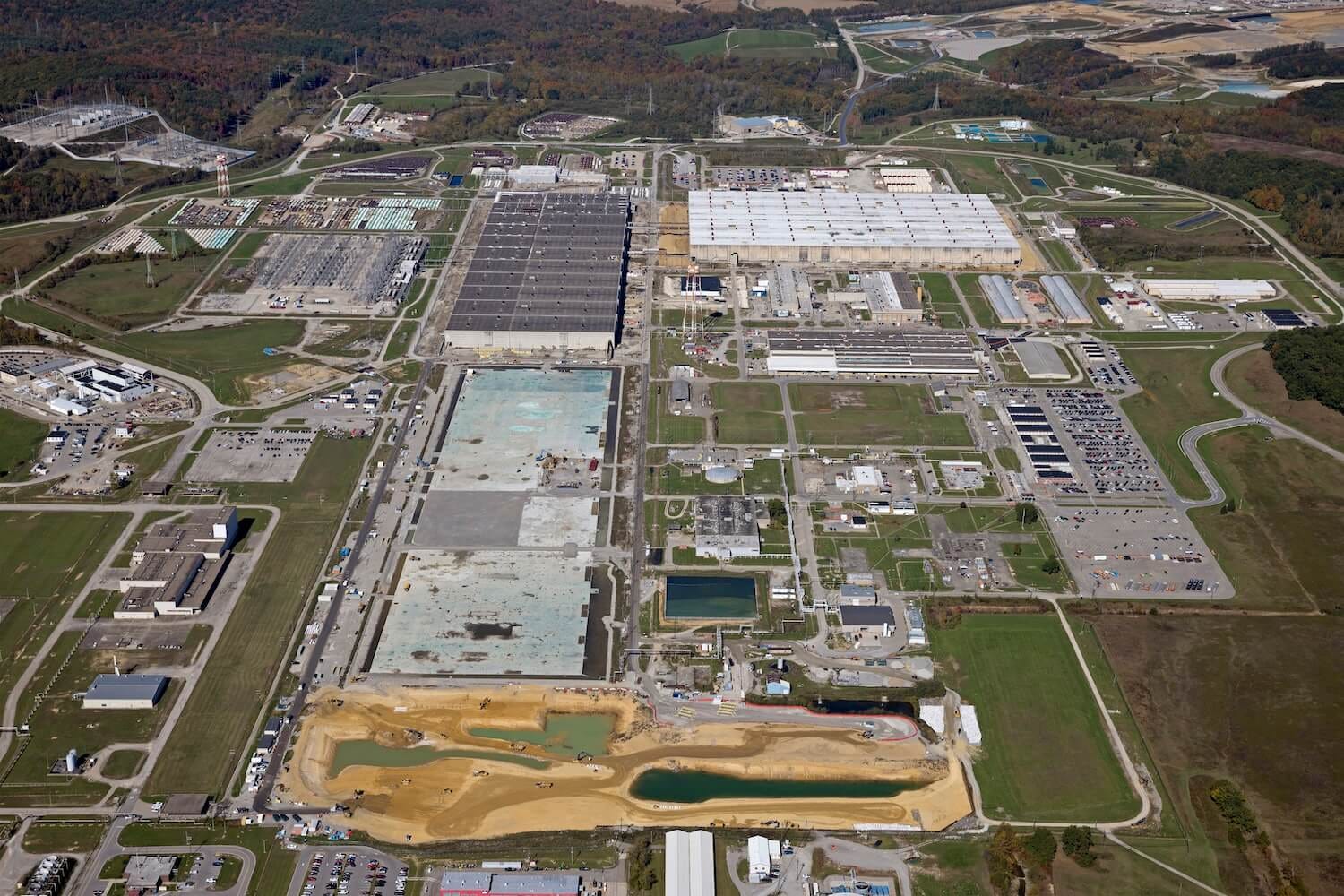
The reason the reservation is power-ready is the half-century it spent as the power problem.
The remediation story is actually the siting story. What DOE’s cleanup program spent two decades producing — cleared pads, live corridors, water infrastructure, and a landlord with statutory authority to lease — is precisely the inventory the AI industry now finds scarce, and PORTS’s Cold War power record is the template for the scale of what is being rebuilt.
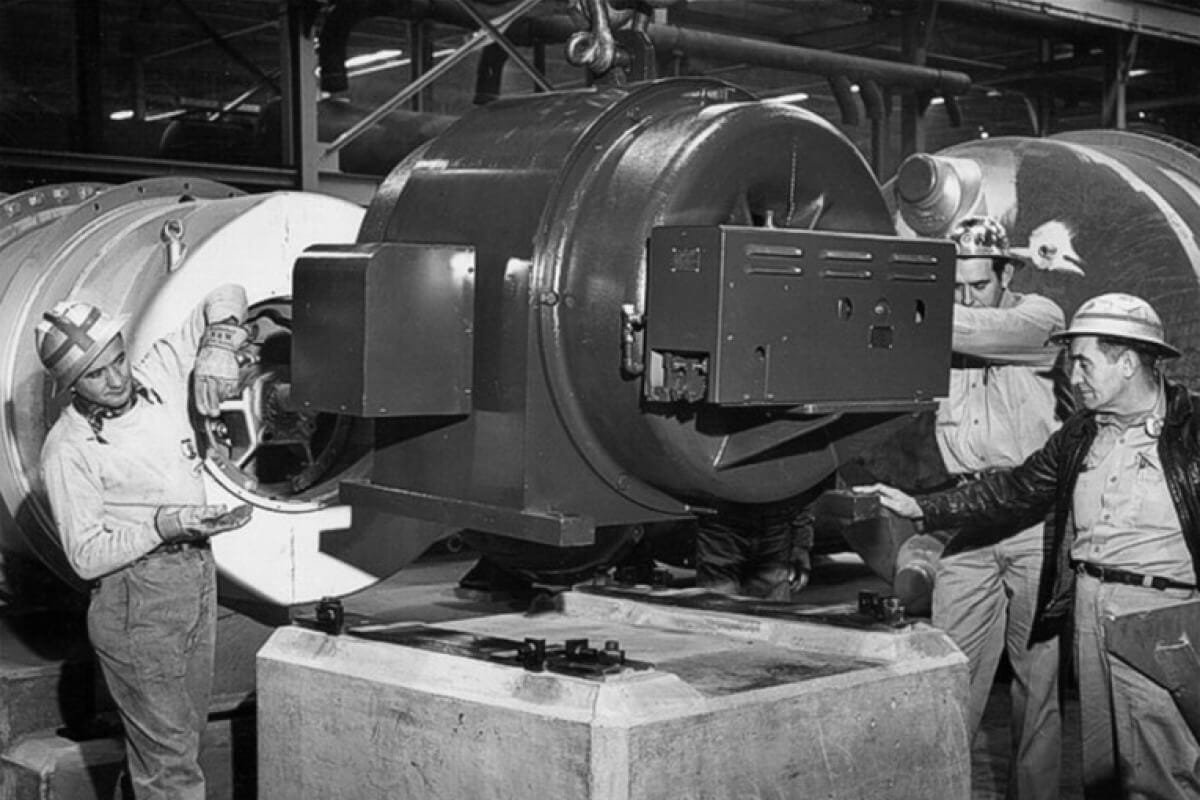
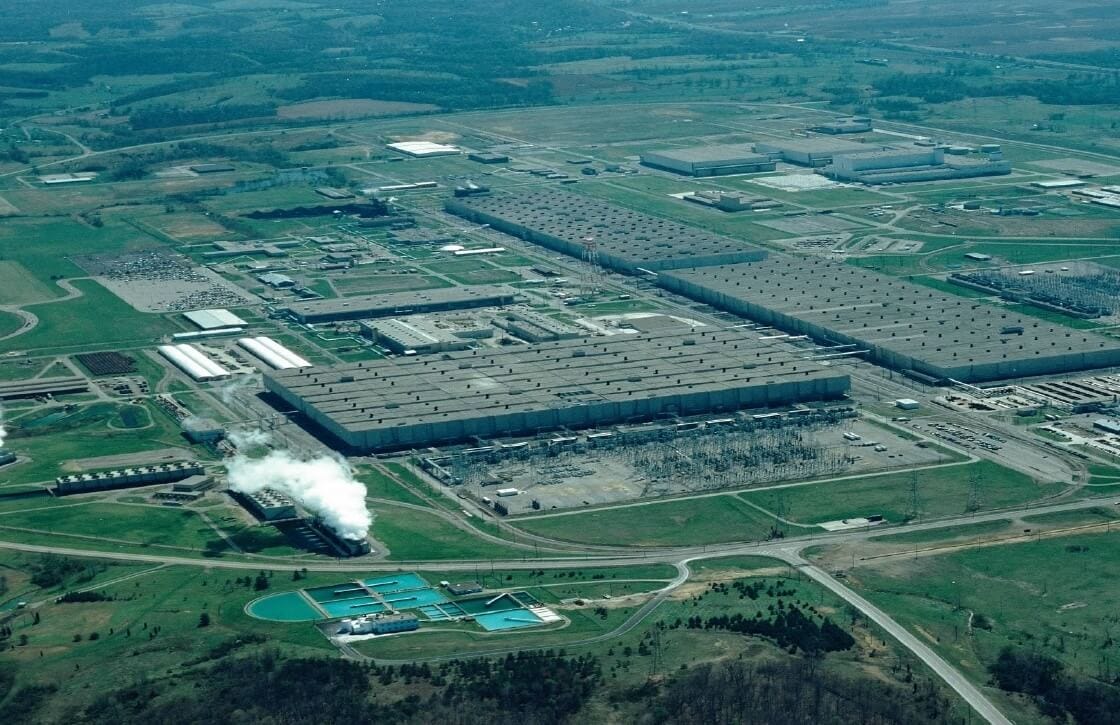
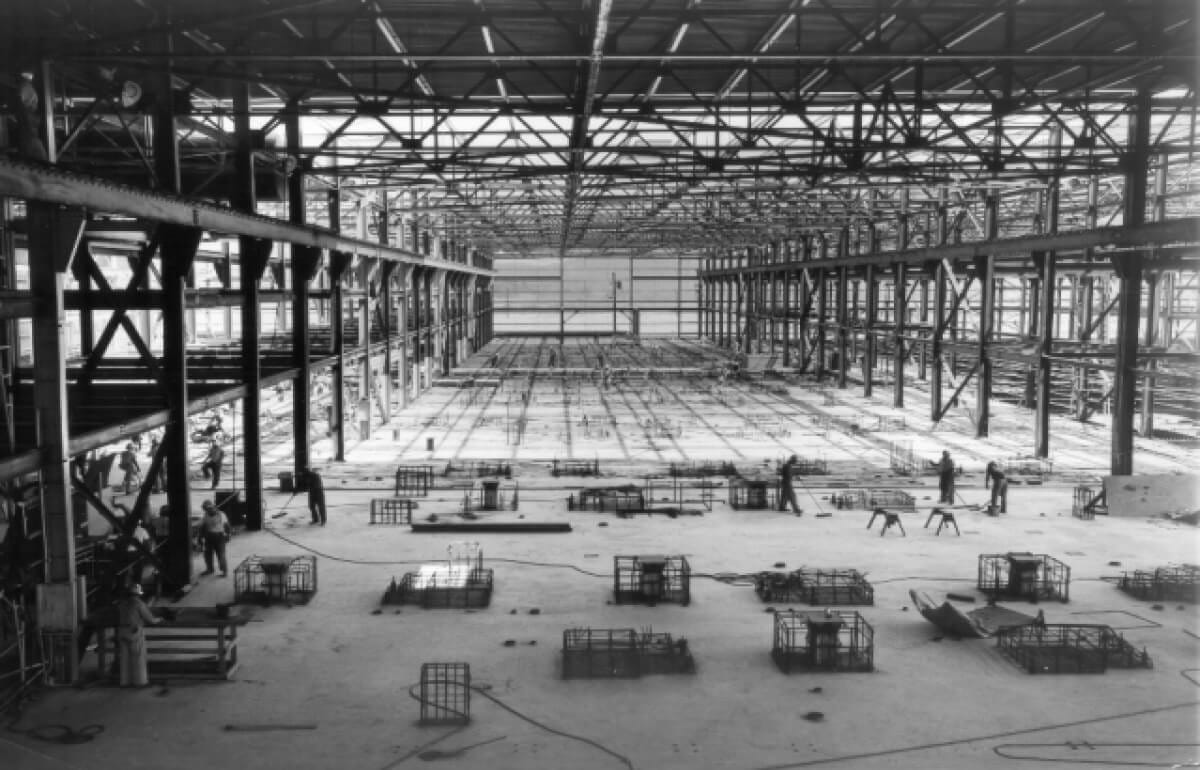
The Portsmouth Gaseous Diffusion Plant enriched uranium from 1954 to 2001 in three process buildings covering roughly 90 acres under roof, employing 25,000 construction workers at the peak and about 800 in operations.
Source: U.S. Department of Energy.
Powering it required inventing a utility. OVEC and its subsidiary were organized on October 1, 1952, by investor-owned utilities “for the purpose of providing the large electric power requirements projected for the uranium enrichment facilities then under construction by the Atomic Energy Commission (AEC) near Portsmouth, Ohio.” Two dedicated coal plants — Kyger Creek in Cheshire, Ohio, and Clifty Creek in Madison, Indiana, about 2.26 GW of combined capability — came online in 1955, tied to the site by high-voltage lines built for the purpose.
Source: U.S. Department of Energy.
The commercial structure looks strikingly familiar. The AEC’s 25-year contract bound the government to 1.8 GW of firm power at a monthly demand charge of $1.361 per kilowatt, owed “whether energy is used or not” — a take-or-pay minimum, terminable only on two years’ notice. The same 1956 opinion blessed a further 150 megawatts for the Portsmouth area — 1.95 GW of continuous delivery in all. On site, a switchyard complex the plant called X-533 — one of two forming a system with a rating of up to 2.2 GW — received power over four 330 kV OVEC lines and stepped the voltage down to run the enrichment machinery filling the three process buildings.
Source: U.S. Department of Energy.
And in 1969, AEP built the Don Marquis substation to provide an interconnection network between OVEC and several other entities. Hold that name: the substation built to interconnect the enrichment plant’s dedicated power supply is the same station AEP will tap to deliver the AI campus’s first phase (Section IV).
The arrangement outlived its purpose by decades. DOE gave OVEC notice of cancellation in September 2000; enrichment ceased in June 2001; the power agreement terminated in April 2003, and a settlement unwound the rest. But the physical legacy never left: OVEC and Ohio Power transmission easements across the site were extended 50 years, to 2067, and the property today resembles a small city with existing high-voltage power lines that the new infrastructure can tap — making it clear why the developers came.
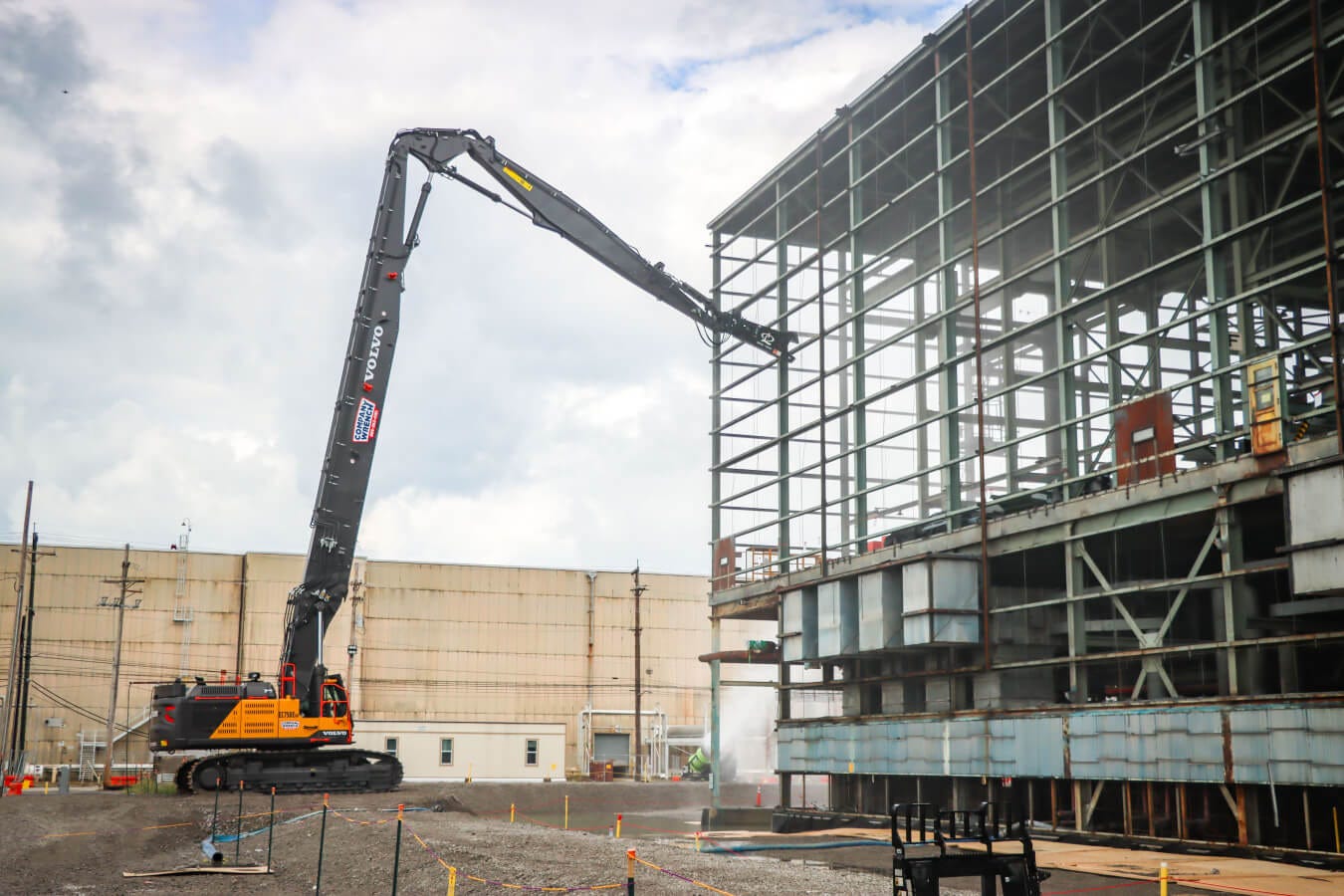
The other half of the inventory is cleared ground, and it is produced on a federal demolition schedule.
Source: U.S. Department of Energy.
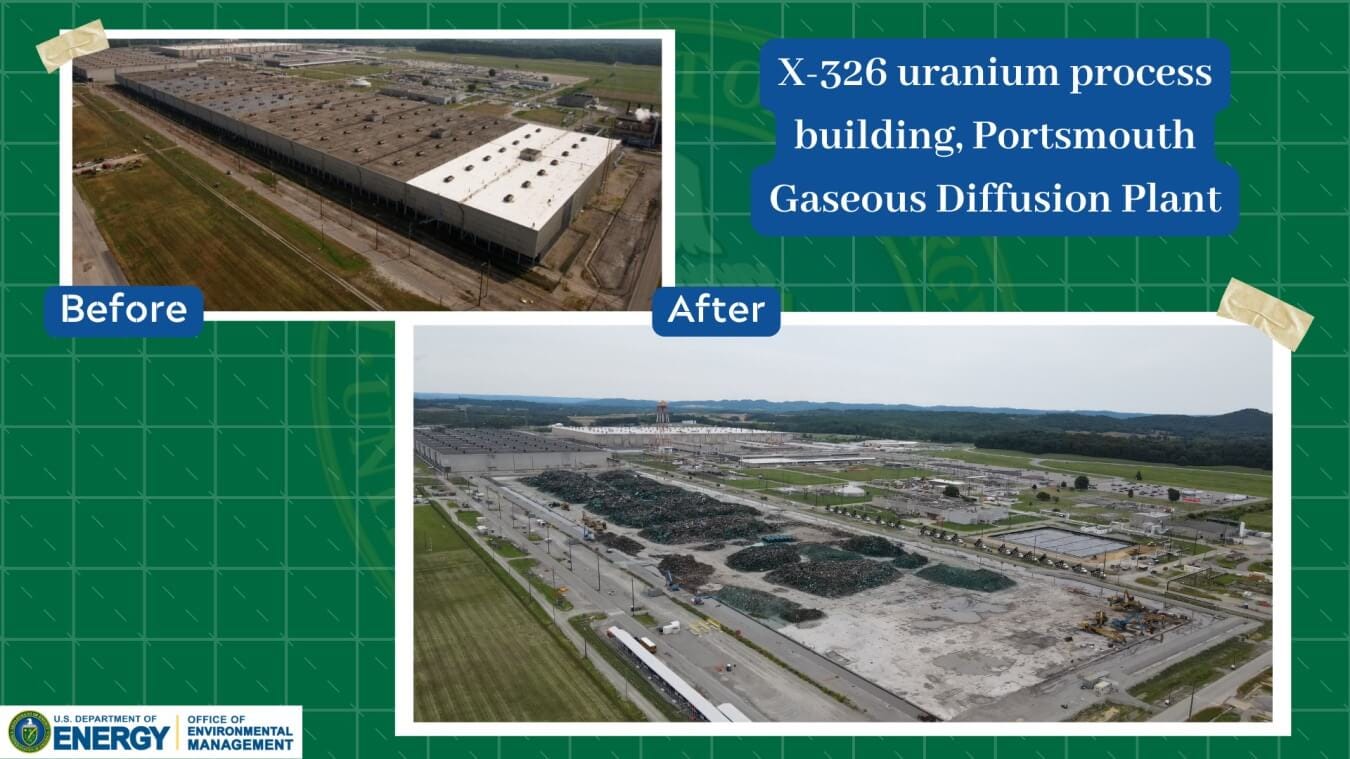
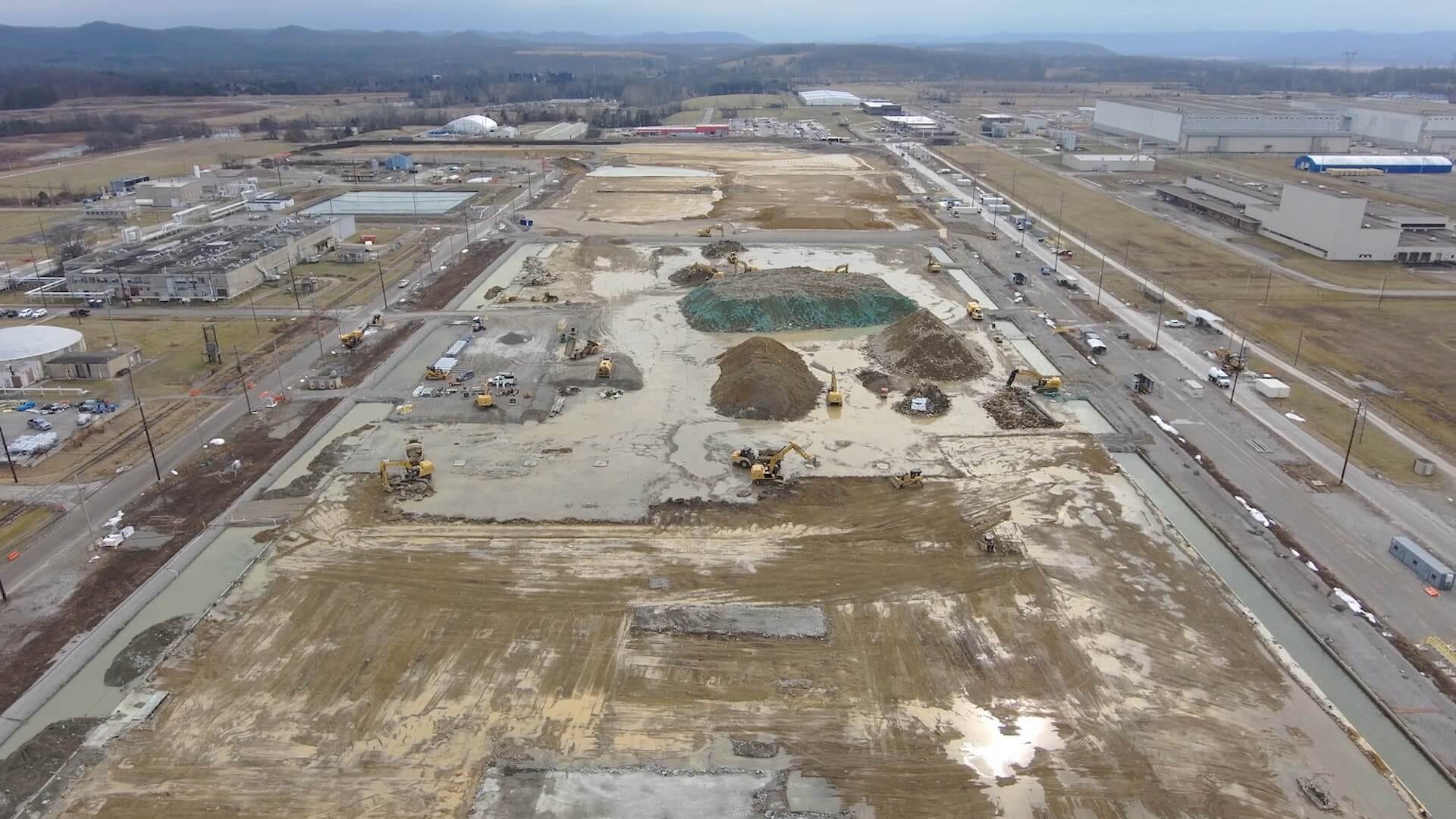
Above-grade demolition of the X-326 process building — the first of the three — finished in May 2024, and its 56-acre pad is where the first data center buildings go.
Source: U.S. Department of Energy.
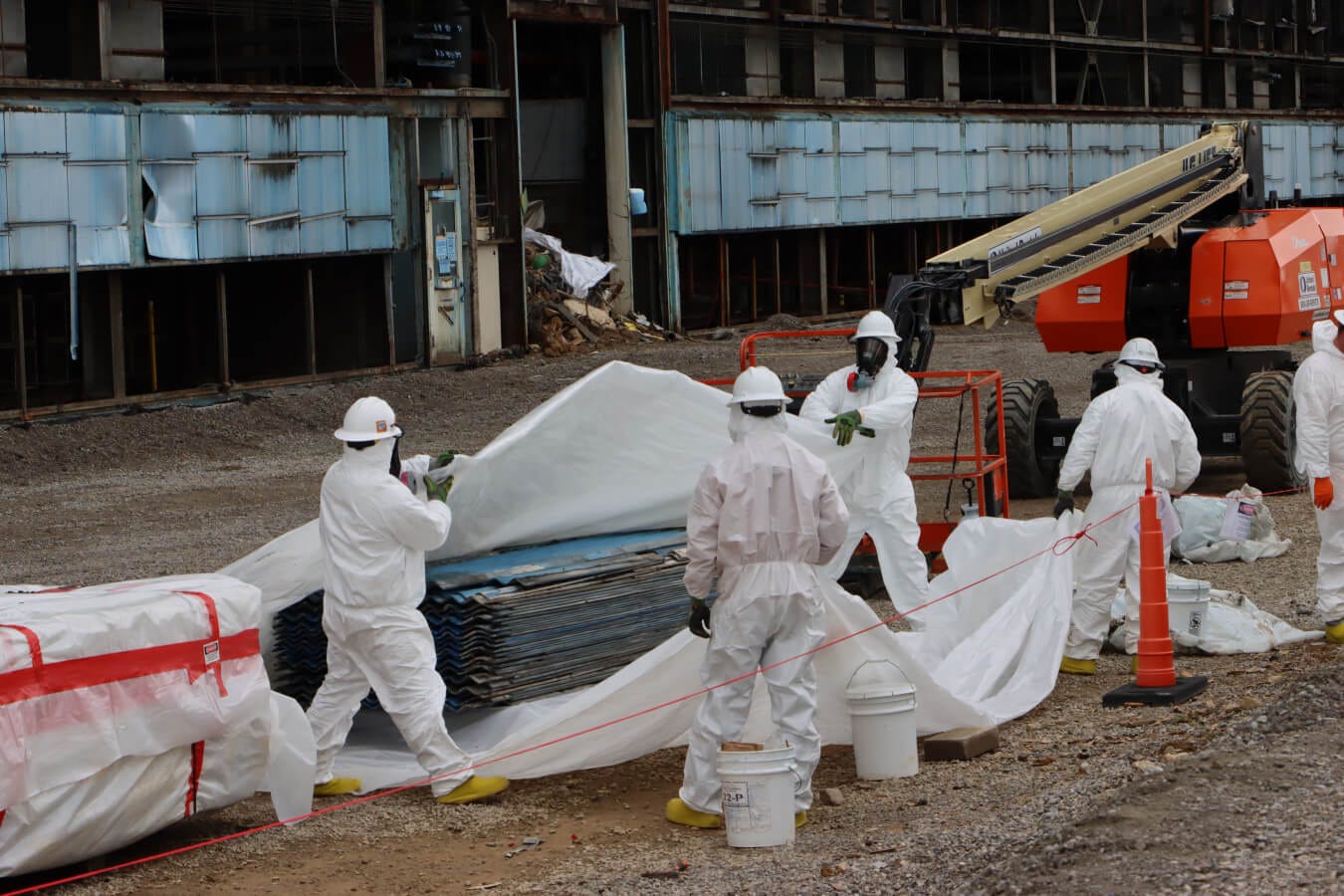
The X-333 building began coming down in April 2025 under a cleanup task order that runs to September 30, 2031; X-330’s demolition is forecast for 2027.
Source: U.S. Department of Energy.
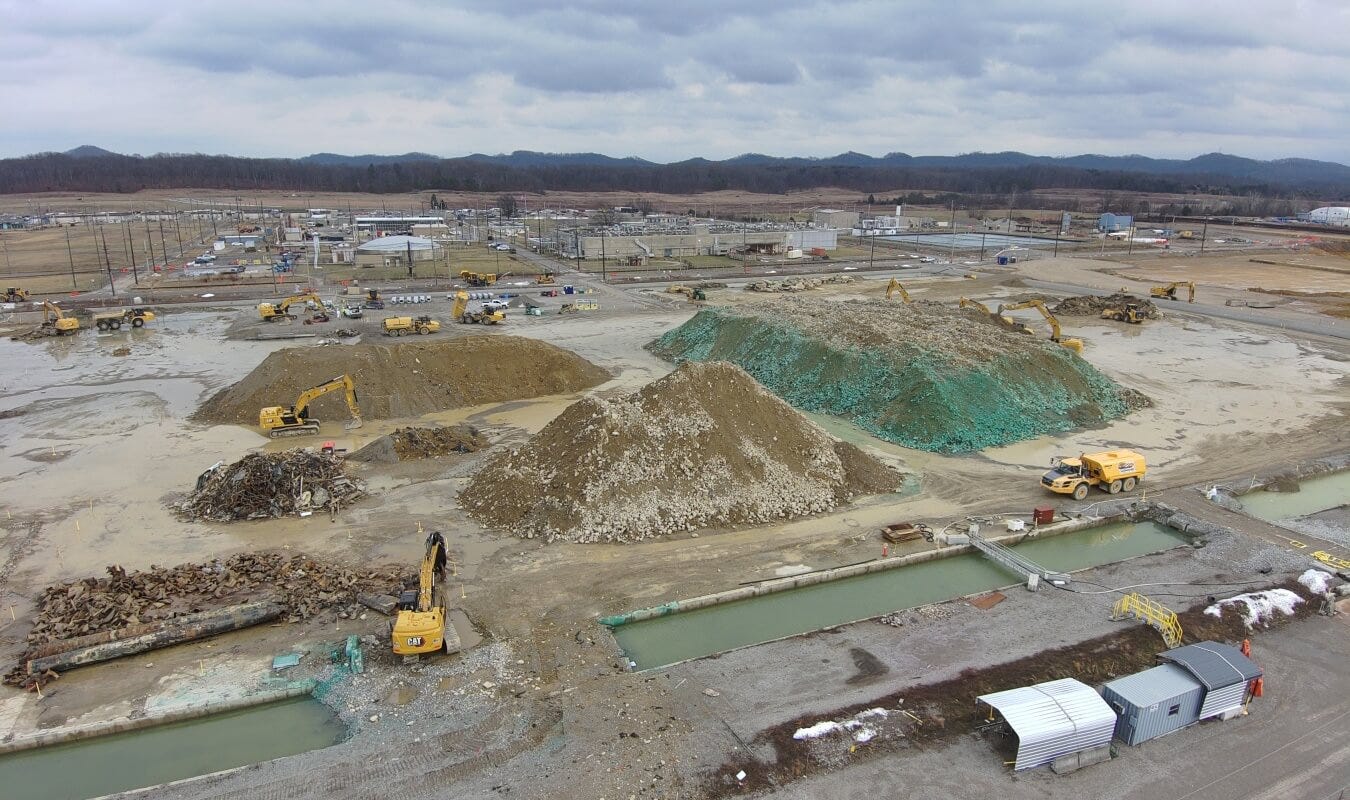
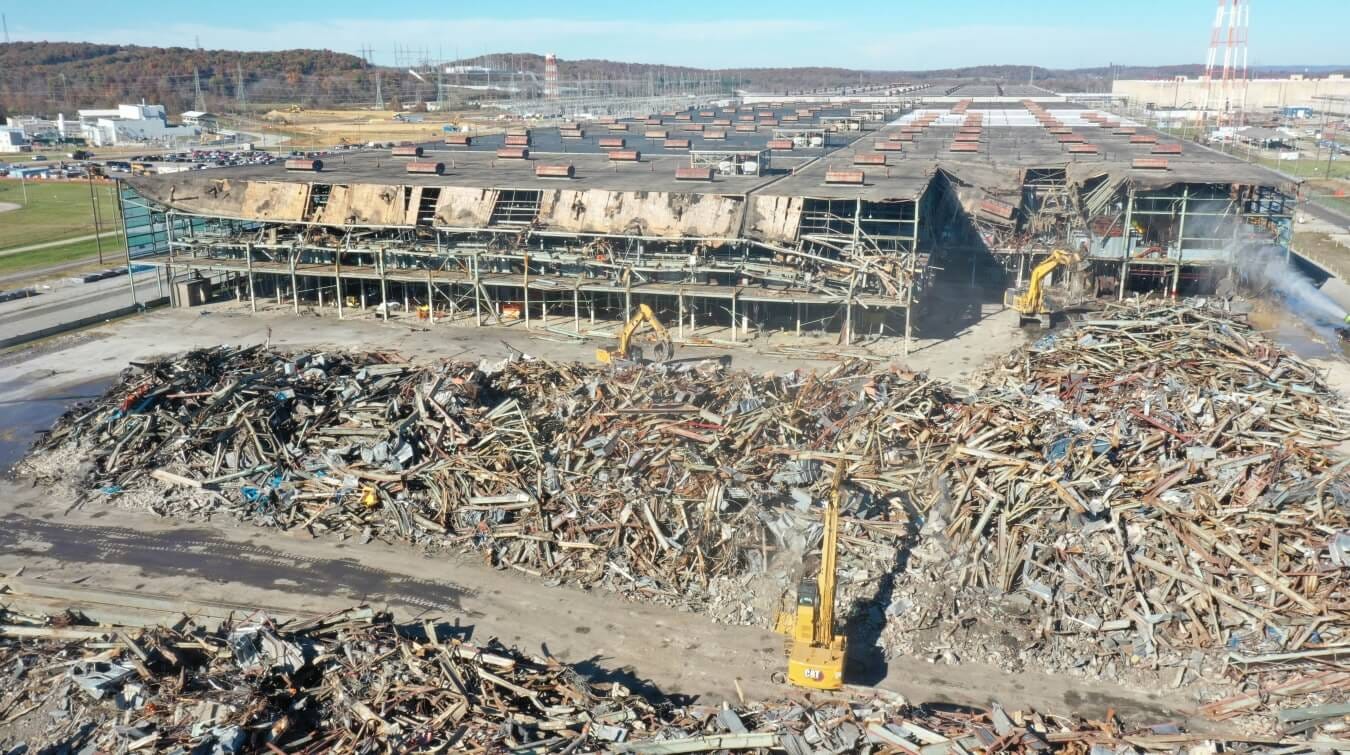
The waste goes into an on-site disposal facility of 10 cells, the first of them already at 99% of working capacity. The schedule runs through the leased ground itself. In 2026, DOE’s contractor is slated to excavate the soils under the old X-600 coal-fired steam plant and the X-760 chemical-engineering building and to take down four remaining support structures inside the 189 acres. The sequencing fact worth holding: the AI campus will be going up amid an active CERCLA (Superfund) demolition, for years.
Source: U.S. Department of Energy.
The lease is the mechanism that converts cleanup into tenancy. The Phase II construction area is gated “unless and until DOE has completed its remedial obligations.” The developer may fund cleanup work itself and take “a dollar-for-dollar credit via an in-kind rental payment” — the contractual form of the reported $200 million to accelerate cleanup. Interconnection is the tenant’s job at no expense or cost to DOE. The lease conveys rights to the site’s X-608B and X-6609 well fields and raw-water lines, reserves a national-security review to DOE, and runs 10 years with four 5-year renewals. The rent structure is on the record; the dollar amounts are withheld.
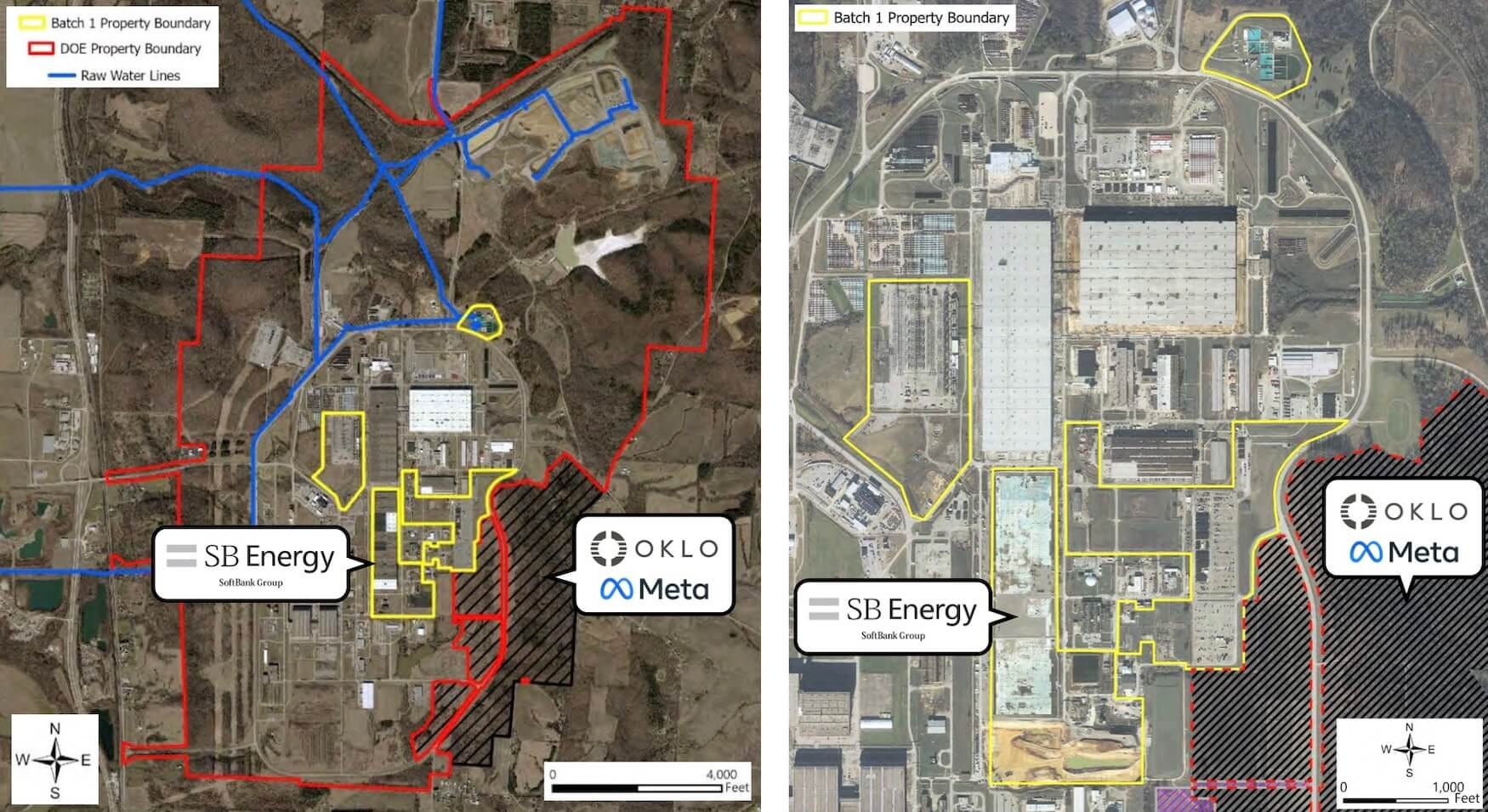
The campus arrived through a bespoke public-private partnership — in DOE’s words, “the first DOE site to reveal plans for an AI data center made possible with private investment.” The door it came through had been open since 1995, when the Southern Ohio Diversification Initiative (SODI) was chartered as the site’s DOE community-reuse organization. An 80-acre land transfer in 2018 set the precedent; more than 350 acres have followed, with an industrial pool of roughly 1,000 acres identified. The 2025–26 land run was the same pipeline at full throttle, running both mechanisms at once: DOE cleared the 189-acre Batch 1 lease to SB Energy’s data center entity on November 17, 2025, and SODI sold Oklo its parcel a month later — lease on one flank, fee simple on the other.
Source: U.S. Department of Energy.
An $80 million community benefits fund accompanies the project — SB Energy’s original $40 million, doubled by an incremental $40 million OpenAI committed on signing — and the site’s advisory board minuted that “no economic development organization or local government could have anticipated the sheer magnitude of the currently proposed investment.” The jobs claims have come in two sizes: SB Energy claims 35,000 construction and 2,500 operating jobs, while the government’s announcement counts more than 10,000 construction jobs over four years and more than 2,000 permanent.
Every verifiable dollar at PORTS is power and land, and every filed permit is for the data center’s ground, not yet its generation.
The deal architecture is a public-private partnership among DOE, the Department of Commerce, SoftBank’s SB Energy (SoftBank Group holds a 90% stake), and AEP Ohio. The $33.3 billion of Japanese money — “Deal 1” under the U.S.–Japan Strategic Trade & Investment Agreement, announced February 17, 2026 — underwrites the 9.2 GW gas fleet, which the United States government will own and SB Energy will operate.
In Tokyo’s own releases, the $33.3 billion (about ¥5.2 trillion) is an estimated project total, to be financed in tranches as Washington selects and calls for them. The first — roughly $1.9 billion, signed April 17, 2026 — pairs a Japan Bank for International Cooperation loan of up to $630 million with $1.26 billion of private-bank lending insured by Japan’s export-credit agency. This money is funneled through a Delaware conduit into a project vehicle that the two governments’ September 2025 memorandum says will be “managed and governed by the United States or its designees.” Profits split 50/50 only until Japan recoups its money, then run 90% to Washington thereafter. About 94% of the headline number has no signed instrument behind it yet.
On the data center side, SB Energy will own and operate the data center itself. Federal financing is not anticipated for the data center complex. A day after the groundbreaking ceremony, the Portsmouth Consortium formed to build it — 21 companies, 12 Japanese and nine American, spanning GE Vernova, Mitsubishi Electric, Hitachi, Toshiba, Bechtel, Kiewit, Kinder Morgan, Carrier, and a bench of banks from Goldman Sachs and J.P. Morgan to MUFG and Mizuho.
The physical program is moving at speed. SB Energy has already ordered the gas turbines from GE Vernova — close to 170 of them, a roughly $10 billion order — and reserved slots at other manufacturers, with first delivery expected by roughly March 2027 and the rest coming online by roughly 2030.
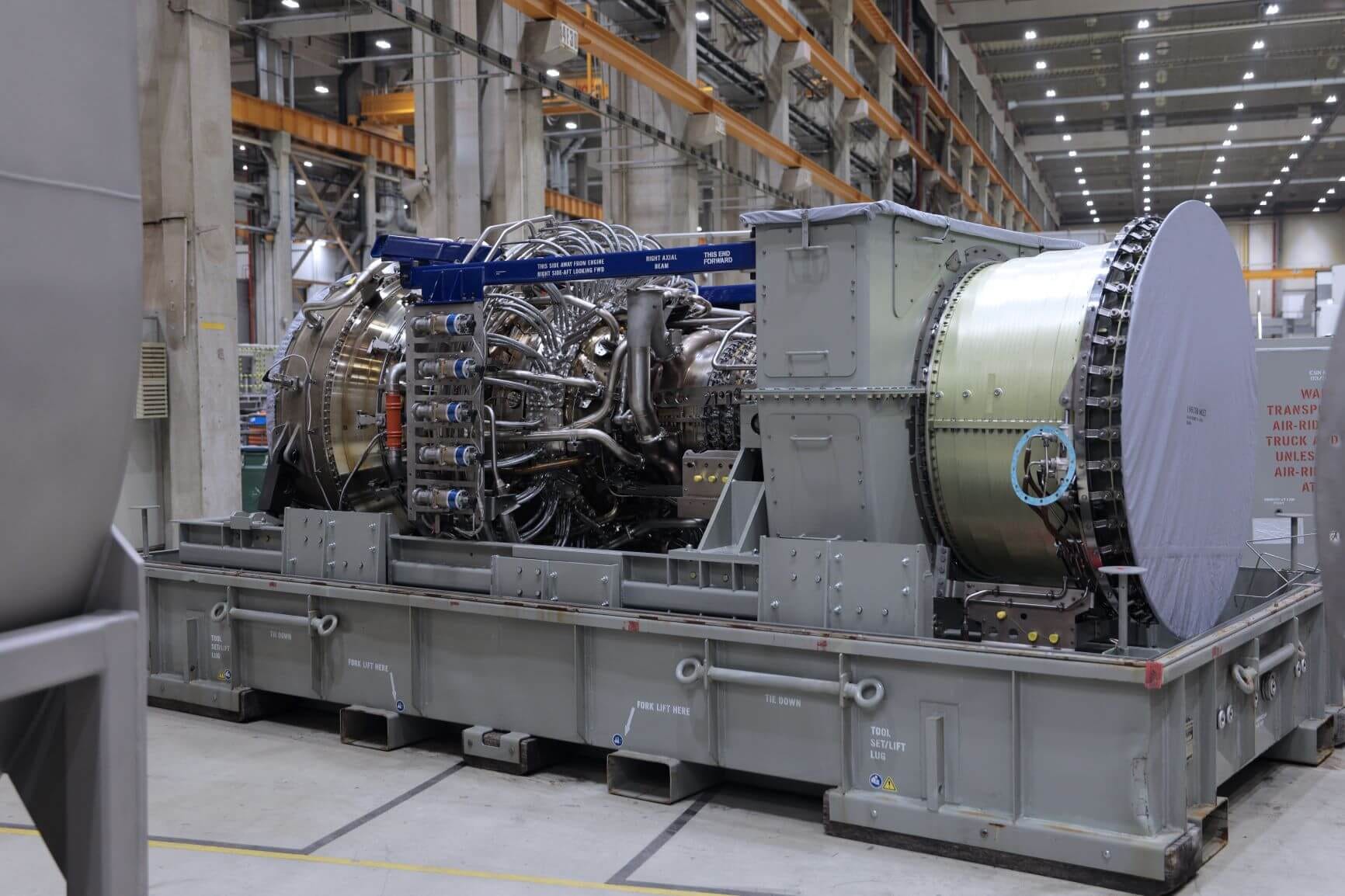
Source: GE Vernova.
The count is the architecture: 9.2 GW across some 170 machines averages about 54 MW per unit, an aeroderivative fleet — jet-engine-derived turbines that ship in months rather than the years a large combined-cycle block takes, buying speed at the cost of burning more gas per megawatt-hour. The premium shows in the math: divide the $33.3 billion of Japanese-funded generation by the 9.2 GW it buys and the fleet prices out at roughly $3.6 million per megawatt — two to three times what a combined-cycle gas plant cost two years ago.
As developer, SB Energy said it would go vertical on the first data center this summer; the 800 MW first phase — a $30–40 billion data center build all-in, chips-included — targets power in early 2028, one increment of a full 8 GW campus put at roughly $500 billion. Tim Walsh, DOE’s assistant secretary for environmental management, quipped: “This is referred to as the A Plant … It will soon be referred to as the AI Plant.” SB Energy has also mentioned an additional 800 MW for the site’s second data center.
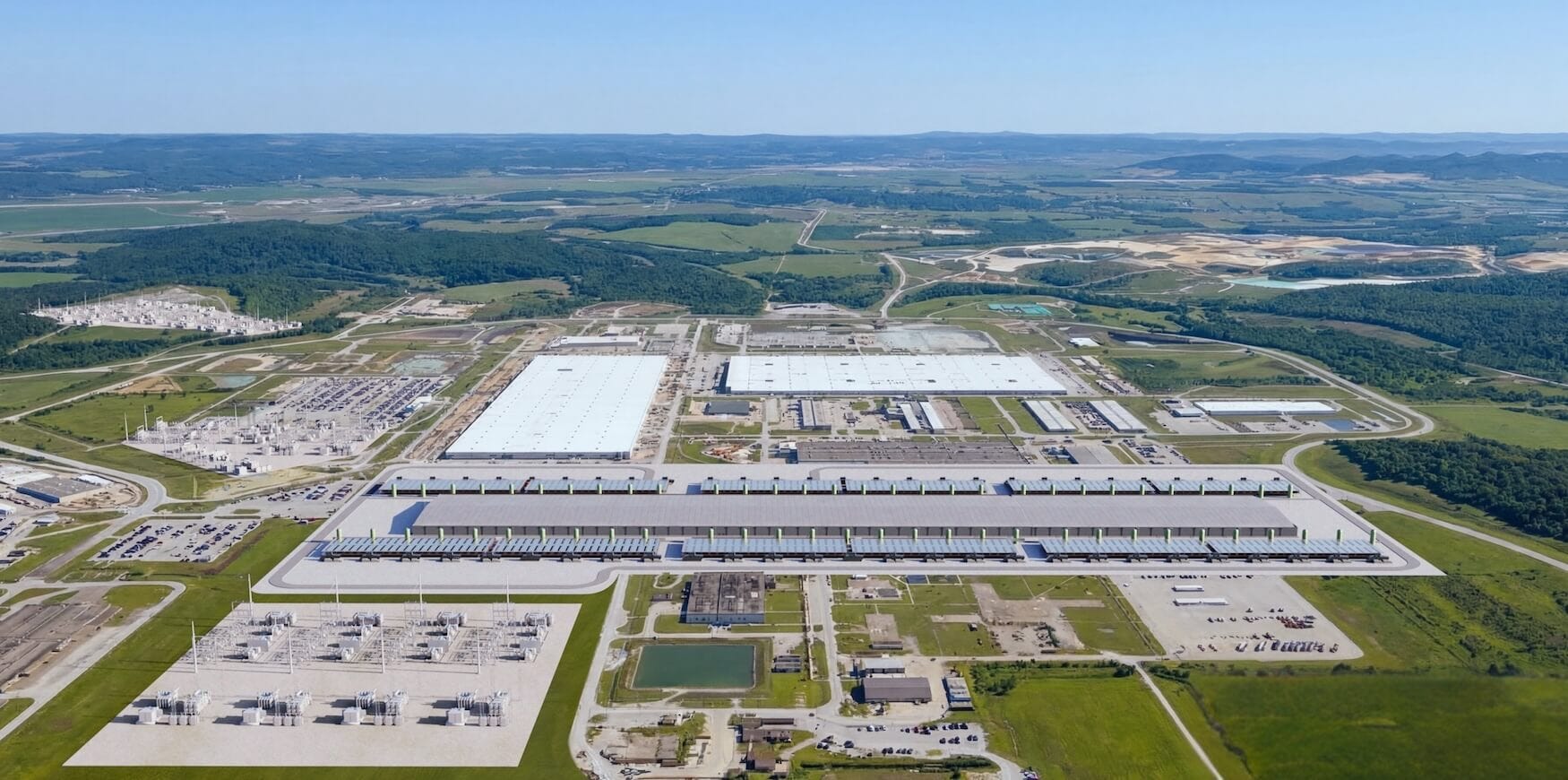
Rendering of future PORTS Technology Campus. Source: SoftBank Group.
The project became the first AI data center “covered project” under FAST-41, the federal permitting dashboard — a federal flagship whose own initiation notice states that “No DOE permitting support is being requested at this time.” A U.S. Army Corps of Engineers individual permit application went in on May 27, 2026, and a combined Ohio EPA water-quality application followed on July 1 — with tree-clearing scheduled for the window between October 1, 2026, and March 31, 2027, and grading running through 2028.
Source: U.S. Department of Energy.
The stated purpose of the project is to build a 10 GW AI data center complex, add new gas generation to balance data center power demand, and invest in grid upgrades.
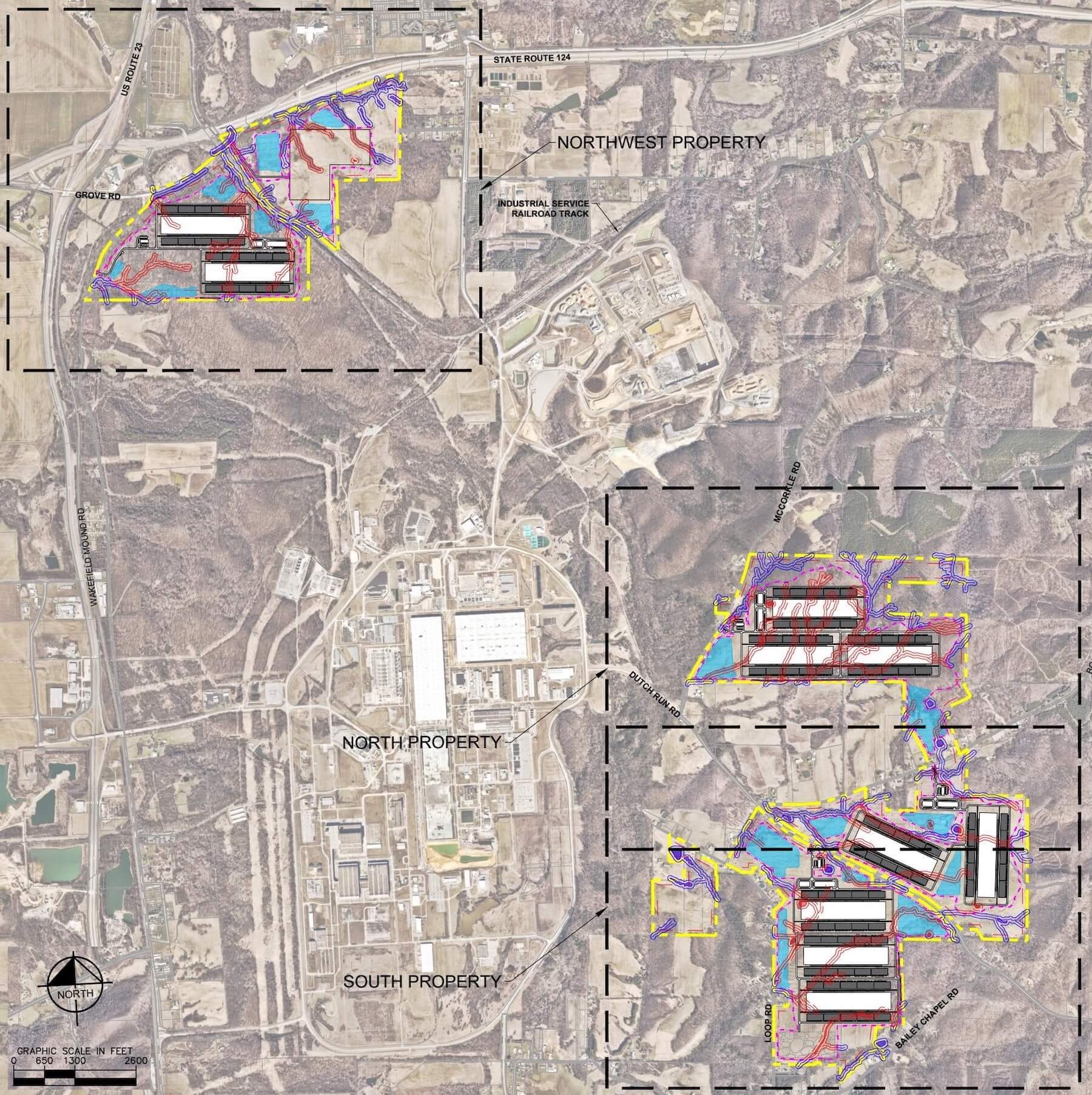
SB Energy currently owns, has the option to purchase, or has rights to all land within the project area — a private landholding of roughly 2,700 acres, of which the Army Corps’ published permit notice puts 1,318 acres as the ground actually being permitted: 930 acres surveyed in late 2025 plus 388 more at Woodburn Heights delineated in early 2026, a footprint that grew mid-permitting.
The permit filings state what goes on it — “several” data center buildings and gas plants in SB Energy’s own application. The permitted ground sits alongside — not inside — the 189 acres leased from DOE.
SB Energy’s permit application carries the campus’s site plans, and they draw every building on all three properties.
Source: U.S. Army Corps of Engineers.
Counted off those sheets, the preferred alternative is 10 data center buildings at 450 MW each.
That is 4.5 GW of total capacity actually being permitted, against the 10 GW the same application says the project exists to build — and ten buildings against the two the federal dashboard lists.
NVIDIA’s August 2026 filing supplies the first outside number that fits: the initial commitment it guarantees is 4.25 GW of IT load and SB Energy says the campus comes online in phases beginning in 2028.
SB Energy comprises a team of 250+ people, 13 projects totaling 5.8 GW, a “pipeline” of 19 GW-IT of data centers and 17 GW of generation, and more than $17 billion raised — a figure NVIDIA is now adding $1.5 billion to, joining existing investors SoftBank Group and OpenAI on the cap table.
That amounts to a solar-and-storage track record now pointed at an AI campus larger than its entire built portfolio — thin enough that Japanese officials are still pushing for the plant’s operation to be put out to tender. To this end, SoftBank is buying part of the missing expertise in parallel: a $4 billion take-private of DigitalBridge, a 30-year digital infrastructure asset manager with a multi-gigawatt portfolio of hyperscale data centers, expected to close in the second half of 2026.
Of the 21 companies in the Portsmouth Consortium, exactly one moves natural gas: Kinder Morgan, which operates the largest natural-gas network in North America and carries roughly 40% of all the gas the country burns.
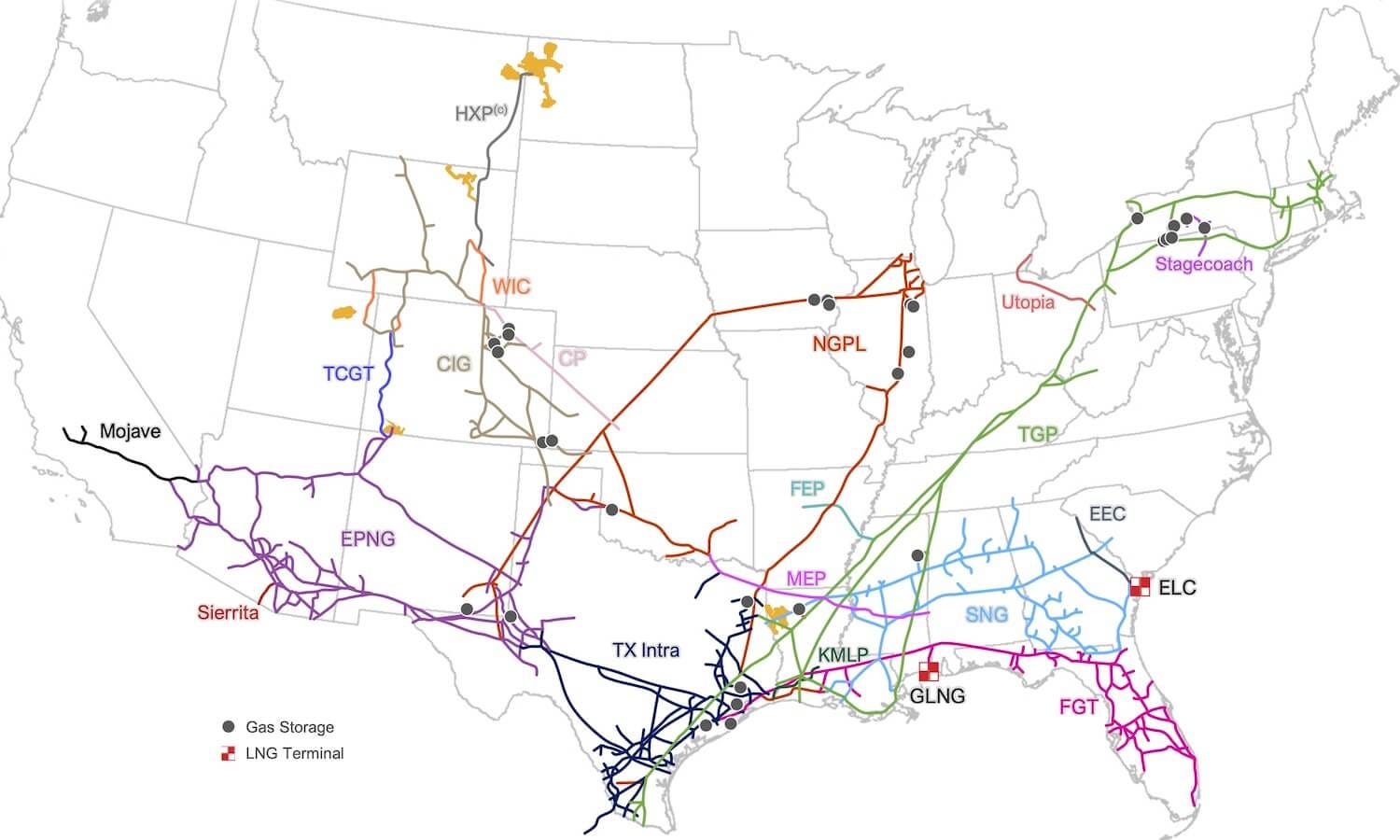
Kinder Morgan’s Natural Gas segment U.S. pipeline network map. Source: Kinder Morgan Inc.
It is there because 9.2 GW of gas generation is inert without a fuel line to feed it, and the line that can feed this one does not yet exist. Every other piece of the project assumes gas shows up at the fence: the turbines SB Energy has ordered, the transmission AEP is building, the concrete already pouring. Kinder Morgan is the consortium’s answer to how it gets there.
The magnitude is the whole problem. Sized for full output — and a feed line must be sized for the fleet’s peak draw — 9.2 GW of gas turbines burns on the order of 2 billion cubic feet of gas a day. That is not a plant’s appetite; it is a region’s, arriving at one address in Pike County. It equals roughly half of all the natural gas the entire state of Ohio consumes today, and it is one-fifth of the more than 10 Bcf/d “shadow backlog” of power and data center demand Kinder Morgan discloses it is chasing across the whole of the United States. One campus, one-fifth of the national opportunity. No pipe in the ground near Piketon was built to carry a sliver of it.
Kinder Morgan already runs the region — its Tennessee Gas Pipeline (the green TGP line in the map above) enters Ohio through Scioto County, immediately south of the reservation, and already feeds Piketon’s local distributor. But a mainline built to move gas through Appalachia cannot drop 2 billion cubic feet a day at a single new meter. Serving PORTS means growing the footprint: a new large-diameter lateral to the campus, new compression and parallel looping to manufacture firm capacity, fresh interconnects to pull supply from the Utica and Marcellus fields to the east, and a delivery station sized to feed the whole fleet at once.
Because it crosses state lines, all of it runs through a FERC certificate — a two-to-four-year path that should be underway now to feed the fleet’s ramp through 2030; the 800 MW first phase can lean on existing supply, but 9.2 GW cannot. And with roughly 700 billion cubic feet of storage on its system, Kinder Morgan can do the other half of the job: guarantee the no-notice, cold-snap-proof supply a data center island cannot operate without.
The gas figure has an electricity mirror, and it is just as state-sized. Run flat, 10 GW of campus load draws about 87.6 terawatt-hours a year — roughly 57% of all the electricity Ohio sold in 2024, and 61% of everything the state generated. Piketon is not a large load bolted onto Ohio’s grid so much as a second power system nearly the size of the first, stood up at one address.
On August 17, 2026, the question that had hung over the campus since the groundbreaking was answered by NVIDIA. OpenAI is the tenant. SB Energy will build, own, and operate the data center under a 20-year lease. And NVIDIA made itself the credit behind it. The campus picked up a commercial name the same day: PORTS-Pike Technology Campus.
OpenAI had signed the same counterparty’s paper before — in Texas. SB Energy is building OpenAI’s Stargate data center in Milam County, Texas — announced at 1.2 GW, known as “Freebird” — under a lease term of over 15 years and a non-exclusive preferred partnership for the projects that follow.
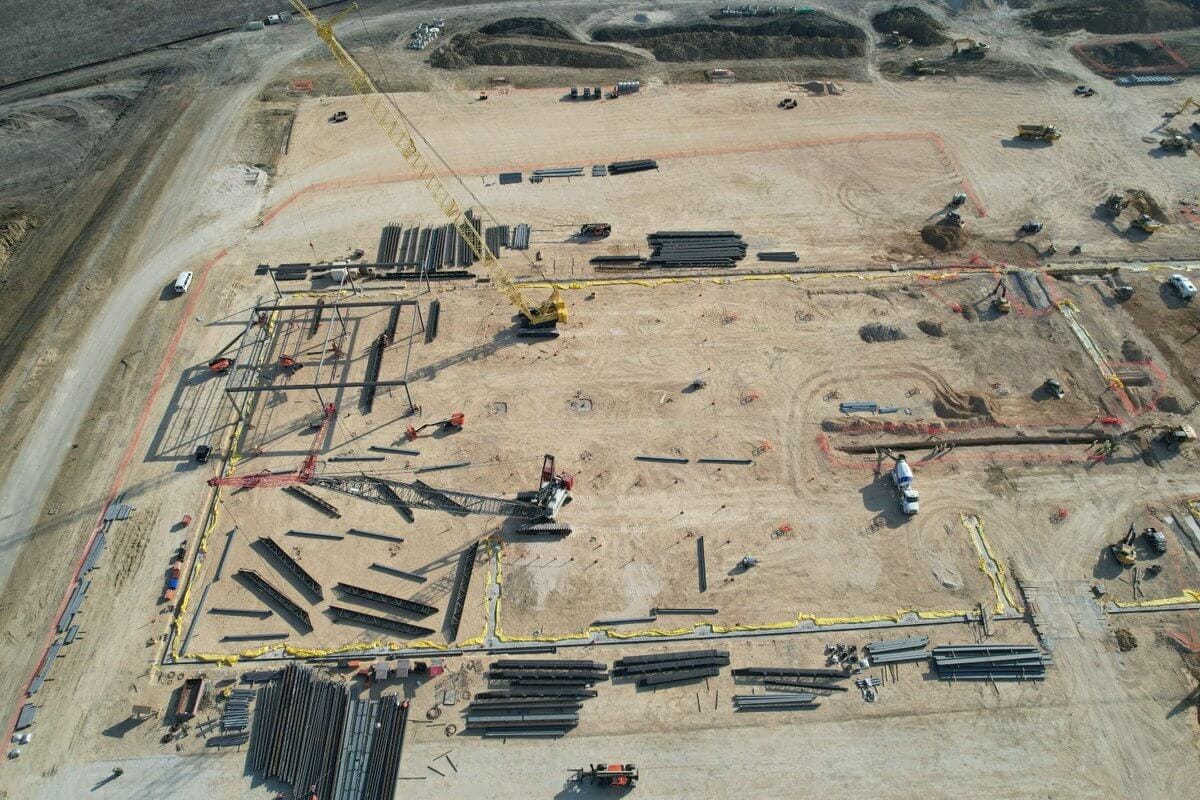
Source: Greg Brockman on X.
OpenAI and SoftBank each put $500 million into SB Energy in January 2026 alongside that project. In Ohio the same developer landed the same tenant — and a third party underwrote it.
The instrument is a set of residual value guaranties on leases covering roughly 4.25 GW of IT load, each taking effect when its lease commences. NVIDIA’s aggregate payment obligation is cumulatively capped at $105 billion for that initial commitment — nearly three times the $33.3 billion Japan is financing and the $4.2 billion AEP is spending on wires, combined. Nothing is owed until SB Energy delivers: payment is conditioned on the lessor meeting ready-for-service conditions, expected beginning in 2028.
What triggers it is narrow, and it is about one company’s credit. If OpenAI becomes insolvent and defaults, or simply fails to pay, NVIDIA covers the shortfall between the lease’s guaranteed minimum value and whatever SB Energy recovers by reletting the space or selling it. NVIDIA can then assume the lease itself, push the landlord to find a new tenant, force a sale, let the lease die, or defer the decision for a year while paying the project’s costs. OpenAI has agreed to reimburse and indemnify NVIDIA for anything NVIDIA actually pays out — which makes the guaranty a bridge across OpenAI’s balance sheet rather than a transfer of the loss off it.
The exit clause is the tell. NVIDIA’s obligation ends at the 20th anniversary of the lease, or if OpenAI terminates it, or — the operative one — when OpenAI achieves a satisfactory credit rating. The guaranty exists because OpenAI does not have one. It is scaffolding, written to come down.
NVIDIA also bought the right to double the position. Beyond the initial 4.25 GW it may provide credit support for roughly 3.75 GW more, which together make up the 8 GW of AI compute the campus’s 10 GW of generation is sized to yield. On NVIDIA’s telling, OpenAI is the customer for all of it.
What NVIDIA gets is a closed hardware franchise. It is the exclusive AI compute infrastructure provider at the site, and OpenAI will use the capacity to deploy NVIDIA’s full-stack DSX AI factory platform — GPUs, CPUs, and networking.
NVIDIA is not lending its balance sheet for a fee; it is buying an 8 GW install base, one Jensen Huang says can be “upgraded repeatedly with each new generation delivering more intelligence and better economics.” Alongside the guaranty it is putting $1.5 billion of equity into SB Energy.
The shape of the deal explains the appeal to OpenAI. It controls the equipment under a long-term lease; the land is leased from DOE; the generation is owned by the U.S. government and financed from Tokyo; the transmission is AEP’s; and the rent is guaranteed by its chip supplier. That is 8 GW of compute with someone else’s balance sheet under every single layer, because here even the government is a counterparty.
“Someone else,” though, is substantially one group: SoftBank has invested roughly $55 billion in OpenAI to date — heading for $65 billion and about 13% ownership with a final tranche this October — owns 90% of the developer, and now shares the SB Energy cap table with both its tenant and its guarantor. A single Ohio campus at 8 GW of compute would exceed OpenAI’s entire Stargate program as announced in September 2025.
The tenant is settled; the megawatts are not. That gate is written in AEP’s own filings — and it is where both Piketon projects’ shapes were forged.
AEP’s own filings define the box any grid-served Ohio data center now sits in: a take-or-pay tariff the hyperscalers fought and lost, and a transmission system whose operator says it cannot reliably serve the new load for years yet.
The campus’s grid framework is a $4.2 billion SB Energy–AEP transmission program, publicly framed as compliance with Ohio’s Ratepayer Protection Pledge. It arrives in stages — an initial 345 kV tie at the end of 2027, the full 765 kV backbone in 2029 — but no stage can carry the whole campus, which is why on-site gas still supplies first power in early 2028 and scales with the load. Its marquee element is Baku–Gavin, a roughly 50-mile 765 kV line from a proposed Baku Substation on Wakefield Mound Road in Pike County, Ohio to the existing Gavin Substation in Cheshire, Gallia County, Ohio.
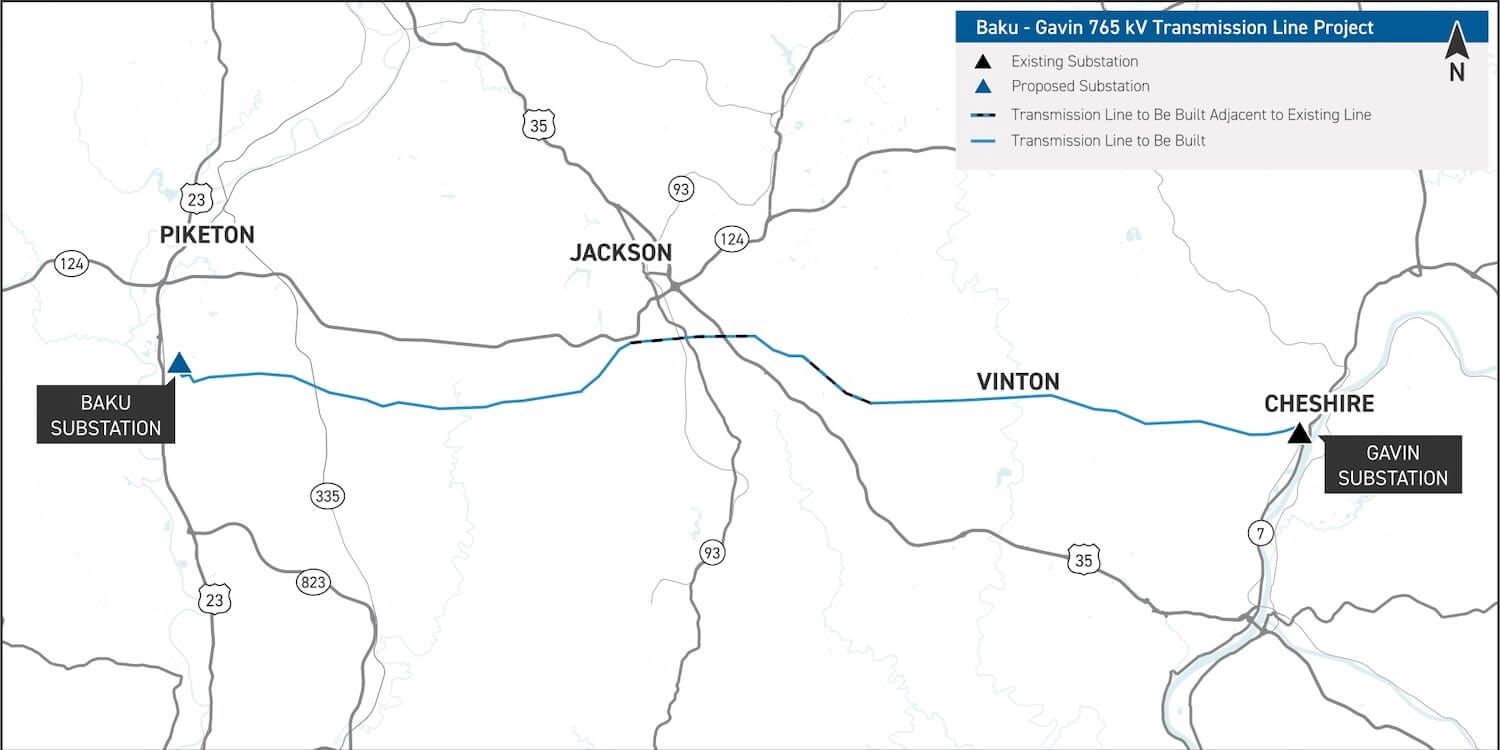
Source: American Electric Power (AEP).
The build comprises 155-foot lattice towers on a 200-foot right-of-way and costs roughly $1.1 billion. It is now before the Ohio Power Siting Board (OPSB), with construction targeted for February 2027 and service in December 2028. The village of Cheshire is a fitting endpoint: it is the Ohio River town where Kyger Creek was built to feed the enrichment plant 70 years ago.
The near-term feed is smaller and faster. Monza, a greenfield 345 kV ring-bus station — six breakers and a 150 MVAR static compensator, $156.6 million, projected in service December 31, 2027 — hangs off the existing Don Marquis substation to serve a need of 800 MW near Piketon identified by PJM, the regional grid operator.

Source: PJM.
This is the full circle: the substation AEP built in 1969 to interconnect the A-Plant’s dedicated power supply will deliver the AI campus’s first phase.
What the projects do not do is instructive. AEP’s active interconnection queue runs to roughly 190 GW system-wide, with 63 GW of contracted capacity — 90% of it data centers — and the 10 GW Piketon campus counted among the requests. But in PJM’s own generation queue, as of July 2026, no campus-scale Pike County, Ohio, entry exists at all.
The wire story runs through AEP’s transmission planning and the state siting board, not the standard queue both projects were built to avoid.
The tariff was built in one Public Utilities Commission of Ohio (PUCO) docket — case 24-0508-EL-ATA — and its outcome explains why Piketon looks the way it does. In March 2023, AEP quietly stopped taking new central-Ohio data center service requests — a moratorium. In May 2024, sitting on an unsigned queue of more than 30 GW, it filed for a data center tariff; two rival settlements followed — Amazon, Google, Microsoft, and Meta behind one; a utility-and-consumer coalition behind the other. The hyperscalers lost: the Commission adopted the coalition’s version, approved final tariffs in July 2025, and denied rehearing that September — resting its reliability case in part on a confidential AEP transmission-planning summary that Meta had entered into the record as an exhibit. Meta helped arm the tariff it fought.
Schedule Data Center Tariff (DCT), as adopted, is two mechanisms:
Load Ramp: Contracted capacity steps up to 90% over as many as four years.
Minimum-Demand Ladder: Once ramped, a customer owes for 60% to 85% of contract capacity — the 85% cap binding at 117 MW and above — “regardless of the customer choosing to curtail, reduce, suspend, or terminate service.” The term runs the ramp plus eight years (12 years at the maximum ramp), behind exit fees and collateral; even self-help is fenced, with netting of behind-the-meter generation requiring equipment that can instantaneously curtail at least as much load.
The aftermath says who felt bound. The hyperscalers stayed; it was the manufacturers — the Ohio Manufacturers’ Association Energy Group — who took the tariff to the Ohio Supreme Court as “textbook discrimination,” in a still-pending case. Seven decades earlier, on this same ground, the federal government signed the same shape of deal from the other side of the table: a demand charge owed “whether energy is used or not.” The take-or-pay contract has come home to Piketon — this time with the data center paying it.
Then there is the timeline itself. AEP’s November 2025 load study stated that none of the 13 GW of “New Data Center Load” can be reliably served until the completion of the “Ohio Seven Year Solution” (PJM 2025W1-570) project, a proposed 765 kV / 345 kV transmission expansion anticipated to be in service by approximately Q4 2031.
By February 2026, AEP Ohio alone counted a grand total of 17.9 GW of data center load under signed Electric Service Agreements. Set those two facts against the Piketon campus’s early 2028 first power and the conclusion writes itself: for a campus of this size on this clock, on-site generation plus dedicated transmission is not a preference — it is the only solution that works.
Ohio’s two biggest data center power projects never appear in the tariff docket — the proceeding that prices grid service for Ohio data centers — because both engineered around it: one by generating on site under federal ownership, the other by building supply rather than taking service. But that is a queue-bypass, not an exit from the grid.
PORTS Technology Campus stays wired to AEP, its grid ties phased in from 2027 to 2029 behind the gas, and its self-supply is now explicit: SB Energy says at least 10 GW of new generation results in 8 GW of IT capacity — implying a power usage effectiveness (PUE) ratio of 1.25. The 2 GW gap is cooling, conversion, and losses. None of it is the roughly 20% reserve margin PJM plans around, so the grid still carries the balancing and contingency an island would have to supply itself. Its tariff status is unresolved, not avoided.
What Meta bought is the other half of this story.
Meta bought power certainty the opposite way: it prepaid a first-of-a-kind nuclear reactor company that had already spent two years assembling recycled federal land and a co-located fuel chain. The deal is signed, and it buys output from a design that has never been licensed anywhere, in a state where its licensing has not publicly begun.
The Piketon nuclear reactor campus was not conjured by Meta’s demand; it was supersized by it. On May 18, 2023 — two and a half years before the AI land rush reached Pike County — Oklo and SODI signed an agreement for two commercial Oklo power plants in Southern Ohio, up to 30 megawatts electric in total. In February 2024, Oklo took an option and right of first refusal on the land.
Only then came Meta: a December 2024 RFP seeking 1–4 GW of new nuclear, delivery starting in the early 2030s. On January 5, 2026, Meta signed a prepayment agreement. Oklo’s CFO connected the dots on the company’s own call: “another important part on Meta was already having a ROFR in place and access to land in Ohio … we’ve leveraged that land access.” Meta’s money scaled a 30 MW toehold forty-fold, to 1.2 GW.
The instrument is a prepayment, not a power purchase agreement (PPA) — a mechanism for Meta to prepay for power and provide funding, with proceeds put toward securing nuclear fuel and advancing the first phase; a future PPA is anticipated. The structure is effectively a non-refundable upfront payment that will be attributed to future power delivery. And the prepayment is the seed of the capital stack, not the whole of it: Oklo assigns the forthcoming PPAs a second job — “to enable project financing with the Office of Energy Dominance Financing and commercial lenders” — routing the build through DOE’s renamed Loan Programs Office.
Note the symmetry across the fence line: Tokyo’s state credit stands behind the gas Washington will own; Washington’s own state lender is penciled in behind the nuclear Meta prepaid. Both theories of power plan to borrow from a government.
The land is also documented. On December 16, 2025, Oklo Power SODI LLC — a Delaware entity registered in Ohio — recorded its deed to 205.9 acres at 3930 US-23 South, Scioto Township, purchased from SODI for $5.15 million. The chain of title runs from “Parcel 2 of the U.S. Department of Energy property”; the deed carries a 40-foot DOE easement, CERCLA environmental covenants, and a defense-nuclear-facility indemnity under §2811. The parcel today is vacant industrial woodland. What Meta prepaid for is the right to what gets built on it.
The Aurora “powerhouse” is a sodium-cooled fast reactor carrying about 75 MW electric per unit.
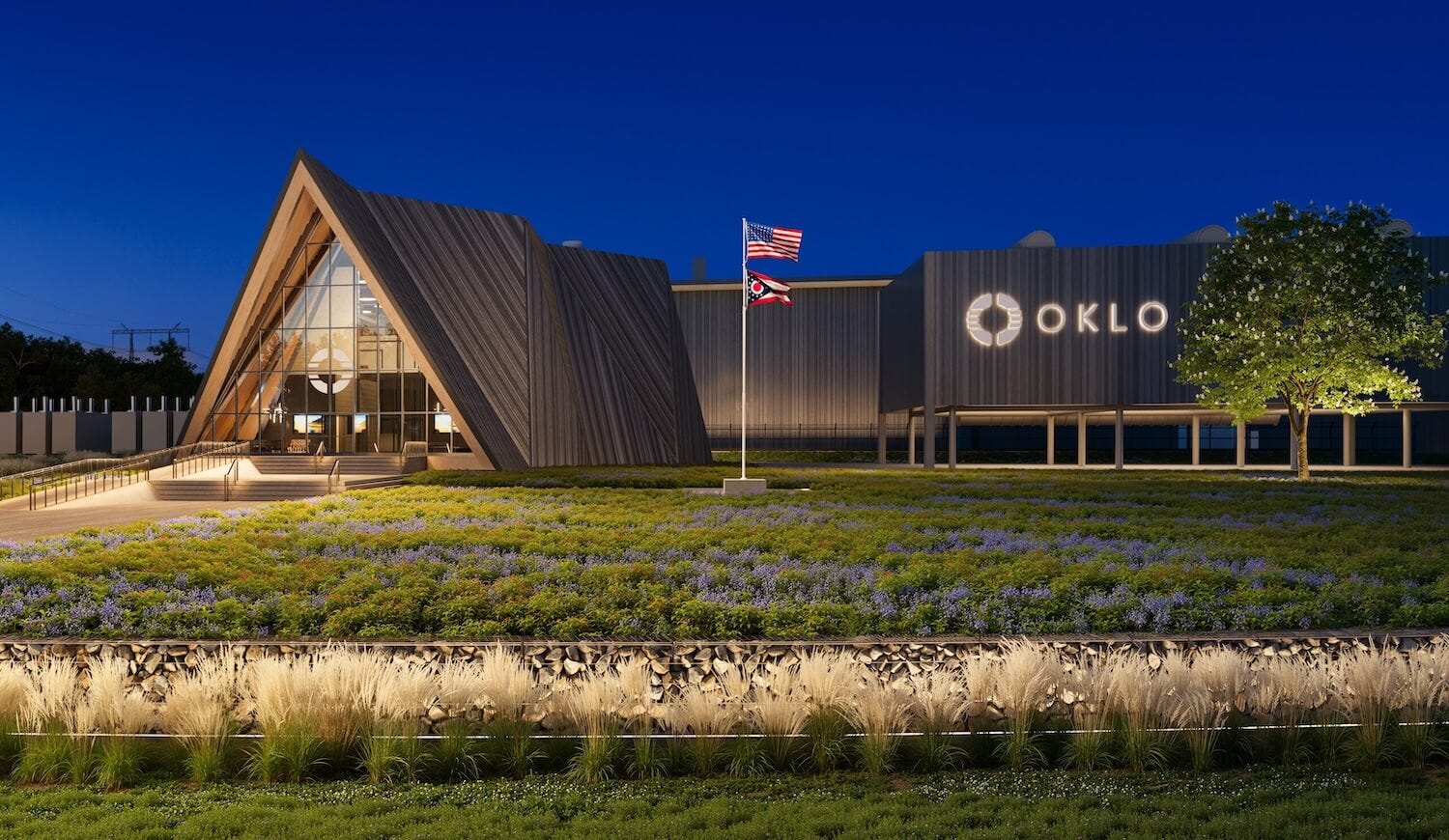
Source: Oklo Inc.
It has a licensing record with one essential feature: none of it is in Ohio. Oklo filed the industry’s first custom combined license application in 2020, for a unit at Idaho National Laboratory (INL); the U.S. Nuclear Regulatory Commission (NRC) denied it without prejudice in January 2022. The INL unit, still targeted for 2027, has since stepped out of the NRC’s line entirely — authorized by DOE itself under the Reactor Pilot Program — so the design’s return to the NRC now runs through the Meta campus: “Aurora Ohio … in connection with Meta agreement” heads Oklo’s own list of assets slated for commercial licensing. Oklo’s strategy is product-based licensing — a design “licensed to a product … regardless of its geographical location,” the aviation type-certificate analogy.
The fuel chain is further along than the reactor. Aurora runs on HALEU — high-assay low-enriched uranium — and Oklo holds two distinct instruments with Centrus, the uranium enricher expanding HALEU production next door at Piketon:
Supply Letter of Intent: Explicitly non-binding, covering up to five powerhouses, deliveries beginning in 2029; and
Planned De-Conversion Joint Venture: Co-located with Centrus’s enrichment operations and adjacent to Oklo’s planned 1.2 GW power campus.
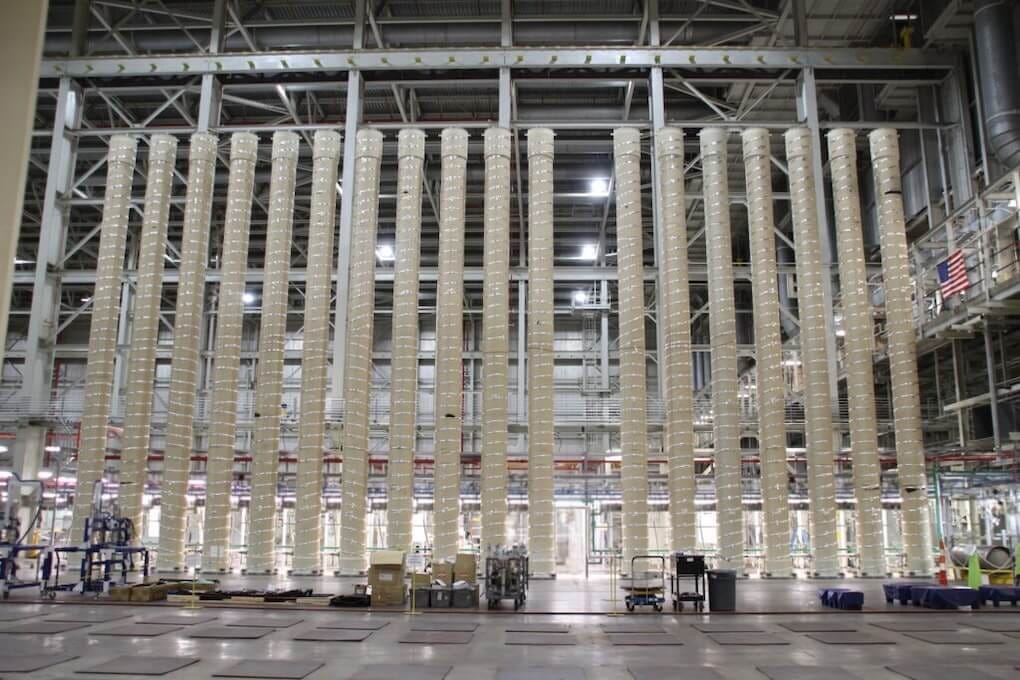
Source: Centrus Energy Corp.
The federally funded enrichment district those instruments plug into is a story of its own (Section VI).
The published timeline: preconstruction and site characterization in 2026–27, with general construction not starting until 2028–29, first 150 MW targeted around 2030, and 1.2 GW by 2034. Oklo intends to operate each powerhouse with about 35 permanent staff, 9,000 gallons of water per day, and no cost to ratepayers.
But “further along” is relative. At about 75 MW each, 1.2 GW is 16 reactors, not one — and the non-binding supply letter covers only five. The fuel for the rest barely exists: Centrus’s Piketon cascade makes roughly 900 kilograms of HALEU a year, essentially all current U.S. output, with no new capacity before 2029. The chain leads the reactor into a supply that isn’t there yet.
There is no Meta data center facility at Piketon and none proposed; the campus would inject up to 1.2 GW of clean baseload power directly into the PJM market, with interconnection applications submitted on April 27, 2026, and Oklo pointing to existing transmission corridors and substations in Pike County. The load it serves sits about 75 miles north: Meta’s operations in the region, including its Prometheus AI supercluster in New Albany, Ohio. The connection is a contract and the grid.
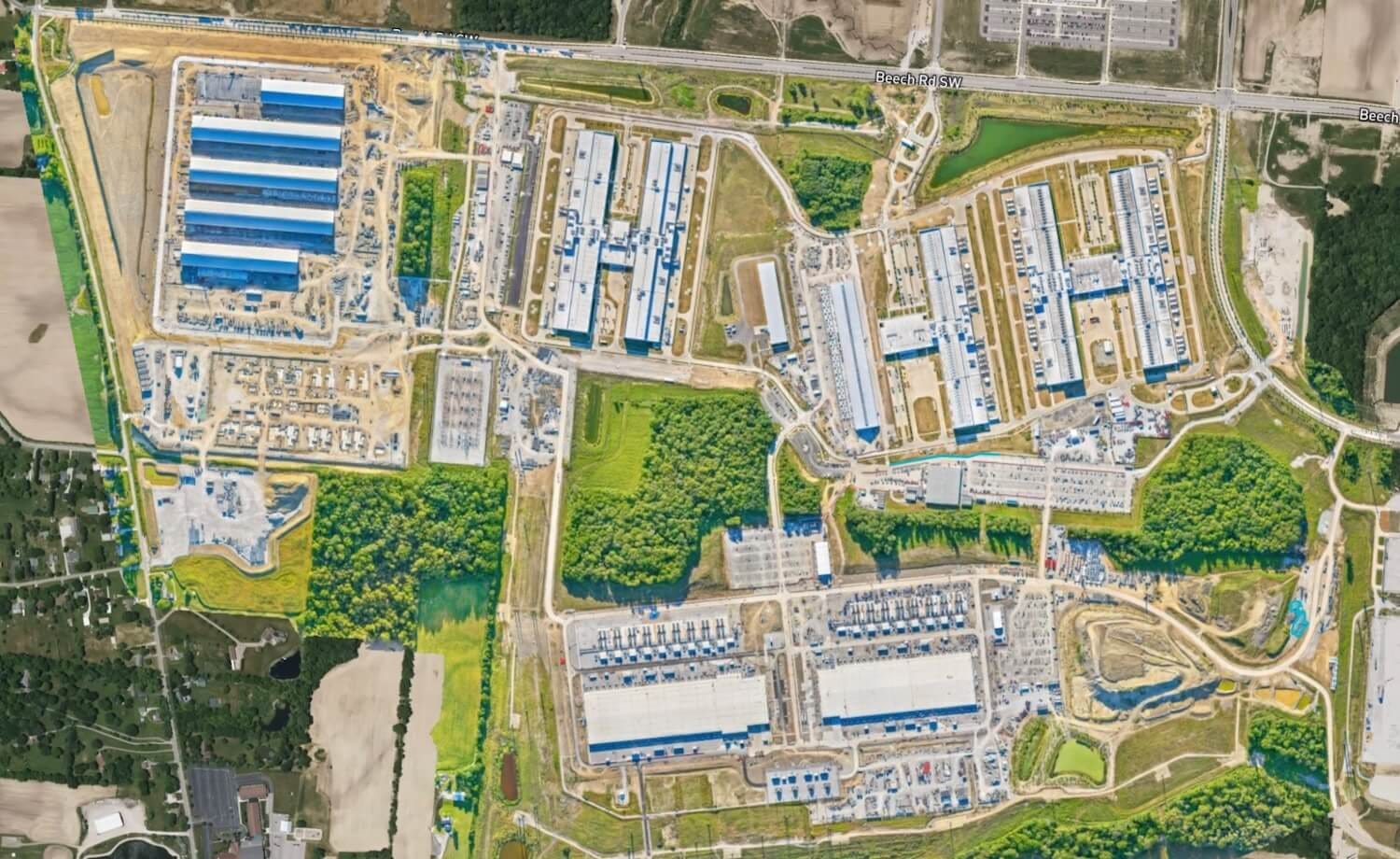
Source: Meta Platforms.
What powers that load in the meantime is the wrinkle in the tidy make-or-buy split. Prometheus is already partially operational and has expanded to more than 3 GW of capacity. Additionally, Meta is building generation at the load itself: the Ohio Power Siting Board approved the 200 MW Socrates South plant, built and operated by a Williams subsidiary, to supply the New Albany campus behind the meter. The buyer of reactors is also a builder of gas-fired generation — standing up exactly the self-supply the new tariff’s netting clause was written to fence (Section IV). Both Piketon camps reach for gas first; they differ on where it burns, who owns it, and which hedge arrives in the 2030s.
What the prepay buys is position. Oklo sits inside Meta’s January 2026 nuclear slate — up to approximately 6.6 GWe across Oklo, TerraPower, and Vistra — which itself sits atop Meta’s separate 1.1 GW Clinton PPA from June 2025; in total a portfolio of 7.7 GW of nuclear partnerships.
Meta has paid for power that arrives after the gas rush — including its own — from a supplier whose construction risk is capped, for Meta, at an undisclosed prepayment. Oklo is pre-revenue, with a $105.7 million net loss in fiscal 2025 and $2.5 billion of liquidity as of March 31, 2026. Meta’s downside is a check it has already written and a delivery date it can survive missing; its upside is first claim on firm, carbon-free megawatts in the exact PJM region where a 50- to 60 GW capacity shortfall looms over the next decade, and where Meta just lost the fight over what grid service costs.
Against the gas project across the fence line, the trade is asymmetrical: the government’s campus is faster, taxpayer-owned, and leased to a tenant whose credit had to be guaranteed by its chip supplier; Meta’s is slower and prepaid off its own balance sheet. Which is the better theory of power is the question the whole reservation now exists to answer.
Piketon is the first place where the industry’s two competing answers to the power problem — build gas fast, or buy nuclear early — sit on the same fence line, on land the federal government spent 20 years clearing.
Pull back and the reservation is quietly becoming a federal energy-industrial park.
Alongside the gas-and-data center lease and the reactor campus: Centrus’s enrichment expansion — a $900 million DOE task order to expand Piketon HALEU production, under contract since June 30, 2026, with Fluor and Geiger Brothers engaged, adjacent to but never part of Oklo’s campus. Uranium enrichment, in other words, is returning to the reservation whose enrichment plant DOE spent two decades demolishing — this time to feed reactors next door. Trillium H2 Power, an early-stage low-carbon hydrogen developer, holds 79.5 acres; Mid-America Conversion Services (a joint venture between AtkinsRéalis, Westinghouse, and Fluor) runs the DUF6 conversion plant. And between the X-326 pad and the Oklo flank sits the “5-Unit Plume,” an active groundwater remediation area — a reminder that this industrial park’s anchor tenant is still the cleanup itself.
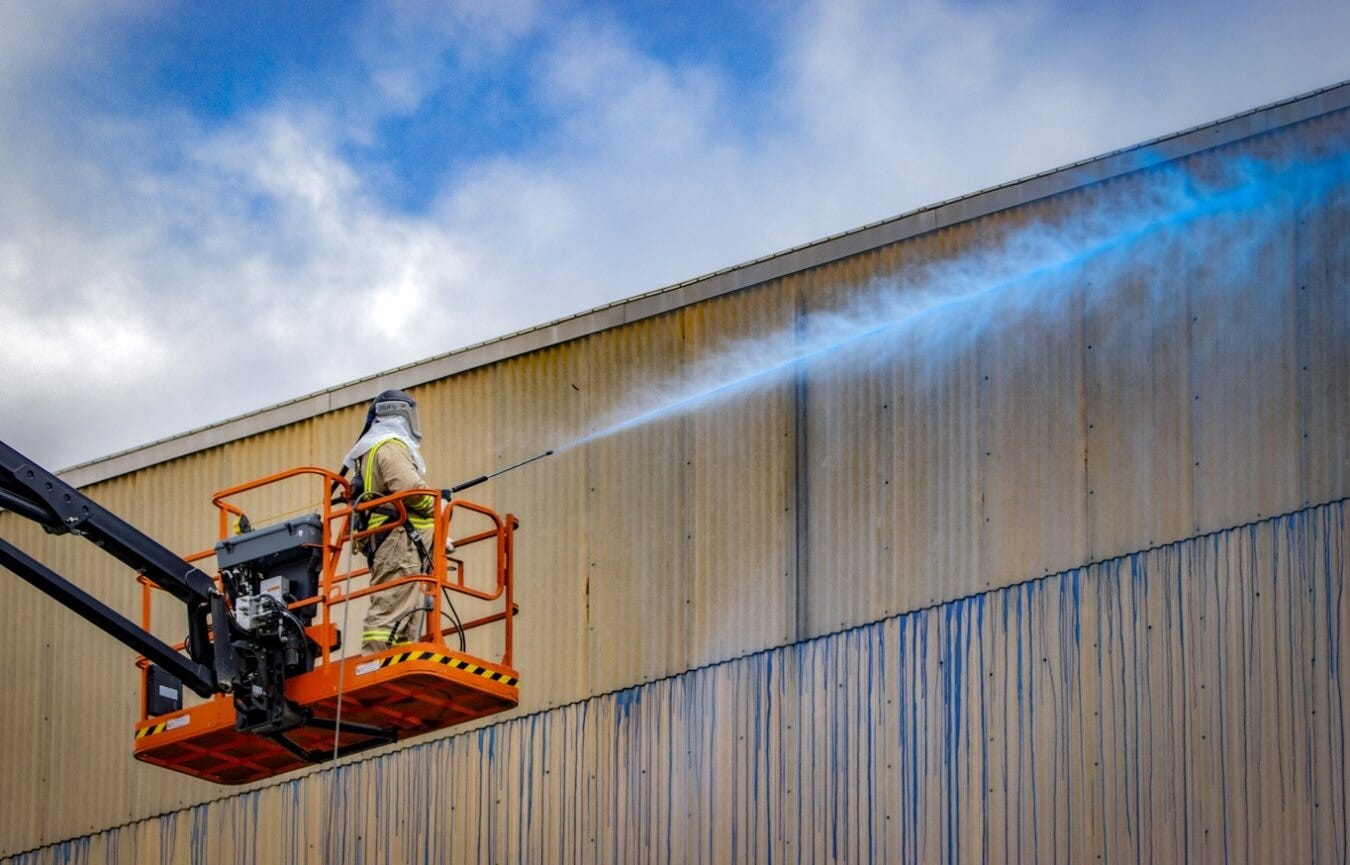
Source: U.S. Department of Energy.
That cluster is the real policy story. The lease runs under the Hall Amendment and DOE’s 10 CFR 770 authority. Its own recitals state the following: DOE support “furthers the Executive mandate to enhance America’s global AI dominance.” The nuclear-weapons complex’s cleanup program — built to shrink federal liability — has become a land-and-power pipeline for AI, and Portsmouth is its proof of concept: a site DOE’s own AI-siting program passed over in July 2025, now framed by DOE as “a model for what could happen at other DOE sites” — implying there are more reservations where this one came from.
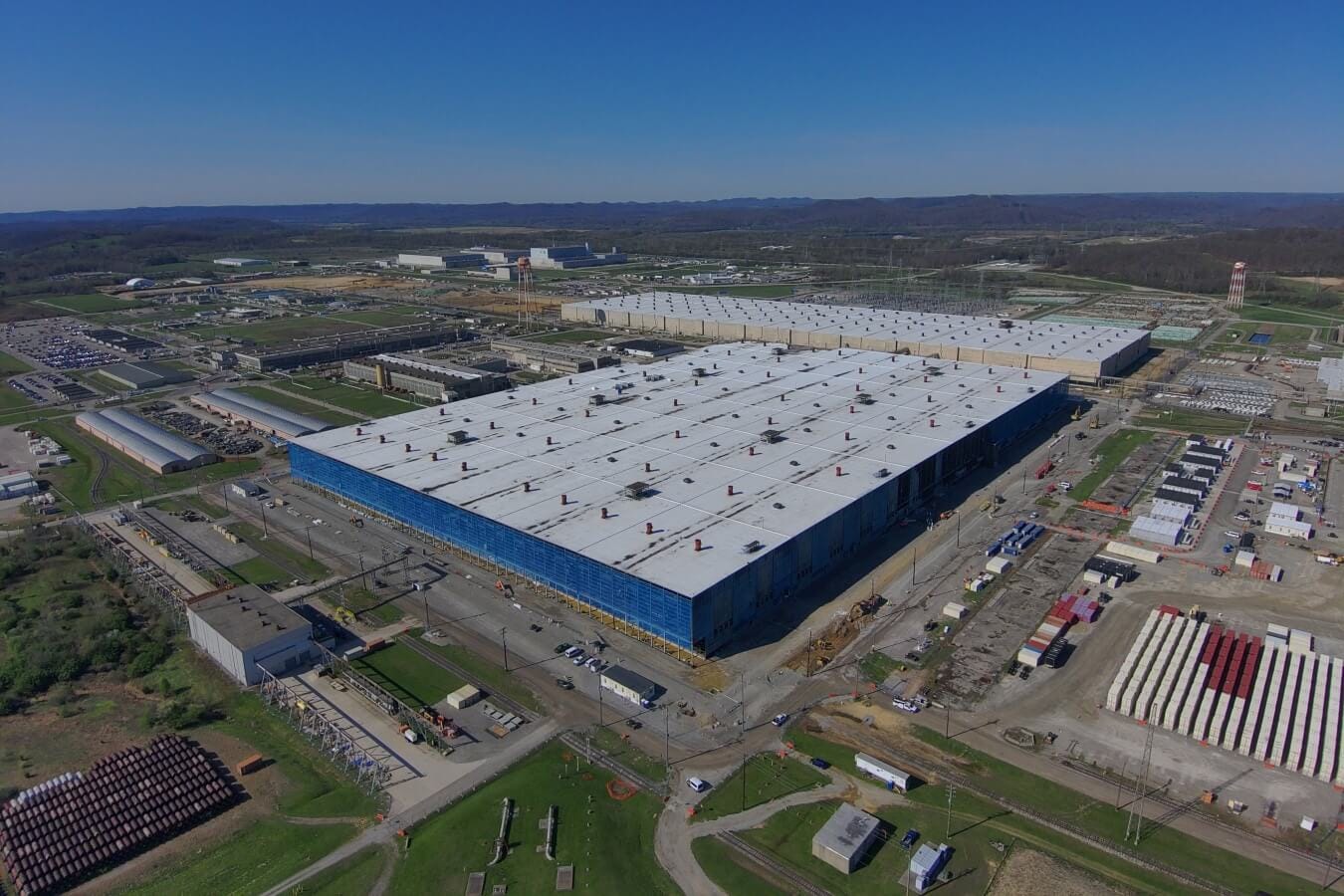
Source: U.S. Department of Energy.
Nearly everything decisive at Piketon is already scheduled — on a permit calendar, a docket, or a delivery window. The dated markers:
Whether NVIDIA doubles down. The option on a further 3.75 GW is exercisable at NVIDIA’s sole discretion and would take the campus to 8 GW of compute. The tell will be a second Army Corps permit application: the 1,318 acres permitted in 2026 carry 4.5 GW — roughly the initial commitment, and no more.
SB Energy goes public. A confidential filing points to an IPO as early as September 2026 at a reported $50 billion-plus — now with a signed 20-year tenant, a $105 billion NVIDIA guaranty behind the rent, and NVIDIA itself on the cap table, but a gas fleet still unbuilt.
First power, early 2028. First building vertical in summer 2026, first GE Vernova gas turbines by roughly March 2027, Monza 345 kV energized December 31, 2027 — and the 800 MW phase closes the Don Marquis full circle.
OPSB case 26-0426. AEP’s Baku–Gavin 765 kV application was filed in summer 2026 and is now before the OPSB, with construction targeted for February 2027 and service in December 2028 — the marquee of the $4.2 billion grid program.
Oklo’s Ohio docket. The real tripwire is the first Ohio-specific NRC filing; site work is slated for 2026–27 and general construction for 2028–29, Centrus HALEU deliveries begin 2029, first 150 MW around 2030.
X-333 demolition, running to 2031. The measure of how long the AI campus rises inside an active CERCLA cleanup — and, with SODI’s roughly 1,000-acre pool, of how much more land the factory can produce.
Source: U.S. Department of Energy.
Measured AI provides institutional-grade analysis of the physical infrastructure powering AI data centers. For access to our full research library, regulatory intelligence, and weekly briefings, visit MeasuredAI.com.
No posts
Comments
Nothing yet. Say the first thing.
Sign in to join the conversation.