
In early February 2026, residents of Sturtevant, Wisconsin, began hearing a sound that would not stop — running 24 hours a day, carrying across the field from the Microsoft campus. As one neighbor later told the Wisconsin Department of Natural Resources (DNR), it “sounded similar to the whirring engine of a freight train parked nearby.” In mid-April, Microsoft’s CEO, Satya Nadella, announced what had been switched on: the Fairwater data center in Wisconsin was “going live, ahead of schedule” — six weeks ahead, he told investors, allowing Microsoft to recognize revenue earlier. On June 23, 2026, Microsoft declared the first data center campus fully operational, and company president Brad Smith pronounced Wisconsin “home to the world’s most powerful supercomputer.”
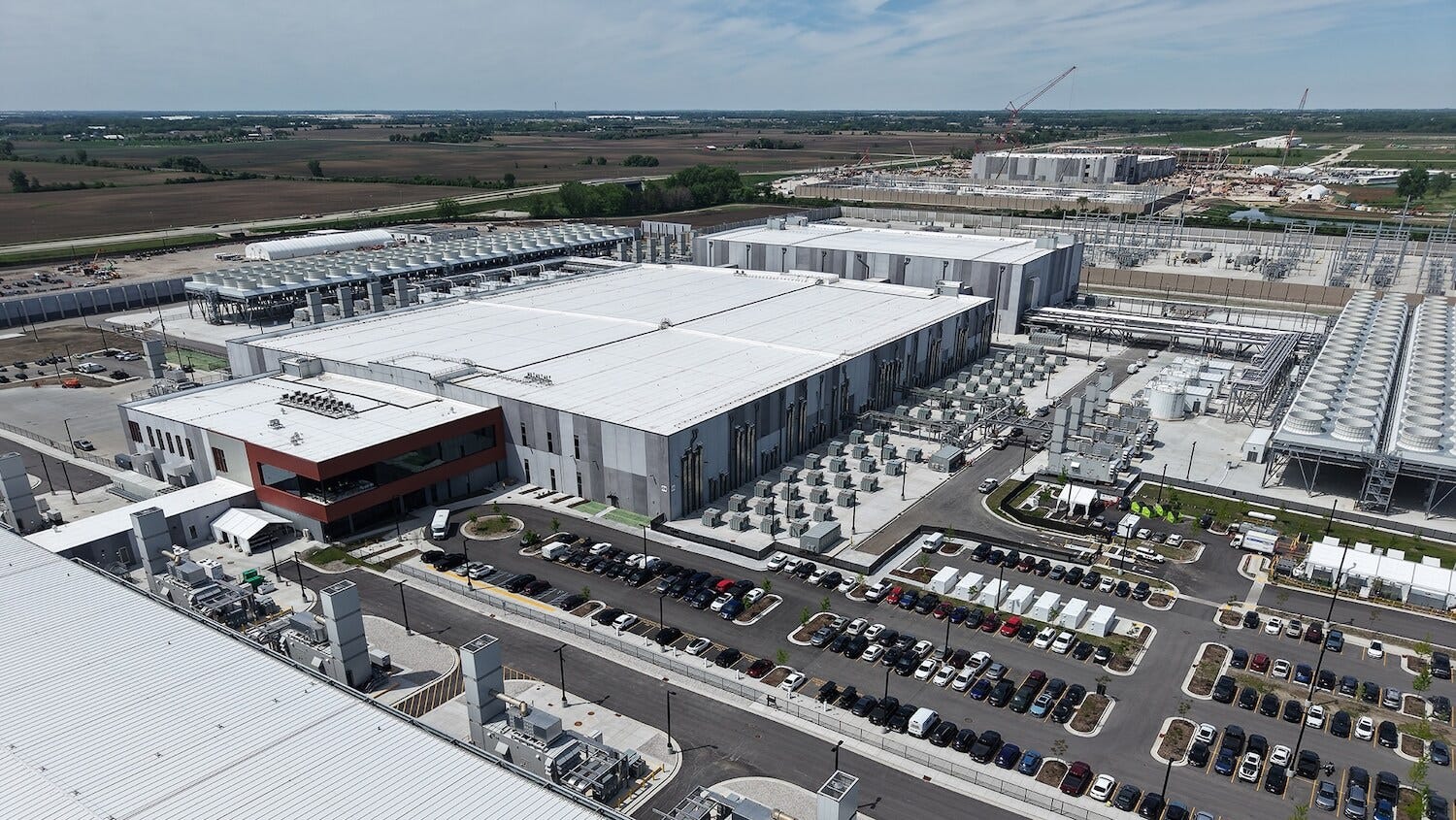
The machine behind those claims sits on former farmland in Mount Pleasant, Racine County, about 30 miles south of Milwaukee: 315 acres, three buildings, 1.2 million square feet under roof, wired to run as a single cluster of “hundreds of thousands” of NVIDIA GB200 GPUs — part of a campus Nadella says will “scale to 2 GW alone,” on land where Microsoft now holds more than 2,000 acres. A second campus is due for completion in 2028, and 15 more data center buildings — a third and fourth campus — won approval in January 2026.
Microsoft’s stated investment has climbed from $1 billion at the 2023 groundbreaking to more than $7 billion as of September 2025 — and, with a further $13.3 billion expansion in 2026, to a program its utility pegs at more than $20 billion. The campus is set to become the biggest electric load served by We Energies, the regulated utility that powers Wisconsin’s southeastern corner.
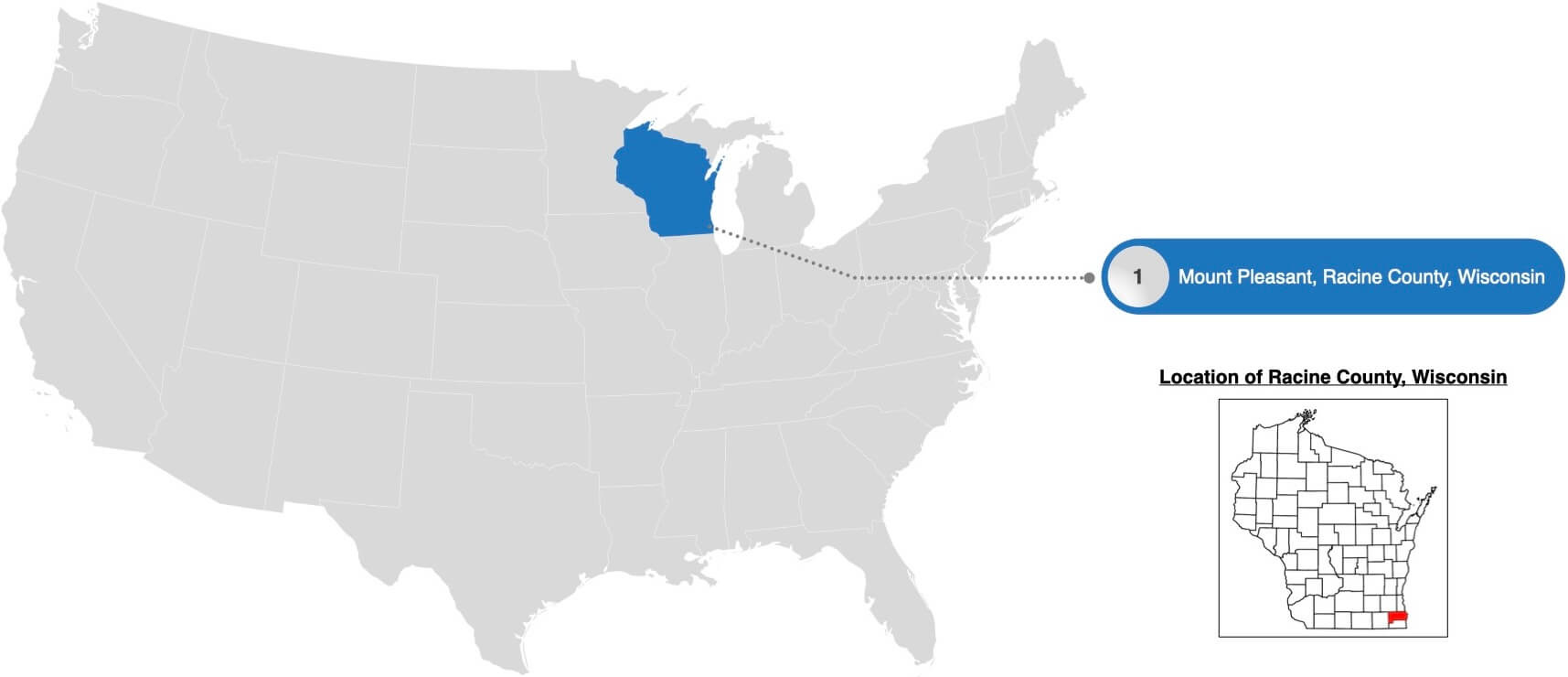
What makes Fairwater Wisconsin worth a close read is a split that runs through every layer of it. This is the flagship Microsoft actually owns — the land, the buildings, the machine — its first Fairwater and the template for the family, in contrast to the leased QTS shells of Microsoft’s Fairwater Atlanta and the rented gigawatt of Microsoft’s Monarch development in West Virginia. But everything that feeds and hosts the machine is inherited, rented, or borrowed: a land bank, tax district, and Great Lakes water diversion built for Foxconn’s abandoned LCD plant; a regulated utility’s rate base, now being rebuilt around one customer; another city’s lake water; and the patience of a village that has already hosted one broken mega-promise.
This AI data center primer walks the four Microsoft campuses in Wisconsin layer by layer — the wager, the land, the machine, the power, the water, the neighborhood, and the fiscal bargain — and closes with the markers that will test it.
Wisconsin is the Fairwater Microsoft self-built and owns end to end — the company calls it “our first Fairwater site,” the “largest and most sophisticated AI factory we’ve built yet,” with “multiple identical Fairwater datacenters under construction in other locations across the US.” Wisconsin is the template; the question the campus answers is whether Microsoft can still execute as an owner.
Source: Microsoft.
That question was live because of who the machine serves and what Microsoft lost while building it. The GPU building is fully dedicated to OpenAI, with OpenAI placing its training workloads inside Microsoft’s Fairwater campus. The relationship behind that dedication is enormous — Microsoft holds an approximately 27% investment in OpenAI and $13 billion in funding commitments, $11.8 billion of it funded by March 31, 2026 — but it is no longer exclusive.
Wisconsin was the intended host of the $100 billion “Stargate” supercomputer Microsoft and OpenAI discussed in early 2024, on a roadmap that would have taken the site past 2 GW. The first Stargate contract went instead to Oracle in Abilene, Texas, and by January 2025 the partnership had loosened to a right of first refusal. The loosening was paid for in demand: when the partnership was restructured again in October 2025, OpenAI committed to an incremental $250 billion of Azure purchases. A further amendment on April 27, 2026, loosened it again — Azure remains OpenAI’s primary cloud, and new OpenAI products still ship there first, but Microsoft’s technology license runs non-exclusive through 2032 and the companies’ revenue-sharing now winds down under a cap.
OpenAI’s own Stargate program now includes a separate Wisconsin campus — the Oracle-and-Vantage build in Port Washington, about 50 miles north — that has nothing to do with this site. The label, though, has since bent back toward Mount Pleasant: OpenAI’s January 2026 “Stargate Community” pledge lists “our latest AI campus with Microsoft in Mount Pleasant, Wisconsin” among “all of our Stargate AI campuses” — the site Stargate passed over, now carried under its banner in OpenAI’s own telling.
Microsoft’s second act is the reversal. The stated investment had climbed from $1 billion at the September 2023 groundbreaking to the $3.3 billion President Biden traveled to Mount Pleasant to announce in May 2024. In September 2025, Microsoft committed an additional $4 billion for a second campus of similar size — taking the first two campuses to $7.3 billion — and branded the site “the world’s most powerful AI datacenter.” The third and fourth campuses approved in January 2026 add another $13.3 billion, putting the full program at more than $20 billion.
Then came the schedule beat: online in April 2026, “6 weeks ahead of schedule,” fully operational June 23. Wisconsin became the proof that Microsoft’s self-build arm still works.
The wager needed ground first — and the ground was already there, cleared and entitled by someone else’s failure.
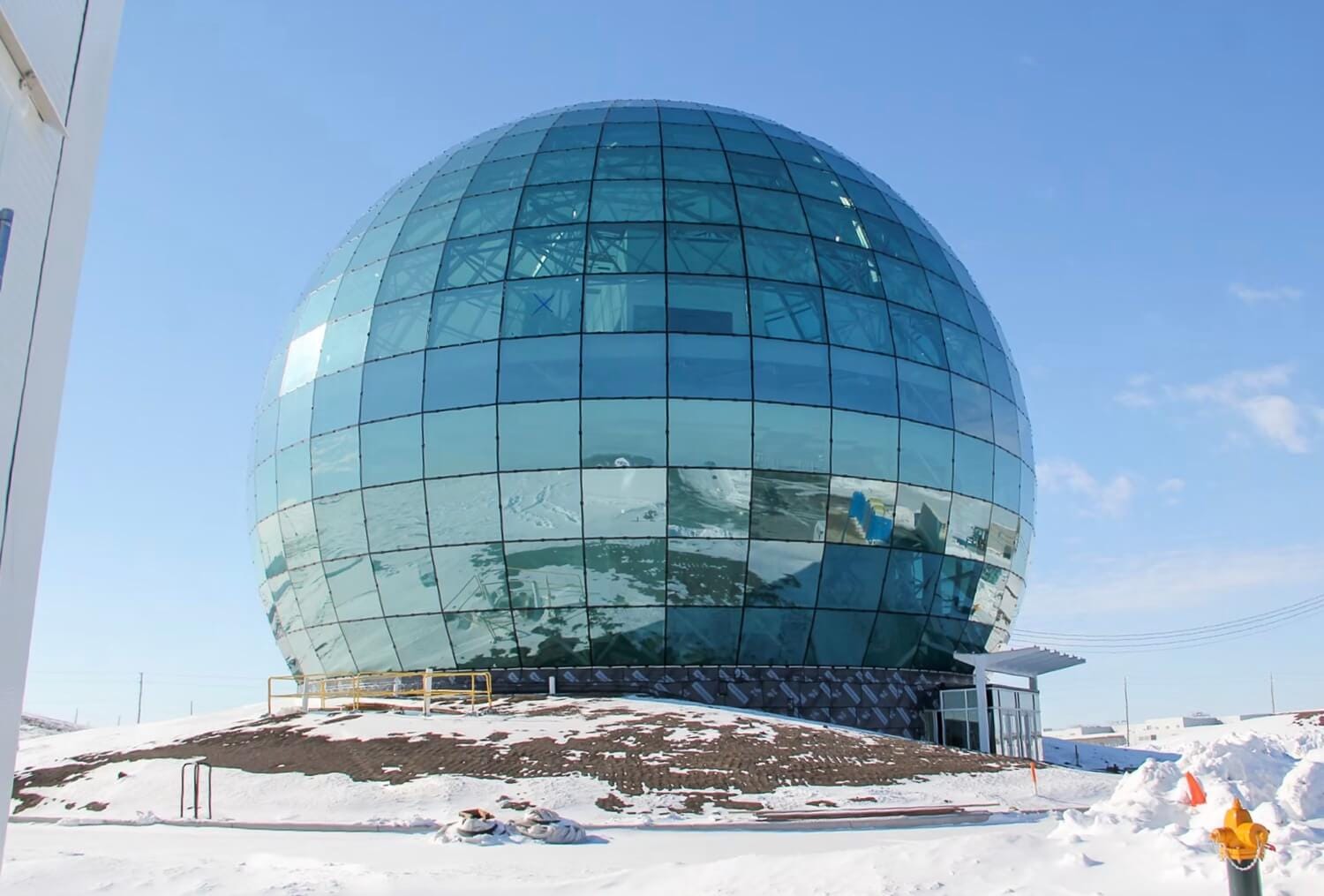
Fairwater exists where it does because Wisconsin had already assembled, zoned, and plumbed thousands of acres for a factory that never came. In 2017, the Village of Mount Pleasant created Tax Incremental District No. 5 (TID 5) — roughly 3,900 acres with $763.8 million of planned public spending — for Foxconn’s promised $10 billion, 20-million-square-foot LCD plant and up to 13,000 jobs at an average salary of $53,875. The plant “never fully materialized”; Foxconn opened a spherical data center on the site in 2021 and shelved the LCD plans.
Source: Foxconn.
The village was left holding shovel-ready industrial land, special-purpose water mains, and Foxconn-era debt. Microsoft bought into all three.
The first purchase set the pattern. On March 30, 2023, the Village Board approved the sale of about 315 acres at 90th Street and Braun Road to Microsoft for $50 million — $159,000 per acre — against the $1 billion development-spending floor written into the development agreement approved the same day. Racine County co-signed the development agreement that April on an 18–1 vote. Microsoft broke ground at 90th Street that September.
As of mid-2026, Microsoft’s plan in Mount Pleasant, once fully constructed, comes to four campuses, 19 data center buildings, 11.2 million square feet, and a stated path to 2 GW:
Building counts are data center buildings only — Campus 1’s third building, the Central Utility Plant housing its chiller hall, is not counted.
The land bank grew in two waves, and the sequence shows what ran out: first the Village’s ex-Foxconn inventory, then the farms around it.
In November 2023, the Village sold Microsoft two more tracts — 231 acres at Campus 2 for $36.5 million and 400 acres at Campus 3 for $63.2 million, both at $158,000 per acre — while Microsoft separately bought the 400-acre Creuziger farm (now part of Campus 3), leaving it with 1,346 acres inside TID 5, more than two square miles. Then came the private assemblage: 205 acres for $33.9 million in July 2024, the Hribar trust’s 70.9 acres for $12.75 million, roughly 160 more acres for over $43 million that September, and two Braun Road tracts plus an Espy Farms parcel in late 2025, taking Microsoft past 2,000 acres of land.
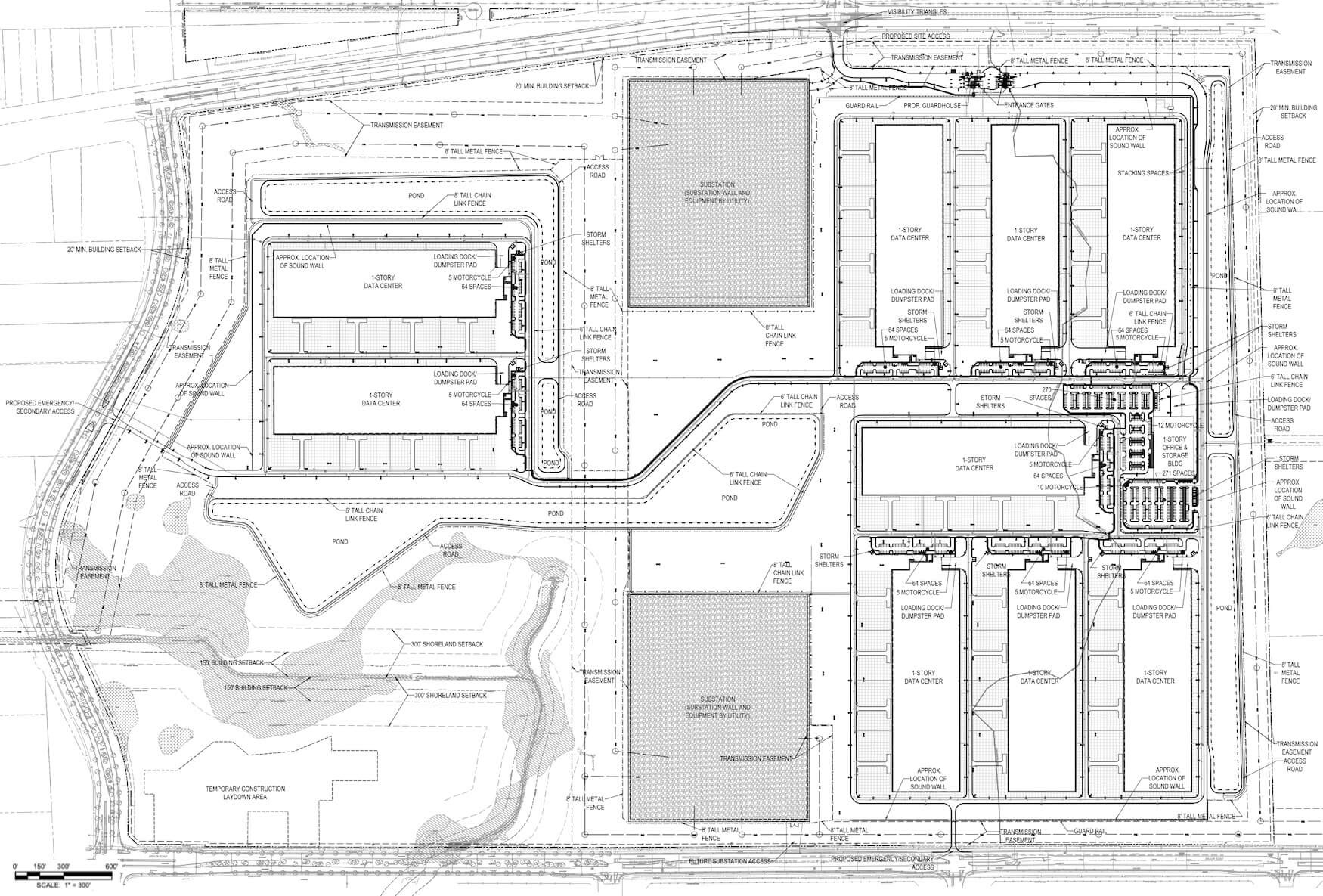
The expansion that defines the campus’s next decade cleared in one evening. On January 26, 2026, the Village Board unanimously approved site plans for 15 more data center buildings across Campuses 3 and 4:
Campus 3’s MKE07–15: Nine one-story data center buildings of roughly 579,000 square feet each on the 791-acre Durand Avenue parcel. Two electrical substations will occupy 36 acres each on the north-central and south-central portions of the campus.
Source: Wisconsin Department of Natural Resources.
Campus 4’s MKE54–59: Six one-story data center buildings of about 568,000 square feet each just north at 2700 International Drive.
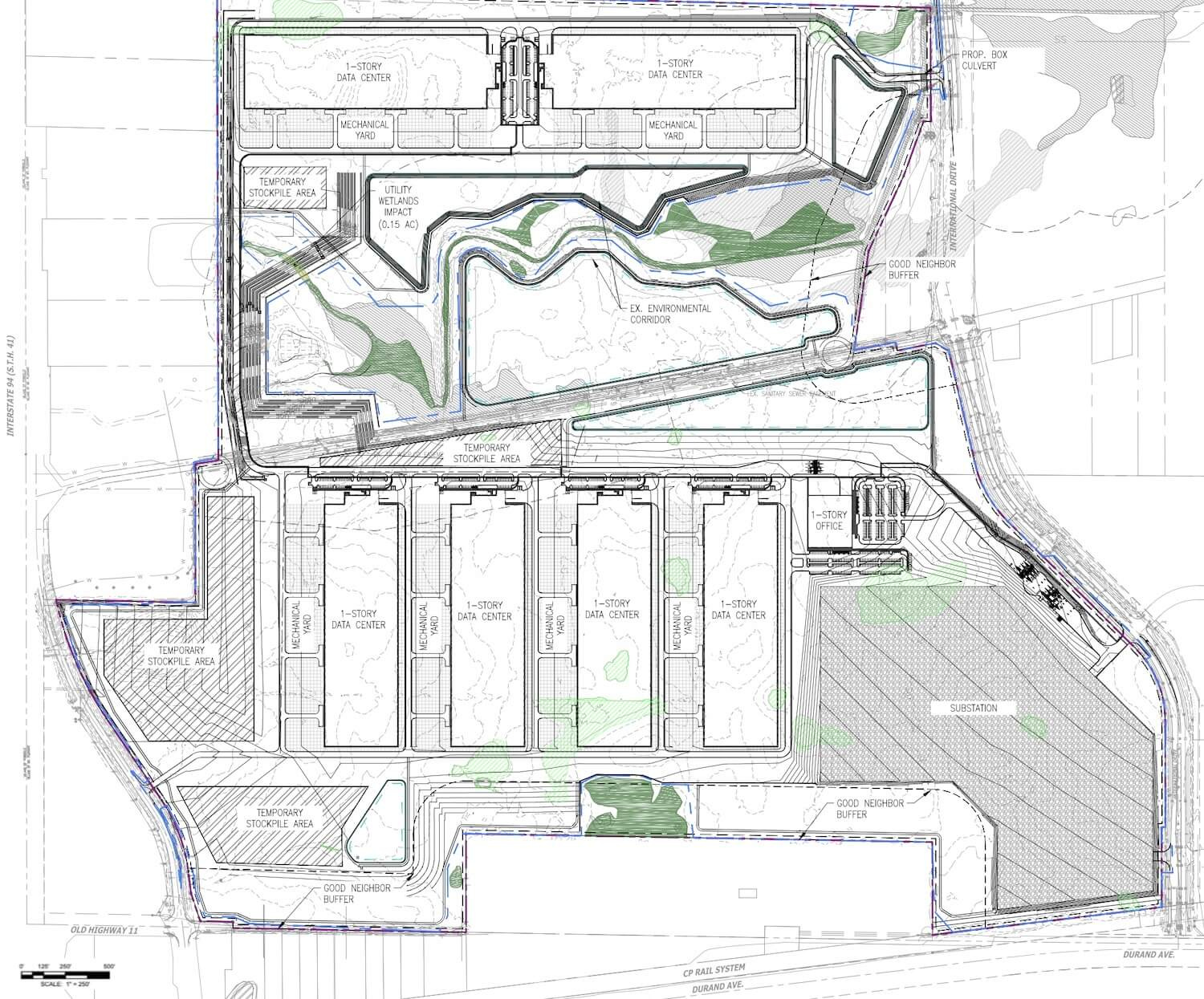
Source: Wisconsin Department of Natural Resources.
Building permits show Microsoft’s ramp on Campus 3 is already underway: the foundation permit for the first Campus 3 building was issued May 14, 2026, three more followed within two weeks, and the first vertical-construction application landed in June 2026.
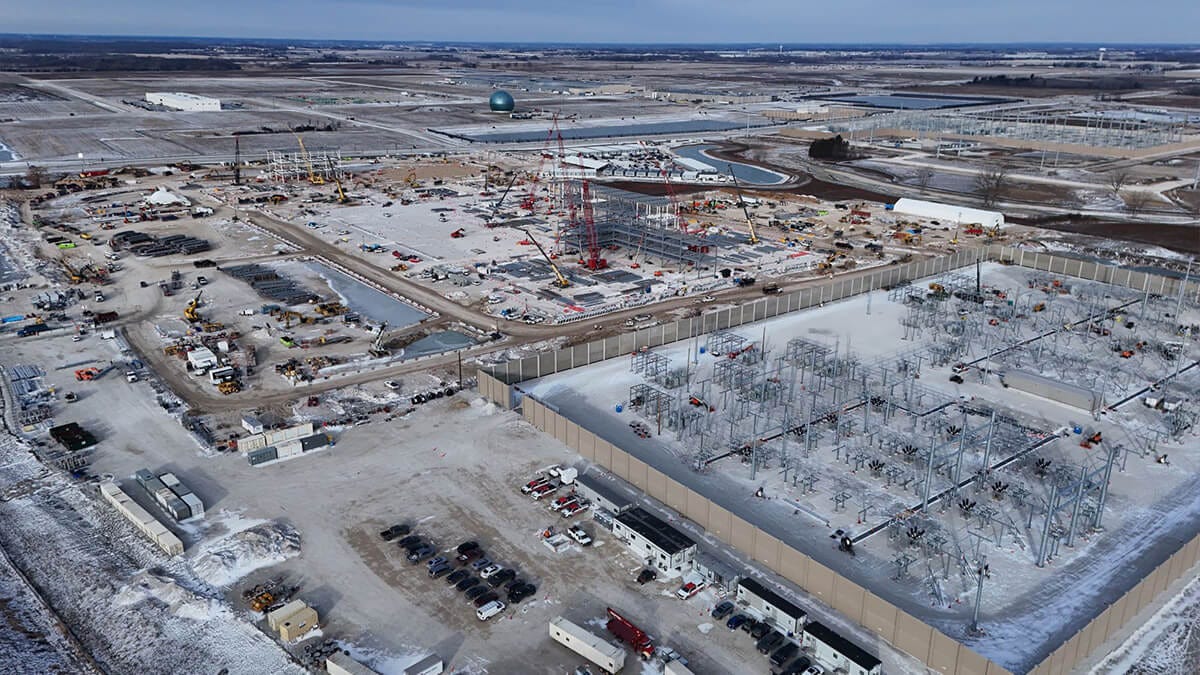
All of this proceeded while Campus 1 received its conditional certificate of occupancy on May 26, 2026. Meanwhile, Campus 2 (shown below) is progressing toward its planned 1.3-million-square-foot, 337.6 MW completion in 2028.
Source: Walsh Construction.
What already stands operational on the first 319 acres is what makes the remaining land significant.
Microsoft’s claim for Fairwater is not that it is a big campus of servers; it is that the campus is one computer — “the most powerful, tightly coupled AI supercomputer in the world, purpose-built for frontier models,” in the words of cloud chief Scott Guthrie, promising “10X the performance of the world’s fastest supercomputer today.”
Source: Walsh Construction.
Microsoft has disclosed its architecture for Fairwater, and it follows a single design principle: shorten every cable, flatten every network, and let nothing fragment the cluster. It is also the master copy — this is the template the rest of the Fairwater family inherits — so the choices below are ones Microsoft made for itself, as owner and architect, not specifications negotiated with a landlord.
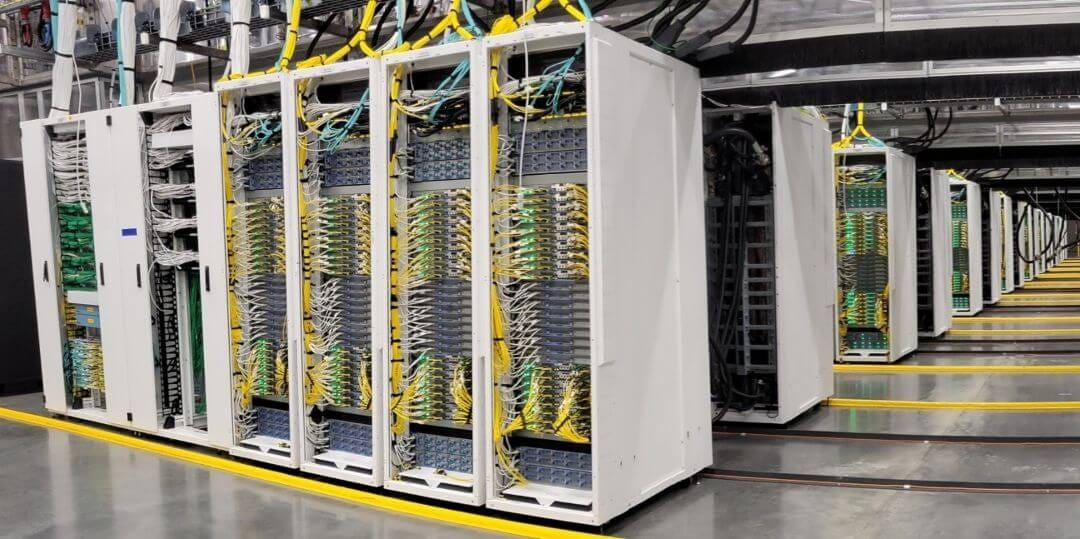
The unit of the machine is the one layer Microsoft buys rather than invents: the rack. Each one packs 72 NVIDIA Blackwell GPUs into a single NVLink domain with 1.8 terabytes per second of GPU-to-GPU bandwidth and 14 terabytes of pooled memory, processing — by Microsoft’s count — 865,000 tokens per second, which it calls the highest throughput of any cloud platform.
Source: Microsoft.
Azure was the first cloud to bring up the GB200 rack systems, and Wisconsin is Microsoft’s flagship deployment; there are more than 150,000 GB200s in Microsoft’s Campus 1 GPU building. Wisconsin’s silicon story is GB200 — the GB300 generation belongs to the Atlanta sister site and the broader fleet.
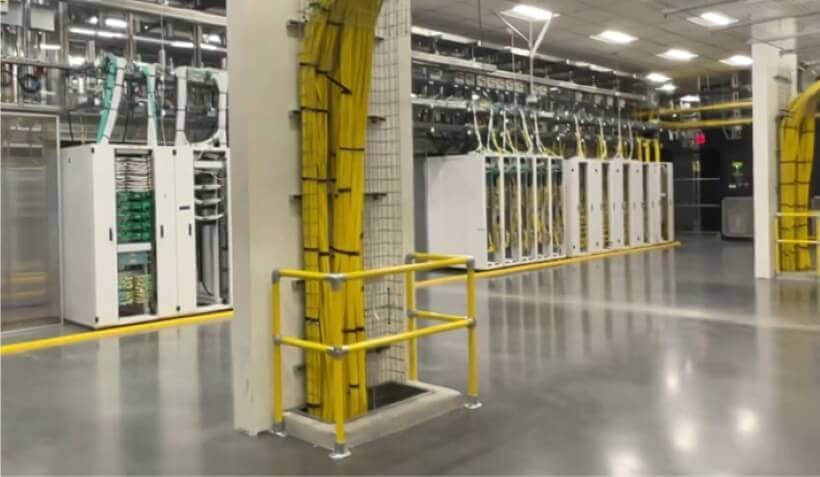
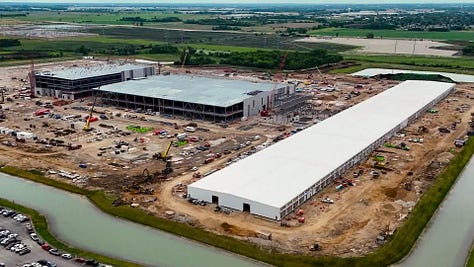
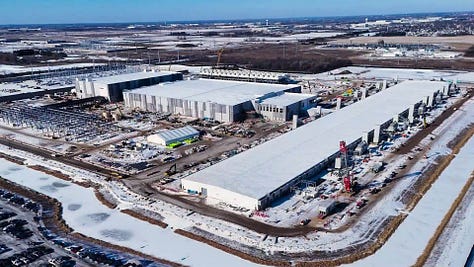
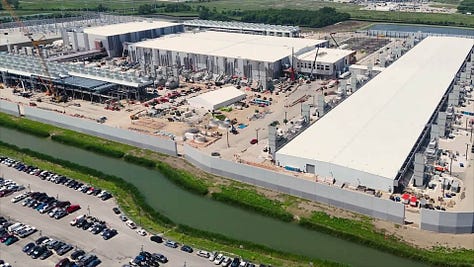
The GB200 racks stack into a building engineered around them — the first rung of the ladder Microsoft designs, builds, and owns outright, shaped by the physics of cable runs. The GPU building is two stories and roughly 750,000 square feet, sized at 294.4 MW of critical IT load, because stacking racks vertically shortens the copper and fiber paths that set training latency.
Source: Microsoft.
Nadella told investors the “two-story design and liquid cooling allow us to run higher GPU densities” and improve both performance and latency for high-scale training. The two-story signature stops with the flagship generation, though: on the approved site plans, all 15 expansion buildings across Campuses 3 and 4 are drawn one story.
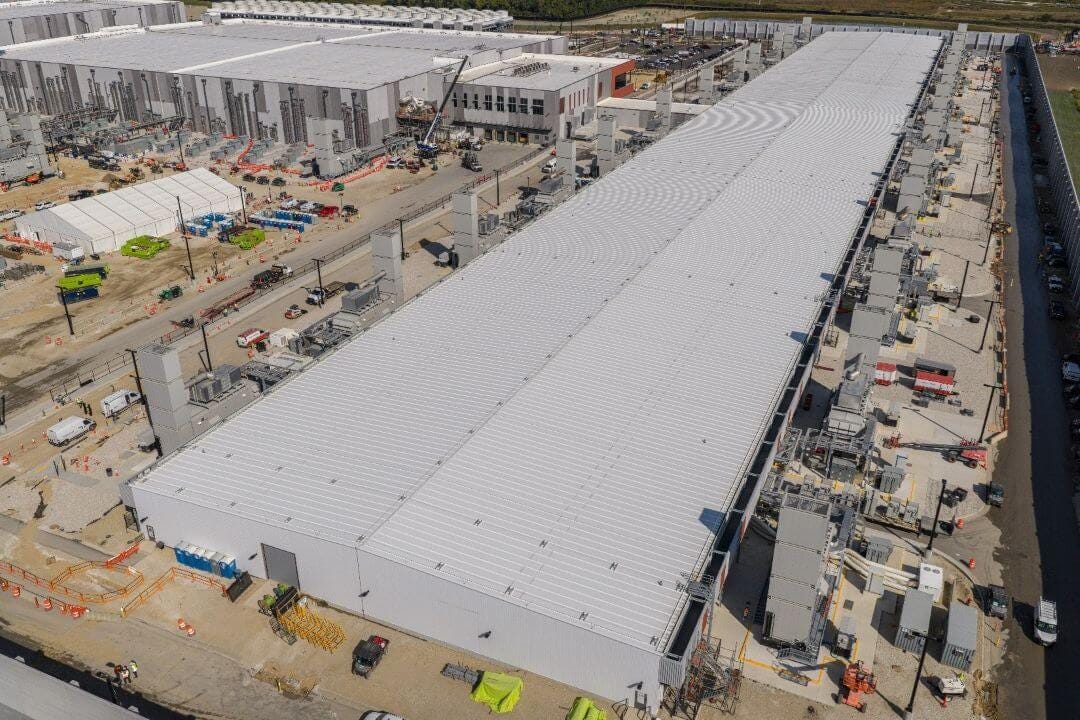
Beside the GPU building sits a dedicated roughly 300,000-square-foot, 43.2 MW CPU-and-storage building — a roughly 1:7 CPU-to-GPU power ratio that exists because reinforcement-learning loops need thousands of CPUs adjacent to the cluster for code compilation, verification, and data processing, with storage systems that run “five football fields in length” — roughly 1,500 feet.
Source: Microsoft.
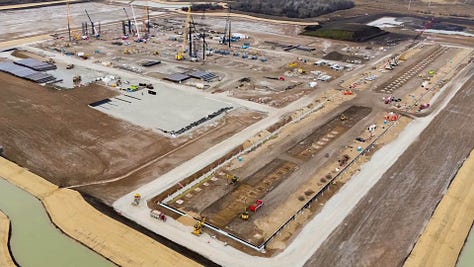
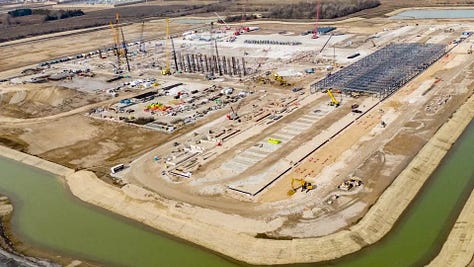
The scale of the Campus 1 self-build, executed by general contractor Walsh Construction, is easiest to read in what construction consumed: 46.6 miles of deep foundation piles, 26.5 million pounds of structural steel, 120 miles of medium-voltage underground cable, and 72.6 miles of mechanical piping.




Source: Microsoft.
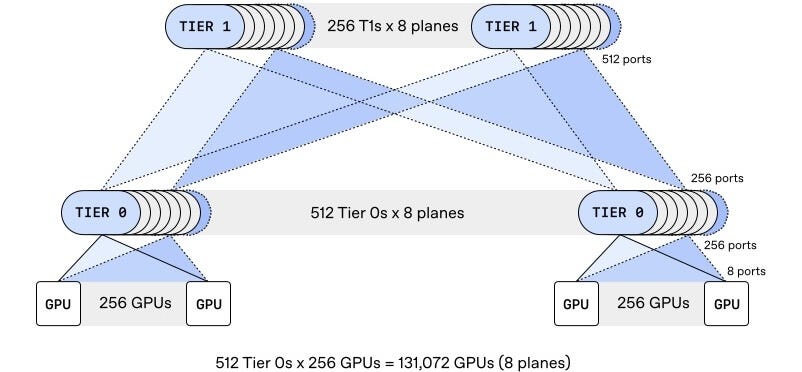
Above the rack, the innovation is Microsoft’s. The GPU building is run as one flat fabric — both InfiniBand and Ethernet at 800 Gbps in a full fat-tree, non-blocking architecture, so that every GPU can communicate with every other GPU without oversubscription. The failure-tolerance layer is a Microsoft-and-OpenAI co-design developed with AMD, Broadcom, Intel, and NVIDIA: the Multipath Reliable Connection (MRC) protocol. MRC’s multi-plane design splits each 800 Gbps network interface across eight parallel planes, letting just two tiers of switches fully connect 131,072 GPUs, whereas a conventional network would need three or four tiers.
Source: OpenAI.
OpenAI says MRC is already deployed across its largest GB200 supercomputers, Microsoft Fairwater among them — OpenAI’s own confirmation of whose models Wisconsin’s machine trains.
The top of the ladder leaves the state. Fairwater Wisconsin is the anchor node of Microsoft’s AI WAN — a dedicated long-haul fabric running at 300 terabits per second with headroom toward 10 petabits, across a global fiber backbone Microsoft says spans more than 500,000 miles. When Fairwater Atlanta came online in late 2025, Microsoft joined the two sites into what it calls “the world’s first AI superfactory.”
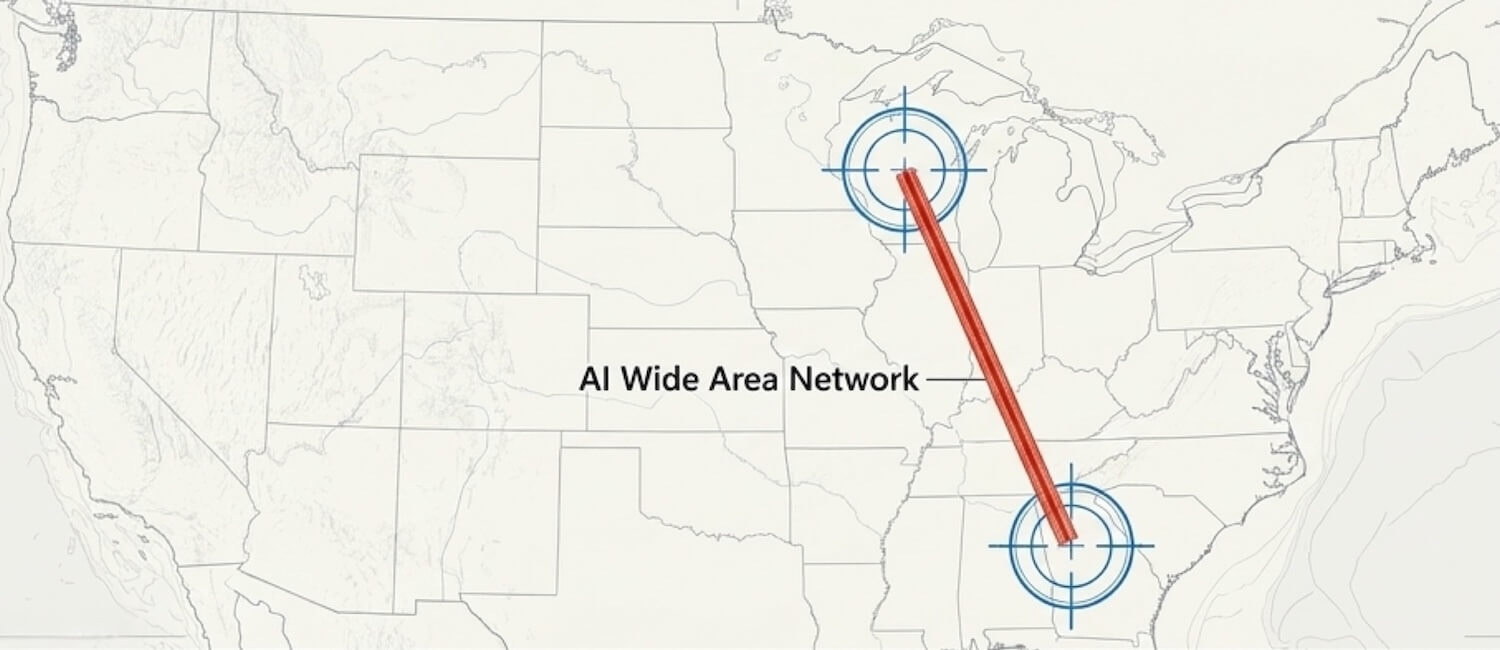
As Azure infrastructure GM Alistair Speirs defines it, “it’s running one complex job across millions of pieces of hardware … it’s not just a single site training an AI model, it’s a network of sites supporting that one job.” Wisconsin’s stated ceiling within that system is Nadella’s: the Wisconsin site will “scale to 2 GW alone.”
A 2-GW machine, though, is only as real as its electricity — and power is the layer Microsoft does not own here.
At Fairwater Wisconsin, the grid layer is a significant part of the story. The campuses are entirely grid-powered and their supplier is a regulated monopoly, We Energies — with the campuses set to become the biggest electric load the utility serves.
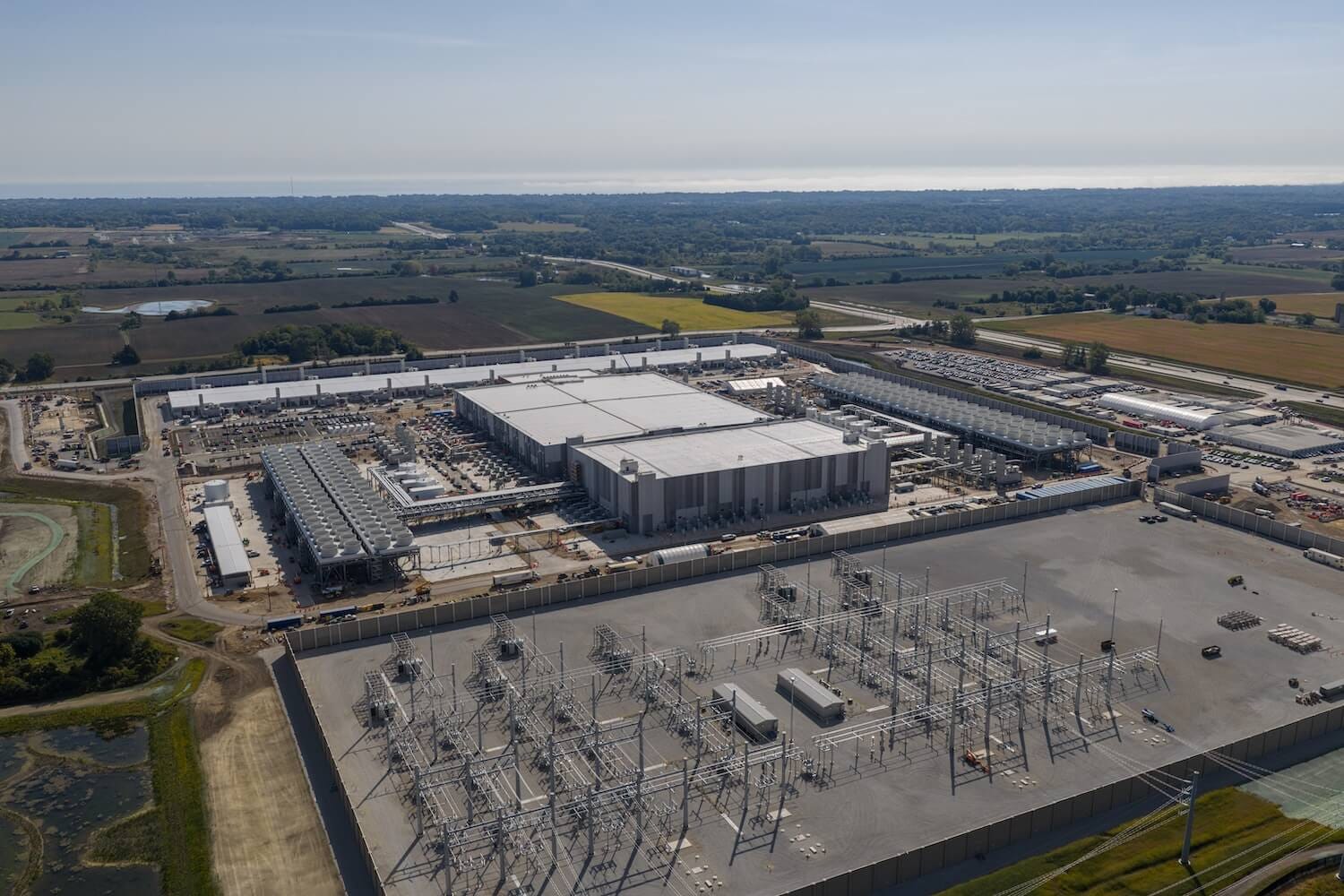
Source: Microsoft.
What Microsoft’s bet has set in motion is a rebuild of southeastern Wisconsin’s energy system: roughly $2.77 billion of Public Service Commission–approved generation, gas, and transmission projects justified on this load, a new tariff class invented for it, and a utility holding company whose five-year capital plan has doubled since the campus was announced.
Microsoft’s name first surfaced in the Public Service Commission of Wisconsin regulatory record only in January 2025 rebuttal testimony, under intervenor pressure: Microsoft, Mount Pleasant — and the one hard load figure, 450 MW for Phase 1. The Commission’s final decisions then ground the need for new natural-gas-fired power plants in one customer, Microsoft. Docket testimony projects that just two data center customers — Microsoft (Mount Pleasant) plus Vantage (Port Washington) — will consume 50% of the utility’s peak demand and energy by approximately 2030.
Microsoft’s own filings size the first two campuses’ substations — named Nimbus and Stratus — at no less than 752 MW apiece, and Campus 3’s two planned substations — named Jupiter and Cosmos — at no less than 1.2 GW per substation, against a stated Campus 3 target of 2.6 GW of grid power to the data center buildings. For Campus 4, an electrical substation will occupy a 54.4-acre pad in the southeast corner of the site — the area for which We Energies’ five-year plan already carries about 500 MW.
To its investors, We Energies’ parent company, WEC Energy Group, discloses Microsoft’s announced $20 billion investment but folds its megawatts into aggregates. The megawatts appear only in a five-year demand-growth forecast now at 3.9 GW, of which 2.6 GW sits in the southeastern corridor that contains Fairwater alongside other industrial loads, with Vantage’s Port Washington campus anchoring the northern balance.
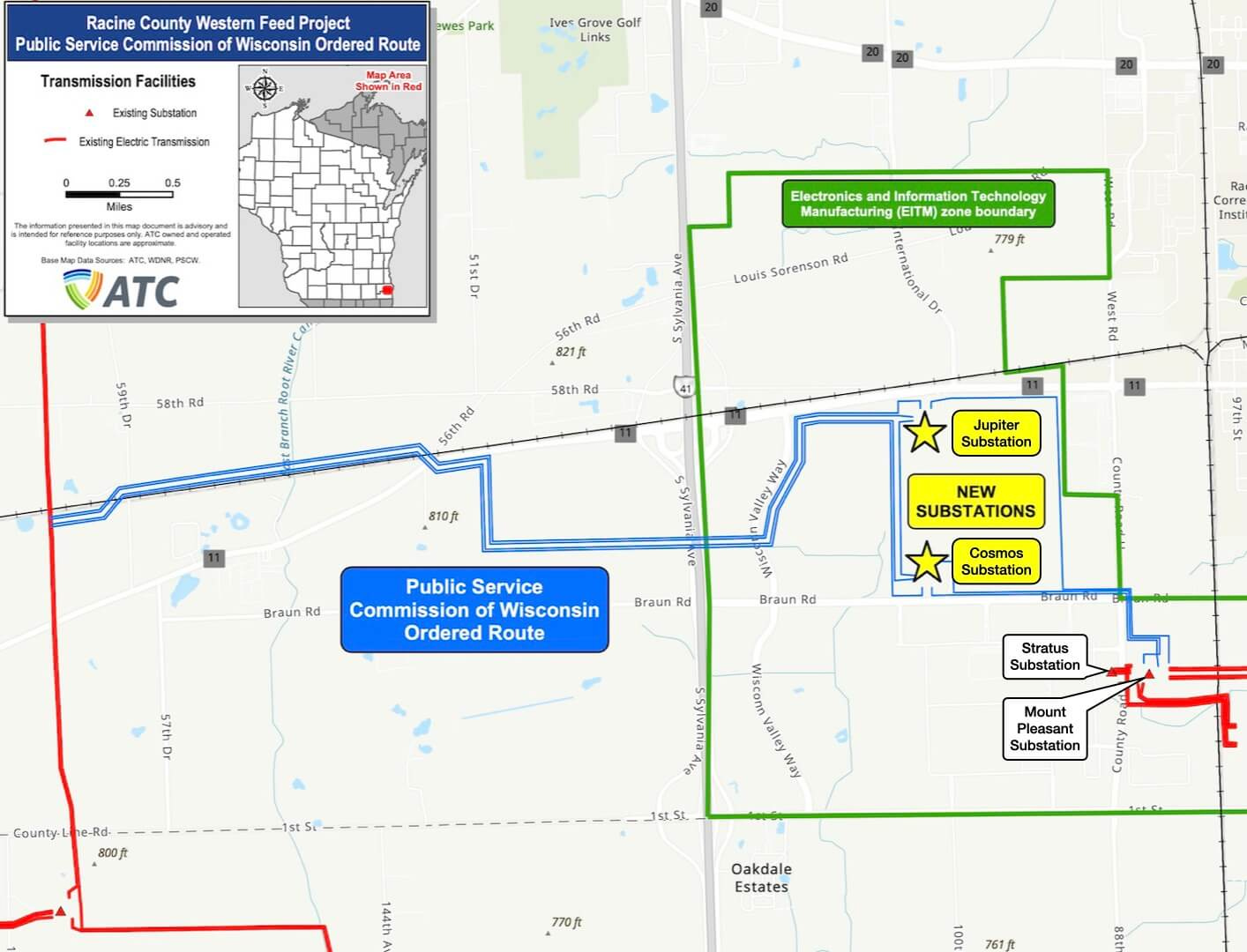
Between May and December 2025, the Commission approved five projects that read as one supply chain, traced backward from the campus’s meter. The wires come first: the ATC Western Feed builds the two substations — Jupiter and Cosmos — that physically interconnect Campus 3, on a schedule American Transmission Company (ATC) said was “driven by the customer’s desire to ensure the new data center is fully operational as soon as possible.”
The wires need generation behind them: the Paris Reciprocating Internal Combustion Engine (RICE) plant is the fast block, slated to land weeks after the first campus reached full operation — a schedule that has since slipped — and the Oak Creek turbines are the bulk block, timed to the second campus. The generation needs fuel: the Rochester Lateral moves the gas to the new plants, and the Oak Creek LNG plant stores two billion cubic feet of it for the days when demand peaks.
Little of it is at the campus: only the Western Feed’s substations sit on Microsoft’s land — the new plants and their fuel rise miles away, at existing utility sites on the Oak Creek lakefront in Milwaukee County and beside the Paris Generating Station in Kenosha County. None of these assets is dedicated to Microsoft — each is a system resource in a utility’s rate base — but every approval rests, directly or one step removed, on the load forecast the Microsoft campus anchors:
The wires are where the chain touches the campus. The first two Microsoft data center campuses draw on an inherited feed: ATC’s $117 million Mount Pleasant Tech Interconnection, approved in 2018 to power Foxconn, whose Mount Pleasant Substation serves them at 138 kV today. That substation could not carry the expansion — ATC found the new load “unprecedented for the applicant’s transmission system.”
American Transmission Company’s Racine County Western Feed — the two new 345/138 kV substations, four 500 MVA transformers apiece, a 350 MVAR STATCOM, and about 9.6 miles of new double-circuit lines through the Villages of Yorkville and Mount Pleasant — was authorized at $625 million “to support new datacenter load addition.”
Source: American Transmission Company (ATC).
MISO classifies the Western Feed as “Other–Load Growth” with no regional cost sharing: Wisconsin transmission customers bear all of it. ATC itself is roughly 60% owned by WEC Energy Group — the wires builder and the utility roll up to the same shareholders.
The Western Feed’s right-of-way politics were sharper: farmland owners objected to easements taken, as one put it, solely for the benefit of a company with “a net worth of over 3 trillion,” and the state agriculture department noted the single largest impacted landowner on the route was Microsoft itself, at 212.9 acres. Construction began in October 2025; the Jupiter Substation is due to take load in January 2027, with the Cosmos Substation following in June 2028 — a date ATC says is “subject to further coordination with Microsoft.”
Behind the wires, the generation is gas. The Paris RICE plant — seven Wärtsilä 18V50SG reciprocating engines of 18.8 MW gross each, about 128 MW net — was approved at a site beside the existing Paris Generating Station in the Town of Paris, Kenosha County, with a July 2026 in-service date. The schedule has not held: all seven engines were reassembled on site by late February 2026, but We Energies now shows construction continuing through summer 2027. It is being built as a single long engine hall on roughly 11 acres, with a row of seven 100-foot exhaust stacks along the roof, one per engine, and a short 138 kV tie into the substation it shares with the co-located Paris solar-battery park.
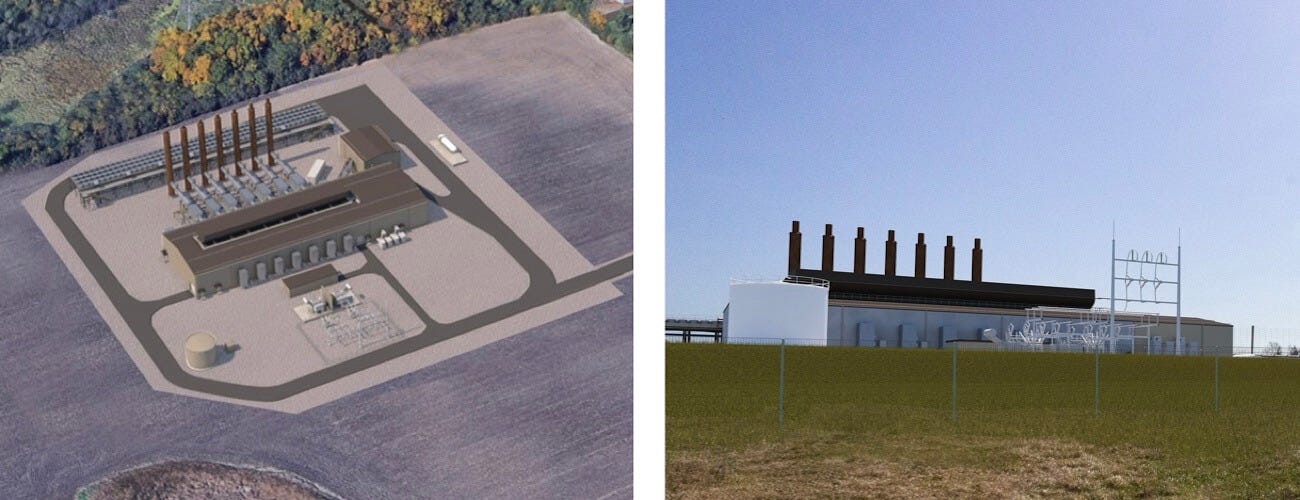
Source: We Energies.
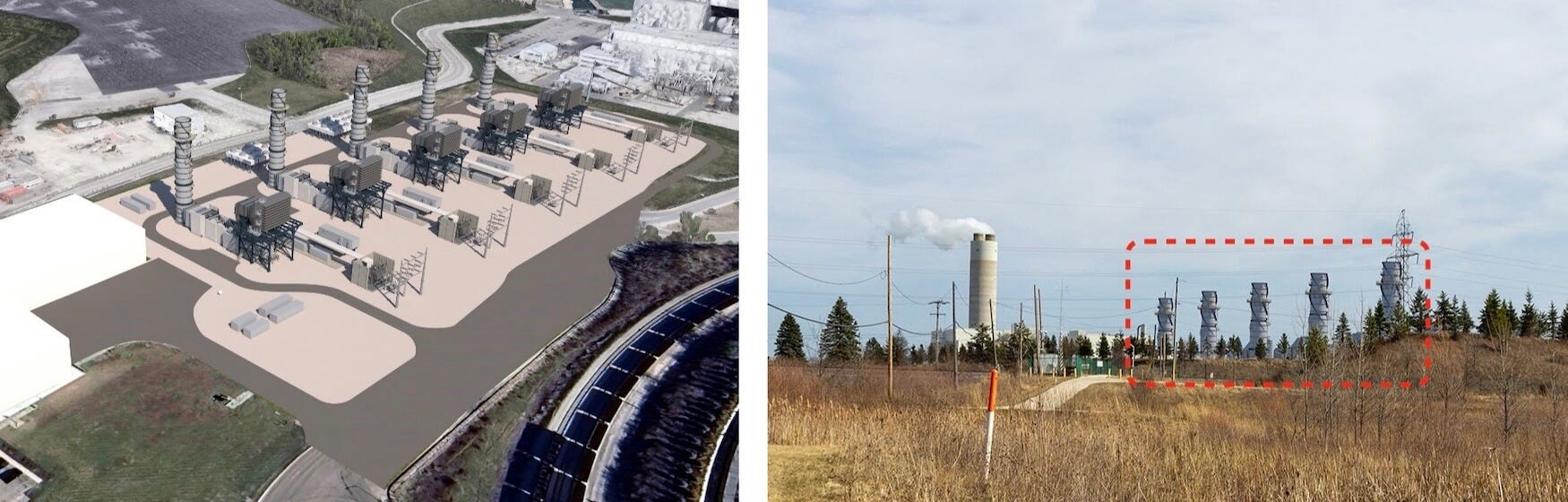
The Oak Creek Combustion Turbines (CTs) are the big block: five simple-cycle GE 7FA.05 units, roughly 1.1 GW, rising on the Lake Michigan shore at Oak Creek, 15 miles south of Milwaukee, on the site where We Energies retired about 1.085 GW of coal capacity across 2024–2025.
Source: We Energies.
The peakers “power up in minutes,” shed heat through closed-loop air-cooled exchangers, and are stitched into the 1,000-acre lakefront site by roughly 36 miles of underground electrical conduit, more than 55,000 feet of buried process piping, and an expanded ATC 345 kV substation. The utility’s clinching argument was a floor, not a forecast: even if only 450 MW of the anticipated new demand materializes — “approximately 20% of the forecasted new demand” — the turbines remain part of the least-cost portfolio. Construction began in July 2025, targeting August 2028.
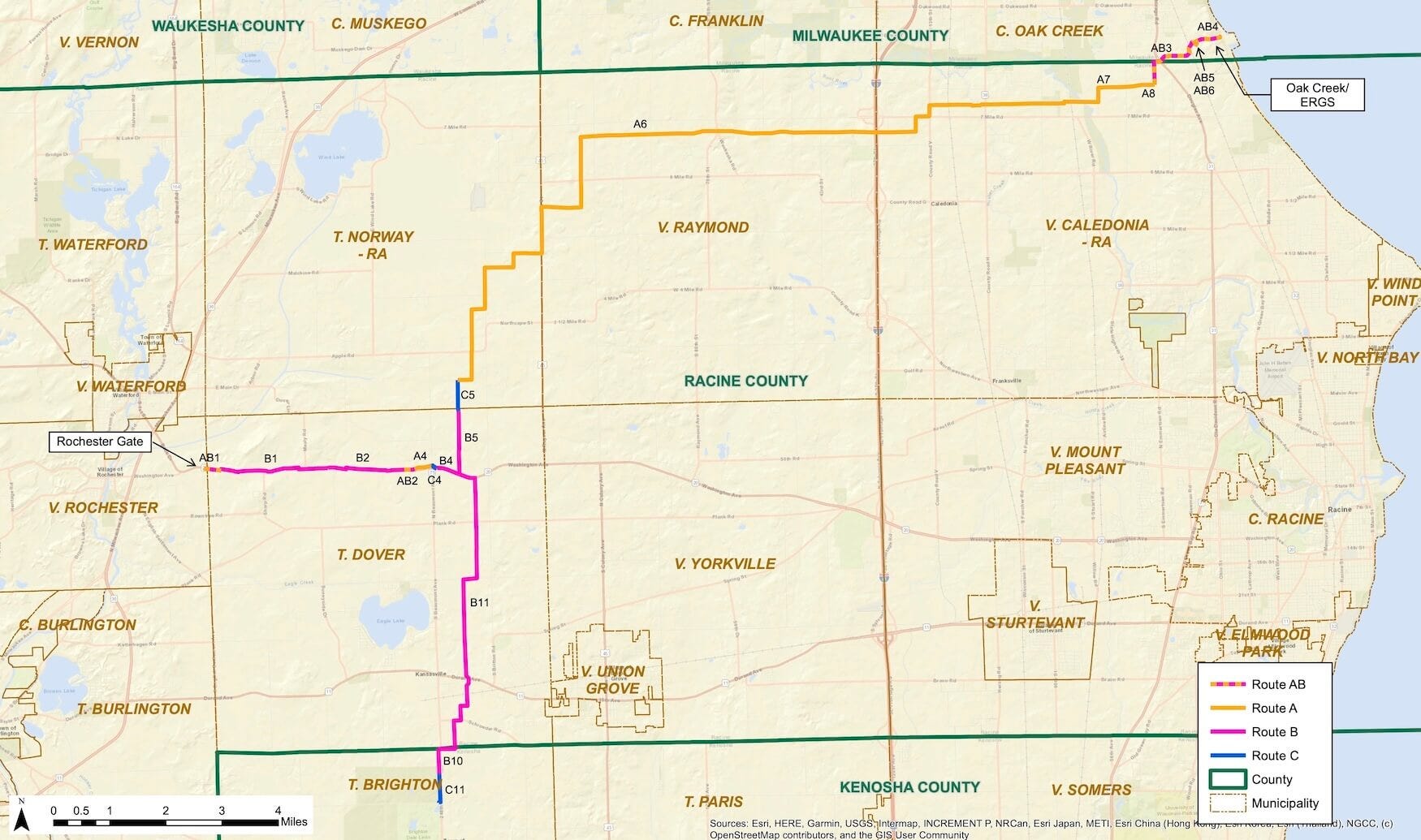
Feeding the new fleet takes its own infrastructure, justified almost entirely by generation demand — electric generation accounts for 94% of the gas utility’s projected demand growth. The 33-mile Rochester Lateral — a 24- and 30-inch steel transmission main rated at 650 psig, running from the ANR interstate pipeline system’s Rochester Gate, in the Village of Rochester, across Kenosha, Racine, and Milwaukee counties to the Oak Creek plant site — is the delivery leg, with 90% of its cost allocated to generation.
Source: Public Service Commission of Wisconsin.
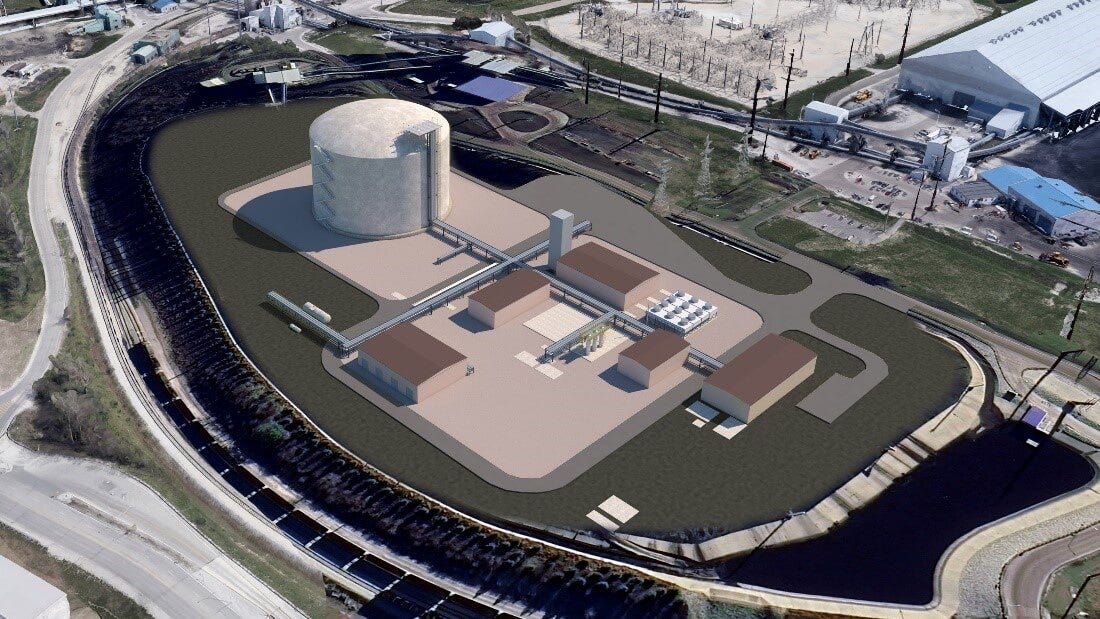
The Oak Creek LNG plant is the peak-day buffer behind the pipeline: a 200-foot-diameter full-containment tank on a former coal pile at the same Oak Creek generating site, holding 2 billion cubic feet of gas at −260°F — filled by on-site liquefaction over roughly 200 days, then drainable in about seven at its full 300,000-dekatherm-per-day send-out.
Source: We Energies.
However finely the dockets sliced the chain, We Energies’ own witness stated where it ends: the LNG plant’s costs would be charged to the new gas plants “and then passed through to [the data centers] via the Very Large Customer and Bespoke Resource tariffs.”
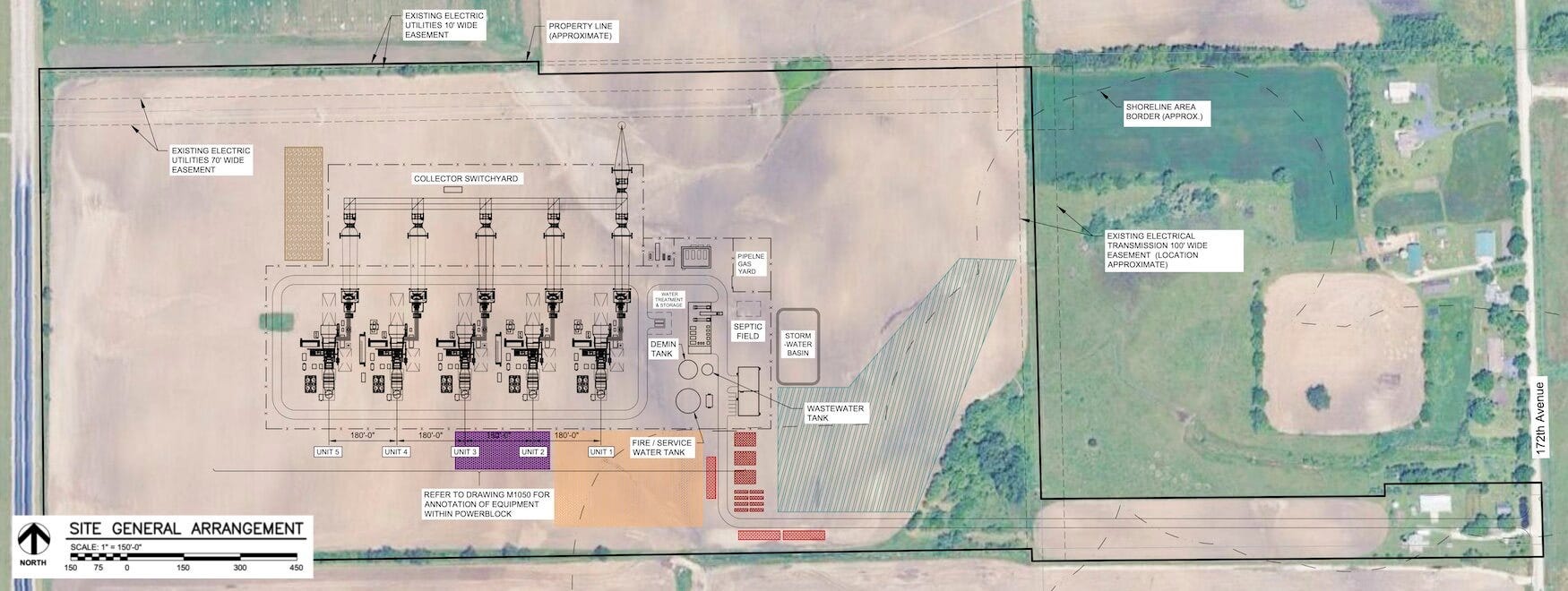
The wave now pending drops the system-resource framing altogether. In November 2025, We Energies filed to acquire Red Oak Ridge — a 1.125 GW, $1.77 billion simple-cycle peaker: five GE 7F.05 turbines on roughly 200 acres in Kenosha County’s Town of Paris, the same town that hosts the new RICE block.
Source: Invenergy.
The structure inverts the self-builds above — Invenergy develops and builds, and We Energies takes ownership at completion, putting the plant into its rate base. Microsoft is subscribed to 100% of Red Oak Ridge as a dedicated “Bespoke Resource” — its costs borne by no other customer — and We Energies’ need case is one line: “additional dispatchable generation would not be required but for” the new tariff-class load.
Until 2026, Microsoft took service under a tariff written for its predecessor — the Foxconn-era EITM rate, capped at 200 MW. The replacement is the Very Large Customer tariff We Energies filed on March 31, 2025, expressly to “shield other ratepayers” from data center costs. Microsoft’s energy VP (at the time) Bobby Hollis endorsed it as ensuring “we are protecting other ratepayers, paying our own way.”
As ordered in May 2026, the Very Large Customer tariff applies mandatorily to loads of 100 MW or more, requires 15-year minimum contracts, charges a fixed $213,118 per billing period plus $305 per MW of maximum demand, sets minimum transmission billing at 100% of forecast load, and demands collateral unless the customer clears a raised credit-waiver bar (A−/A3 ratings plus balance-sheet tests).
The utility’s case for the tariff quantified the stakes: without it, roughly $1.5 billion of data center–driven plant would shift onto other customers, raising residential bills about 5%. The contest was over whether the shield is complete — Commission staff’s own analysis found that a large customer whose transmission needs run beyond forecast could still push $441 million onto other transmission customers over 45 years, and the Citizens Utility Board of Wisconsin argued the standard should be “no harm,” not less harm.
The public read the docket the same way. The tariff drew 2,130 comments, 88.5% opposed — but the coded record shows nearly nine in ten of those opponents were attacking the tariff’s design, demanding data centers pay 100% of the new costs, not opposing data centers as such; only about one in ten opposed the build-out itself.
The counterweight came from labor: union bulk petitions carrying roughly 2,400 signatures backed the companion gas projects. The first stress test arrived within weeks of the order — Microsoft filed a request for clarification, and Oracle (whose roughly 1 GW Port Washington campus tripped the new credit bar) petitioned to reopen; both were pending as of mid-2026, and actual cost recovery lands in the utility’s 2027–2028 rate case.
For WEC Energy Group’s shareholders, the same story reads as transformation. The parent company’s five-year capital plan — a system-wide figure spanning utilities in four states, not just southeastern Wisconsin — stood at $18.2 to $20.1 billion in the 2023 vintage. It now runs to $37.5 billion for 2026–2030.
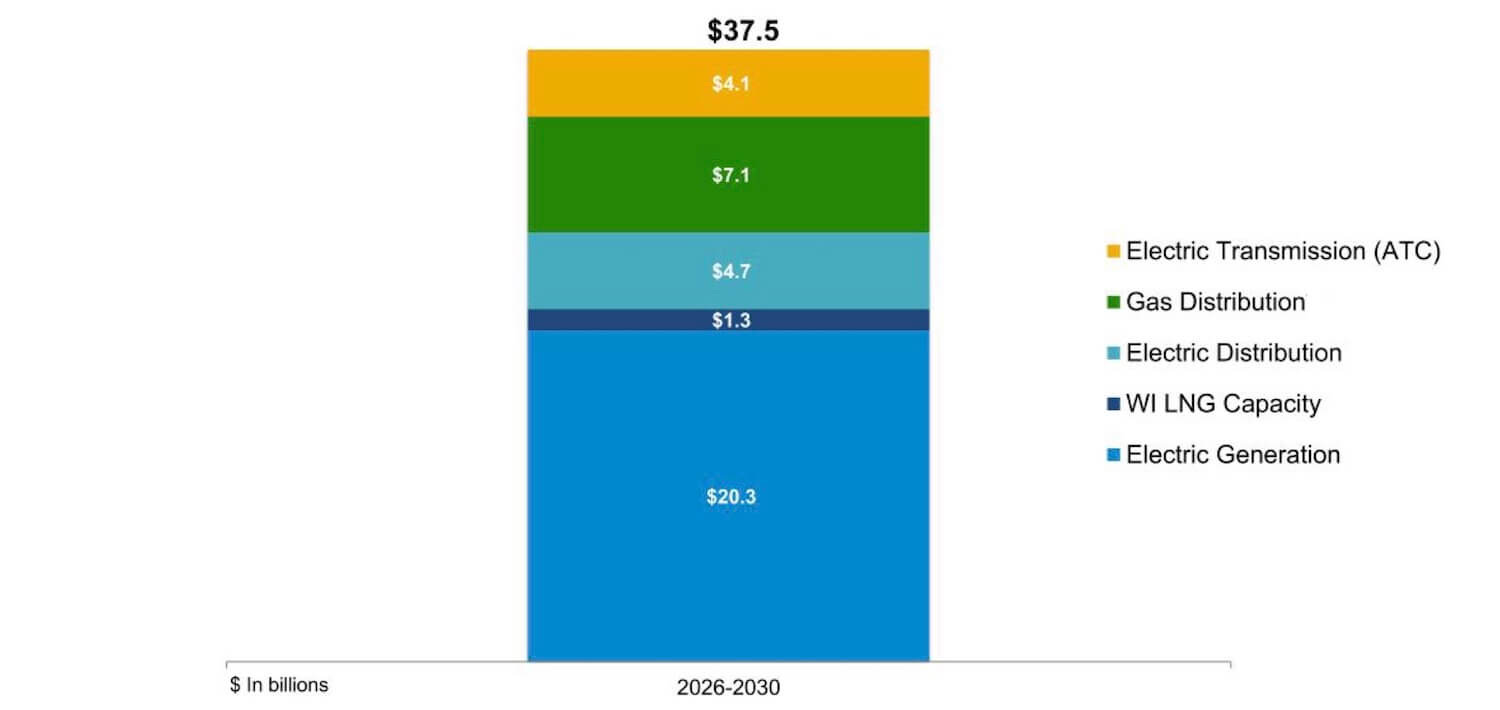
Source: WEC Energy Group.
WEC now expects electric demand to rise “approximately 45%,” with very-large-customer and dedicated (”bespoke”) assets reaching about 15% of its asset base by 2030.
That fleet has now moved further along: recitals in a July 2026 We Energies filing disclose eight signed Microsoft payment-and-cancellation agreements to date — five simply “necessary to serve” the load, one covering capacity for Microsoft’s first roughly 1 GW of firm load, one for the 1.125 GW Red Oak Ridge gas peaker in Kenosha County, and one for the 150 MW Superior Solar farm — each obliging Microsoft to reimburse the utility’s sunk costs if regulators withhold approval or the load shrinks.
The campus’s own generation is strictly for emergencies — and engineered, permit by permit, to stay under the federal major-source line. In four construction permits issued from November 2023 to June 2026, the DNR has authorized 229 emergency generators and 10 fire-pump engines across eight permitted data center buildings.
The fleet’s theoretical NOx potential runs to 2,779 tons per year; enforceable limits pin its permitted potential at 99.21 tons — just under the 100-ton threshold that would make it a Title V major source, the same under-the-line engineering AWS used at New Carlisle against the PSD threshold.
The emergency generator fleet, which comprises mainly Cummins C3000 D6e models each permitted at up to 3.2 MW, has a standby capacity of about 723 MW based on its permitted unit ratings.
In its 2026 permit, Microsoft made a concession with teeth: it elected an outright prohibition on non-emergency peak-shaving and demand-response operation, locking the diesels to genuine emergencies, and it has committed to running them on renewable biofuel, specifically hydrotreated vegetable oil.
Microsoft’s renewable answer is a contract, not a campus asset. In October 2024 it signed a power purchase agreement with National Grid Renewables (now known as Geronimo Power) for the 250 MW Portage Solar project — roughly 1,800 acres of farmland in Portage County, central Wisconsin, some 150 miles from the Microsoft campuses.
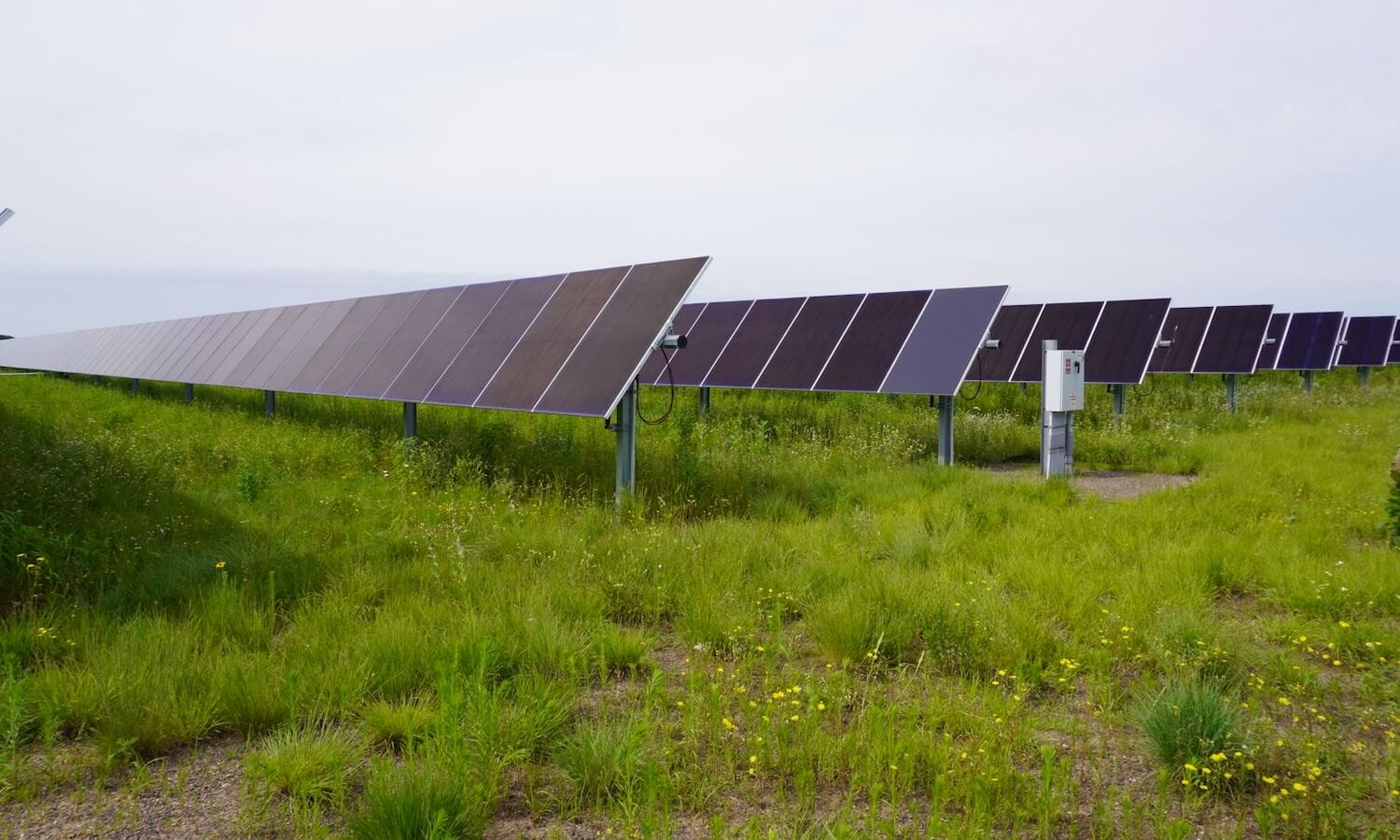
Source: Geronimo Power.
Construction started in April 2025 and commercial operation is projected for March 2027. As of early 2026, construction had not yet begun on a planned 137.5 MW / 550 MWh battery, which would store midday generation and discharge it into the evening and other high-demand hours.
The PPA is a grid-match: Microsoft’s pledge to offset every fossil kilowatt-hour one-for-one with carbon-free energy added to the grid, plus a $20 million community fund over the contract term. Critics did the math early — Clean Wisconsin and 11 other groups wrote in September 2024 that 250 MW “represents just a fraction of the data center’s energy needs,” warning the campus would anchor “30 more years of fossil fuels”; We Energies’ spokesman answered that gas is “the cheapest, most reliable and lowest carbon approach” when wind and solar fall short. The generation table above is the Commission’s verdict on whose math prevailed.
The solar match now has a sequel, structured the opposite way. We Energies and Madison Gas & Electric are buying Invenergy’s 150 MW Superior Solar project in Michigan’s Upper Peninsula — a roughly $393 million asset the utility will own, with Microsoft subscribed to “80% of the total nameplate capacity of the project or roughly 120 MW“ under the new bespoke machinery, targeting service in Q4 2028. The executed agreement, filed July 1, 2026, named Microsoft — bringing the nameplate solar matched to its Wisconsin load to roughly 370 MW, still a fraction of a campus pointed at 2 GW.
Electricity is the rented layer with the biggest price tag. The other fluid running through the campus has an older, stranger provenance.
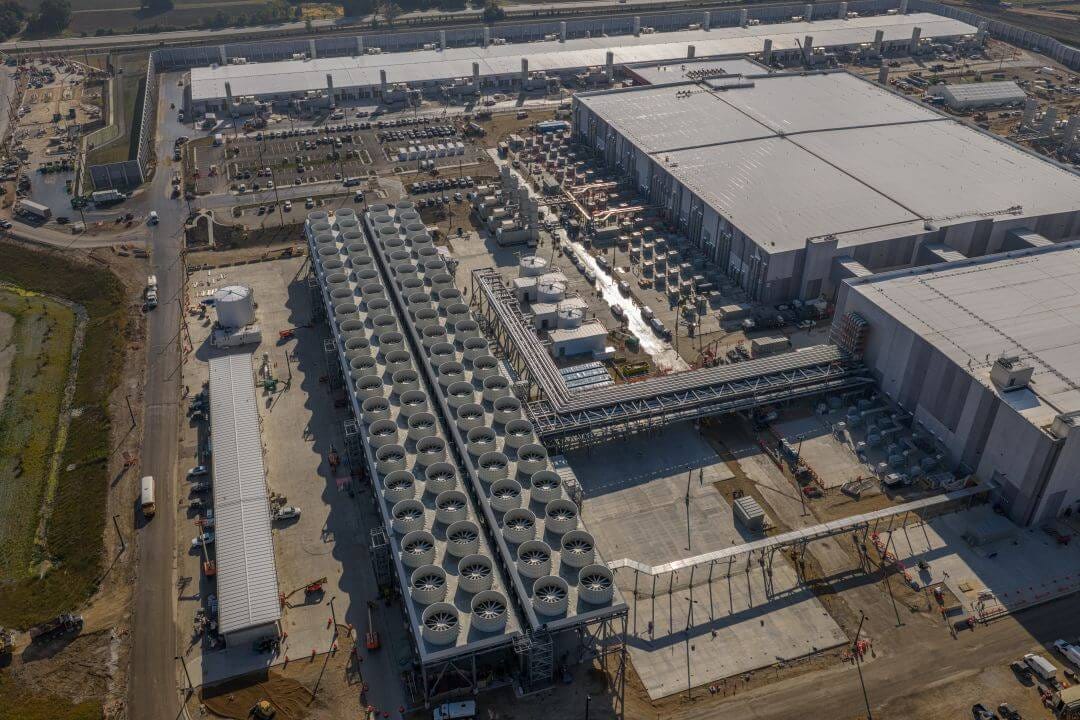
Cooling is where Fairwater’s engineering does exactly what Microsoft promises; water is where the campus is most visibly a tenant of someone else’s deal. The buildings themselves barely consume water: more than 90% of the facility runs closed-loop liquid cooling, filled once during construction and recirculated indefinitely — “zero water waste” — with the remaining traditional servers on outside air, drawing water only on the hottest days, less than 5% of the year above 85°F.
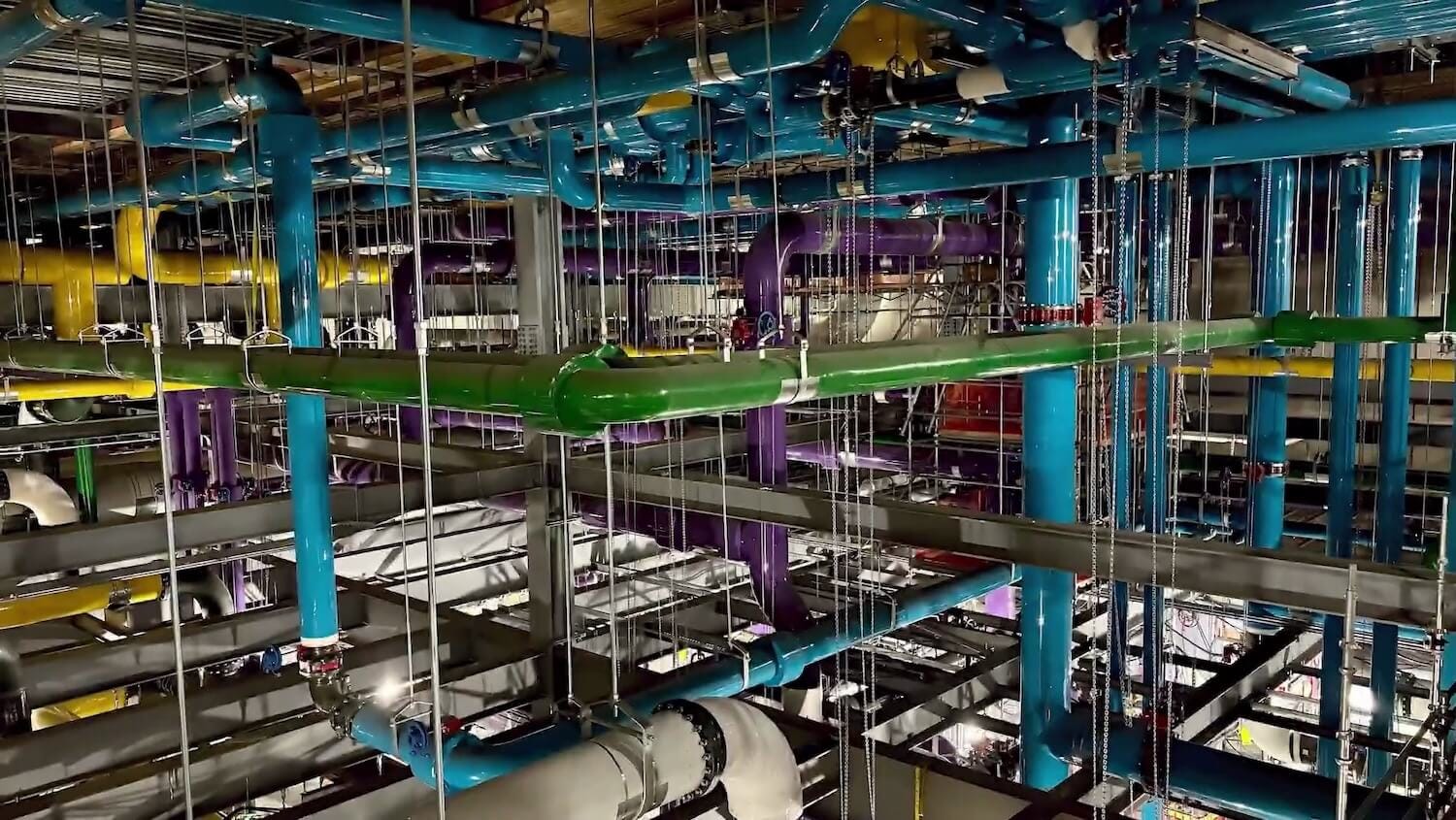
Source: Microsoft.
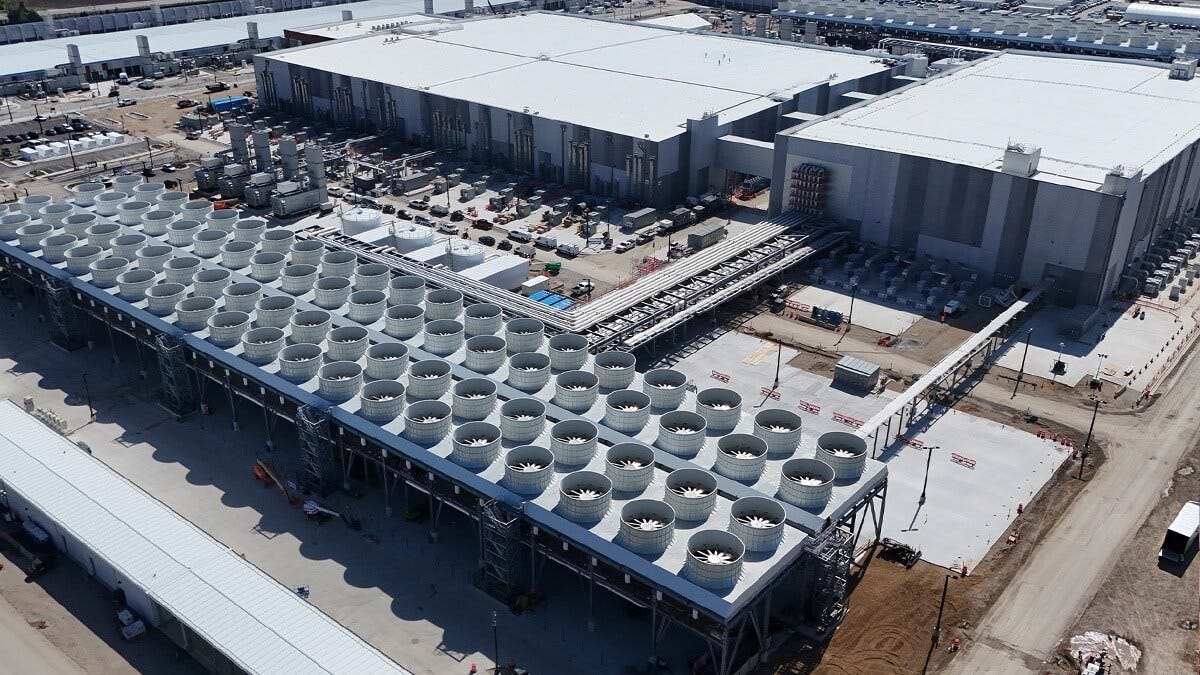
What the loop rejects, hardware handles at scale: Microsoft calls the campus’s chiller plant “the second largest water-cooled chiller plant on the planet,” shedding heat through 172 twenty-foot fans.
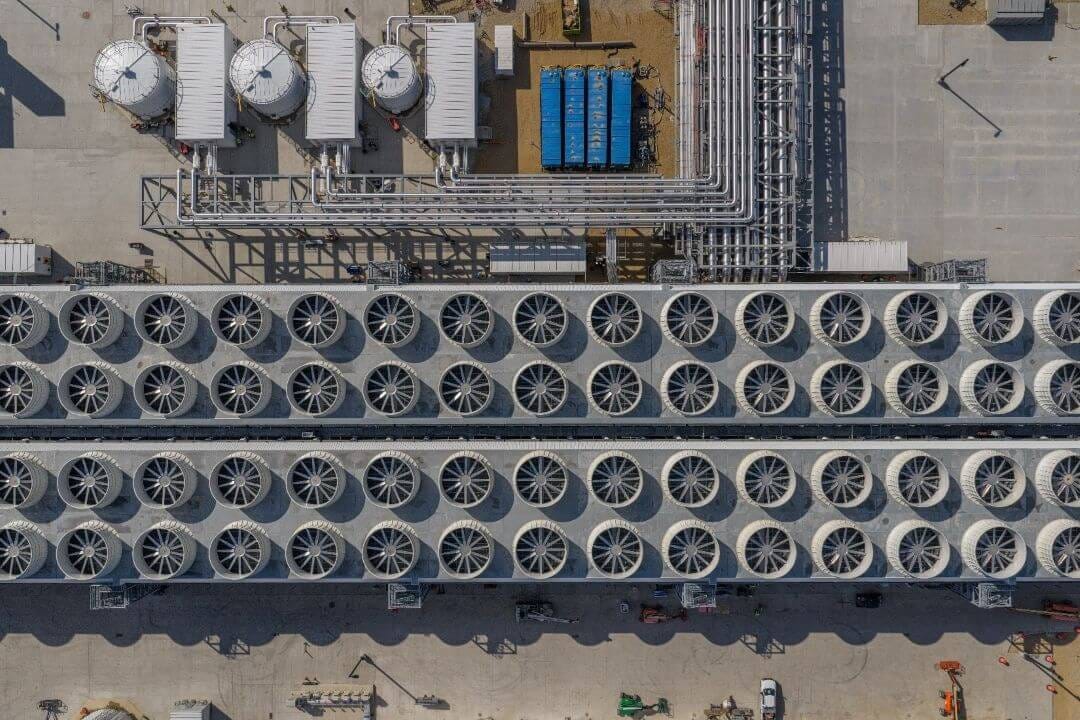
Source: Microsoft.
Microsoft’s public quantification is an analogy — annual water use “roughly the amount … a typical restaurant uses annually.” The Village of Mount Pleasant record supplies the hard numbers at both scales: about 2.8 million gallons annually for the first phase — the facility the analogy described — and about 8.4 million gallons drawn from the Racine Water Utility for the full build-out, the “all-encompassing number for all of these sites” Microsoft’s engineers gave the Plan Commission.
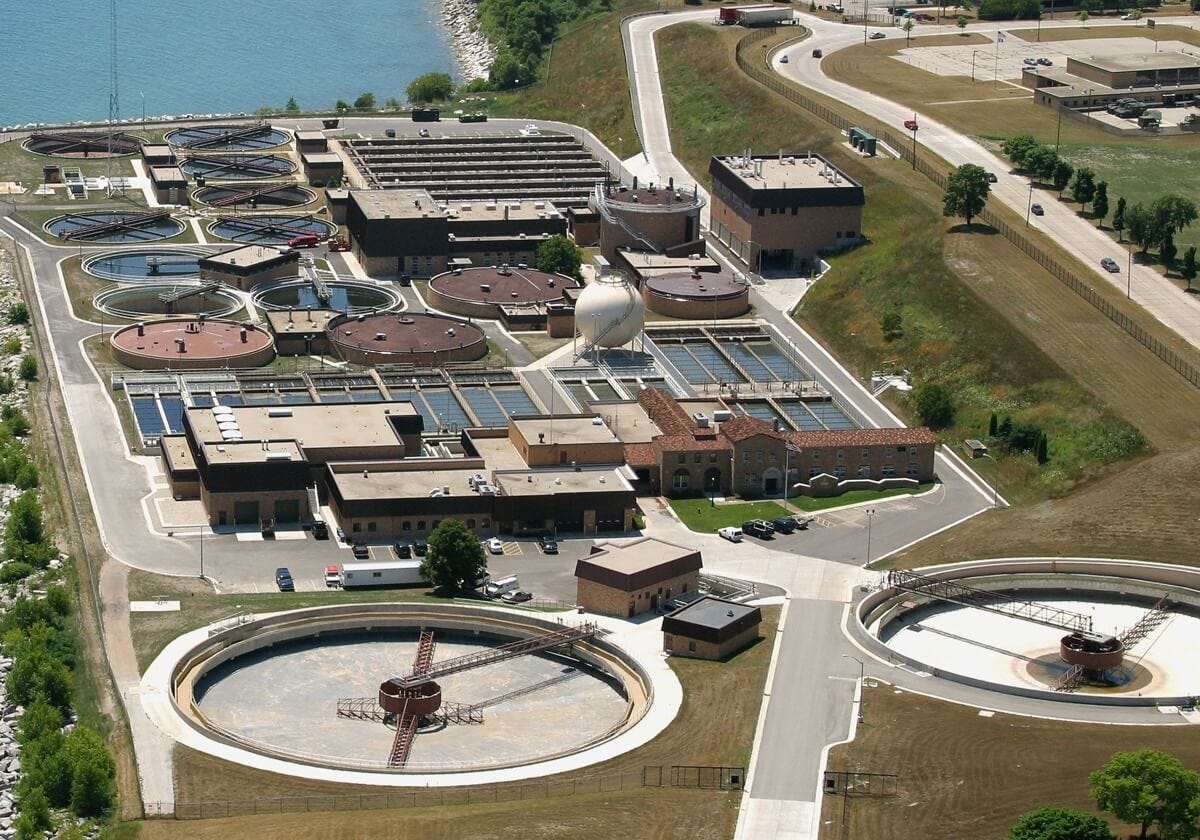
The supply chain behind those gallons is the borrowed part. The campus sits in Mount Pleasant, but Mount Pleasant treats no water; Microsoft “will purchase water from the City of Racine,” a different government, under an intergovernmental Retail Water Service Agreement dated May 24, 2004, with sewage returning to Racine’s wastewater treatment plant under a 2002 sewer agreement.
Source: Applied Technologies.
And the marquee water instrument in the area — the Great Lakes diversion — is a Foxconn-era artifact end to end. Racine obtained it from the DNR in April 2018, for up to 7 million gallons per day averaged over a calendar year, to serve the part of Mount Pleasant that lies outside the Great Lakes basin; the application leaned on the state’s Foxconn-specific manufacturing-zone statute, and Foxconn’s own cooling data supported the consumptive-use analysis.
Seven years on, the diversion’s sole customer is still Foxconn, whose annual draw — 13.8 million gallons in 2022, rising to 25.6 million in 2025 — reached only about 1% of the permitted volume even at its peak. Racine’s own diversion reports state plainly that Microsoft’s first phase “will not be located in the diversion area”; only future phases sit on diversion-area land. The most contested water approval in the region’s history, in other words, is not yet Fairwater’s water supply — it is the option Microsoft inherited with the ground.
What Microsoft’s arrival did change is the deal’s politics. In June 2024, Racine’s city attorney served the Village with a Notice of Potential Material Change of Circumstances under the 2004 water agreement — and a parallel notice under the 2002 sewer agreement — arguing that the Village had swapped tenants on the district Racine built its waterworks case around: Foxconn’s promised plant and payroll, replaced by a Microsoft project the notice pegs at $3 billion to $10 billion in value but “approximately 200 jobs associated with each of the 5 phases.” The city calls it the “Job Disparity.”
The fights over water stayed procedural. The fight over sound did not.
Every friction around Fairwater traces to the same fact: the flagship landed beside subdivisions, in a county that had already absorbed one broken mega-project — and the second time around, the neighbors’ tolerance is thinner. The hum made that concrete.
Residents north of Campus 1 (4800 90th St) began noticing a constant tonal sound in early February 2026, as the first data centers started up. Microsoft’s April 15 statement acknowledged it directly: the sound “comes from cooling fans that are currently operating at high speeds”; the facility “meet[s] the requirements set by the local ordinance”; the company “did not expect the tonal quality of the sound to travel as far as it has.” The village president of neighboring St
urtevant, Mike Rosenbaum, put the local mood in one line at a Microsoft Q&A: “I don’t need to be driving people out of my village because of some fan noise.”
On July 1, 2026, the hum became a federal case. Ostergaard v. Microsoft (E.D. Wis., No. 2:26-cv-01169) is a class-action nuisance and negligence suit by three Sturtevant residents, on behalf of everyone in a defined residential area north of Campus 1 — “over a thousand residential households” — alleging a 24/7 low-frequency hum from generators and cooling equipment, much of it infrasound that standard decibel meters miss. The suit seeks damages above the $5 million class-action threshold and injunctive relief.
The permitting record shows the same curve of rising resistance. Microsoft’s fourth air-permit revision drew a public hearing on April 28, 2026 — requested jointly by the Villages of Mount Pleasant and Sturtevant — with 69 attendees and 21 speakers, all in opposition. Ten miles north, community feedback had already put a stop to a sibling project: Microsoft withdrew its 244-acre Caledonia “Project Nova” campus in October 2025, with its land-use counsel conceding “nobody really wants a data center in their backyard.”
Mount Pleasant itself, though, is the exception, and the reason is timing: data centers were made a permitted use by ordinance in early 2023 through the Foxconn-era planning apparatus — five public hearings across the re-zonings, all passed unanimously — which is why January’s expansion could clear without floor debate, even as the air-permit hearing three months later drew only opponents.
These frictions are one side of the ledger the region keeps. The other side is the bargain.
The Microsoft deal is Foxconn’s inverted. Foxconn came with a state package of roughly $3 billion in refundable credits (later renegotiated down) and promises that never survived contact with reality.
Microsoft came with no state mega-package: it bought its land outright, guaranteed a tax base, and pays its way into a district built — and indebted — for its predecessor. The structure runs through three governments: the Village of Mount Pleasant owns and sells the land, Racine County co-signs the development agreements, and the City of Racine supplies the water.
The enforceable core is a guarantee stack. Microsoft commits to at least $1.4 billion of assessed value on the expansion areas by January 1, 2028, with shortfalls made up in cash at up to $15 million a year through 2047, and to at least four buildings on the expansion land by milestone dates in 2030, 2037, and 2044, backed by Village of Mount Pleasant rights to repurchase undeveloped land at Microsoft’s acquisition price. The clawbacks fall away only once $3 billion of aggregate guaranteed value is on the rolls and vertical construction has begun on Campus 3.
Against those commitments, the Village rebates 42% of the incremental property taxes from buildings on the first campus area, capped at $5 million a year. The one large subsidy is the state’s qualified data center sales-and-use-tax exemption, for which Microsoft was certified on October 1, 2023 — a statewide statute rather than a negotiated award. Beyond that, the state’s direct spending is modest: two $500,000 WEDC innovation grants and $2 million for technical-college AI programs.
The money already moves the other way. The Village’s three land sales brought in $149.8 million; the first sale’s proceeds went to Foxconn at closing under the old development agreement, and Microsoft separately funded an $18.4 million defeasance that retired $19 million of the county’s Series 2019B “Foxconn” land bonds — eliminating $24.4 million in debt service. The district Foxconn was supposed to fill is now filling: TID 5’s incremental value rose from $906 million to $1.7 billion in a year, its projected lifetime surplus from $80.6 million to $136.7 million, and the joint review board projects $2.1 billion of value by January 1, 2028.
On Racine County’s tax roll, Microsoft went from unlisted in 2023 to the county’s largest taxpayer by 2025, at $1.22 billion of taxable assessed value — 4.5% of the county’s total. The January 1, 2026 roll more than doubles it: $2.58 billion across Microsoft’s 30 parcels, $1.87 billion of it on the first campus alone — the buildings themselves now carry nearly four times the value of the land beneath them.
Jobs are the bargain’s soft spot. Construction is the boom: more than 3,000 workers at daily peak, nearly 10,000 over two years, $700 million spent with Racine County construction suppliers and purchases from 29 businesses across 11 Wisconsin counties — part of the $4.7 billion Microsoft estimates it will spend on hyperscale construction in the state between 2024 and 2028. Permanent operations are the modest tail: about 500 full-time roles at the first data center campus — “nearly 550” at go-live — growing to around 800 full-time roles once the second campus is complete, with a Datacenter Academy at Gateway Technical College in Racine training more than 1,000 students over five years.
The bargain Wisconsin struck this time trades away almost nothing in cash, but it also buys almost nothing in payroll: what it gets is tax base, and the record says the tax base is real.
Source: Microsoft.
Most of what happens next at Fairwater is already on a docket, a permit, or a contract calendar. Five markers:
The build cadence toward 2 GW. The second data center campus (MKE16–17) is due for completion in 2028, with its fire-protection plan reviews still working through mid-2026. On the 15-building expansion (Campuses 3 and 4), the foundation permit for the first Durand Avenue building was issued May 14, 2026, with vertical construction applied for in June — the pace of those permits is the real test of Nadella’s “scale to 2 GW alone.”
The generation calendar. Paris RICE — approved for July 2026 — now shows construction running through summer 2027. The ATC Western Feed substations energize in sequence — Jupiter in January 2027, Cosmos in June 2028; the Oak Creek turbines target August 2028, with the LNG plant and Rochester Lateral under construction beneath them. Red Oak Ridge needs a written order by October 1, 2026 to close and break ground, its five turbines phasing in from December 2029 to June 2030.
The tariff endgame. Microsoft’s request for clarification and Oracle’s petition to reopen the Very Large Customer tariff (both filed June 10, 2026) were as yet undecided, and the tariff’s real incidence gets set in We Energies’ 2027–2028 rate case.
The noise docket. Ostergaard v. Microsoft runs on a 12-to-14-month clock under the court’s standing order, with Microsoft’s response the first tell. In parallel, watch whether the cooling-fan mitigation Microsoft promised in April 2026 quiets the DNR complaint file.
The January 1, 2028 test. Microsoft’s guarantee of $1.4 billion in assessed value on the expansion areas comes due, with shortfalls payable at up to $15 million a year — against a joint review board projection of $2.1 billion by the same date.
Measured AI provides institutional-grade analysis of the physical infrastructure powering AI data centers. For access to our full research library, regulatory intelligence, and weekly briefings, visit MeasuredAI.com.
No posts
Comments
Nothing yet. Say the first thing.
Sign in to join the conversation.