
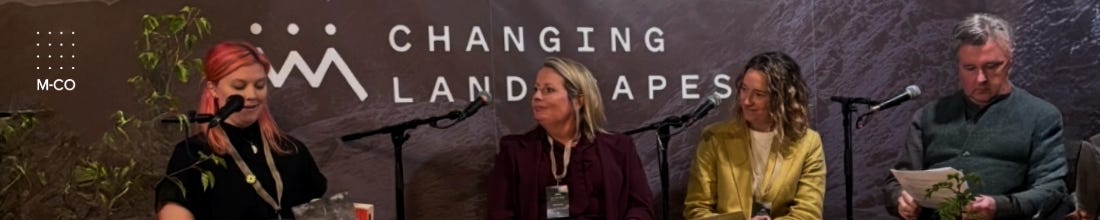
Last week, Ruth joined Philip Boucher-Hayes and Maura Kiely on the Culture Eats Strategy panel hosted by Laura Costello at Hometree’s Changing Landscapes conference. The brief from the organisers was refreshing: fewer of the usual lines, fewer of the polished answers we all fall back on. Say the thing you wouldn’t normally say on a panel.
Drawing on twenty years of research and practice in public engagement, climate action and behaviour change, these are her thoughts.
We are getting the message wrong because we keep starting in the wrong place
The panel asked why getting communication right is so difficult. Before we answer that, we have to ask a more basic question: what is the message, and why are we communicating about climate change at all?
The honest answer is that we communicate because we need action. Ireland has emissions targets, and those targets demand large changes in how we organise ourselves, how we move, and how we consume. Those changes have to happen on the ground, in real streets and real communities, and people need to support them for them to work.
That reframing matters, because too much climate communication still leads with despair, pity, or a lecture on the science. In our public engagement work at M-CO, we rarely lead with climate change. We lead with the change itself and the benefits it brings.
We cannot expect top-down messaging to deliver buy-in. People don’t like having things imposed on them. That is not stubbornness, it’s human.
So the work has to start earlier, with collaboration and co-design, helping people understand the why and the benefits before a single design hits the drawing board. When it’s done well, the people you engage become advocates for the change rather than an audience to be persuaded after the fact.
Local, ordinary people are the trusted messengers here, not consultants and not the government. When you bring local people into a project early, they know it, they understand it, and they can speak for it in a way no campaign ever could.
Connecting people with nature means making climate local
Much of my work involves public consultation and the framing of projects, and I have watched that framing evolve over the years, from SEAI’s Power of One campaign, the national ‘Change Campaign’ on climate action, to Living Streets Dún Laoghaire.
The lesson across all of it is the same. If you want to connect people with climate action, they need to understand that climate is a local problem and see the benefits of action where they live. The question every community asks is simple and fair: why is this project good for me, my street, my area?
An active travel route is not really about cars versus bikes – though that can often be the first place people’s minds go. Framed well, it becomes a corridor of life, a moment of calm, a way to absorb rainfall, a way to clean the air.
When we work with local authorities on these projects, the job is to bring to life those broader benefits, not to win an argument about transport modes.
Culture really does eat strategy
What are we getting right? For me, the standout is the role of creativity, and the Creative Climate Action Fund is the clearest example.
The fund sits within the Creative Ireland Programme and is supported by the Department of Culture, Communications and Sport. It is founded on exactly the premise of Hometree’s panel: that culture eats strategy. It funds theatre interventions, sculptures, festivals and similar initiatives that provoke conversation, build awareness, and let people visualise impacts they would otherwise never see. Línte na Farraige is a wonderful example – an Irish public art project that uses light installations projected onto well-known public buildings to show future sea level rise and storm-surge risk along our coast.
I have a particular fondness for this programme because of how it came about. M-CO had been working with the Creative Ireland Programme on a roadmap for the creative industries and, at the same time, with DECC on the National Dialogue on Climate Action. We were involved in brokering some cross-pollination between the two, and a scoping study we carried out pointed to the need for a dedicated fund. It is now in its third round of funding, with €6.5 million committed.
I am also encouraged by a quieter shift: the growing interest in evaluating the systemic impacts of climate action, especially the social, personal and well-being benefits. We see this across public policy now, a move beyond purely financial or economic measures. There is a practical reason for it. Evidence of wellbeing benefits convinces politicians to keep investing, and it generates good stories, stories that paint climate action as better for people, better for physical and mental health – a better life, in short.
That is a healthy move away from the Stern Review era, twenty years ago now, a seminal piece of work that framed climate change through the cost to the economy. The economic lens was necessary then. It is not sufficient now. As the saying goes, not everything that can be counted counts, and not everything that counts can be counted.
The one thing I would change
If I could accelerate action with a single shift, it would be a clearer, joined-up national vision for climate action.
In our consultation work, the questions we are asked again and again are: why do we need this project, why here, and why now? We answer by connecting the project to climate action and to the planning and studies behind it. But those answers are hard to land when there is mistrust of climate change itself, or of the political response to it.
So while we absolutely need to sell the benefits at grassroots level, that work has to be matched by a stronger shared understanding of climate action as a national priority. If we had a genuine consensus around a larger vision for climate action in Ireland, ideally a vision co-created or agreed through collaborative forums such as a Citizens’ Assembly, then the why would already be understood when we arrive in a community.
That would free us to move straight to the question I always want to be asking on the ground: how can we make this work best for you?
That is the conversation most worth having.
No posts
Comments
Nothing yet. Say the first thing.
Sign in to join the conversation.