
March is B-Corp month, a time when the global B Corp community celebrates business as a force for good. At M-CO, we’ve been working with public sector organisations for over 20 years in healthcare infrastructure, climate action, and active travel. Becoming a B Corp wasn’t a new direction. It was recognition of the direction we’d always been travelling, a natural extension of existing M-CO practices to foster diversity, equity, inclusion, and minimise our environmental impact in work that we believe genuinely matters.
The B Corp certification gave us a framework to demonstrate what we’d always known about ourselves, and as our Managing Director, Della O’Donoghue, puts it:
“Success isn’t only about profits. It’s about the lives improved, the carbon reduced, the communities strengthened, and the systems transformed.”
We recognised the value in joining a network of Irish and international like-minded companies who are striving towards creating a better world. We received our B Corp certification in November 2025.
Our score was 110.2, placing us in the top 9% of Irish B Corps.
We’re proud of that, so as part of B-Corp Month, it feels like a good moment to share our honest approach to what it actually takes to get certified, and what we think other Irish organisations should know before they start.
The Process:
B-Corp is a rigorous assessment that takes a whole-company effort and project coordination. It is no small undertaking, but with clear decision-making and project management around information retrieval, underpinned by consistent communications, it is possible for small companies to manage the process without additional external input.
At a glance:
We answered 216 questions across five areas: Governance, Workers, Community, the Environment, and Customers.
We submitted over 60 supporting documents.
A total of 15 months and over 200 hours with company-wide support.
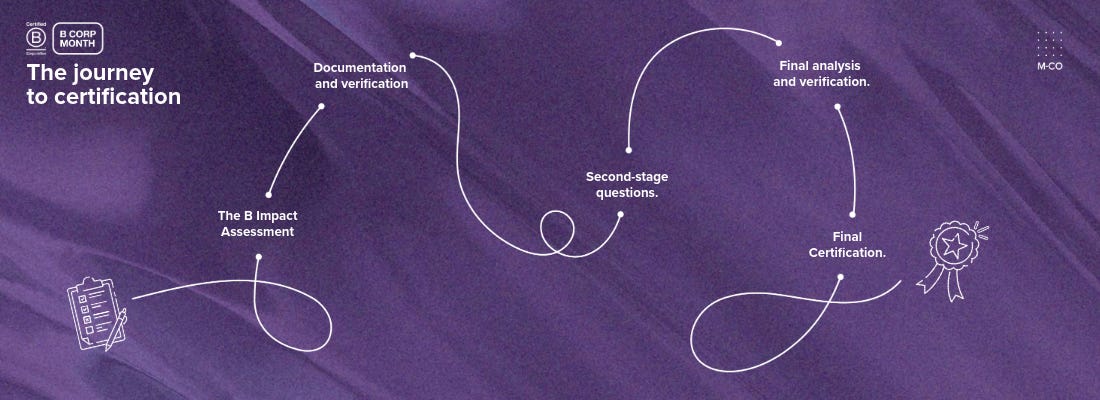
The process has five key steps:
The B Impact Assessment. Much of the submission process is blind. Answering certain questions unlocks new ones, so you can’t see everything in advance. A basic questionnaire is available, though, and provides a useful framework. You’ll need to reach a minimum of 80 points to certify, and your score updates as you go. Bear in mind that verification may adjust your tally once supporting evidence is assessed. Aiming well above 80 before you submit gives you a stronger chance of success.
Documentation and verification. Most of our submission was based on existing practices, policies, and work – we were certified on the strength of what we already do. When submitting documents, you may find your company has not formalised a well-established process or approach – this is a great opportunity to do this, creating a repository of company documents that can be shared with the team.
Second-stage questions. Most of the B Corp process involves filling out a multiple-choice questionnaire: the B Impact Assessment. There are no wrong answers, but what you answer changes your score and reveals follow-up questions you must answer to clarify early responses.
Final analysis and verification. Once you have submitted your application, a B Corp analyst chooses questions to verify through documentation, specifically focusing on Impact Business Models. For M-CO, more detailed narrative and evidence documentation across several areas, such as our measurable contribution to healthcare improvement, innovative impact approaches, and work with underserved populations. This is an intensive process with tight timeframes and stringent rules around the applicability of evidence, so be prepared!
Certification. The final step involves updating your company’s documents, including memos and articles of association. This makes your business legally accountable to all stakeholders, not just shareholders. This status provides a legal foundation to use business as a force for good, even during ownership or leadership transitions. Pay the associated fee – this will be determined by the company category you are in.
Engaging with your Assigned Analyst:
When you are assigned an analyst, it is important to work with them to process your application in a timely and thorough manner. Clear communication around expectations from both sides is critical.
Process – be clear on what process will be followed to notify management and the team responsible for certification to ensure timely submissions.
Portal – get comfortable with navigating the portal, where documentation is uploaded, and narrative submissions are made. Ensure requisite access is given to team members.
Turnaround times – be very clear on the time allowed by B-Corp to you to complete submissions, linking the appropriate email to the account to receive notifications. Equally, being clear on the expected timeframe for responses from your analyst helps programme time and input required, as well as follow-up documentation.

Getting certified is a whole-company effort.
Here’s what we’d prioritise if we were starting again:
Start earlier than you think you need to: The timeline is longer than most SMEs expect.
Assign a B-Corp Champion: Assign one person to own the process from day one. Not just to coordinate, but to drive it and monitor a trackable document keeps everyone aligned.
Bring your team with you. Keep the whole organisation informed and ask for input. The process touches every part of the business, and people engage better when they understand why it matters.
Get clear on what’s being asked. The assessment language isn’t always straightforward. Take time to ensure the team has a shared interpretation of requirements before anyone starts answering questions or gathering documents.
Talk to people who’ve done it. Schedule a call with B Lab Ireland early. Find other Irish SMEs who’ve been through certification. Hearing how others navigated the same questions is genuinely useful, and the community is open and generous with their experience.
Treat documentation as a project in itself. During the first-round assessment, flag anything that might serve as supporting evidence later. That means formal policies, management-held company information, HR documents, and anything that doesn’t yet exist and needs to be created. Categorise it, assign it, and track it. Note gaps early and escalate them.
Challenges & how we overcame them:
Resourcing & time commitment – the whole process probably took much longer than we anticipated because we did not appreciate the nature of the evolving questionnaire format. Setting the team up to manage changes to requirements and timelines would help to avoid delays.
Data gaps – These will likely arise. Whether it is due to a lack of formalised documentation or a process to measure impact, be aware that your company may need to adapt how information is gathered to ensure adequate evidence to support your B-Corp application.
Measuring impact – the metrics and process for measuring impact were not always something we had control over (given that the majority of our work is with public sector clients, who serve the general population of Ireland). We had to find ways to demonstrate proxy measures or utilise population-wide information, or client-authored reports.
Team buy-in – clear communication from early on about the purpose and importance of becoming certified is key. Down from management, but also across teams, where new ways of working may be required to provide the documentation or information for submission. If your team understands why you are being certified, it’s easier for them to provide the information.
Applicability of standards to our work - B Corp started in the US, and a lot of the questions assume a US legal framework. It is quite manufacturing or production-focused, so there are elements of it that aren’t relevant to a company like ours. While the overall process is quite generic, companies are grouped by sector, size, and geography.
The impact on our business:
Continuous improvement: Taking a social return on investment type approach, we will be developing a social impact framework that we can apply to M-CO projects, so that we can assess the impact that our work has. This is a new way of working for us, and will require considerable work to establish, but will provide numerous benefits beyond aiding the recertification process, including showcasing our impact to clients and helping to achieve access to a greater number of new areas of work we care about
Formalising our work practices: We thought M-CO was already very aligned with the B-Corp standards before certification, but without a formalised benchmark, it was our word and track record with existing clients that led us to believe this. Now that we are certified, we can prove to a much wider audience (and our own team!) that the way we operate is of the highest standard. Formalising what we do is not necessarily in our nature, as we like to work on bespoke models and tailored approaches, but finding a way to frame our work to meet the standards helped us to crystallise our offering and document our approaches.
Accountability: Recertification is every 3 years. The process for recertification will be the same as the first time, but the questions and criteria will have evolved. We are working towards adherence and being prepared for the level of work involved. Without this cycle of accountability, it is easy for internal improvement work to be set aside while we work with clients.
Network: Connections with change-makers are an exciting part of becoming a B-Corp company. We have already attended some events and panel discussions with the aim of finding like-minded partners to work on the things that matter to people and the planet.
If you’re thinking about it
B Corp Month is a good time to start the conversation inside your organisation. Not necessarily to commit to the process right now, but to ask honestly: do we operate in a way that could stand up to this kind of scrutiny? Are we ready to formalise what we stand for?
If you’re an Irish SME working in areas that matter to people and planet, the answer is probably yes.
We’re happy to talk to anyone who wants to know more about our experience.
Reach us at info@mco.ie or find us on LinkedIn.
No posts
Comments
Nothing yet. Say the first thing.
Sign in to join the conversation.