
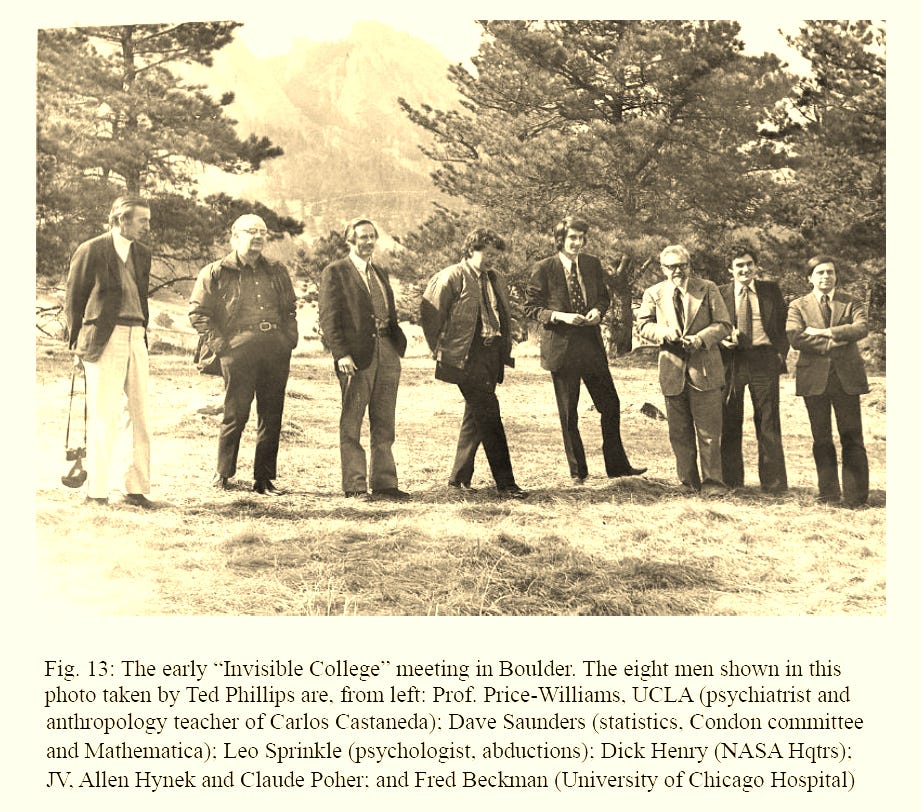
Jacques Vallée gave an address at Contact in the Desert (CITD) this May, remembering J. Allen Hynek, and there is a photograph in it that I keep returning to.
Ted Phillips took it outside Boulder in the fall of 1966. Eight men stand in a dry field with the Flatirons behind them, dressed in the dark suits and narrow ties of the period. Vallée identifies the gathering as an early meeting of the Invisible College, the informal network he and Hynek helped build when the institutions around them made serious investigation nearly impossible.
There is Douglass Price-Williams, a UCLA psychiatrist and anthropologist. Dave Saunders, the statistician who served on the Condon Committee. Leo Sprinkle, a psychologist studying abduction reports. Dick Henry from NASA headquarters. Claude Poher, a French physicist. Hynek and Vallée. Fred Beckman from the University of Chicago Hospital.
Psychiatry. Psychology. Anthropology. Statistics. Medicine. Physics. Astronomy.
The photograph is striking not only because of who is in it, but because nobody appears to find the arrangement unusual. Half the group came from psychiatry, psychology, statistics, or medicine. At the beginning, the human side of the phenomenon was not an accommodation made after the serious work was finished. It was part of the serious work.
Vallée’s own seven-person research team included his wife, Janine, as its psychologist and statistician. He identifies her as a co-author of his early books. The people attempting to establish the subject as a legitimate scientific problem understood that whatever was happening in the sky was also happening inside human perception, memory, belief, culture, and life. They could not yet say what the phenomenon was, and that uncertainty enlarged the table rather than narrowing it.
Sixty years later, the field risks forgetting what the photograph knew by instinct. Our instruments point upward. Our hearings concern airspace, surveillance, sensor data, metallurgy, propulsion, classified programs, and declassification schedules. The witness is often treated as the least reliable component of the event, a noisy instrument through which the valuable information must be filtered.
The person becomes interference.
That departure from the field’s beginnings may be among the most consequential. It is also the part of Vallée’s legacy we are in the greatest danger of losing.
His subject was never merely the object. It was the larger system formed among the object, the witness, the culture, the physical trace, the report, the institution receiving it, and the beliefs altered in its wake. He resisted every attempt to tear one element free and call it the whole. That resistance is the heart of his work.
Vallée is often remembered as the mystic of modern ufology: the theorist of Magonia, the trickster, the control system, the intelligence that may appear through the symbolic vocabulary of whatever culture encounters it. In the public imagination, he became the elegant French scientist standing at the border of the inexplicable.
What disappears from that portrait is the informaticist.
Vallée built computerized catalogues of UFO cases when computers could barely sustain a conversation with their own data. In the 1960s, he developed an artificial-intelligence system for astronomical research and envisioned interactive databases through which investigators could test hypotheses across thousands of reports. His unpaid team proposed using a real-time computer catalogue to complement the Condon investigation. The Air Force agreed. Northwestern University refused to authorize the work.
His instinct was methodological before it was metaphysical. A luminous object could not be placed on a laboratory bench after it vanished. Its report could be classified, compared, cross-referenced, and situated within a larger pattern. The report was not identical to the event, but it was the record the event left behind.
I recognized that instinct the first time I read him, because it is the discipline I was trained in before I became a nurse informaticist. I have always felt a particular kinship with the way Vallée thinks, because I spent years as a data scientist after being a nurse, and data science is, underneath everything else, a discipline about the distance between events and the records we are able to make of them. We rarely possess the event itself. We possess the measurement, the memory, the observation, the code, the note written by someone with limited time and imperfect categories. We build knowledge from those records while trying not to forget the distance between what happened and what the record was capable of holding.
Vallée built much of his career inside that distance, decades before my field had a name for it.
He insisted on physical evidence. He studied landing traces, radar observations, physiological effects, instrument readings, and cases with multiple witnesses. He also understood that matter did not exhaust the event. A sighting could leave a mark on the ground while rearranging a witness’s understanding of reality. A close encounter could have biological effects, psychological effects, symbolic content, and consequences that spread through families and communities. The layers did not cancel one another. Together, they formed the case.
This is why describing Vallée as either a nuts-and-bolts researcher or a mystic misses the architecture of his thought. He did not move from science toward spirituality as though one had replaced the other. He widened the unit of study. Again and again, the field wanted an object. Vallée kept finding a system.
In Passport to Magonia, Vallée compared contemporary UFO reports with older stories of fairies, aerial beings, abductions, apparitions, and supernatural visitors. The names and costumes changed with culture. Certain structures appeared to persist: an encounter, disorientation, altered time, a message, a return, and a life divided into before and after.
This line of inquiry led toward his control-system hypothesis. The phenomenon, he proposed, might not be understood by accepting its apparent identity or message at face value. What presented itself as an extraterrestrial visitor might not be extraterrestrial. What appeared spiritual might not be benevolent. What offered revelation might be influencing belief for reasons the recipient could not perceive.
The important methodological question became less What does it say it is? and more What does it do?
How does it enter a belief system? What behavior follows? What institutions form around it? What kinds of authority does it produce? What happens to a person or a culture after the encounter?
Vallée turned that skepticism in every direction. He distrusted official dismissal, but he also distrusted easy extraterrestrial explanations. He questioned military narratives, charismatic contactees, salvational movements, and anyone who claimed that the mystery had privately appointed them its interpreter. In Messengers of Deception, he warned that stories of superior beings and imminent transformation could become instruments of manipulation, obedience, and political control.
One faction of the field wants to turn the encounter into hardware. Another wants to turn it into revelation. The first reduces the witness to a sensor. The second risks turning the witness into a disciple. Both promise relief from uncertainty, and both can take the experience away from the person who had it. Vallée’s better inheritance is the refusal of that relief.
He followed physical evidence without pretending that matter told the whole story. He investigated folklore, consciousness, and meaning without declaring every anomalous experience a sacred teaching. He remained open without becoming credulous, and skeptical without becoming dismissive. After more than six decades of investigation, he did not hand the field a final ontology. That absence is not the failure of his career. It may be its deepest integrity.
This May, the same season as the address that opened this piece, he made that refusal explicit. Forbidden Science 7: Final Report closed a set of journals he had kept for nearly seventy years, and he has called it his withdrawal from visible research. It does not name a final theory. It does not resolve the object. It states, plainly, that premature certainty is dangerous; which may be the one conclusion seventy years of evidence actually produced. He is routing what comes next toward an archive at Rice University for the researchers who will continue after him, and toward organizations like uNHIdden, built specifically around the psychological welfare of the witnesses themselves.
Vallée did not teach us what to believe about the phenomenon. He taught us how much must remain in view while we do not know: the trace, the pattern, the deception, the symbol, the social consequence, the institution, and the human life through which the mystery passes.
Uncertainty, in this tradition, is not indecision. It is a discipline.
Near the end of his Contact in the Desert address, Vallée says that the real secrets were never confined to the Pentagon, the White House, or the vaults of private industry. They remain in the minds and lives of the millions of ordinary people who have encountered these objects and the forms of life associated with them.
“They still are,” he adds.
The sentence quietly relocates the center of the field. The repository everyone keeps trying to open is not only a classified archive. It is a population.
These people wake up and go to work. They raise children, lose marriages, change religions, abandon religions, sleep with the lights on, begin painting, stop trusting themselves, become convinced they have been given a purpose, or spend decades trying to recover the person they were before that one impossible night.
Their experiences may eventually reveal something about consciousness, perception, trauma, folklore, intelligence, or the formation of belief. They may arise from several unrelated causes that have been forced together beneath a single unstable name. Some may never be explained. None of those possibilities alters the fact that the consequences are already here.
Vallée does not say that human beings are necessarily the metaphysical center of the phenomenon. We do not know what the phenomenon is centered on, or whether it possesses anything we could call an intention. What we know is that human beings are where its consequences become lives.
The same passage in his address holds two obligations beside each other. Vallée says that some cases contain potentially important physical evidence, yet remain unpublished out of deference to the families and communities involved. The scientific value matters. So does the human cost of exposing it. He does not purchase one by sacrificing the other. That may reveal more about his legacy than any single theory. He preserved the evidence without forgetting the person to whom the evidence happened.
I hear in his words the outline of a public health problem. That is my extension of Vallée’s work, not a clinical model he proposed himself.
A population is reporting experiences that can produce enduring psychological, social, spiritual, and bodily effects. Yet the systems meant to receive those people have few pathways, categories, or standards of care suited to what they describe. The absence of an agreed explanation becomes an excuse for the absence of support. Thus, a population goes underserved.
Vallée’s method suggests a different clinical posture: just as he cautioned researchers against accepting the phenomenon’s presentation as a final explanation of its identity, a clinician need not ratify an experiencer’s proposed ontology in order to take seriously what the experience has done.
A person may describe extraterrestrials, spirits, interdimensional beings, military technology, angels, future humans, or an intelligence for which no existing category is adequate. Care does not require the clinician to confirm any of those explanations. It does not require ridicule or reflexive correction either.
The clinician can ask what changed.
What happened to the person’s sleep, body, relationships, work, identity, and sense of safety? Which assumptions about reality collapsed? Which new beliefs became consoling, frightening, or overwhelming? Has the experience produced isolation, grief, grandiosity, terror, purpose, transformation, or some unstable mixture of them? Can the person live beside the unanswered question without being consumed by it?
Vallée did not propose a treatment model. But his method suggests a posture of care that mirrors the method his hypothesis requires. Do not begin by adjudicating appearances. Follow the changes produced in the belief system. In research, that means asking what the encounter does. In care, it means asking what the experience has done to the person, then helping them integrate those changes without forcing either belief or disbelief upon them.
The immediate clinical question is not whether the story is ontologically true. It is whether the person can carry what happened to them.
We can remain uncertain about the object without remaining uncertain about our obligation to the person.
Consider a hypothetical woman driving home from a night shift on a county road.
Something happens.
Perhaps there is a light over a field. Perhaps the radio goes silent. Perhaps an hour disappears. Perhaps she experiences a presence she cannot describe without sounding impossible even to herself.
She has no language for it. Her heart races. Her hands shake. She becomes certain she is dying. She pulls onto the shoulder because she can no longer hold the car straight. She sits in the dark with her hazards flashing.
Then a trooper taps on the window.
From that moment, the experience has entered a system. The dispatcher needed a call type before anyone arrived. The officer needs a disposition. If she describes what happened, she risks being recorded as delusional or placed on a psychiatric hold. If she refuses to explain, she is a frightened woman alone on a road at three in the morning, behaving unpredictably, which may lead to the same conclusion. She has several seconds to decide which version of herself might still be believed.
An ambulance may arrive. A paramedic writes a run report. An emergency department receives her. A nurse assigns an acuity and records a chief complaint. A physician reads what came before. Somewhere farther downstream, if she is persistent, fortunate, and still willing to speak, she may reach a clinician prepared to listen.
By then, several records exist. A dispatch entry. An officer’s narrative. A run report. A triage note.
Each was written by someone under pressure, using categories designed for other kinds of events. Each shapes what the next person believes before meeting her. One phrase, “possible psychiatric”, can follow her through every subsequent encounter.
The object, whatever it was, has disappeared. The documentation remains.
Vallée spent a career studying what happened when an anomalous event entered systems of reporting, classification, culture, and belief. Healthcare should examine the same process in itself. What happens when an experience passes through our forms, codes, handoffs, and assumptions? What is preserved? What is discarded? What does the record make easier to see, and what does it make impossible to say?
The person is not merely a source of testimony. She is also the site on which every institutional response leaves another trace.
A diagnosis. A joke. A revelation. A data point. A threat. A story she learns never to tell again.
The human being may or may not be the phenomenon’s intended center. She is certainly the center of our responsibility once the account reaches us.
The care she receives should resemble Vallée’s best method. It should remain curious without becoming credulous, skeptical without becoming contemptuous, attentive to patterns without reducing the person to one. It should resist pretending that the first available category has solved what happened. It should study the effects while leaving the ultimate cause open.
There is a detail in Vallée’s address that I have been unable to put down.
Hynek travelled with two heavily annotated books. One was William James’s Is Life Worth Living? The other was Rudolf Steiner’s Knowledge of the Higher Worlds, carried so often that its binding tore and its pages worked loose.
In the James essay, Hynek had marked a passage describing the physical order of nature, as science knows it, as “merely weather, doing and undoing, without end”.
A man who spent his life studying the sky marked a sentence about what the instruments could not tell him.
During a drive from Denver to Boulder in November 1966, Vallée asked why Hynek had allowed himself to become involved in questions most scientists could pass an entire career without touching. Hynek replied that hard science was the best available route toward the fundamental questions of the larger world, but those questions led directly to the nature of the human spirit and its relationship to the universe.
This should not be read as proof that Hynek possessed a hidden spiritual solution to the UFO problem. The books reveal no secret doctrine. They show a scientist who allowed his questions to remain larger than his methods. He did not discard science when it reached its limits. He carried those limits with him.
After Hynek died, Mimi Hynek asked Vallée to meet with her in Arizona. She gave him the books because Allen had wanted him to have them. Vallée says their real value lay in the margins, in the handwritten evidence of a mind returning repeatedly to questions no instrument could settle. There is something deeply human in that inheritance.
Vallée received no final theory. He received another man’s unfinished thinking.
Vallée is eighty-six now, and I don’t think it’s a coincidence that he closed his own record this May in almost the same gesture Mimi Hynek made in that room in Arizona. He is not handing anyone a final theory either. He is handing over seventy years of unfinished thinking, on purpose, to an archive at Rice for whoever keeps researching and to an organization built around witnesses’ welfare for whoever keeps caring for them. I don’t know if he thinks about it in those terms. I know I can’t read the scene with Mimi Hynek without thinking about what it will mean when someone, someday, is handed his own torn and annotated record, and what it will ask of whoever receives it.
The torn binding, the loose pages, the underlining, the marks made privately beside sentences that had followed Hynek across years and distances: this was what passed from one researcher to another. Not an answer. A way of remaining in relationship with the question.
Vallée closes his address with Robert Oppenheimer’s distinction between two ways of thinking, the way of time and the way of eternity. Neither can be reduced to the other. Neither tells the whole story. That may be the narrow path the field has repeatedly failed to hold.
The nuts-and-bolts approach gives us the way of time: measurements, materials, trajectories, causal sequences, and records. The spiritual approach reaches toward eternity: meaning, consciousness, transformation, destiny, and the possibility that an encounter belongs to a reality larger than our categories can contain. Either can become a form of fundamentalism when it declares itself sufficient.
Vallée’s legacy asks us to inhabit the tension. Follow the evidence without mistaking evidence for totality. Remain open to meaning without treating meaning as proof. Recognize that physical, psychological, symbolic, and social dimensions may coexist without collapsing neatly into one another.
The photograph in Boulder captures that discipline before the field had a name for it. Eight people stood together because no single discipline could plausibly own the mystery.
The photograph should not be romanticized. The Invisible College existed because established institutions had failed. Its necessity was an indictment.
Nor is the lesson simply that future councils and review boards should add a psychologist, nurse, or physician to the guest list. A board can contain the human sciences and still treat the witness as an inconvenient container for more valuable data. A research program can administer mental-health questionnaires and never regard the participant’s welfare as important beyond the usefulness of the report.
Centering the human being is not a seat. It is a habit of attention.
It means understanding that the event does not end when the light disappears. It continues through memory, interpretation, family, belief, culture, documentation, research, treatment, and silence. It continues through every person who handles the account afterward.
The field can continue searching for physical evidence. And it should. It can build better sensors, databases, classification systems, and methods for distinguishing genuine anomalies from noise. But it cannot call its work complete while treating the human consequences as contamination.
Whatever the phenomenon intends, if it intends anything, we still have a choice about how we show up in response to it.
We can use the unknown as another reason to accumulate authority, enforce orthodoxies, divide the world into believers and fools, and surrender our uncertainty to whoever speaks with the greatest confidence. We can turn the mystery into hardware alone, or into scripture.
We can also allow it to enlarge our moral imagination.
We can ask how we might create forms of care capable of receiving experiences that exceed our categories. How we might remain rigorous without becoming cruel, and open without surrendering discernment. How we might help someone rebuild a livable world without demanding that she first prove what shattered the old one.
The phenomenon does not have to be benevolent for us to become more humane in response to it. It does not need to contain a message for the mystery to alter how we treat one another.
That choice is ours, regardless of what stands behind the experience.
Vallée’s career does not tell us what was in the field with the woman at three in the morning. It tells us not to pretend that we know.
His legacy asks something harder: that we remain useful to her while we do not know. That we receive the experience without forcing it into either pathology or revelation. That we help her understand what it has done to her world, what it has taken from her, what it may have opened, and how she might build a life spacious enough to contain what cannot yet be resolved.
Eight people stood in a field in Colorado in 1966, and the human being still belonged inside the question. As new institutions rise around the mystery, that may be the inheritance most worth protecting.
The instruments can keep pointing toward the sky.
Someone must remain beside the person beneath it.
The mystery may last the rest of her life.
Our obligation to one another does not have to wait for it to end.
Meredith Spearman, MSN, RN, NI-BC, CMSRN, is a public health nurse informaticist, graduate professor, and writer. Jacques Vallée’s address, “Now It Can Be Told! Remembering Dr. J. Allen Hynek,” was delivered at Contact in the Desert in May 2026.
If this resonated, you’d likely find your people in the Discord: a growing community for the stranger end of the phenomena, the philosophy under it, and the experiencers living it. We go deeper in real time. JOIN HERE.
New to The Maze to Metanoia? SUBSCRIBE to follow along, and feel free to SHARE this article as well:
The experience is yours. The silence is optional.
Comments
Nothing yet. Say the first thing.
Sign in to join the conversation.