
Author’s note:
My day job and personal life have been unusually demanding these last few weeks, and something had to give. Regular readers probably noticed the next installment of The Threshold series did not arrive on Sunday as it normally would on our two week cadence. It will come either the week after, or the one after that. Paid subscribers, thank you for your patience! The essay is written; it is not yet good enough, and I would rather be late than thin. In the meantime, this piece is free and outside the Threshold series, because a policy brief landed last week that goes directly to the thing I have been building here.
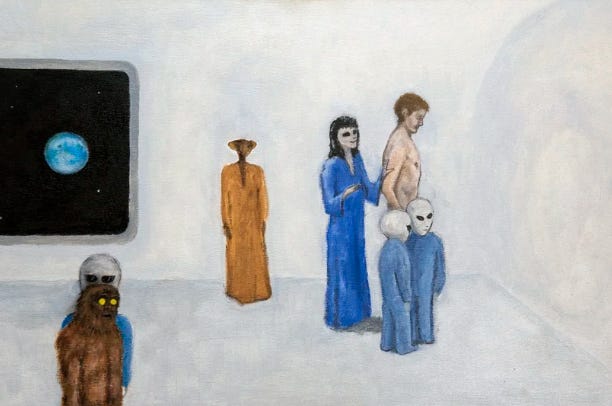
David Huggins, Going Home.
Two things happened in the last week that I want to put side by side.
The first is a policy brief. The Disclosure Foundation published its sixth one, and I want to begin by saying that it is good. I mean that without qualification.
It asks the Administration to direct Health and Human Services, through the Administration for Strategic Preparedness and Response, to establish a National Disclosure Preparedness Task Force and develop a national strategy for the human consequences of disclosure. Jennice Vilhauer, Carlos Eire, and Christopher Mellon wrote it.
Vilhauer is why this document reads the way it does. The psychological impact research underneath it is hers, and the brief takes that research and turns it into something an agency could actually act on. Not many researchers can do that, and even fewer bother trying.
The second is that Dr. Phil McGraw had Vilhauer on his podcast.
I want to sit with that pairing for a moment, because I think people in this space are underestimating what it means. I also want to raise something about the brief that I have not seen anyone else raise, which is that its monitoring framework depends on a piece of infrastructure that does not currently exist…
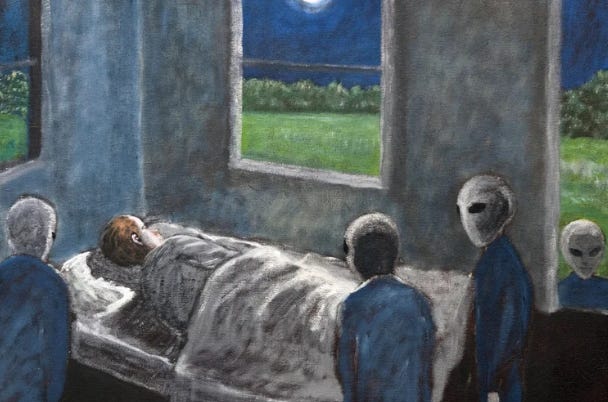
David Huggins, In My Bedroom.
For twenty-five years, the reason nobody worked on this was stigma. Vilhauer laid the mechanism out plainly in that Dr. Phil interview, and the numbers behind it are ones I wrote about in March, in Told to Be Careful. Researchers surveyed 1,460 faculty across fourteen disciplines at 144 major American research universities. Most said UAP warranted serious scientific study. Nearly one in five reported having personally seen something aerial they could not identify. Fewer than one percent had ever conducted research on it. In a follow-up, roughly twenty-eight percent said they might vote against a colleague's tenure case for pursuing it, including people who believed the topic deserved investigation.
Fear, not doubt, is what has kept the field empty. Vilhauer also cited research suggesting only about five percent of people who witness something ever report it.
Five percent. Whatever you believe about what is in the sky, that number describes something real and measurable about human beings: nineteen out of twenty people who experience something anomalous decide that silence is cheaper than speech.
That rule is not natural law. It was built. Vilhauer and Dr. Phil walked through the construction of it, from the Robertson Panel to decades of tabloid headlines about alien corpses and lunar bombers, and made the case that the ridicule was not entirely accidental. Whether or not you accept the intentionality, the effect is not in dispute. People learned what disclosure costs, and they adjusted.
Which is why Dr. Phil matters here, and I say this as someone who does not particularly care about daytime television. He has been a fixture in American psychology and American television for fifty years. The White House gave him access to the UAP files before the public saw them. His audience is measured in millions, and it is not an audience of people who read policy briefs. When he tells that audience the biggest news in human history might arrive with no instructions attached, the stigma that kept psychology out of this for a generation starts to crack.
The most useful line in the whole conversation was his closer. Resilient is not the same as ready.

David Huggins, Floating Up.
I am aware that for a portion of this audience, the previous section was hard to read, so let me deal with it rather than pretend otherwise.
The objections to McGraw’s involvement are not frivolous. He is a political ally of the president and sits on the administration’s Religious Liberty Commission, which means the person asked to assess how the public will react to disclosure is aligned with the people deciding what gets disclosed. And the file releases he has been commenting on have underwhelmed the researchers who have followed this longest, one of whom told the New York Times that it is the same game as always, another carrot dangled.
He has also said things in this coverage that undercut his own argument. Around the nine minute mark he brings up, unprompted, that Vilhauer had taken exception to his description of the people who have historically talked about UFOs in public as being “too drunk to fish”. He restates the line. He says he stands by it.
Here is what I actually take from it. Vilhauer is doing the thing she is asking her whole profession to do. She came out of the safety of clinical practice, said out loud that this deserves serious attention, and walked into a room where the price of admission was sitting still while the stigma got performed at her. She had objected privately. It got surfaced and dismissed publicly. She kept going, because the alternative was not being in the conversation at all.
Readers outside academic psychology may not see what she’s actually risking here, so let me spell it out. That tenure survey I cited earlier isn’t abstract to her. Twenty-eight percent of faculty said they might vote against a colleague over this. She’s got Emory and Cedars-Sinai behind her, a published book, a therapy model with her name on it, and a referral network that runs entirely on what other clinicians think of her judgment. All of that is exposed. She isn’t going to come out of this with more professional standing than she went in with, and she did it anyway, under her own name, on a show where she knew exactly how the framing would go.
People keep asking why a psychologist is talking about UFOs. I don’t think they understand what she’s paying for it.
Everyone who follows her will pay some version of that bill. The psychologists she's recruiting, the psychiatrists, the nurses, the informaticists. Every one of them will have to weigh whether the platform is worth what they will have to absorb on it. Some will decide it is not, which is exactly how the field stayed empty for twenty-five years.
So I am not pointing at that exchange to fault anyone in it. I am pointing at it because it is the clearest available evidence that the stigma is not historical. It is operating right now, on the people currently trying to dismantle it, in real time, on the biggest platform available to them. Nobody covering this has mentioned it.
I have written before about borrowed credibility, in the context of Neil deGrasse Tyson deciding that the era of trust-me testimony had expired and then announcing a book about aliens. The pattern there was an astrophysicist importing authority earned in one field and spending it in another, on ridicule, against the people with the most proximity to the phenomenon.
McGraw is spending borrowed credibility too. He is spending it in a better direction, and I am not going to pretend those are equivalent. But the phrase is the same phrase. It sorts witnesses into credible and not, by vibe, in front of millions of people, in the middle of an argument about how devastating it has been to sort witnesses into credible and not. His defense is that the discrediting was deliberate, that the drunks were pushed forward while serious people were buried. It does not change what the line does when it lands. Every person who has ever decided not to tell a doctor what they saw, heard it and did the math again.
So I am not going to argue that he is the ideal person for this. I want to point at something else instead, which is the selection criterion.
Interviewers keep asking why an administration weighing the biggest announcement in human history went to a television host rather than an astrophysicist. McGraw has answered it plainly more than once: because he has been a trusted voice on television for years. He thinks they gave him access because they wanted someone the public already believes, saying what he actually thinks rather than reading a script.
Set aside whether that was a good call. Notice what it reveals about how these decisions get made.
When a government considers telling the public something destabilizing, it does not look for the most credentialed available expert. It looks for whoever the public already trusts, because trust is the thing that determines whether information lands as information or as threat. That instinct is not stupid. Vilhauer’s entire argument is that people respond to their interpretation of information rather than the information itself, and interpretation runs on trust.
Which raises a question that seems not to have occurred to anyone in this conversation.
If public trust is the qualification, who actually has it?
Gallup has been asking a version of that question every December for twenty-five years, and the answer has not changed once. The answer is not a psychologist, a physician, or a television host.
I will come back to it.
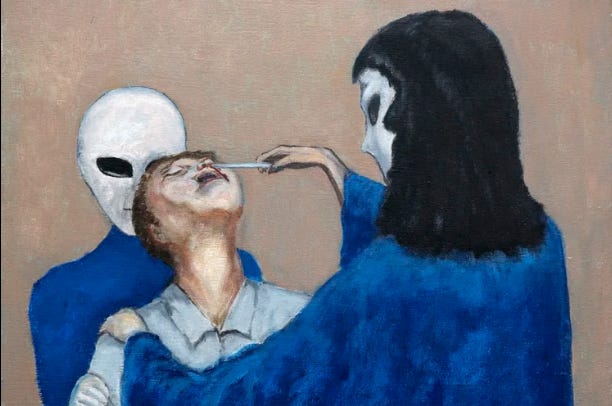
David Huggins, Implant.
Vilhauer named something useful in that interview. She called it the clinical response gap: research indicating that most mental health professionals do not feel comfortable addressing these issues. Her point was that mobilizing existing mental health resources will not help much if the people staffing them have no idea what to do.
I recognized it immediately, because I spend my working life inside a version of it.
I work in HIV. Providers in this space genuinely want to offer testing and PrEP. They believe in it. They will tell you so. And then a patient sits down in front of them and the conversation that would establish whether that patient needs PrEP does not happen, because it requires asking direct questions about sex and a great many clinicians are too uncomfortable to ask them. This is one of the best documented barriers in the field. Providers report it about their colleagues and, more carefully, about themselves. Primary care providers frequently report making little or no use of sexual history screening, which is why PrEP so often gets prescribed only when the patient thinks to ask for it. The person most likely to benefit is the person least likely to raise it.
The result is a prevention tool that works, sitting on a shelf, separated from the people who need it by four minutes of conversational discomfort.
But discomfort is only half of it, and the other half is the half nobody writes op-eds about. Many electronic health records have no standardized prompt for any of this. There is no moment in the workflow where the question has to be asked, no structured place for the answer, and no downstream logic that does anything with it. So the awkwardness never gets interrupted by the system, because the system does not know the conversation was supposed to happen.
Where this has actually been fixed, here is what fixed it: a structured sexual history built into the visit, and a decision support alert that fires when the documented answers meet prescribing criteria. A field, a prompt, and a consequence for what gets entered; not a training module about being less squeamish.
Clinician discomfort plus an absent field produces an invisible population every single time. You cannot train your way out of the second half.
Which is why the clinical response gap Vilhauer describes is not going to close through training either, and why it is worth being precise about the shape of it. A gap is defined by what is missing from it.
What is missing is a name for the thing being harmed.
I call it ontological health: the capacity to maintain or rebuild meaning, identity, coherence, and a workable relationship with reality after an experience disrupts a person’s fundamental assumptions about what exists and what is possible.
The concept is deliberately agnostic about what caused the experience. A UAP encounter can initiate ontological disruption. So can a near-death experience, a deathbed vision, a psychedelic session, a sudden conversion or loss of faith, a traumatic event, a catastrophic diagnosis, or a scientific finding that dismantles something a person had organized their life around. The precipitating events have almost nothing in common. What follows them looks remarkably similar, and it is the part clinicians actually encounter.
The clinical question is never whether the institution has settled the patient’s metaphysics. It is whether the person can integrate what happened without losing meaning, connection, safety, or the ability to function.
That gap is also wider than the mental health workforce, and the pilots are the clearest illustration of why.
The numbers attached to it are stark: roughly forty-five percent of pilots report having witnessed something they could not identify, and about ninety percent of them never report it.
The mechanism is entirely bureaucratic. FAA medical certification treats perceiving what is not officially there as a possible indicator of instability, so a report can trigger psychiatric evaluation and months of unpaid grounding. Report it and risk the certificate. Deny it and sign the form, and risk a false statement if radar and a co-pilot say otherwise. Trained observers, with instrumentation, in controlled airspace, and the safest available option is to say nothing.
That is a documentation problem with a person's career inside it. The form has no category that corresponds to what happened, so any honest answer becomes a wrong answer.
Now move that same structure into healthcare, where the stakes are the patient rather than the license.
Someone reports an experience that has disrupted their sense of what is real. The brief instructs clinicians not to pathologize reflexively and not to validate uncritically, but to attend to functioning, distress, and safety. That is exactly right, and I do not think a clinician can reliably do it under current conditions.
The problem is not compassion. It is that the record offers nowhere to put what the patient just stated.
The health record contains plenty of adjacent terminology. A clinician can document anxiety, hallucinations, sleep disturbance, spiritual distress, altered mental status, trauma symptoms, fear. Each may be appropriate in a given case. None of them captures the situation the brief is describing: a person reporting an anomalous or reality-disrupting experience of uncertain origin, whose distress, safety, functioning, meaning, and support needs all require assessment.
So the experience gets compressed into the nearest available symptom, routed prematurely into a psychiatric pathway, or left out of the chart entirely. Usually the last one. And then it is gone.
It is worth sitting with what that costs the person, because everything else in this argument is infrastructure.
Someone spent years deciding whether to say this out loud. They finally did, to a stranger, in a paper gown, at the worst hour of the night. If it ends up in the chart as hallucinations, that word follows them. It is there at the next visit, and the one after that, read by clinicians who were not in the room and have no idea what was actually said. It shapes how the next person listens before the patient opens their mouth. And the patient learns what they suspected all along, which is that telling the truth about this costs more than staying quiet. They will not make that mistake twice.
That is the mechanism producing the five percent. Not culture in the abstract. One chart entry at a time.
None of this requires certifying that anything happened. A responsible documentation framework would not ask a clinician to endorse a patient’s interpretation of their experience. The clinician would still evaluate for delirium, psychosis, trauma, neurological disease, sleep disorders, medication and substance effects, acute illness, and immediate safety. What the record would also preserve is what the person says happened, the meaning they assign to it, how certain or uncertain they are, the associated distress, functional change, isolation, fear of telling anyone, available support, and what help they are actually seeking.
That is the balance the brief is reaching for. Careful assessment without epistemic humiliation.

David Huggins, Coming Through.
Here is what caught me about the interview, and it is a small thing that turns out not to be small.
Both of them named the organizations that need to move. Vilhauer called on the American Psychological Association and the American Psychiatric Association to take this seriously and lead from the top. McGraw added the American Medical Association, noting its emergency response arms and his friendship with its incoming head. Their shared point was sound: this has to run through existing infrastructure, because there is no time to build new infrastructure from scratch.
No nursing organization was mentioned. Neither was any informatics body.
I do not think that was deliberate. I think it is the default, and there is a literature documenting exactly how reliable a default it is.
In 1997, a study named for USA Today founding editor Nancy Woodhull examined a month of health coverage in major newspapers, newsweeklies, and industry publications. Nurses turned up as sources in about four percent of quotations. In stories specifically about health policy, they appeared as sources zero times.
Researchers replicated it twenty years later using the same publications and the same coding scheme. Nurses had dropped to two percent of quotes. They were still never sourced in health policy stories. When nurses were quoted at all, they were mostly commenting on nursing itself, rather than on health.
Two decades, no movement, and a profession that had grown to over three million people in the US was speaking in health policy coverage exactly as often as it had before, which is to say not at all.
The precedent that should concern anyone building a preparedness task force is more recent than either of those studies.
When COVID arrived, the White House Coronavirus Task Force included no nurses. Neither did most state and local response teams. When the administration changed, the incoming transition’s COVID advisory board was announced with thirteen members and also included no nurses. Two administrations, opposite parties, same omission, during a public health emergency in which nurses delivered the overwhelming majority of the actual care and absorbed most of the actual risk.
And the exclusion is not only from tables. It is built into the health record itself.
When Congress funded the national transition to electronic records through the HITECH Act, it attached roughly fifteen billion dollars in incentive payments to “eligible professionals”. Staff nurses were not among them. HHS’s own retrospective analysis explains the reasoning without embarrassment: the incentives concentrated on physicians because physicians drive most decisions about care, and on hospitals because that is where the money goes. Everyone else was categorically ineligible.
So the systems that every American’s care now runs through were designed, funded, and certified around the documentation needs of one profession, on purpose, as a matter of federal policy. The largest clinical workforce in the country was a user of that software rather than a customer for it.
The consequences are still with us. Standardized nursing terminologies have existed since the 1970s and several are recognized by the American Nurses Association, yet they remain unevenly represented in certified systems and in the federal interoperability standards that determine which data actually crosses between institutions. Nursing organizations are still, in 2026, filing public comments asking that nursing data be included in the core interoperability set.
This is the part I teach my informatics students, because it explains so much of what they will encounter. Health IT engages medicine and only accommodates nursing. Those are very different verbs.
It is also why ontological health has no field. A domain of wellbeing that surfaces mainly in what patients say to nurses, chaplains, and hospice staff was never going to make it into a record built around billable physician decisions. The omission is not a judgment about whether the domain is real. It is a judgment about whose observations the system was designed to keep.
Nurse researchers writing in the American Journal of Public Health after the pandemic described this exclusion as structural rather than incidental, and traced how invisibility in media coverage and absence from policy tables reinforce each other. If nurses are never quoted as policy experts, they are not thought of as policy experts, so they are not invited, so there is nothing to quote.
That is the machinery that produced the guest list in this conversation. Nobody is hostile to nursing. The groove is just worn deep enough that no one notices steering into it.
There are roughly 3.4 million registered nurses in the United States, the largest healthcare practitioner occupation in the country by a wide margin. They are distributed through hospitals, homes, schools, clinics, emergency departments, long-term care, public health, and hospice. In Gallup’s most recent measurement, seventy-five percent of Americans rated nurses’ honesty and ethics as high or very high, first place for the twenty-fifth consecutive year, and notably during a period when trust in nearly every profession is at or near historic lows.
That is the answer to the question the White House was implicitly asking when it went looking for a trusted voice. For twenty-five years running, the most trusted profession in America has been standing in every hospital, school, and living room in the country, and nobody has thought to ask it anything.
If five percent of witnesses currently report, the question of who receives the other ninety-five percent when they finally decide to speak is not academic. Most of them will not begin with a psychiatrist. Statistically, the person in the room is going to be a nurse.
For readers outside healthcare, it may help to say plainly how this actually unfolds. Nobody makes an appointment to disclose an anomalous experience. It comes out sideways, during a visit for something else, usually to whoever is already in the room and not looking at a screen. That is a nurse, at triage, or during an assessment, or at three in the morning when the floor is quiet and the patient has been lying awake deciding whether to say it.
What happens next runs entirely through that nurse. She decides whether this is an emergency or a conversation. She decides what goes in the chart and in what language. She decides whether to page psychiatry, call the chaplain, flag it to the attending, or let it sit until morning. Every specialist who eventually becomes involved gets involved because a nurse escalated, and they arrive already primed by how she documented it. If she wrote “hallucinations,” the consult that shows up is looking for psychosis before anyone says hello.
So nursing is not one profession among several who should be consulted here. Nursing is the intake layer. Whatever guidance the psychologists write will be executed, or not, in that first four minutes, by someone who was not in the room when it was written.
There is one more thing, and the brief gets to it before anyone else has. It notes, almost in passing, that clinicians and caregivers may be processing the same information as their patients.
That sentence deserves more attention than it has gotten. If nearly one in five faculty report having seen something they could not identify, there is no reason to think a workforce of 3.4 million nurses is different. Some meaningful number of the people who will be receiving these disclosures have their own, and have never told anyone either, for exactly the reasons their patients have not. Nobody has ever asked them. There has never been a safe way to answer.
We already know what happens when we send this workforce into something without preparing them for it, because we did it six years ago. Nurses carried the pandemic. They also carried the moral injury of it, and they left in numbers the profession has not recovered from. The lesson everyone drew afterward was about staffing ratios and burnout programs, which are real, but the deeper failure was that nobody planned for what it would do to the people delivering the care. They were treated as the response rather than as part of the population experiencing the event.
Disclosure preparedness cannot repeat that. If a national strategy prepares the public and not the workforce, it will be asking hundreds of thousands of people to hold something they have no framework for, on behalf of patients, while quietly holding their own version of it alone. That is not a wellbeing footnote. It is a capacity question, and we have already run the experiment once.
Nursing is also better prepared for this work than the policy conversation seems to know. The discipline’s frameworks explicitly join person-centered care, population health, systems practice, ethics, informatics, and the whole of a person’s lived experience. Nursing scholarship has used phenomenology for decades, precisely because the field needed rigorous ways to understand an experience from inside the life of the person having it, without first settling its external cause. That is a methodology, not a bedside manner, and it happens to be the one this problem requires.
Access matters here too. The brief asks for equitable access to support, and in much of the country the nearest psychologist is an hour away or does not exist. What likely exists is a nurse practitioner, a public health nurse, or a school nurse. A strategy routed exclusively through psychology arrives in metropolitan areas and stops. Telehealth closes some of that gap, but not all of it, and not where broadband doesn't reach.
The informatics omission is the more consequential one, because it is invisible until it fails.
The brief asks HHS to monitor the public health effects of disclosure through indicators like crisis line volume, psychiatric visits, counseling demand, sleep complaints, and pastoral care requests. Those are all countable. What will not be countable is why. No surveillance system can detect a pattern the source record was never designed to represent. If a person’s model of reality has come apart and the chart says anxiety, the system counts anxiety and loses the event that produced it.
There is a related problem with the safeguards, and I think that paragraph may be the most important one in the document.
The brief prohibits registries based on belief, religious interpretation, anomalous experience, or lawful speech. It forbids information collected to support people from being repurposed for intelligence or law enforcement. Both of those are exactly right, and both of them describe something that has to be built rather than promised.
Think about what the failure looks like. Someone tells a nurse about an experience during an emergency visit. It gets documented, because we have finally given clinicians somewhere to put it. That record now moves the way records move: to the health information exchange, to a payer, into a research extract, into whatever downstream system asks for it with a legitimate-looking reason. Nobody has to intend harm at any point. Absent explicit rules to the contrary, data flows toward whoever requests it.
Preventing that is engineering work, and it is not the kind you can add later. The record has to carry, alongside the observation itself, an instruction about what the observation may be used for. It has to be locked to specific roles rather than visible to anyone with a login. It has to log every access, so misuse leaves a trace. And it has to be separable from the rest of the chart, so this one disclosure does not ride along on every routine data release for the rest of the patient’s life.
Retrofitting those controls onto a system already in motion does not work. Every copy of the data made before the rules existed remains outside the rules.
So the sentence in that brief prohibiting an experiencer registry is worth precisely as much as the access controls behind it, and right now there are none, because there is nothing to control.
Medicine has been here before. Pain was undeniable to the person in the body and invisible to everyone else, and the institutional answer was eventually to give the patient's report a scale, a field in the record, and a place in the workflow. The lesson is not that ontological health should become a sixth vital sign. It is that once a health system decides a subjective report matters, someone has to decide what gets asked, where the answer goes, what assessment follows, and who is allowed to see it. Otherwise "take patients seriously" stays a sentiment.

David Huggins, Walking Home.
Vilhauer’s concrete ask in that interview was that the review board in the UAP Disclosure Act, which currently has no psychologist, be expanded to include one, along with other disciplines integral to preparedness.
I would like to widen that ask by exactly two.
I am saying it now while the task force is still hypothetical and the composition is still a paragraph in a policy brief rather than a press release with names on it. This is the stage where these decisions actually get made, and the last stage where they are cheap to change.
Two specific bodies. The Review Board established under the UAP Disclosure Act, the one Vilhauer is already asking to expand. And the National Disclosure Preparedness Task Force this brief proposes, if it is stood up. Both should include nursing, because a national strategy is enacted through millions of individual encounters and nurses are the people most likely to be in them. And both should include clinical informatics, because whatever healthcare cannot represent, it cannot see, study, fund, or protect, and every promise in that brief about monitoring, guidance, research, and safeguards runs straight through an information system that currently has no field for any of it.
The work is a case definition that distinguishes ontological disruption from delirium and from psychosis. A minimum data set. A terminology gap analysis against SNOMED CT, LOINC, and ICD-10-CM. Coded observations and value sets. Workflow and decision support requirements for the clinicians who will actually be documenting at 2am. Interoperability specifications that allow responsible aggregation. And the privacy, consent, provenance, and secondary-use controls that make the brief's registry prohibition technically real. None of it is glamorous. All of it takes years. It has to start before the strategy is written rather than after, which means it has to start now.
The stigma is finally breaking. A policy brief went to the Administration with footnotes. Dr. Phil is asking millions of people whether we are ready, and the honest answer is that healthcare is not, and will not be until someone does the unglamorous work of building the room where these conversations can safely land. Resilient is not the same as ready, and he is right about that.
Vilhauer’s whole argument is that people don’t respond to information, they respond to what they tell themselves about it. Institutions work the same way. Healthcare won’t respond to disclosure, it’ll respond to whatever it can write down about disclosure, and at the current moment it can’t write down anything.
Ready has a name for what is being harmed, a place to write it down, and someone in the room who knows what to do when it is said out loud.
This is part of an ongoing series on ontological health: the capacity to maintain or rebuild meaning, identity, coherence, and a workable relationship with reality after an experience disrupts a person’s fundamental assumptions about what exists and what is possible. The framework was introduced in Ontological Health: A Proposal. A longer article advancing it is forthcoming this year.
Meredith Spearman, MSN, RN, NI-BC, CMSRN, is a public health nurse informaticist, graduate professor, and writer. The Disclosure Foundation’s Policy Brief No. 6, A National Preparedness Framework for the Human Consequences of Disclosure, is available at disclosure.org.
If this resonated, you’d likely find your people in the Discord: a growing community for the stranger end of the phenomena, the philosophy under it, and the experiencers living it. We go deeper in real time. JOIN HERE.
New to The Maze to Metanoia? SUBSCRIBE to follow along, and feel free to SHARE this article as well:
The experience is yours. The silence is optional.
Comments
Nothing yet. Say the first thing.
Sign in to join the conversation.