
About a year ago, I had a conversation with a friend of mine that I haven’t been able to stop thinking about.
She is one of the most talented woodworkers that I know personally, and her work is unbelievably well-executed with a distinctive, yet restrained design style. We were having a conversation about how the technical execution of a piece influences the design of a piece.
I posed an interested would-you-rather question to her: “Would you rather have an object with an ugly design that is perfectly executed, or an object with a beautiful design that is poorly executed?”
Her response was, “Well, I’d want a beautiful design that is well executed.”
Her response was funny to me, but as we got more into it, she began to make an interesting connection between the design of a piece and the quality at which it’s made.
She recalled seeing pieces in museums that from afar seemed to be nice, but the experience of it was ruined for her when she looked closely and noticed glue stains, sloppy joints, and overall poor execution.
I countered, saying that I’d rather have that object as opposed to one with terrible proportions/design, but is perfectly executed.
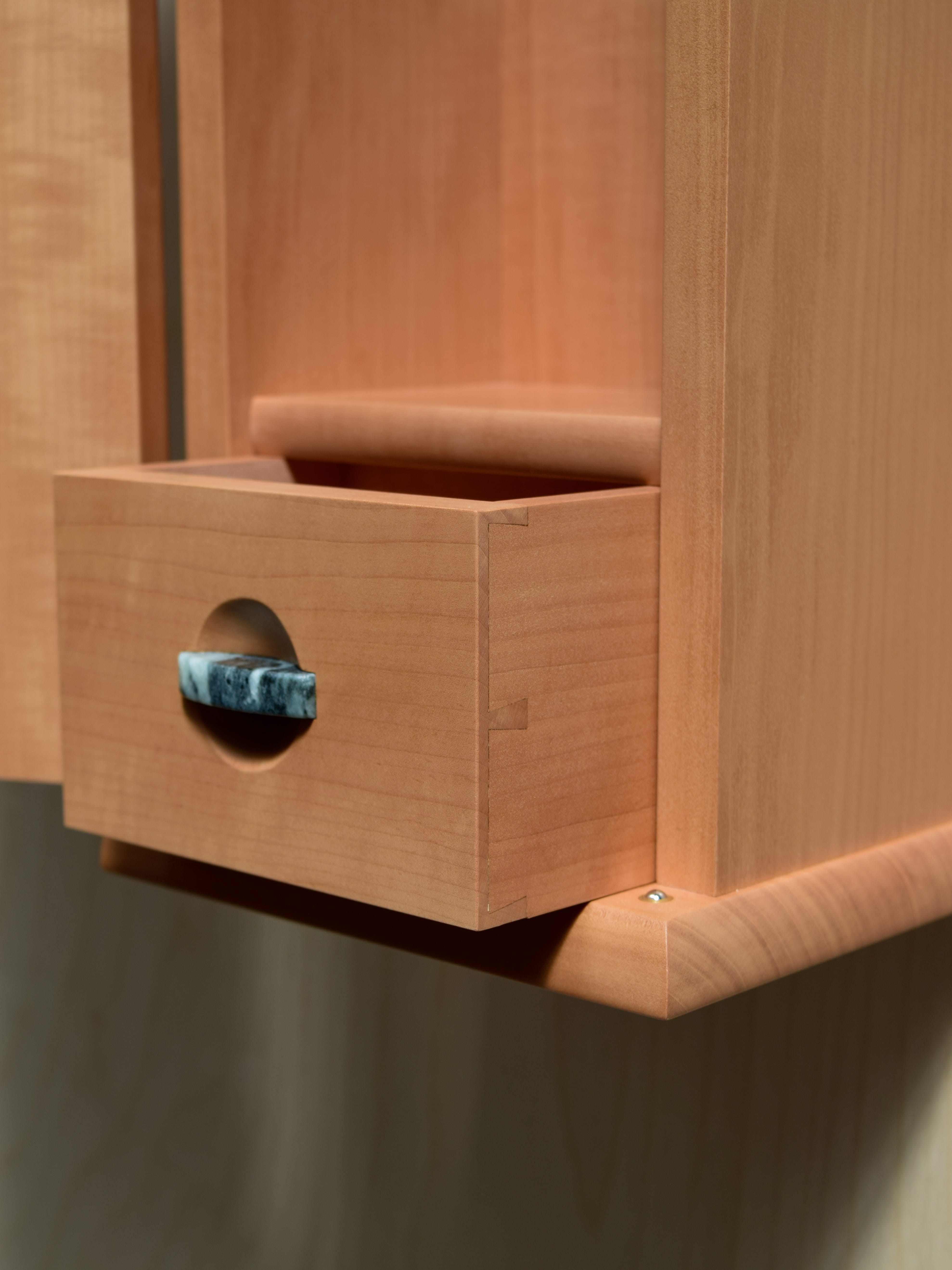
I suggested the following thought experiment: imagine two dovetailed boxes. The first has poorly selected grain, weirdly partitioned tails and pins, and stock that is far too thick for the size of the box. However, the dovetails are absolutely perfect, every joint is crisp, and the surfaces are perfect.
Contrast that with the second dovetailed box which contains harmonious grain selection and pleasing proportions between stock thickness, pins, and tails, but with some gaps and glue stains and poorly prepped surfaces.
I thought the better object is the latter. Of course, both leave much to be desired.
Though I’m not sure we ever reached a conclusion, her thoughts revealed something interesting to me. Design and craftsmanship are heavily intertwined in how a piece is perceived and experienced.
As l’ve started to become immersed within the practices of craft and design in the world of wood, I’ve begun to notice some patterns emerging.
Someone who identifies first and foremost as a craftsman or a woodworker often priorities the quality of execution of a piece. That is, they prioritize the construction of a piece to make sure that the piece is strong, long-lasting, highly functional, and that their demonstration of technical excellence is undeniable. The craftsman seeks to understand wood deeply and uses that material knowledge as the foundation of their practice.
Their work is often perfectionistic, built to be “textbook” correct, and the engineering demonstrates a thorough understanding of wood as a material in the context of wood movement and grain orientation. However, if I may generalize, the craftsman’s emphasis on process may inadvertently steer them to more conservative forms.
In an attempt to build by the book, the craftsman may only build tried and true designs from plans, or may only compose pieces in an established historical style. I suppose the craftsman may do this because the process of building in a particular way and demonstrating mastery of technique is sometimes more important to them than the finished object itself. In essence, the object is secondary to the process. And perhaps even more importantly, the craftsman wants to do things the “right” way, and that way has been clearly paved by the masters that preceded them.
These characteristics of the craftsman are not inherently wrong, and there surely is wisdom to this approach when creating utilitarian objects. However, I believe it leaves much to be desired.
Someone who identifies first as a designer or artist often prioritizes the form itself and the message that the object embodies. Their goal is to create objects which convey an idea, thought, emotion, or message. This work is often evocative and original.
The issue I often find, and please forgive my sweeping generalization, is that the designer/artist often makes work that is so focused on form that it sacrifices craftsmanship. In other words, the form the artist has conceived outpaces their skill in technical execution; thus, the resulting object is often not executed to a high standard and demonstrates a lack of technical and material mastery.
For instance, this is clear when seeing designer furniture pieces made from solid wood with the exposure of short grain and lack of engineering to account for wood movement. Or pieces that lack technical excellence with gappy joints and uneven finishes. These pieces can clearly demonstrate an idea or concept but will not last the test of time. Furthermore, these poor qualities can detract from someone’s experience of the object itself (e.g. my friend’s experience at the museum).
Both the craftsman/woodworker and designer/artist work with wood. Both are formidable thinkers, though the thinking they do is different. I find the craftsman thinks in process while the designer thinks in end result. This siloed thinking often leads to the optimization of one part of the object which unfortunately detracts from another.
The craftsman is so focused on technical execution that they gravitate toward safer forms to preserve their process-oriented making.
The designer is so focused on the object in their sketchbook that they may inadvertently sacrifice the quality of execution of the object to make it a reality.
Though I’ve separated craftsmanship and design to seem like two distinct categories, the reality is that they are deeply intertwined when making things out of wood. In our previous example about the two dovetailed boxes, I implied the choice of grain, stock proportions, and tail/pin ratios are design choices while the quality of joinery and wood surfaces are craft choices. I’m sure we could also make an educated argument for the exact opposite.
Doesn’t the grain orientation, the way the board is sawed, stock proportions, and tail/pin ratios affect the structural integrity and stability of the object?
Can’t the quality of joinery and surfaces be a design choice because seamless joinery or perfectly prepped surfaces are a part of the object’s visual language?
Even choosing to use dovetails in a box is both a craftsmanship and design choice. In my eyes, every choice made about an object is both a craftsmanship and a design choice.
They are not separate. Instead, it becomes a question of priority. Which should influence the other?
To make the best objects, a deep understanding of craftsmanship should set the foundation for design, and not the other way around. In Fine Woodworking magazine, the legendary Tage Frid writes,
“If you combine technique and knowledge of the material, you certainly should be able to make some interesting a beautiful furniture - because if you have this background, you will automatically design around the construction, and not construct around the design. You will combine the two of them, as construction becomes second nature when you are designing.”
I believe this applies to anything made out of wood, but it is especially relevant for furniture because it often serves a utilitarian purpose. Wood is a unique material in that there are many peculiarities that come with working it. It’s an inconsistent, unstable, and mostly-strong-but-sometimes-not material. These qualities must be front of mind when designing a piece.
Creating something out of wood is like writing a message. A good message needs a clear idea communicated with proper written language. I think of craftsmanship as orthography and syntax, which gives us standardized system and basic blueprint for written language. I think of design as the idea; it’s the message conveyed through form.
Without the knowledge of putting words together in a way that makes sense, writers cannot effectively communicate their ideas. In that same vein, a writer who has a great technical command of written language with nothing interesting to say is also forgettable.
When I think back to the writers I enjoy reading, their work doesn’t stand out to me because I actively remember their impeccable grammar and perfect spelling. And I certainly don’t remember the writers who had profound, yet unreadable ideas because I couldn’t even properly decipher their words in the first place.
I remember their work because their technical fluency in written language allowed meaningful ideas to be communicated beautifully.
Similarly, craftsmanship is the foundation of creating an object. It teaches us how the material works and the time-tested methods for construction. It also teaches us what doesn’t work and what will fail over time. Craftsmanship provides us with the technical knowledge needed to physically create amazing things, but it is not the end destination.
I’d go as far to say that technical excellence is the beginning of creating great objects. It should be a baseline expectation in great work. The best objects demand both great craftsmanship and design. And it is impossible to practice just one because they are both deeply intertwined when a foundational understanding and appreciation of material is central to the object.
No posts
Comments
Nothing yet. Say the first thing.
Sign in to join the conversation.