
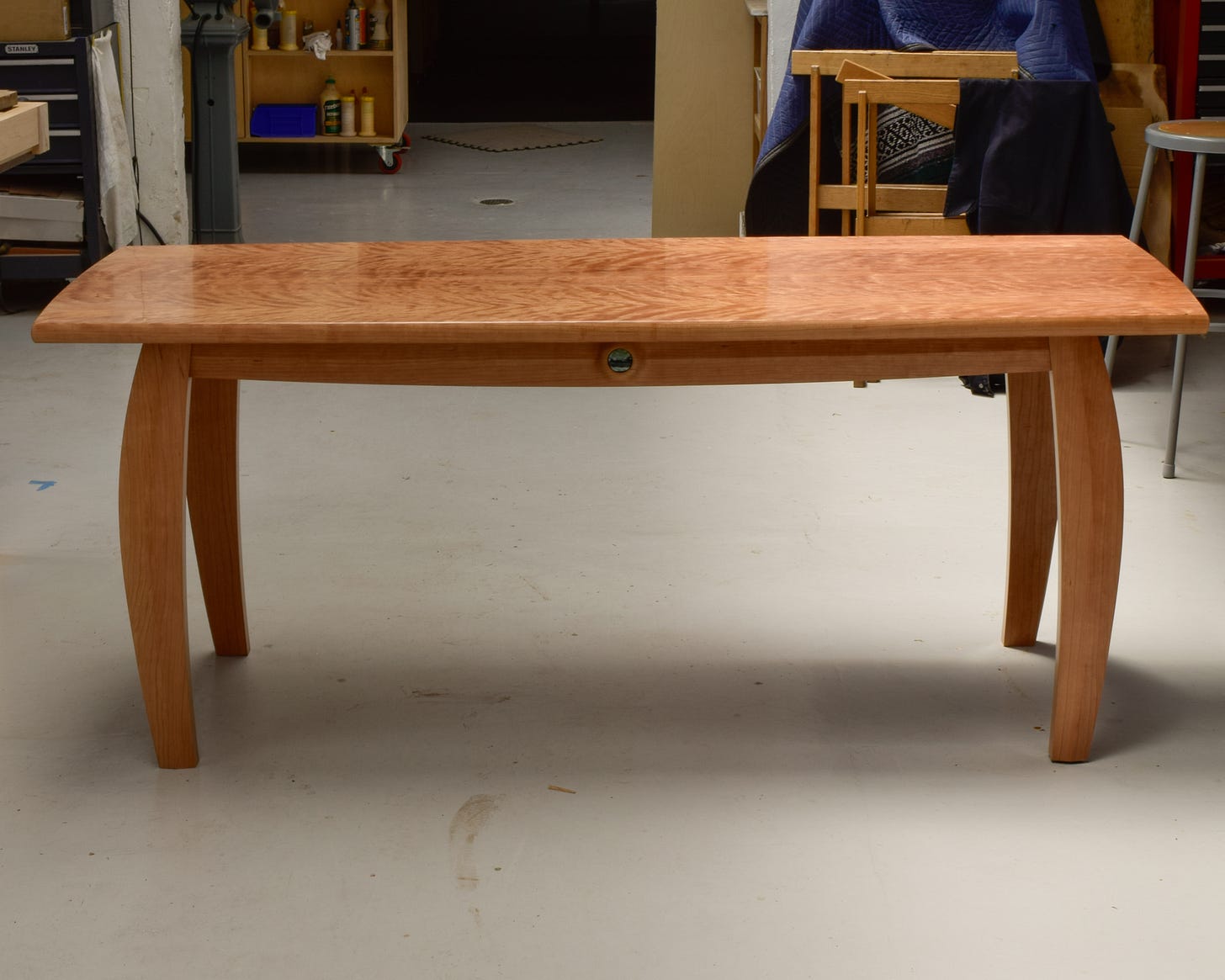
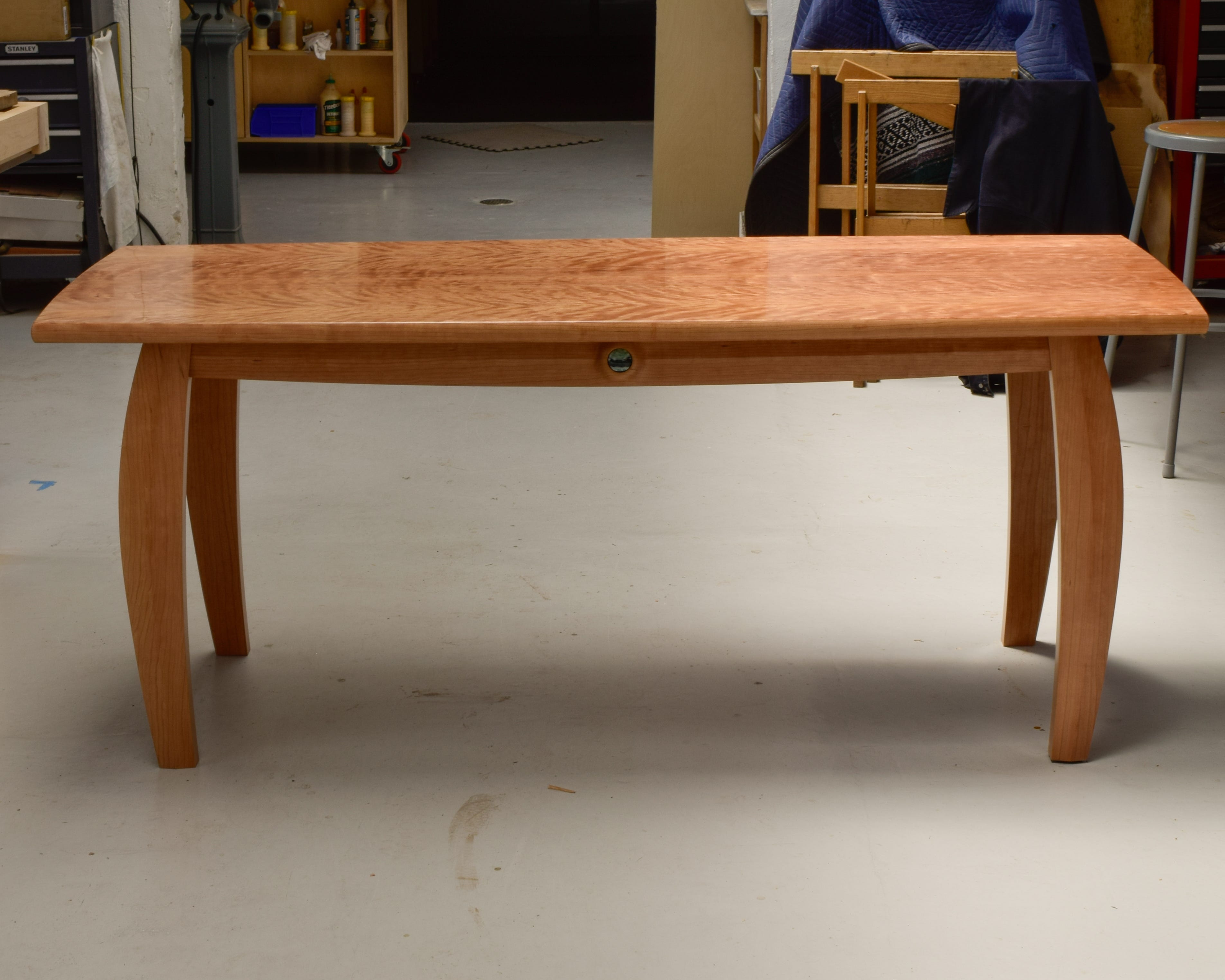
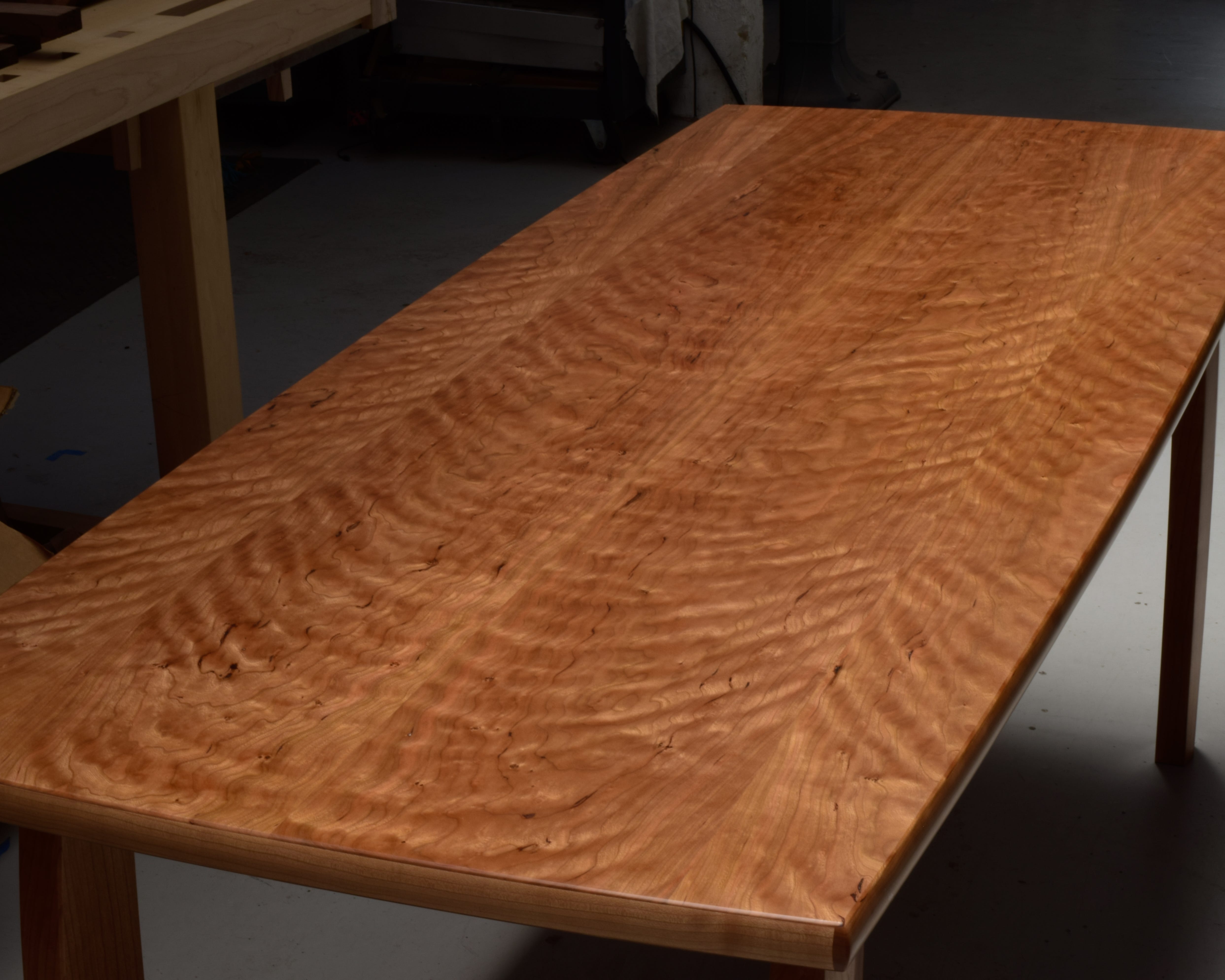
After 119 hours of dedicated work, I’ve officially completed my largest build yet: a sculptural 6-foot table made from curly cherry and soapstone. Some technical details about the build: the boat-shaped top is 72”x 30” made from a lumbercore panel with curved edge banding and bookmatched shop-sawn veneer. The base features sculpted stretchers and legs with multi-routed floating tenon joinery, soapstone inlay, and curved joinery. I created wood buttons to secure the top to the base. I experimented with many techniques for the first time, namely lumbercore, large veneer work, multi-router joinery, and curved joinery. The project was largely a success, and in the process, l’ve learned many lessons.
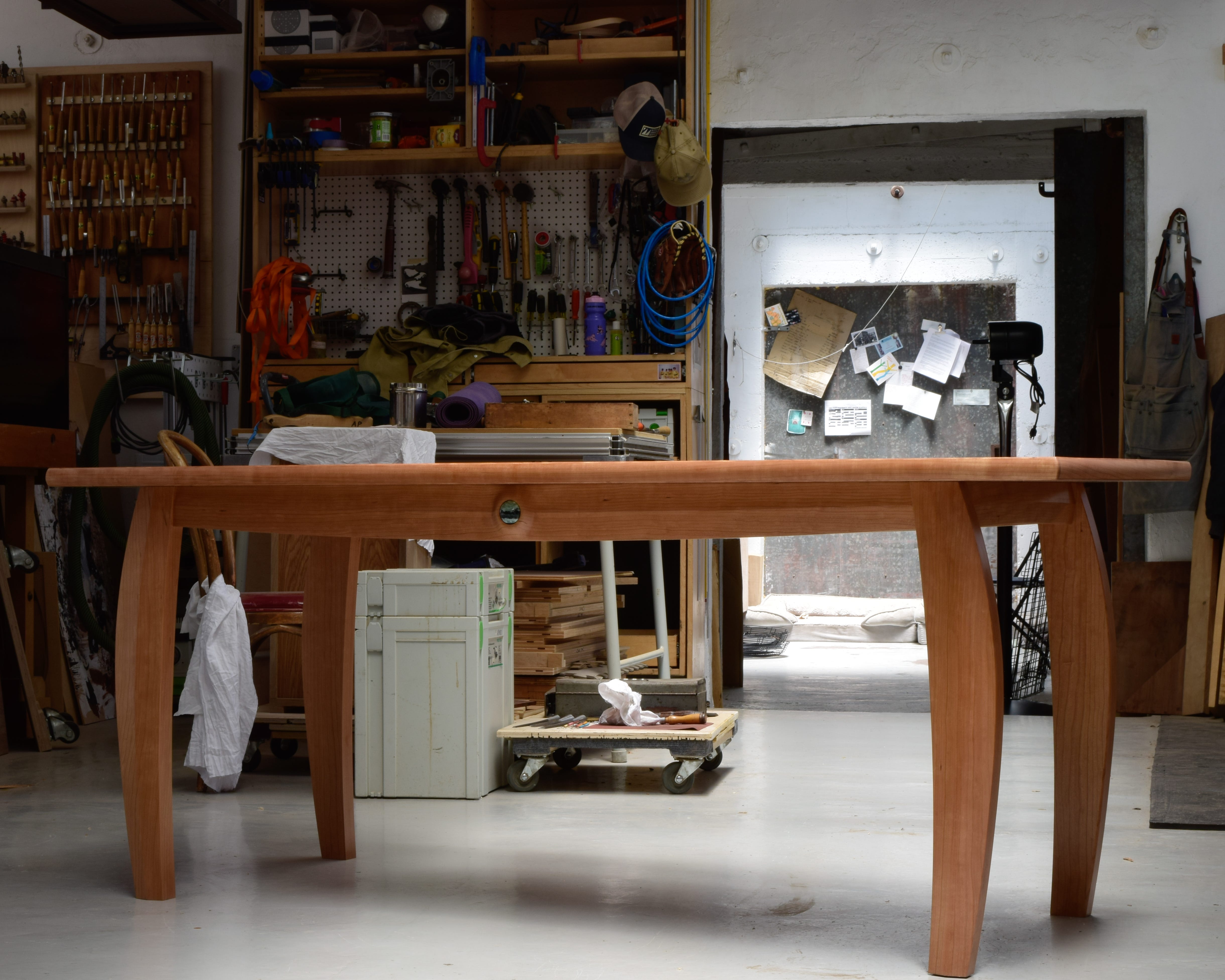
Scale matters. I’ve now been in my current shop for nearly two years at this point in time, and up until this point, l’ve only made small to medium sized objects out of this space. With the size of this table, I knew I’d be pushing the boundaries of what was possible in this shop when creating objects with precision. The table was bigger than my bench, so much of my work on the top was done on our shop’s large table saw outfeed table. This meant being in everyone’s way, including my own for much of the build. Machining a 6+ foot board needs different considerations than milling a piece that is 3 feet or smaller. I can’t just walk up to a machine and throw a large board on it without setting up rollers and triple checking that I have enough clearance on both the infeed and outfeed. Storage is also an issue. In a small workspace, where do you store milled parts? Where do you store pieces while they’re being finished? The length and thicknesses of the pieces were not suitable for many of the tools previously used for other projects, so some creativity was needed to make precise cuts possible on long parts. The tabletop was too large to be flattened through our machines, so final flattening of the panel was done with a hand plane. All of these issues were predictable, and I anticipated scale being an issue for operations and storage. What I didn’t expect was how much that scale impacted the amount of time I’d spend on processes. It did not scale linearly from smaller projects. Simple activities such as planning edge banding flush to the panel took nearly an hour, versus something that would normally take 10-15 minutes. Everything took way longer. This was partly due to there being more material, but the true reason was that my infrastructure such as work holding, bench space, and tools were all set up for a smaller size. The larger sizes required some creative solutions and extra steps to get the same job done.
Wood is going to act like wood. I originally thought that lumber core was going to be my saving grace for a flat, lightweight tabletop. The promise of dead flat panels, any thickness I wanted, that was lightweight and technically “solid wood” was quite enticing to me. For the most part, the technique actually delivered. The panel was the exact thickness I wanted, it was light enough for me to carry around comfortably which was essential for doing this build by myself, and it was fairly flat. I say fairly flat, because it was not dead flat. I anticipated the size of the panel, combined with my platen being a single sheet of melamine as opposed to a torsion box would introduce some error. Additionally, my drum sanded veneers had slight variation in thicknesses, so the veneer field seams were already not perfectly flush. Two hours of hand planing flattened both sides without much issue. With that hard work behind me, I thought that the panel was going to stay totally flat for the rest of time. We got a heat wave that swept through the shop, along with some sporadic showers. Those fluctuations in weather caused the panel to slightly cup, then relax, then cup again. Across 30”, the cup was about 1/32” at its lowest point. At that point, I had begun applying finish so I decided to make peace with the fact that the panel was not going to stay dead flat. Besides, that was likely a better result when compared to a traditional solid wood table top. It was somewhat disappointing, but also a reminder for me that wood will act like wood, even if we do our best to engineer our pieces for stability.
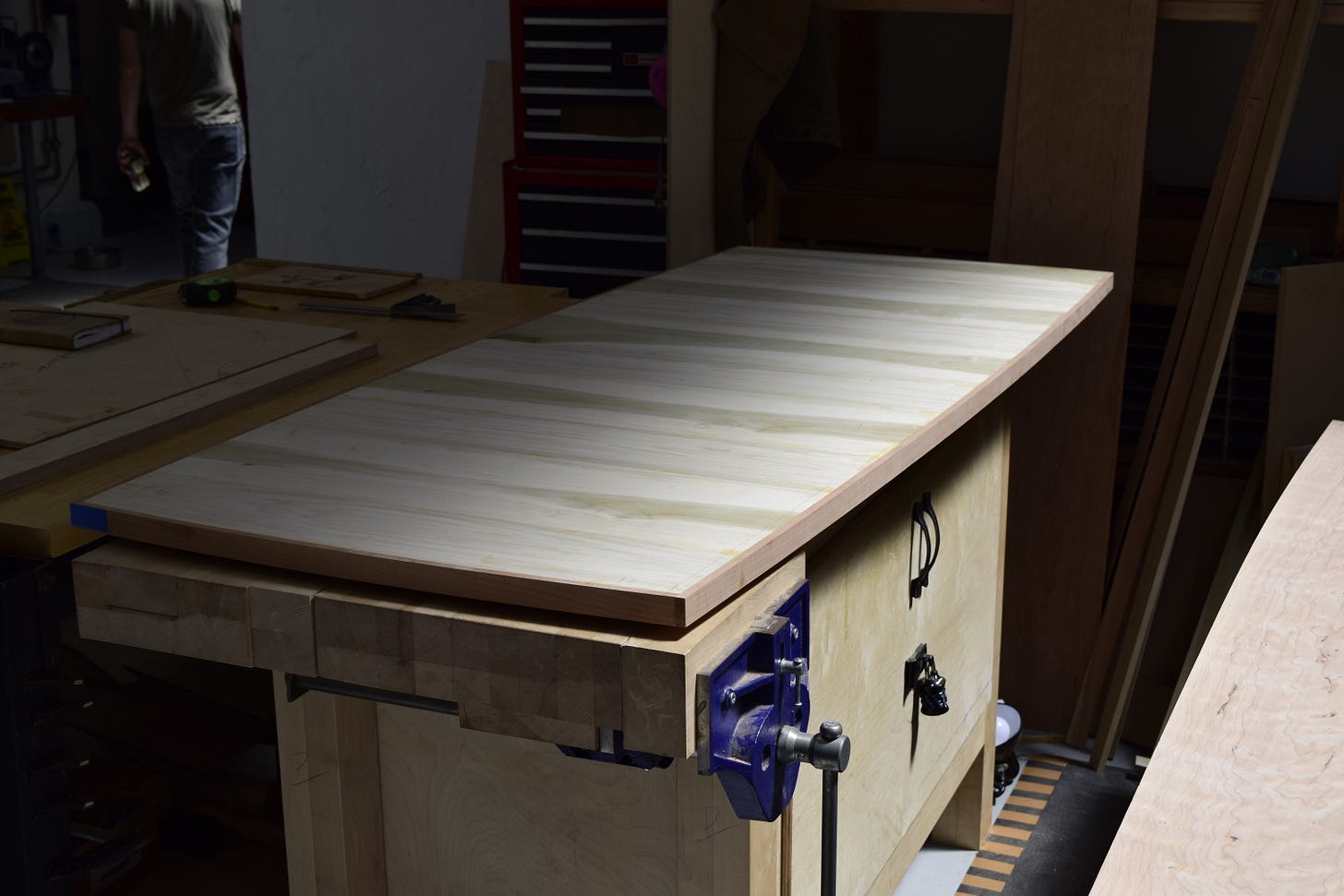
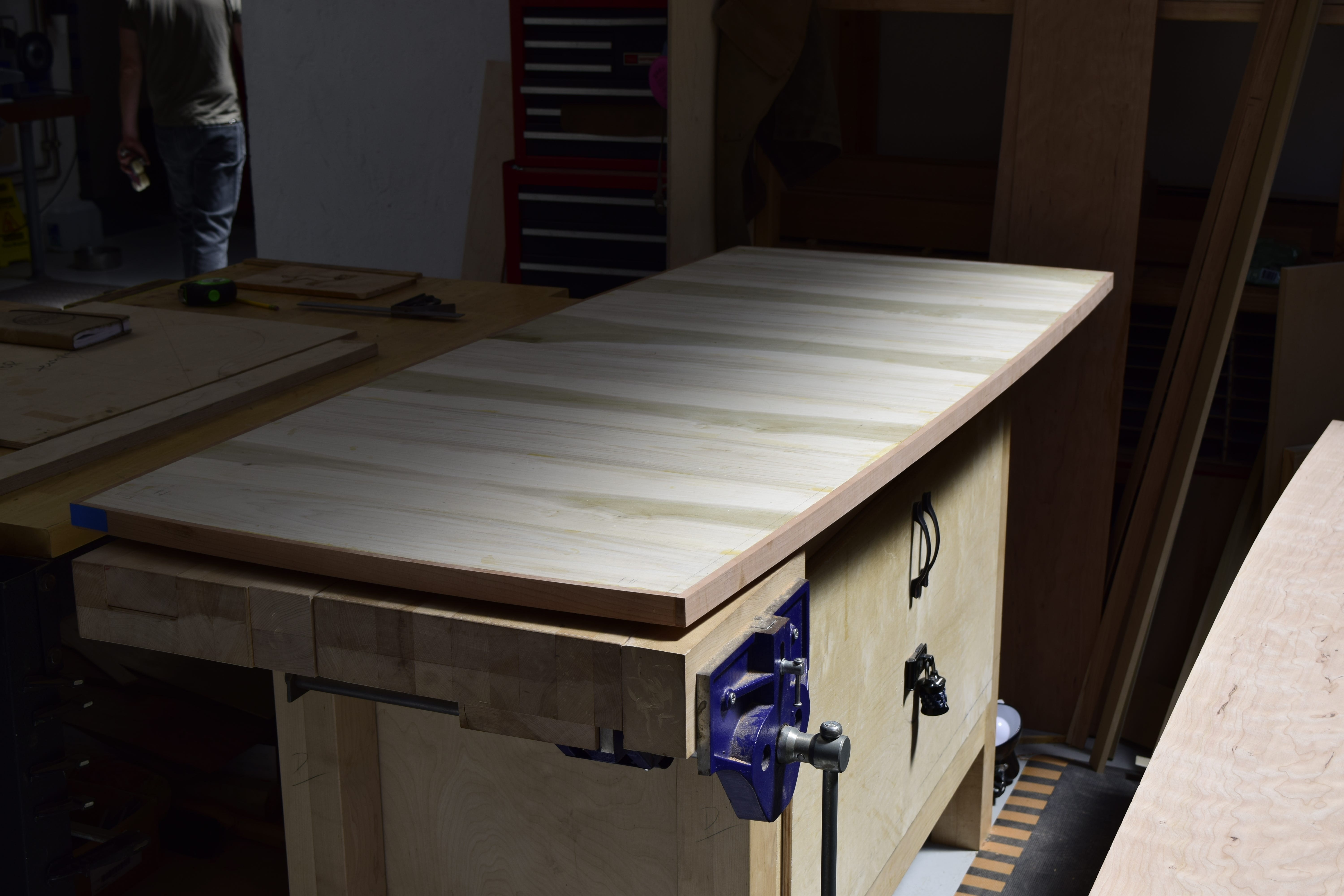
The lumbercore tabletop panel without the face veneers on. The poplar crossbanding is visible. Creating large, sculptural objects is a deceivingly physically intense process. What’s deceiving is that the actual motion of using a blockplane, card scraper, spokeshave, or block with sandpaper isn’t that demanding in isolation. However, do that for many hours a day for weeks on end and it is a whole other ordeal. I spent nearly 13 hours sculpting with hand tools and over 40 hours on surface prepping, finishing, and wet sanding. When I time myself, I pause the timer for short breaks that I take when I get fatigued. In other words, the times that I’ve shared are actual working man-hours. Typically, I can sculpt or sand continuously for about an hour before I need a 10 minute break. On most weekdays, I’d do about 3-4 hours of dedicated sculpting or sanding. Most weekends were around 5-6 dedicated hours. The movements themselves weren’t difficult, but after thousands of repetitions in a session, the fatigue eventually catches up to the body after two and a half weeks straight without rest days. I don’t say this as a “woe-is-me” story; instead, I actually found it to be a fascinating learning experience. This was a situation where I was thoroughly enthusiastic to get to work day after day. But my body did not like it and that was the limiting factor in how much I could work in the last stretch of the project. The fatigue I experienced was also interesting, and not something I’d experienced before. It didn’t feel like l just went on a run or had a heavy lifting session. I didn’t have sore muscles. Just heavy, tired ones. Picking up the tools again the next day felt all too familiar to the hands, to the point it felt like my fingers were begrudgingly molding to my tools. At 24, I’m at an interesting point in life right now where I am actively noticing my body stop being so accommodating of bad habits as it was when I was just 4-5 years younger. A week of unhealthy eating or bad sleep can be felt immediately. But I’m not at the point where I’m reaping the consequences of decades worth of injuries and bad habits. I’ve mentioned in a previous article that my decision to become a professional has completely changed the way I take care of my body. A lighter exercise regimen, stretching, nutrition, and sleep have become major priorities for sustaining my body as I put it to work every day. In spite of that, I am still trying to find a balance between rest and physical work for the body.
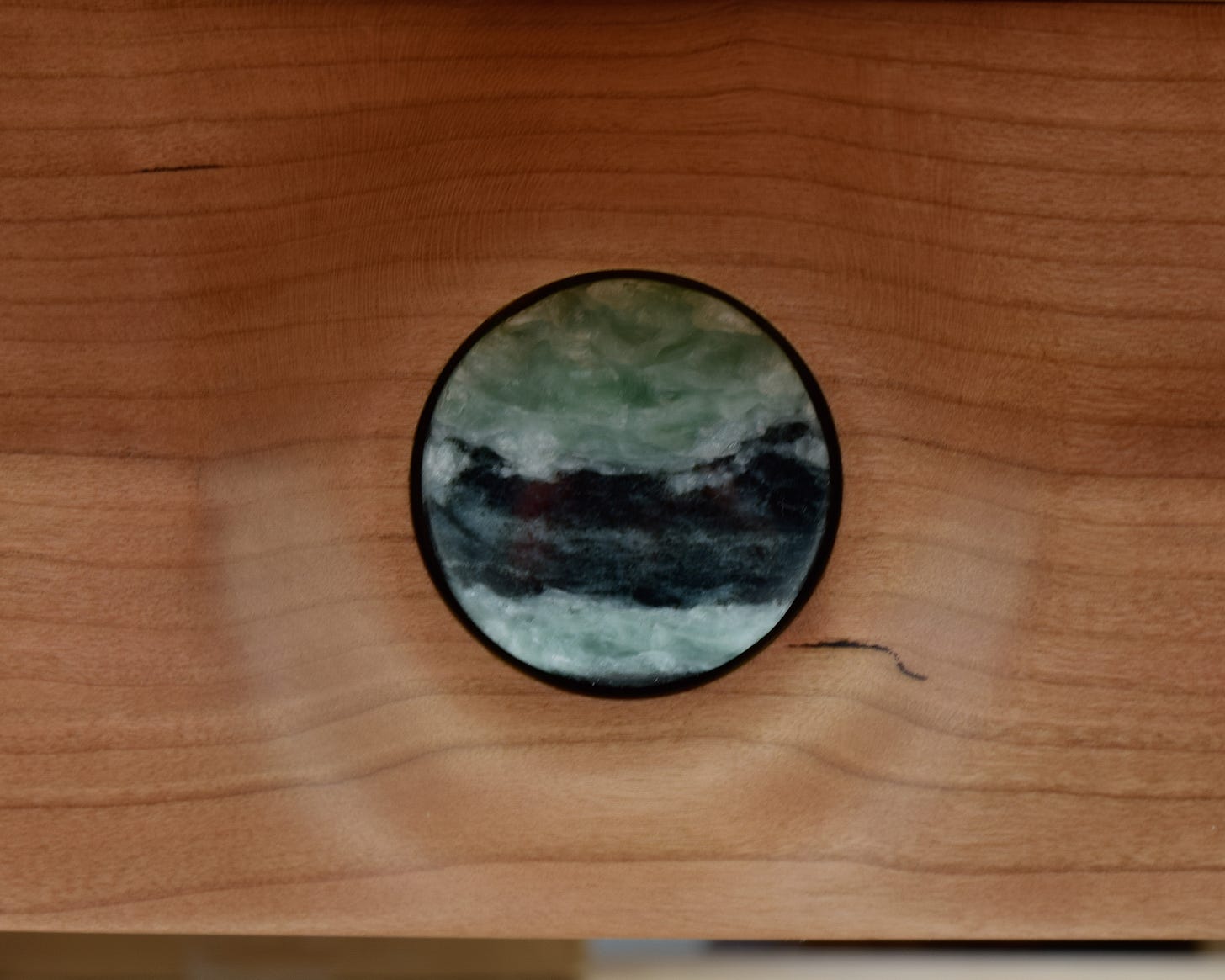
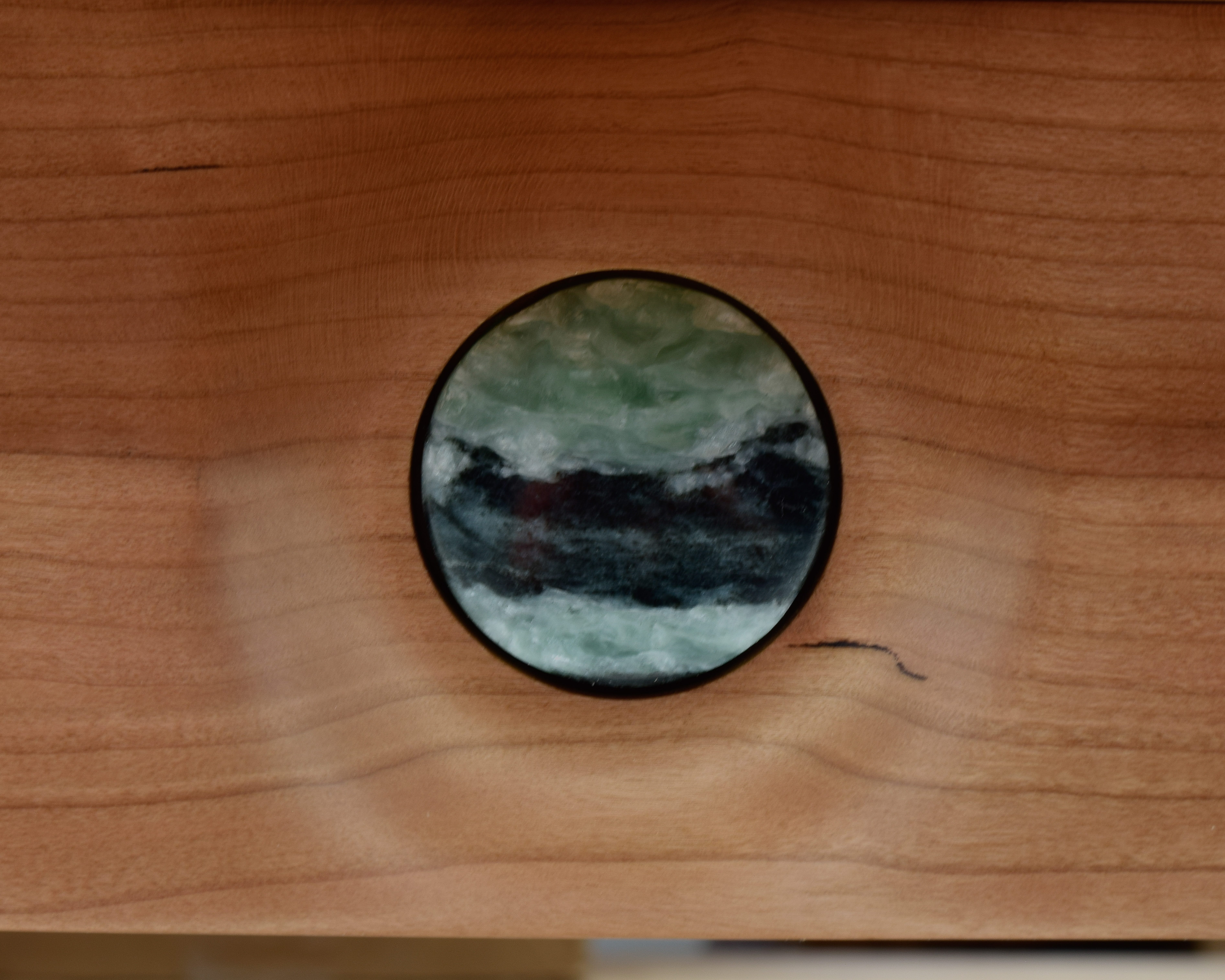
A close-up of the soapstone sculpture Veneering is a tremendous skillset to master. I have dabbled with basic veneering in a few of my other builds, typically for the back panels of some of my casework. Early in my journey, I stayed away from veneer as I erroneously believed that veneer was inferior to solid wood. In present day, that mindset has gone almost 180 when working with shop-sawn veneer, as it has the stable properties of veneer, yet is thick enough to work like solid wood. Shop-sawn veneer opened up a whole new world that I was previously not aware of. It allows me to play with grain in ways that I could not efficiently do before. This was the first build that I used a vacuum press. That tool is absolutely incredible. It has opened up a world of possibilities that I am thrilled to explore. Veneering stands out to me as an area that I must develop further technical fluency in. I sense that veneered bent laminations and experiments with complex or unusual grain compositions will be key in future work.
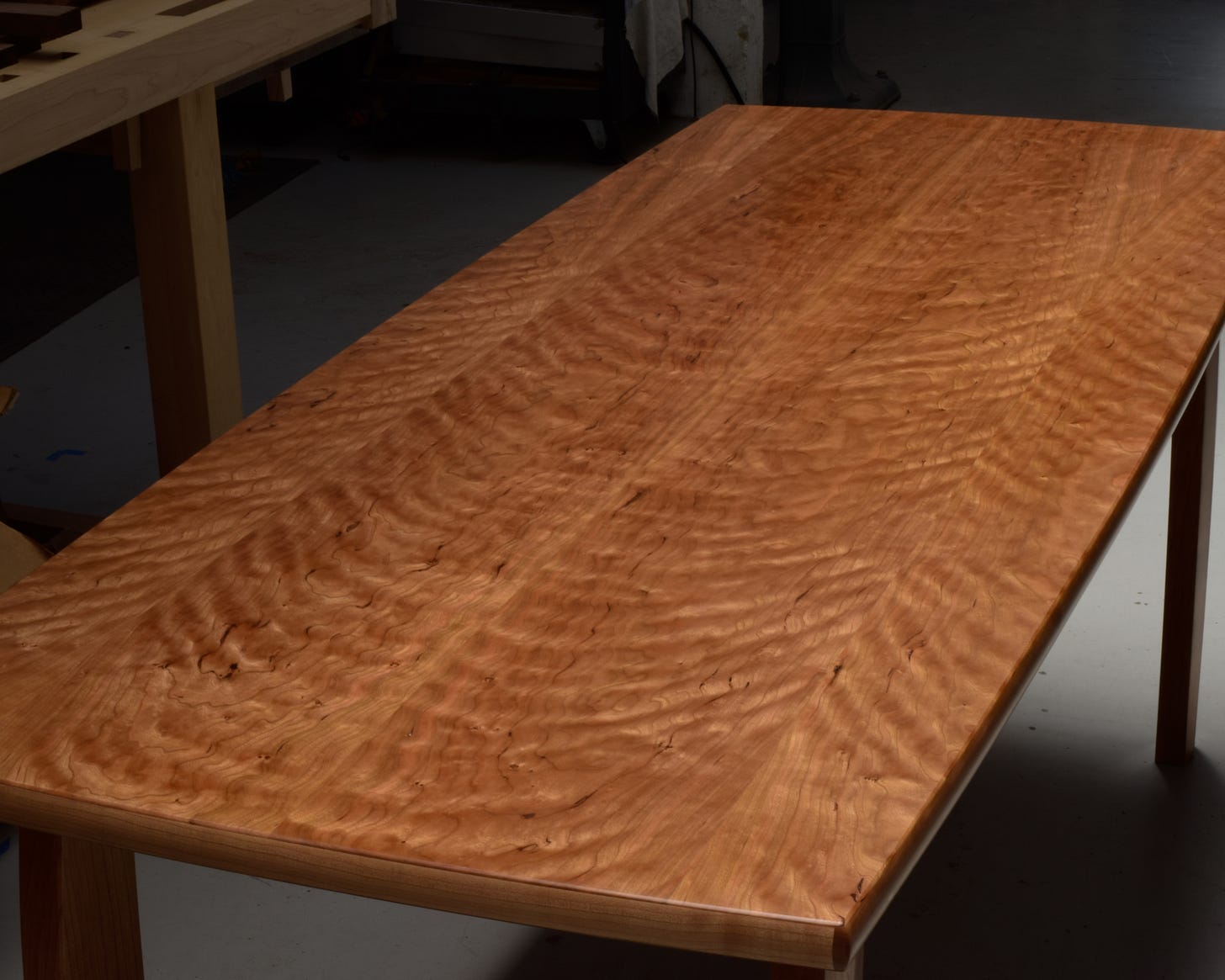
Book-matched top with shop-sawn veneer. Seams were shot with a handplane.
More important than anything I learned technically, this project clarified what I actually want to spend my life making. I do not have a burning desire to continue exploring furniture. I have loved my journey thus far with making furniture, as it has allowed me to practice making objects that serve an easily defined purpose. I believe that all of my future work will have a purpose and a use. But, furniture is historically considered to be quite utilitarian and it is generally expected to serve a particular purpose. The purpose and function of a piece will always influence its form and proportions. I am finding that the purpose of furniture to be used in a utilitarian way makes me less interested in making these objects. As I continue my journey as an artist, I find myself more compelled to make highly technical sculptures and conceptual art that is interactive, similarly to furniture. However, the purposes the work will serve will be highly specific, novel, and even impractical. The practice of furniture making has allowed me to learn the language of precision, workflow, and designing for the physical body. I would now like to use that same language as a foundation to compose different works. I am not writing off making furniture for the future, but I am excited to explore this new direction for the remainder of 2026.
No posts
Comments
Nothing yet. Say the first thing.
Sign in to join the conversation.