
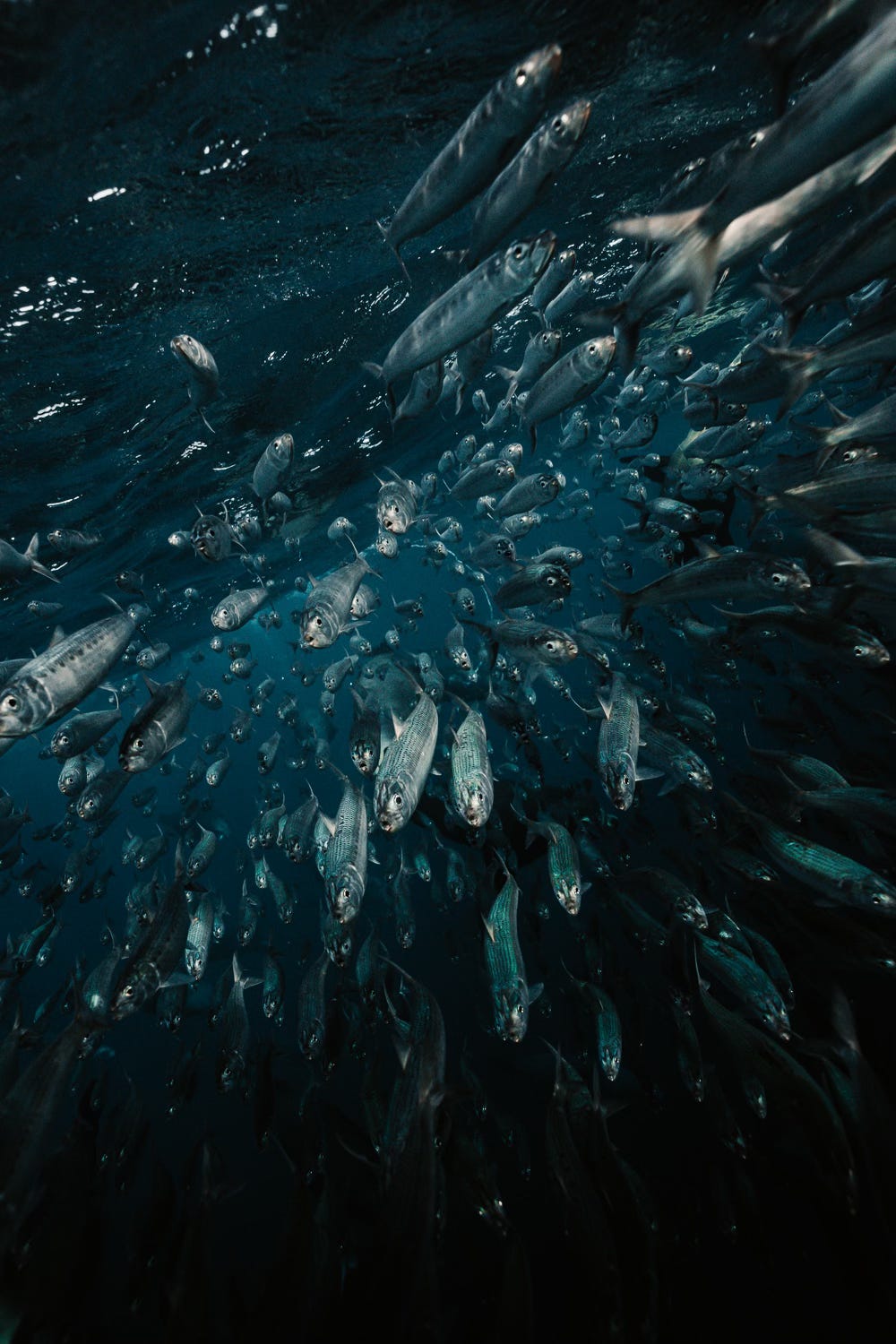
Here, I barely have time to think. Everything happens too fast, I have to lean on instinct, on years of expeditions before this one. The water is cold, but not freezing. I check myself as If I was my own dive buddy “fins ok”, “weights ok", "camera ok”. The ocean is rough and all I can see is other boats, people in the water and birds everywhere. Pure chaos. Everything blurs past my eyes before I can process it and I feel confused if I should keep my face out of the water for a moment to understand what’s going on.
Until…
The moment I put my head back down.
Two hundred sardines, right in front of me.
The instant they see me, they turn and shoot straight toward me! My heart slams. I lose my breath even though the snorkel is still feeding me air, and somewhere behind me, I hear:
“Maya, get back, get back, get back!”
It’s almost impossible. The sardines want my body and my hand is exactly where it should be: on my camera’s the shutter button.
Welcome to Wild Wednesdays! Once a week, I share the true story behind the photo.
MAGDALENA BAY, MEXICO
I was co-hosting an expedition in Bahía Magdalena, on the Pacific side of Baja California Sur, Mexico, a stretch of coast that, for a few weeks each year, turns into one of the most hectic buffets in the ocean.
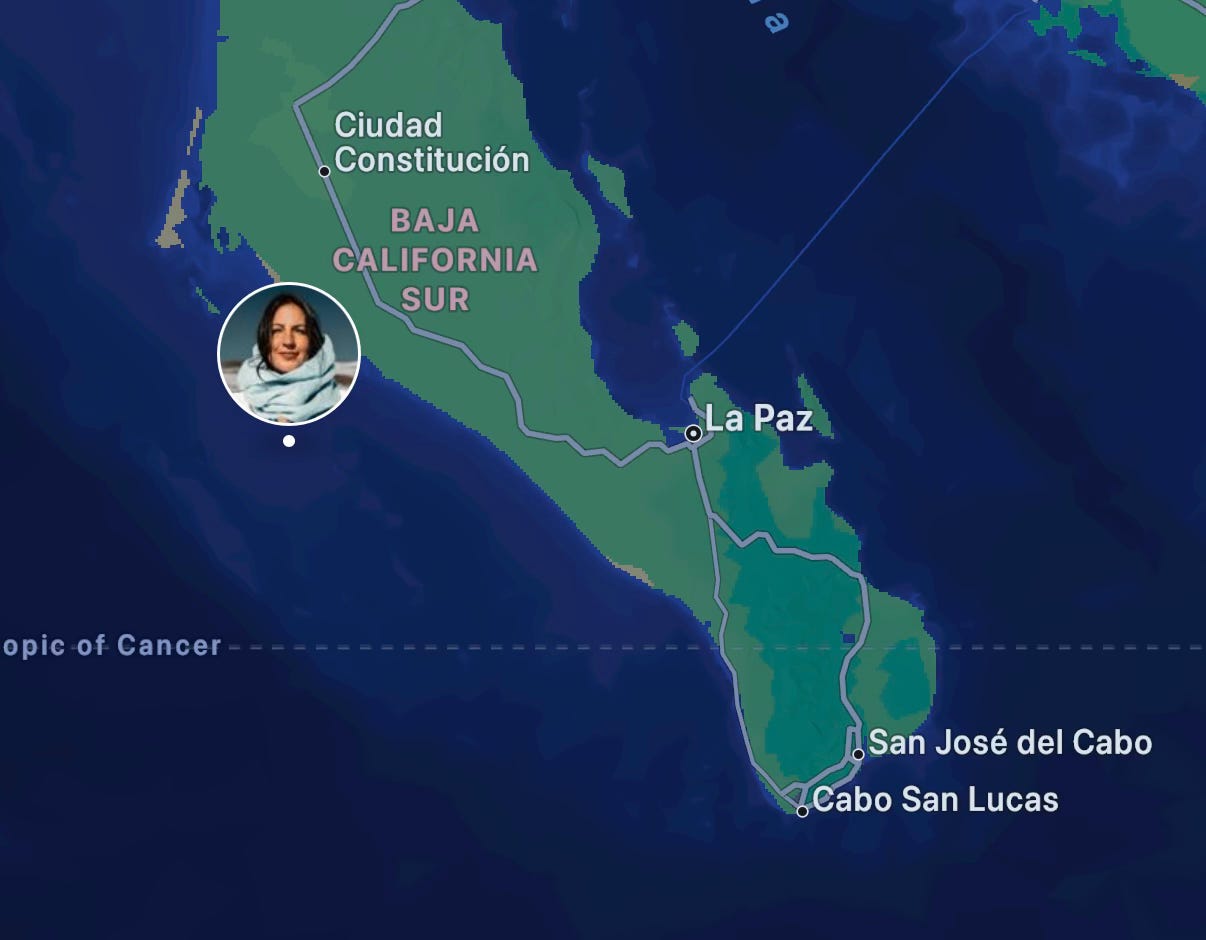
Most people who’ve heard of Magdalena Bay know it as a gray whale nursery, calm water where mothers bring their calves to nurse in the shallows. But offshore, in the open blue, a different season is happening at the same time: sardines, moving by the millions, and everything in the ocean that eats sardines, following close behind.
What I was floating in wasn’t just “a lot of fish.”
It was a bait ball: the sardines’ last line of defense.
Alone, a sardine is nothing. But together, thousands of them move as a single silver organism, shifting shape so fast and so uniformly that a predator’s eye struggles to lock onto any one fish (pretty genius!).
There’s no leader organizing it, it’s in fact a physics problem solved by biology. Each sardine reacts in milliseconds to its neighbors, the whole mass bending, splitting, and reforming around whatever is trying to kill it.
And a lot was trying to kill it!
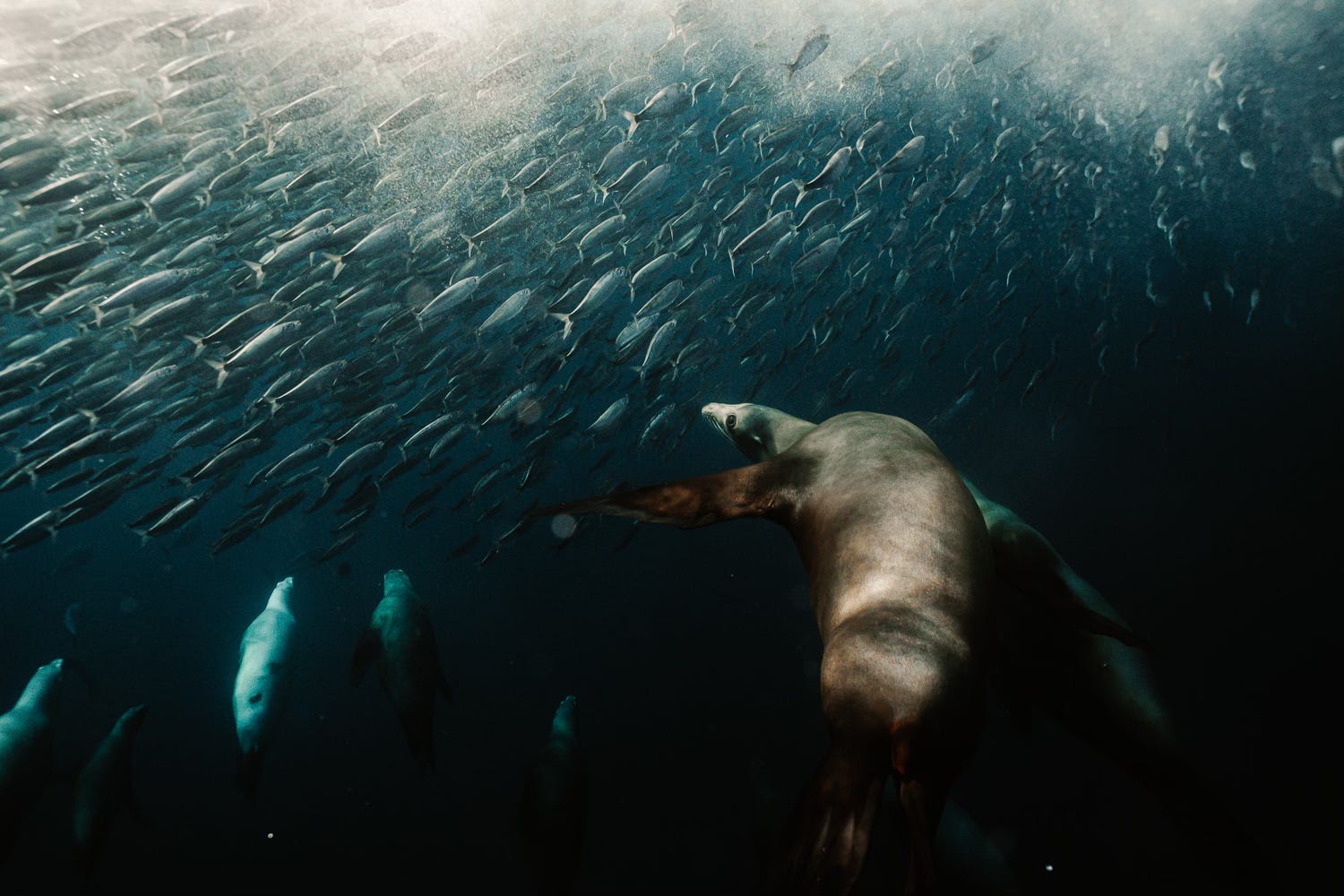
Sea lions barrel in first, fast and reckless.
Dolphins work the edges, herding.
Birds hit the surface like thrown spears.
And underneath it all, the ones built for exactly this: striped marlin, among the fastest fish in the ocean, cutting through the ball with a bill designed to slash, stun, and pick off the wounded.
This is why the sardines ran at me, I wasn’t the target, I was just in the way of a much older dynamic.
When a bait ball is attacked from multiple sides at once, it has nowhere “safe” left to bend toward. For a few seconds, that direction was mine.
What felt like being chosen (hundreds of fish reading my black wetsuit as somewhere to hide) was really just survival math. And then I was standing in the middle of that math, with real odds of becoming collateral.
Fear and absolute fascination were happening in me at the exact same moment, and neither one canceled the other out. I was scared and I was fascinated! And, at the same time, some quieter part of my brain was doing math of its own: predator confusion, escape vectors. Both were true.
Well I thought that was the whole story…
It wasn’t.
By the time the second bait ball formed, I thought I’d found my rhythm.
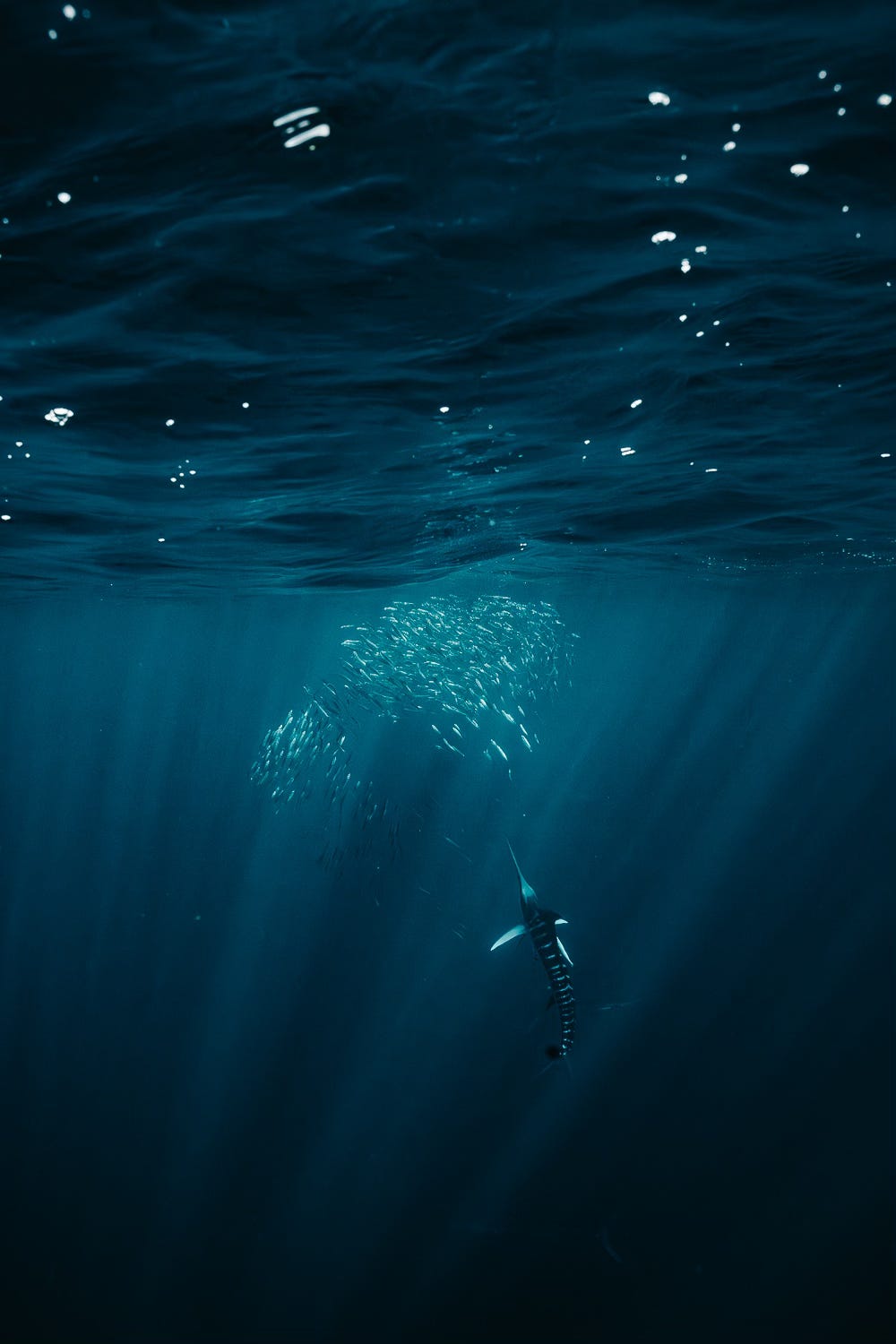
This one felt calmer. When you find a static ball, you can just watch it underwater like it’s a nature documentary playing on your living room TV. It hangs there, an IMAX screen made of fish. As with every encounter, I’d put a safe distance between myself and the beautiful chaos. But these are wild animals, they move when they want to move, and sometimes you have to react just as fast as they do.
Out of nowhere, the marlin arrived.
I’d cited their speed in lectures, but nothing about knowing the number prepared me for watching it happen in. front. of. my. nose.
My hands were shaking around the camera. Pure adrenaline.
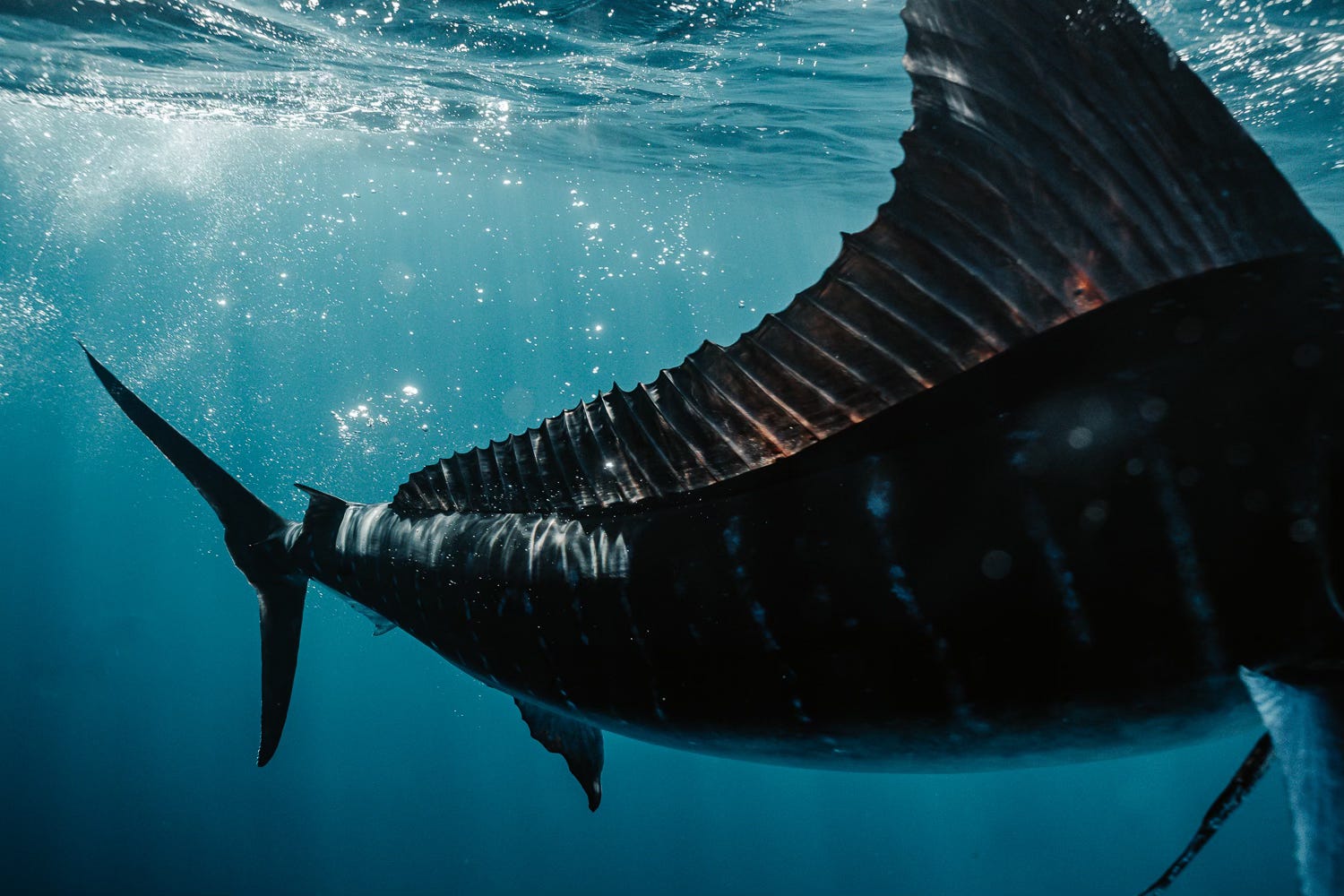
I was so locked onto the shot, framing, focus, waiting for one marlin to break clean from the school, that I stopped tracking anything else. It came close enough that the photo I took in that same instant still makes my stomach drop when I look at it: this shot was taken mere milliseconds after its bill turned away from my face. They're fast, but they know what they're doing, or at least, they're just as fast at redirecting their bodies.
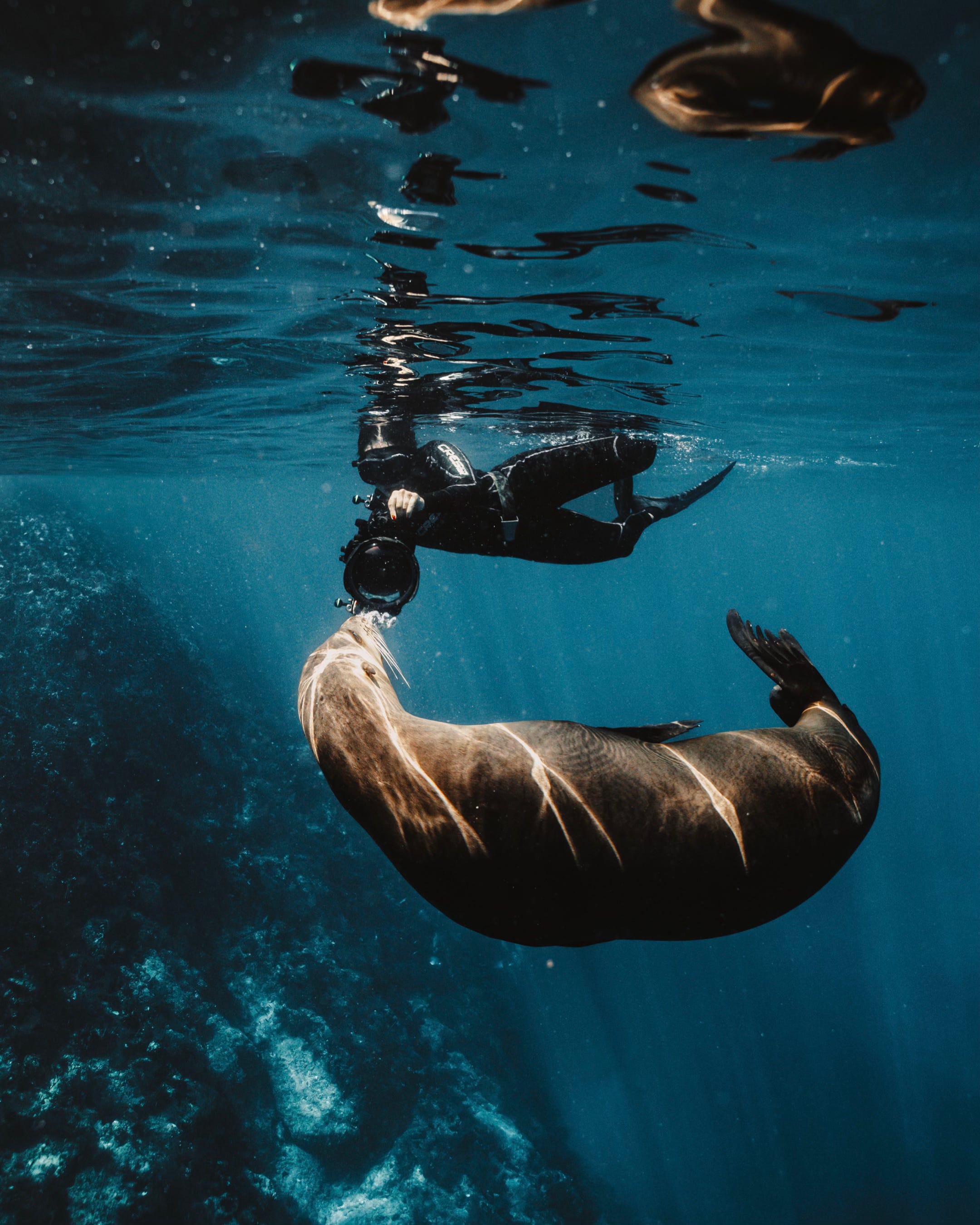
I know this story sounds like a lot. But if I’m honest about what scared me most that day, it wasn’t the sardines, and it wasn’t the marlin. It was the fishing boats working that same stretch of water. Watching them, I couldn’t stop thinking about what they represent: an industry still pulling hard from an ocean we’ve barely started to protect.
And still, I felt lucky.
To watch predator and prey collide like that, raw and complete, is a privilege most people never get.
To catch it on camera is rarer still.
And having guests beside me who felt the same awe I did, who understood exactly what they were looking at, made it even more so.
A quick note, for anyone already imagining themselves there: this particular expedition is built for advanced swimmers, run under strict safety protocols with guides who’ve done this for years and knows how to approach. That’s what it takes to be ready for a day like this one, and it’s exactly the kind of trip I hope to bring more of you on.
Because here’s what I keep coming back to:
the more people who see this dynamic up close, its wildness and its order, its intensity and its beauty, the more defenders the ocean gains. I’ve watched it happen to the people who’ve dived with me. I believe it’ll happen to you too.
So if you made it all the way until here, I have an invitation: find the nearest body of water to you this week (ocean, river, lake, whatever you’ve got) and go stand at its edge for five minutes. Then come back here and tell me what you noticed. What’s the dynamic between the species you watch? You can also bring me a photo taken from your phone.
I read every comment, and I reply to as many as I can.
Every story I write starts with a good cup of coffee. This piece took me 3 days and 3 cups. If this one moved you, thank you for buying me the next cup ☕☺️
No posts
Comments
Nothing yet. Say the first thing.
Sign in to join the conversation.