
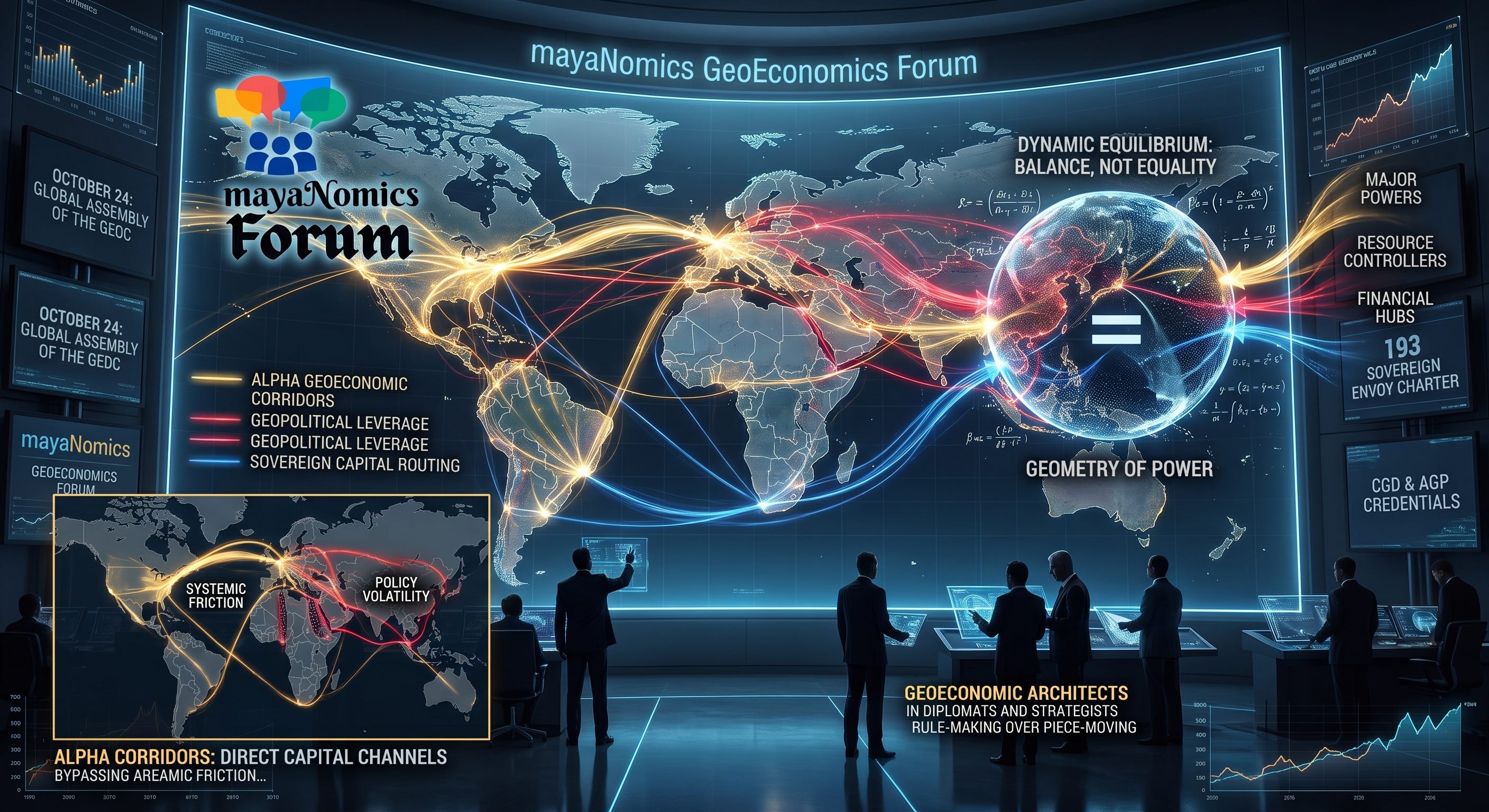
The world as a market can be either beautiful or brutal, depending on which side of the equation you are. The global market is a paradox of design: to the uninitiated, it is a brutal meat grinder of sudden systemic shocks, policy shifts, and capital erosion; to the geoeconomic architect, it is an elegant playground of strategic leverage. Which side of that equation you occupy determines whether you extract value from the global order or are consumed by it.
Consider the mathematical illusion that underpins our modern understanding of stability. In formal logic, theoretical physics, and quantitative finance, the equals sign (=) rarely denotes absolute, ontological identity. It represents dynamic equilibrium. Two wildly volatile, asymmetrical forces are approximated to one another only by holding specific variables artificially constant within a controlled vacuum. When a mathematician writes Q.E.D. (Quod Erat Demonstrandum) at the end of a proof, they have not eliminated the underlying entropy of physical reality; they have merely validated a theorem under a highly specific, idealized set of constraints.
Macroeconomics, statecraft, and international finance operate under this exact law.
For decades, global institutions operated under the comforting myth that certain economic parameters were permanent, universal constants: open capital markets, rules-based trade, frictionless supply chains, and predictable fiat currencies. But in real-world statecraft, “equality” is an idealist’s fiction; the world runs entirely on a shifting balance of power.
When those underlying parameters shift—when supply chains are weaponized, currency rails are restricted, or trade treaties are unilaterally rewritten—the idealized equations fail. The logic that justified an investment thesis or foreign policy strategy yesterday becomes dangerously obsolete today.
I: The Decay of Systemic Constants
The central flaw of modern strategic planning—whether in foreign service institutes, sovereign wealth boards, or multinational C-suites—is an epistemological trap: confusing a temporary political equilibrium with an immutable law of nature.
For three decades, global commerce was modeled on a series of assumed constants (k). Economists, investors, and diplomats built their entire operating architectures on the assumption that certain baseline conditions would remain frozen in time:
Unrestricted Capital Velocity: The belief that money could move freely across borders via standardized clearing rails (like SWIFT) without sudden, unilateral jurisdiction locks.
Neutral Financial Infrastructure: The assumption that reserve currencies, global clearinghouses, and maritime transit lanes were public goods, immune to weaponization.
Contractual Inviolability: The faith that international legal frameworks, sovereign debt covenants, and intellectual property regimes held fixed, universal definitions across all borders.
In classical physics, when you hold k constant, your equations work predictably. In global statecraft, however, these k-factors were never actual constants; they were geopolitical variables (v) held still by a temporary, dominant balance of power.
When that balance shifts, those pseudo-constants unfreeze overnight.
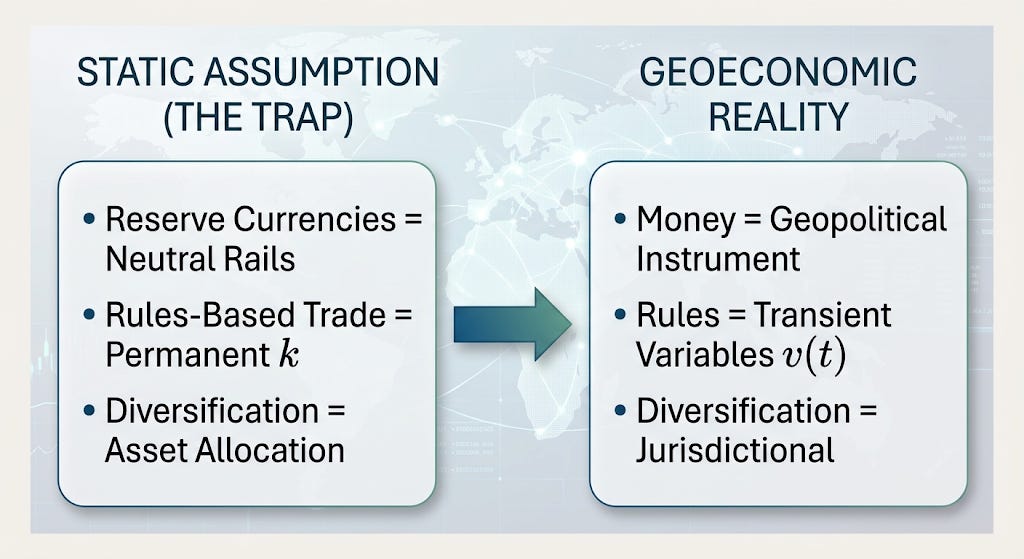
This decay of systemic constants explains why 90% of wealthy family fortunes dissipate by the third generation, and why legacy corporate conglomerates collapse during global transitions.
First-generation wealth builders operate with raw, opportunistic instinct—they intuitively grasp the unwritten rules of leverage in their specific era. Second-generation stewards consolidate, formalizing systems to optimize yields within those established rules. By the third generation, the stewards no longer understand how the board was built; they treat the existing rules as unshakeable reality.
When a systemic regime shift occurs, these institutions continue optimizing for a game that is no longer being played. They hold nominal assets (real estate, paper equities, fiat bonds) inside a single regulatory or jurisdictional container, completely oblivious to the fact that the actors controlling the perimeter are altering the parameters of ownership itself.
When a geoeconomic flash flood strikes—whether through sudden sanction regimes, algorithmic trade blockades, weaponized tariffs, or currency re-denominations—traditional portfolio diversification fails entirely. In a systemic shock, all asset classes pegged to the failing infrastructure correlate to 1.
Passive actors, relying on static rules, are liquidated. They are left holding legal titles to assets in jurisdictions where those titles no longer carry force, or holding capital locked behind rails that no longer clear.
The geoeconomic architect, by contrast, operates on the assumption of inevitable systemic decay. They do not seek static safety within a single system; they build structural arbitrage. They position capital, supply chains, and legal mandates across multiple, complementary jurisdictions—designing architectures that extract yield during periods of stability and automatically reroute value when systemic constants unfreeze.
II: The Fallacy of the Game Board
Popular business literature and diplomatic commentary routinely rely on a simplistic strategic trope: “While others play checkers, you must play chess.”
While calculating moves in advance on a two-dimensional grid is certainly superior to remaining an unthinking piece slaughtered in supply-chain disruptions, the metaphor suffers from a fatal structural flaw: if you are playing chess, you are still operating inside a closed, bounded system whose rules, pieces, and victory conditions were written by someone else.
In standard chess, the board remains an invariant 8 X 8 grid. A pawn moves forward; a rook moves along orthogonals; the boundaries are absolute. But in contemporary global statecraft and macro-finance, the board is neither static nor two-dimensional. The dimensions expand without warning, the pieces mutate mid-game, and the player across the table retains the unilateral ability to tip over the board, re-define what constitutes a checkmate, or charge you an exorbitant toll merely to keep your pieces on the squares.
To rely on conventional game-theory models inside a volatile world order is to invite strategic paralysis.
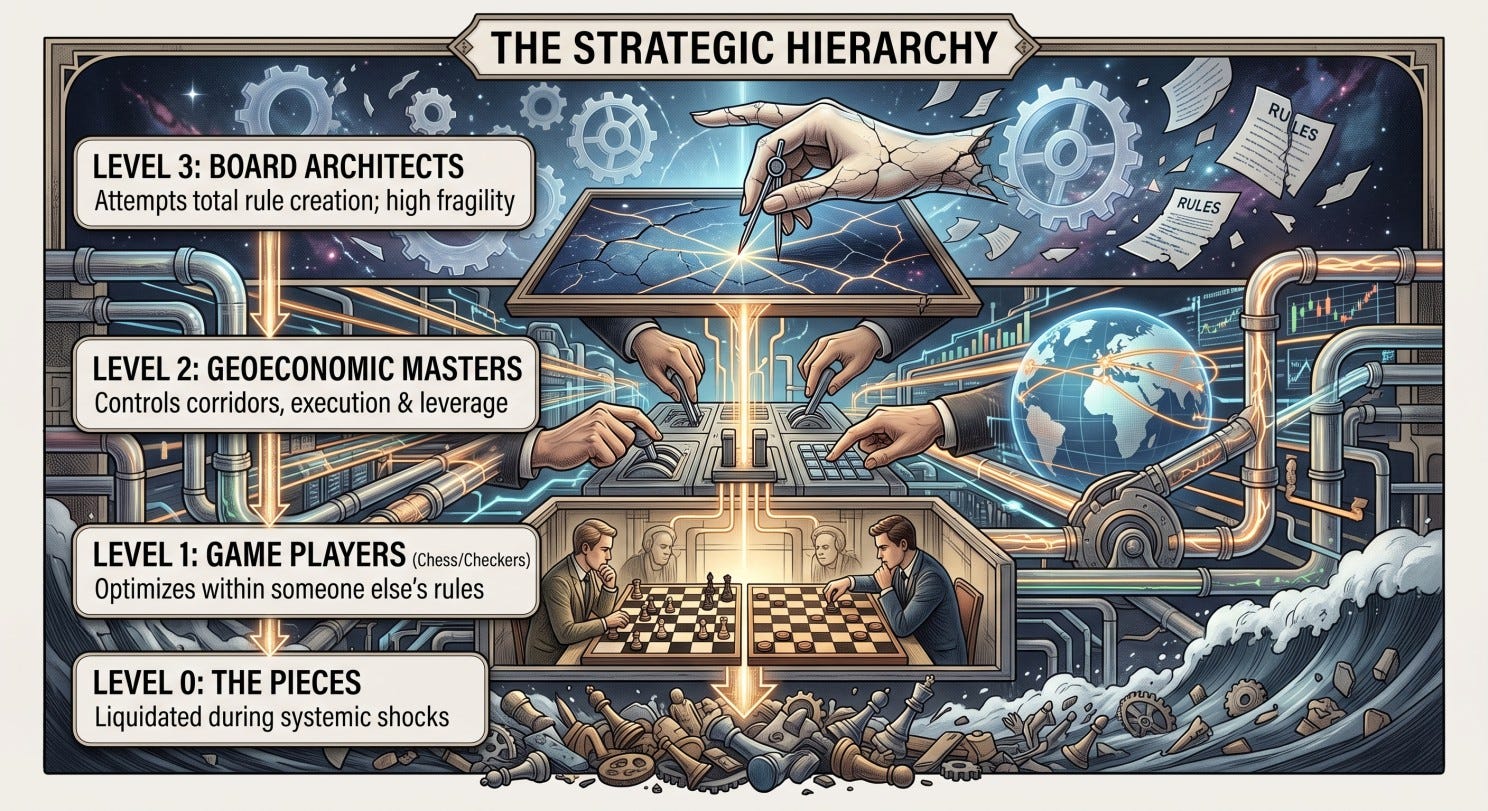
Observing this vulnerability, an ambitious minority attempts to jump directly to Level 3: becoming the absolute rule-makers. They seek to build entirely new international institutions, launch competing reserve currencies, or impose unilateral legal frameworks from scratch.
While conceptually romantic, attempting to conquer and rewrite the entire global board through sheer force of will is a strategy reserved for a tiny, hyper-elite group. It demands immense legacy capital, decades of unyielding institutional leverage, or an extreme appetite for existential geopolitical risk. For ninety-nine percent of state actors, sovereign funds, and institutional investors, attempting to unilaterally write the global rulebook is not a strategy—it is hubris.
Moreover, rule-makers face their own unique vulnerability: extreme systemic overhead. The hegemon that maintains the rules must spend vast amounts of military, financial, and political capital to enforce the boundaries of the board. The moment their enforcement energy drops below the threshold of global entropy, their rules are defied, bypassed, or rigged by lower-level actors.
The pragmatic strategist avoids both extremes. They refuse to be a passive piece on someone else’s board (Level 0), they reject the illusion that playing standard chess protects them (Level 1), and they do not waste finite resources attempting to conquer the global hegemon (Level 3).
Instead, they occupy Level 2: The Geoeconomic Master.
The Geoeconomic Master focuses not on controlling the board, but on controlling execution, access points, and strategic corridors. They recognize that while major powers fight over macro-ideologies and grand treaties, the real mechanics of global trade run on granular, pragmatic infrastructure:
Strategic Choke Points: Physical waterways, digital clearing channels, critical mineral processing facilities, and specialized sub-jurisdictions.
Sub-Rule Manipulation: The technical art of leveraging bilateral treaties, special economic zones (SEZs), and regulatory exemptions to create protected sub-environments inside broader, hostile rule-sets.
Adaptive Asset Encapsulation: Structuring capital and intellectual property in modular, sovereign-agnostic formats that can migrate instantly when a regional board collapses.
You do not need to own the entire chessboard to win the game. By controlling the critical corridors through which both kings and pawns must pass, you ensure that regardless of who writes the macro-rules, the net yield flows through your hands.
III: The Five Axioms of Geoeconomic Leverage
When conventional geopolitical assumptions fail and the rules of international commerce are rewritten in real time, organizations require a new foundational mechanics. You cannot navigate a fragmented world order using the vocabulary of a frictionless past.
To transition from a passive participant on the global board to a geoeconomic architect, you must operate according to five core axioms. These principles form the baseline operating system for modern economic statecraft, sovereign wealth management, and high-leverage enterprise.
The foundational error of classical trade theory is treating the global economy as a flat, frictionless plane where goods and capital flow naturally to their point of highest efficiency. In reality, the world is a complex, asymmetric topology carved out by sovereign jurisdictions, maritime chokepoints, subsea fiber-optic cables, digital clearing hubs, and regulatory borders.
Geoeconomic leverage requires viewing the globe not as an abstract “market,” but as a series of physical and digital pressure points. Capital does not move freely; it flows through specific pipes. Power belongs to those who control the valves, the clearinghouses, and the jurisdictional intersections where value switches rails.
Political alliances are fragile; ideological treaties collapse when domestic regimes shift. Geoeconomics, however, is order-agnostic. It is a technical toolset engineered to function effectively whether the prevailing global order is unipolar, multipolar, or fundamentally fragmented.
While political statecraft relies on goodwill and moral posturing, geoeconomic tools rely on structural necessity and financial mechanics. Frameworks such as Intrinsic Value-Oriented Architecture (IVOA), Real-World Asset (RWA) encapsulation, and bilateral capital corridors operate independently of macro-political harmony. They allow institutions to settle trade, protect balance sheets, and enforce contracts even between geopolitical adversaries.
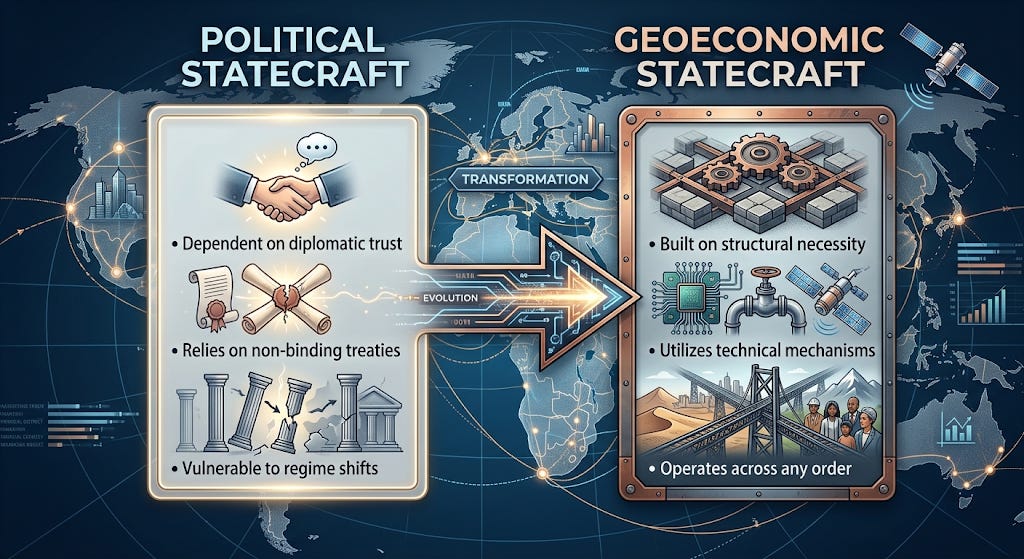
In the legacy paradigm, diplomacy was defined as the art of political compromise—communicated through protocol dinners, summit handshakes, and vague joint declarations. In the geoeconomic paradigm, diplomacy is redefined as the granular, technical engineering of jurisdictional sub-rules.
Modern diplomats, policy directors, and corporate strategists do not spend their leverage attempting to fix global treaties. They focus on building precise, bilateral carve-outs:
Negotiating bespoke trade corridors that bypass multilateral tariffs.
Designing special economic zones (SEZs) with custom arbitration frameworks.
Structuring currency swap lines and alternative clearing rails that insulate trade partners from third-party sanctions.
Diplomacy is no longer about managing political optics; it is about engineering legal and financial mechanisms that grant your institutions unfair structural advantage.
To the passive investor or traditional accountant, an asset is merely an entry on a balance sheet valued in fiat currency. To the geoeconomic architect, an asset is a structural instrument of leverage.
Critical mineral deposits, energy processing infrastructure, deep-water ports, sovereign tech stacks, and agricultural corridors do not just generate yield—they command behavior. They represent physical anchor points that force external actors to negotiate on your terms.
An asset is only as valuable as the strategic leverage it confers. In times of systemic transition, paper claims to future cash flows erode rapidly; physical, sovereign, or infrastructure assets that sit at the core of essential supply chains retain absolute pricing power.
The ultimate defeatism in statecraft and business is assuming that because major powers can alter international law, freeze reserves, or impose unilateral tariffs, strategic autonomy is impossible.
While you cannot prevent a major power from attempting to rig the macro-rules of the board, you retain absolute control over your organizational risk profile, capital velocity, and strategic positioning.
By diversifying across sovereign jurisdictions, embedding flexibility directly into cross-border contracts, and utilizing sovereign capital corridors, you decouple your institution from single-point-of-failure risks. The outcome of the game is not determined by the player who writes the macro-rules; it is determined by the player who can recalibrate their system faster than the macro-rules can collapse around them.
IV: The Architecture of Alpha Corridors
Traditional financial theory preaches asset class diversification: balancing equities against fixed income, real estate against commodities, or domestic exposure against developed international funds.
In a stable, unipolar global order, this model works. In a fragmented, weaponized world order, geographic asset allocation through centralized clearinghouses is an illusion. If your diversified assets all rely on the same correspondent banking rails, cleared through the same central jurisdictions, and governed by the same extraterritorial legal frameworks, you do not possess a diversified portfolio—you possess a single, highly compound point of failure.
To insulate capital, secure critical supply lines, and maintain strategic autonomy, leaders must step away from broad market index exposure and build Alpha Geoeconomic Corridors.
An Alpha Corridor is a direct, high-velocity, mini-lateral trade and capital channel engineered between complementary sovereign nodes. Rather than routing commerce through generic, high-friction international intermediaries, an Alpha Corridor establishes bespoke, insulated pipelines designed to withstand macro-economic shocks and policy shifts.
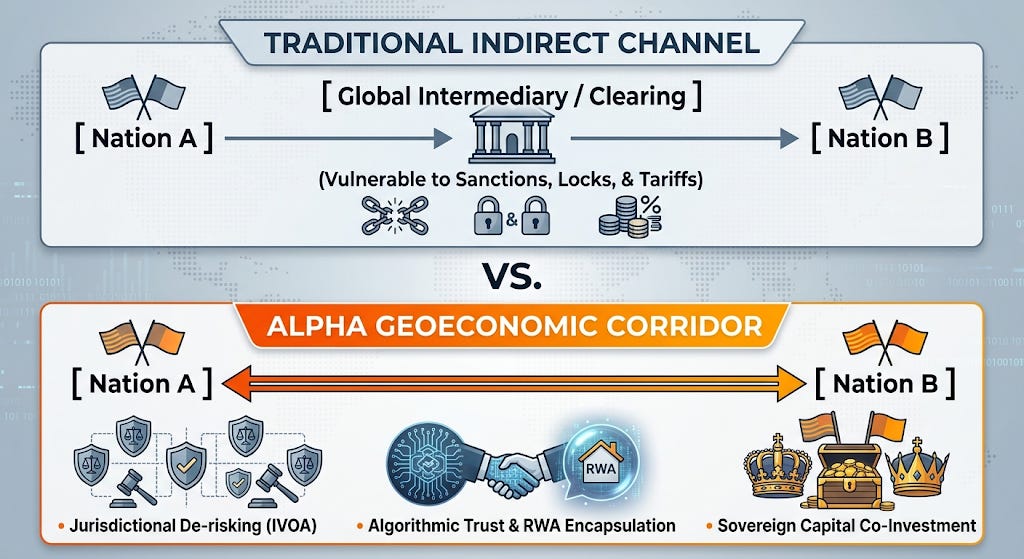
Building an operational Alpha Corridor requires deploying three technical mechanisms that bypass systemic friction:
Traditional bilateral trade suffers from currency risk and political volatility. By employing Intrinsic Value-Oriented Architecture (IVOA), trade contracts are settled not against volatile fiat representations or weaponized debt instruments, but against intrinsic economic units—such as energy quotas, critical mineral baskets, or sovereign agricultural yields. The contract is legalistically decoupled from third-party jurisdictions, insulating the underlying asset from sudden sanctions or currency devaluations.
Intermediary risk thrives on opacity. By utilizing Real-World Asset (RWA) encapsulation, physical trade goods—such as oil shipments, semiconductor components, or port cargo capacity—are tokenized and tracked via immutable, ledger-backed verification rails. Algorithmic trust replaces trust in foreign correspondent banks, allowing trade settlement to execute automatically upon verified physical delivery, cutting out vulnerable clearing intermediaries.
Traditional foreign direct investment (FDI) often relies on speculative hot money that flees at the first sign of geopolitical tension. Alpha Corridors are anchored by direct Sovereign Wealth Fund (SWF) alignment. Sovereign allocators from both ends of the corridor co-invest directly into shared, critical infrastructure—deep-water ports, processing hubs, subsea data links—creating an economic shield where both nations have direct skin in the game to protect the corridor against external interference.
When macro-policy shifts—when a major power imposes a sudden 25% tariff, freezes a clearing rail, or restricts a currency—unprepared institutions panic.
The geoeconomic architect operating within an Alpha Corridor, however, experiences no interruption. Because their capital, trade, and settlement pipelines are pre-routed through custom bilateral sub-rules, they absorb the shock seamlessly. While competitors struggle to comply with or navigate new restrictions, the corridor operator acquires distressed market share, captures local price inefficiencies, and converts regional policy volatility into pure structural arbitrage.
Frameworks, Alpha Corridors, and algorithmic trade rails are ultimately inert without human infrastructure. The most sophisticated geoeconomic toolkit is useless if the diplomats, allocators, and executives operating it are still using the intellectual vocabulary of a bygone era.
Traditional education in international relations and macroeconomics was designed for a unipolar, friction-free model. Foreign service academies trained diplomats to write political cables, draft non-binding communiqués, and host protocol dinners. Business schools taught managers to optimize cash flows under assumed, static legal constants.
Neither paradigm prepares leaders to engineer bilateral trade channels, navigate weaponized currency regimes, or secure critical asset corridors against sudden jurisdictional shocks. To thrive in the emerging world order, institutions must institutionalize geoeconomic statecraft as a distinct, rigorous discipline—training and accrediting a new class of operators who blend statecraft, financial engineering, and international law
If the global economy is an equation whose parameters are constantly rewritten by power, then relying on static rules is a formula for guaranteed obsolescence. Equity is a philosophical ideal; balance is a physical requirement.
When the variables of global trade unfreeze, those who rely on outdated theorems find their leverage dissolved, their clearing rails locked, and their balance sheets exposed. True strategic autonomy does not come from wishing the rules were fair, nor from naively assuming the board will remain stable. It comes from mastering the underlying geometry of power—understanding how capital, sovereignty, technology, and law intersect, and deploying the geoeconomic tools required to recalibrate your position faster than the surrounding system can collapse.
You do not need to conquer the entire chessboard to dictate your destination. By mastering the art of geoeconomic statecraft, establishing direct Alpha Corridors, and claiming your institutional seat within the global architecture, you ensure a vital truth: no matter how the game is rigged, how the parameters shift, or how the balance of power tilts, the ultimate outcome remains firmly in your hands.
************************END************************
Welcome to the MayaNomics Geoeconomics Forum
Pursue a greater role in Diplomacy & Political Leadership.
Become a geoeconomically savvy investor or a financial professional.
Take action to stay afloat when there is an economic flash flood.
Learn to become a Businessman & an Entrepreneur with leverage instead of chasing your tail.
Build or protect generational wealth by playing through the alpha geoeconomic corridor and its rules.
Equip yourself with the best geoeconomic tools and strategies.
Https://mayanomics.org
The transition from traditional foreign policy to active geoeconomic statecraft requires concrete, verifiable standards of competency. mayaNomics GeoEconomic Forum introduced a Program, “The GeoEconomic Diplomatic Corps (GEDC)” that establishes this baseline through two formal professional tracks:
Target: Serving Diplomats, Trade Attachés, Foreign Ministry Directors, and Sovereign Capital Allocators.
Core Mandate: Master the technical execution of Alpha Corridors, Intrinsic Value-Oriented Architecture (IVOA), and jurisdictional de-risking. CGD holders do not merely analyze trade shifts—they serve as policy rapporteurs across five specialized Standing Committees, designing the legal and financial rails for sovereign trade.
Target: International Relations Scholars, Graduate Researchers, and Early-Career Civil Servants.
Core Mandate: Establish foundational proficiency in geoeconomic risk modeling, Real-World Asset (RWA) tracking, and supply-chain vulnerability mapping. The AGP credential provides young professionals with direct entry into Chatham House speed-mentoring channels alongside senior envoys and policy directors.
At the absolute apex of this institutional architecture sits the 193 Sovereign Envoy Charter. Recognizing that global stability requires dynamic balance rather than unilateral mandate, the Charter allocates strictly one official seat per UN Member State. Sovereign Envoys are not passive convention delegates; they are institutionally nominated representatives—endorsed by foreign ministries, embassies, or accredited local chapters—who hold their nation’s seat in the global assembly.
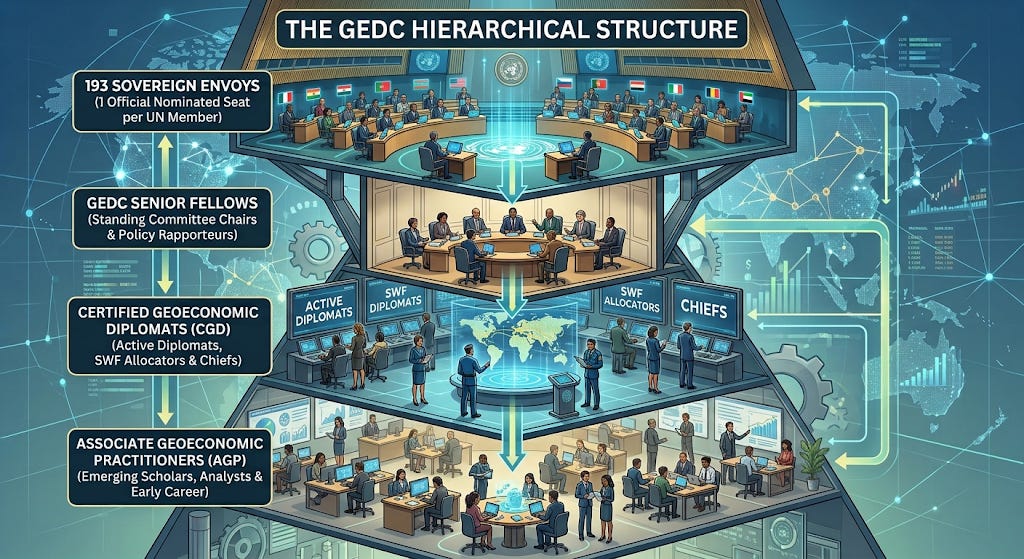
Sovereign Envoys serve as country rapporteurs, aligning national trade priorities with committee working groups, leading local chapter initiatives, and representing their state during the annual Sovereign Roll Call.
All of these operational threads—the theoretical frameworks, the Alpha Corridors, the credentialing tracks, and the 193 sovereign seats—converge annually on October 24 (International Day of Diplomats and UN Day).
Hosted live from the London and broadcast globally, the Inaugural Global Assembly of the GeoEconomic Diplomatic Corps serves as the official convocation of the modern statecraft ecosystem.
09:00 ──► THE 193 SOVEREIGN ROLL CALL
              Formal reading of the Charter; activating national seats on the live map.
10:30 ──► KEYNOTE & WAR ROOM SIMULATION
              60-minute interactive scenario testing delegates against real-time trade shocks.
14:00 ──► STANDING COMMITTEE WORKING BREAKOUTS
              Drafting policy standards for Sovereign Capital, AI Statecraft, and RWA Rails.
15:30 ──► MAYANOMICS HOUSE SPEED MENTORING
              Direct access connecting AGP Junior Members with Senior Envoys and Fellows.
17:00 ──► CREDENTIALING & INDUCTION CEREMONY
              Official conferral of ledger-backed CGD and AGP digital credentials.
18:00 --> Networking and Cocktail.
The October 24th Assembly is not an academic exercise; it is an operational milestone where strategy becomes policy, country seats are claimed, and a new generation of geoeconomic architects takes the field.
Whether you are an active foreign service officer sharpening your technical trade edge, an institutional allocator seeking to insulate balance sheets, or an emerging scholar building recognized diplomatic credentials, the opportunity to shape the global board is available now.
Explore the Forum & Frameworks: mayanomics.org
Register for the Oct 24 Global Assembly: mayanomics.org/gedc/assembly
Explore the 193 Sovereign Envoy Charter: mayanomics.org/gedc/sovereign-charter
Comments
Nothing yet. Say the first thing.
Sign in to join the conversation.