
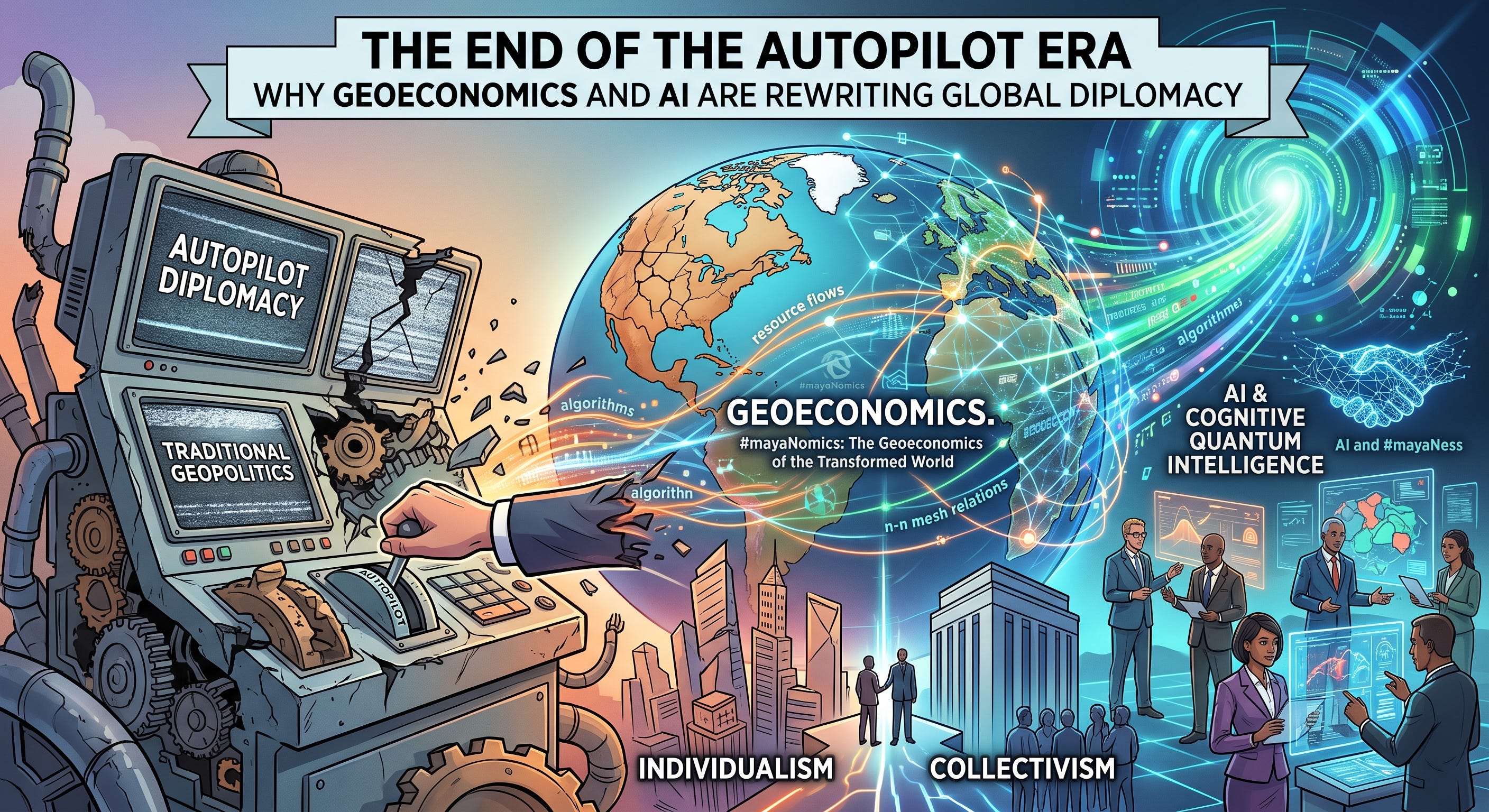
I recently read a Newsweek article with a striking headline: “China Wants Trump to Roll Out the Red Carpet—and Roll Over.” It noted that when Xi Jinping arrives in the U.S. for a state visit, the optics—the size of the red carpet, the grandness of the protocol—will matter immensely. But beyond the ceremony, Xi will bring a distinct playbook for U.S.-China relations: nudging the President to bypass normal political and bureaucratic channels in favor of “top-down management.”
This dynamic isn’t just about China or the United States. It reveals a fundamental truth about leadership, diplomacy, trade, and the global investment landscape that many traditionalists refuse to accept.
If you believe that systems, rules, and processes can be made to run on autopilot and perfectly survive across leadership transitions, you are living in a myth. It doesn’t work within a family, it doesn’t work in a small shop, and it certainly doesn’t work in a multinational corporation. How, then, can we expect it to work at national and international scales?
The world transforms from one generation to the next. No matter how much effort is spent injecting established values, beliefs, and skills into a system, a new leader inevitably wants to do things their way. Consequently, rigid systems and rules will either be destroyed or completely rewritten to align with the new leadership and their followers.
In my lifelong journey, I have identified a distinct pattern: every power-oriented, prominent person experiences a peak operational window of about 2 times 7 years.
Seven is a significant number in the human evolutionary process. Some leaders will stretch this peak period to three cycles (21 years) through extraordinary effort, discipline, and execution. Whether it is a nation, a nation-state, a corporation, or even a family, the leadership is at its absolute best performance during this window.
Because of this, anyone operating in their orbit—be it a partner, associate, diplomat, or envoy—must play by the systems, rules, and processes “AS-IS.” You cannot navigate the present based on how things should have been in the past, or how they ought to be in the future. You must navigate the reality on the ground.
For decades, the “International Rule of Law” existed in a highly brittle form, largely because superpowers systematically exempted themselves from it. While other nations understood this reality perfectly well, they lived with the exemptions because they received protection and economic stability in return.
But the paradigm has shifted. As the U.S. began to disengage from its traditional superpower obligations, the world was left without its familiar anchor. Today, nations are left navigating an n-n mesh relationship around the world, driven entirely by modern-era GeoEconomic diplomacy rather than traditional GeoPolitics.
I say that traditional Geopolitical diplomacy is outdated because it relied heavily on a static world order, blanket treaties, and an unwavering International Rule of Law. Those who graduated in Political Science, building their PhDs and careers on research based on these 20th-century international relationships and treaties, are watching their foundations crumble. Everything they have ever known is becoming a mirage.
In my book, #mayaNomics: The Geoeconomics of the Transformed World, I presented a clear architectural framework for modern-day global diplomacy. It is not based on what geopolitics should be; it is based on what it is.
I built the blueprint of geoeconomics on the foundation of human evolution and the eternal conflict between two schools: Individualism and Collectivism. Collectivism can be based on religion, race, ethnicity, philosophy, or a specific school of thought. Human evolution has always been pinned between these two opposing forces.
My conclusion is absolute: There is no way these two will ever be fully merged or joined. Total integration is impossible at all levels. The only viable solution is a Federated Model, featuring highly specific and clear integration points at certain levels of governance and trade.
The blueprint of mayaNomics proposes a framework of dynamic diplomacy. It advocates for the digital transformation of diplomacy through “just-in-time” treaties, and scenario-based trade and diplomatic rules of engagement.
To manage this complexity, we need a new engine. In my framework, I proposed Artificial Intelligence as the necessary second leg—standing apart from, but not superior to, human intelligence. After publishing mayaNomics, it took me three years to refine an AI blueprint capable of serving this immense purpose.
That effort culminated in the creation of the mayaNess Blueprint of Cognitive Quantum Intelligence, for which I recently published the White Paper. (References for mayaNomics and mayaNess are available in the comments below).
Let’s Build the Future: We are entering an era that requires unprecedented agility. If you are interested in exploring specific propositions at a larger scale—be it an impactful project, program, diplomatic initiative, or investment—reach out to me via Direct Message or through websites: https://www.mayakannan.com, https://www.mayanomics.org and https://www.mayaness.org.
Investor with $500M+ Mandate —> https://www.valianttelos.com/engage
Check out Two Key Events Happening in October In London. Don’t Miss the Opportunity to be Part of it!
Comments
Nothing yet. Say the first thing.
Sign in to join the conversation.