
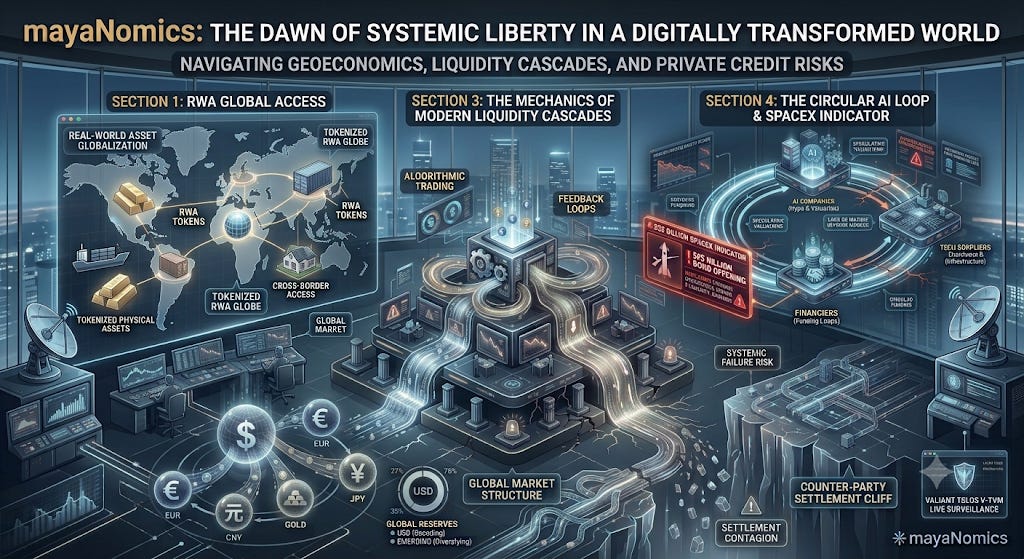
The global macro-financial architecture is operating on a highly compressed timeline, sustaining its nominal stability through an increasingly fragile loop of synthetic valuations and aggressive monetary intervention. To navigate the current market landscape, institutional asset allocators, family offices, and investment bank risk officers must look past superficial market indices and confront a systemic vulnerability: the total detachment of public and private capital markets from primary business architecture.
A poignant example of the current macroeconomic cognitive dissonance occurred recently when a financial commentator with a PhD publicly classified the U.S. Dollar as a “Real World Asset” (RWA). This classification reveals a fundamental misunderstanding of asset taxonomy at the highest academic and institutional levels.
A fiat currency is not an RWA; it is a centralized ledger entry—a non-yielding liability of a sovereign central bank backed by nothing more than political decree and the capacity to enforce taxation. Real World Assets, conversely, represent tangible or primary productive mechanisms: real estate, commodities, infrastructure, and businesses generating deterministic cash flows. Classifying a depreciating debt-instrument ledger like fiat currency as an RWA exposes how deeply the modern financial elite have confused the representation of value with value itself.

This conceptual failure is precisely what the digital GeoEconomics framework, articulated by Maya Suresh Kannan through the mayaNomics Framework, seeks to correct. True geoeconomic resilience depends on shifting capital from centralized, manipulated financial structures back to robust, primary productive architectures. To participate in high-level strategic discourse surrounding this re-allocation, global principals leverage the open intelligence environment of the mayaNomics Forum.
To understand the systemic risk within current public equities, investors must strip away institutional abstractions and return to the primary mechanics of commercial operation. In a fundamental micro-enterprise framework—such as the “mom-and-pop” enterprise—commerce is governed by transparent, immutable operational variables:
The Customer & Income: The primary engines of value generation.
The Expense, Profit, & Loss: The definitive metrics of operational efficiency.
The Supplier, Vendor, Financier: The structural counter-party ecosystem.
In this primary ecosystem, capital allocation is direct and operational visibility is absolute. True entrepreneurship is the strategic management of these real-world variables.
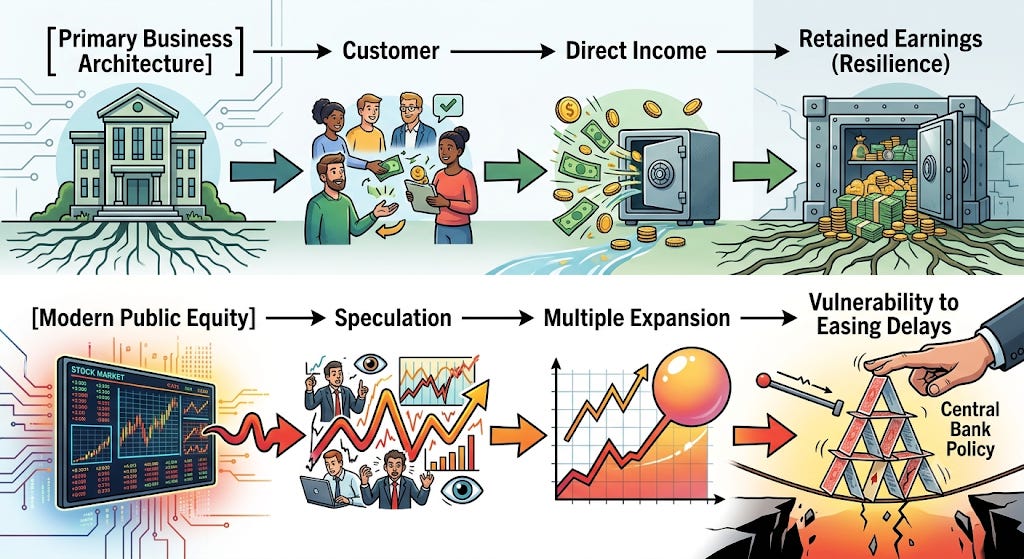
Conversely, modern public equity markets have devolved into speculative vehicles divorced from these realities. The typical market participant allocates capital without conducting a rigorous audit of corporate balance sheets. Compounding this issue, corporate financial statements are routinely optimized, engineered, and smoothed by a concentrated group of financial architects to meet short-term equity valuation targets.
When an entire ecosystem obscures its underlying fundamentals, it ceases to function as a discovery market and instead becomes a source of compounding systemic risk. Building an enterprise on a solid, self-sustaining architecture remains the ultimate hedge against macroeconomic volatility. While public market participants see their paper gains erased during structural corrections, enterprises built on verified fundamentals possess the structural resilience to pivot, rebuild, and capture market share.
For a comprehensive analysis of how to transition capital networks from speculative data loops to AI-driven wisdom, corporate leaders can reference the core blueprint, MayaNomics: GeoEconomics of the Digitally Transformed World, available via the Amazon Store.
The operational profile of financial crises has fundamentally changed over the past quarter-century. Institutional risk management requires a precise understanding of how communication velocity and monetary policy interact during market shocks.In the 2026 macro-financial ecosystem, a liquidity cascade is no longer just a rapid drop in asset prices—it is a high-velocity decoupling of the clearing system itself. When market stress hits, automated networks, shadow banking, and real-time media feeds create an aggressive, multi-tiered downward spiral.
A modern liquidity event bypasses traditional human interventions, moving through four distinct phases:
The Algorithmic Trigger: High-Frequency Trading (HFT) engines and quantitative models respond to macroeconomic data shifts simultaneously. Instead of absorbing shock, these correlated algorithms instantly withdraw bid liquidity, causing order books to evaporate in milliseconds.
Social Velocity & Herding: Real-time digital feeds and private macro networks eliminate geographic or institutional buffers. Information distributes globally instantly, transforming localized volatility into synchronized, global institutional herding.
The Private Credit Margin Contagion: As public equity valuations decline, the collateral backing the $2 trillion private credit ecosystem deteriorates. Lenders issue immediate margin calls on illiquid private assets. To find cash, corporations are forced to dump their most liquid holdings—high-grade public equities—accelerating the crash across unrelated sectors.
The Settlement Catch-22: When tens of trillions of dollars attempt to exit the system simultaneously, clearing banks face gridlock. Sovereign authorities face a structural ultimatum: allow total counter-party failure or inject over $10 trillion in fresh liquidity, risking structural hyperinflation.
The mayaNomics Takeaway: Traditional passive indexing is entirely unhedged against this velocity. Protecting institutional capital requires moving away from circular, engineered valuations and realigning portfolios with primary business architecture and live surveillance systems like the V-TVM.

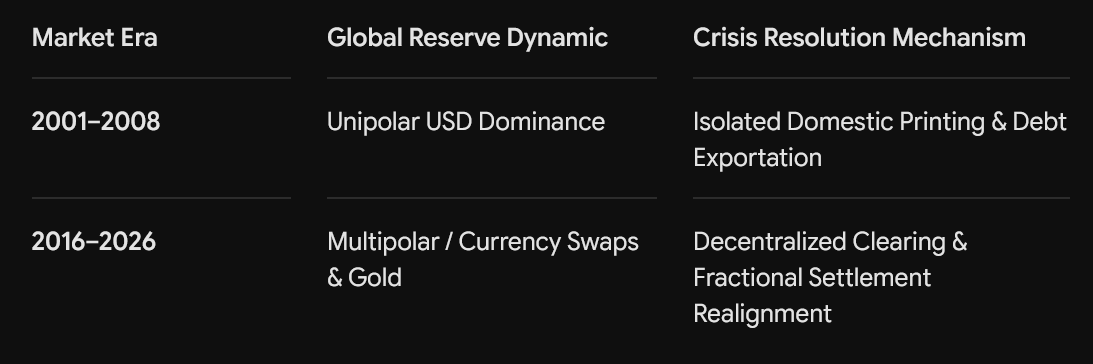
The market corrections of 2001 and 2008 occurred in an environment of low information velocity. Macroeconomic warnings, systemic cracks, and inside information circulated slowly within insulated networks. Because the broader market was structurally blind to impending liquidity crises until institutional counter-party failures occurred, liquidations were sharp, rapid, and highly volatile.
Conversely, subsequent market cycles—including the market pressures of 2016, 2020, 2023, and the current realities of 2026—have been mediated by high-velocity digital communication networks. Real-time macroeconomic commentary and programmatic sentiment tools allow market participants to adjust exposure more fluidly, smoothing what would otherwise be vertical sell-offs into more gradual declines.
However, the more dangerous shift lies in the state’s response function. Rather than allowing natural market corrections to purge insolvent, unproductive entities, central banks and sovereign treasuries have consistently responded by injecting massive amounts of cheap money into the banking apparatus.
By prioritizing the salvation of institutions deemed “too big to fail,” policy decisions have structurally distorted the natural business cycle. The stock market has expanded primarily through speculative multiple expansion, decoupling equity valuations from underlying dollar reserves. This permanent intervention model requires a continuous expansion of sovereign liquidity simply to prevent a massive settlement failure.
This systemic distortion is currently manifesting at an unprecedented scale within the Artificial Intelligence and private technology sectors.
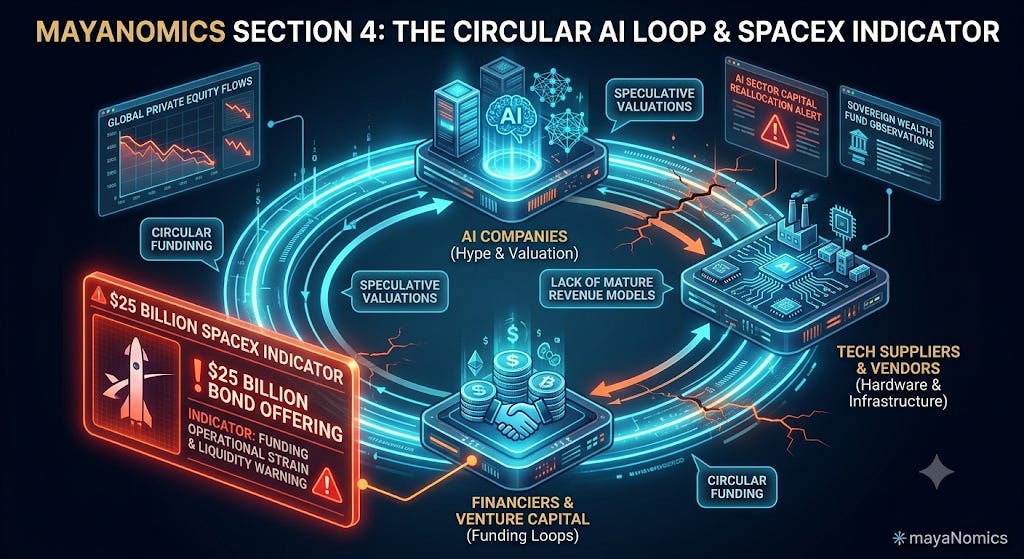
We are witnessing a monumental reallocation of capital: trillions of dollars that historically anchored the global financial system via safe-haven assets, such as U.S. Treasuries, have been re-routed into private equity and venture capital to back AI valuations.
The Operational Reality: A significant portion of this tech ecosystem comprises companies that lack mature customer bases, clear pathways to profitability, or sustainable consumer margins. Instead, their elevated valuations are sustained by a highly insular capital loop consisting of interconnected suppliers, vendors, and hyper-capitalized financiers funding one another’s balance sheets.
A clear indicator of this structural strain appeared in late June 2026, when SpaceX launched a massive, multi-tranche $25 billion debut investment-grade bond offering. While public headlines focused on the heavy over-subscription and the sheer size of the capital raise, institutional risk analysts must look at the underlying necessity driving the debt issuance.
SpaceX—traditionally a hyper-valuable private entity—is taking on tens of billions in long-term debt to fund highly capital-intensive AI infrastructure, data center construction, and power requirements, while simultaneously absorbing the rapid cash burn of associated speculative entities like xAI. When even the premier private monopolies of the global tech economy must aggressively tap debt markets at a meaningful spread over Treasuries to maintain their capital loops, it signals that the private capital cushion is thinning.
This dynamic represents a highly calculated extraction phase: inflating private tech valuations to an absolute ceiling to harvest liquid dollar wealth before global macroeconomic dominance shifts. If the U.S. financial system is forced to absorb a broad-based correction across these over-leveraged private tech networks, the required sovereign liquidity injection would easily exceed $10 trillion. Unlike previous cycles, deploying monetary expansion on this scale in an already strained global economy risks triggering structural hyperinflation, directly threatening the purchasing power of the fiat dollar.
Historically, the status of the U.S. dollar as the premier global reserve currency allowed the domestic economy to export its inflationary pressures and insulate its domestic banking system from the consequences of aggressive monetary expansion. That insulation has eroded.
The global financial landscape has shifted into a multi-currency paradigm. Sovereign nations are actively mitigating their exposure to western reserve shocks by accumulating substantial physical gold reserves and establishing bilateral currency swap networks that completely bypass traditional clearing systems.
As international structural demand for the dollar normalizes, the underlying vulnerabilities of the domestic commercial banking apparatus become acute. While public equity indices can be temporarily supported through regulatory adjustments and liquidity facilities, the tangled web of private markets cannot be easily papered over. A synchronized default across private equity, private credit, and complex corporate credit arrangements exposes the financial sector - the aggregate global corporate credit apparatus and its layered derivative settlement linkages, exceeds $100 trillion.
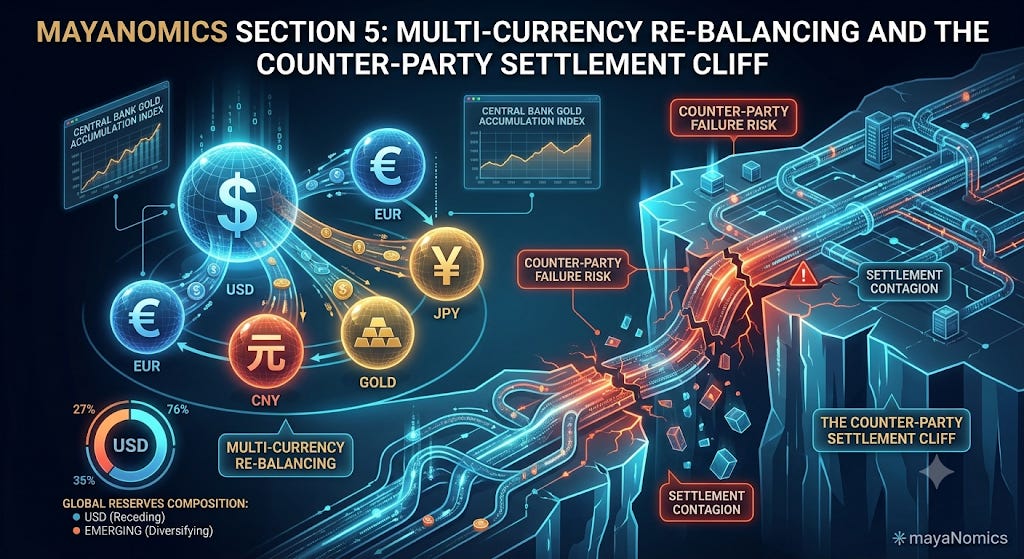
The critical risk for institutional allocators in this environment is not simple price depreciation, but systemic counter-party settlement failure. When an institutional fund or family office decides to exit a position, that transaction must clear through a commercial banking institution. In a synchronized systemic liquidity event, the immediate hazard shifts from asset valuation to liquidity access: Who settles the trade when the clearing bank faces insolvency?
Faced with a settlement crisis of this scale, the sovereign response will likely involve non-traditional settlement mechanisms:
Conditional Digital Currencies: Central banks may mandate settlements through Central Bank Digital Currencies (CBDCs) or programmatic digital dollars tied to strict withdrawal limits, capital controls, and approved allocation channels.
Proprietary Private Asset Tokens: Investment banks and large corporate conglomerates will likely attempt to settle outstanding obligations using internal stablecoins or tokenized private credits, introducing immense volatility regarding real-world dollar parity and convertibility.
Ultimately, the validity of any financial settlement asset is tested at the primary point of consumption. When systemic inflation strips away the purchasing power of fiat currency and digital ledger accounting faces gridlock, the real economy defaults to tangible value.
For senior executives, asset managers, and family offices, the mandate for the remainder of 2026 is unambiguous: systematically reduce exposure to circular, hyper-financialized tech valuations, and aggressively realign portfolio capital with robust operational architecture, verifiable cash flows, and transparent, ironclad counter-party settlement structures.
To navigate this opaque and interconnected credit landscape, traditional lagging economic indicators and standard terminal data feeds are no longer sufficient. Institutional decision-makers require real-time visibility into the hidden liabilities, circular capital flows, and off-balance-sheet exposures that threaten systemic stability.
To meet this critical operational need, the Valiant Telos Initiative has deployed the Valiant Telos Vault Live Macro-Surveillance Monitor (V-TVM). Designed specifically for sophisticated investment banks, institutional allocators, and family offices, the V-TVM functions as a high-fidelity macro-surveillance command center. It continuously tracks systemic counter-party vulnerabilities, tracks hidden leverage within private credit ecosystems, and monitors settlement risks across global clearing nodes before they trigger a cascade.

By providing institutional leaders with predictive, actionable intelligence, the V-TVM allows portfolios to shift from reactive crisis management to proactive structural positioning. Senior executives and institutional risk officers looking to isolate their capital from the impending settlement cliff can evaluate the monitoring architecture and engage directly at Valiant Telos V-TVM.
Curated and Engineered by,
Chief GeoEconomic & Cognitive Command Architect, Valiant Telos Inc
Chief Convenor, mayaNomics GeoEconomics Forum
Comments
Nothing yet. Say the first thing.
Sign in to join the conversation.