
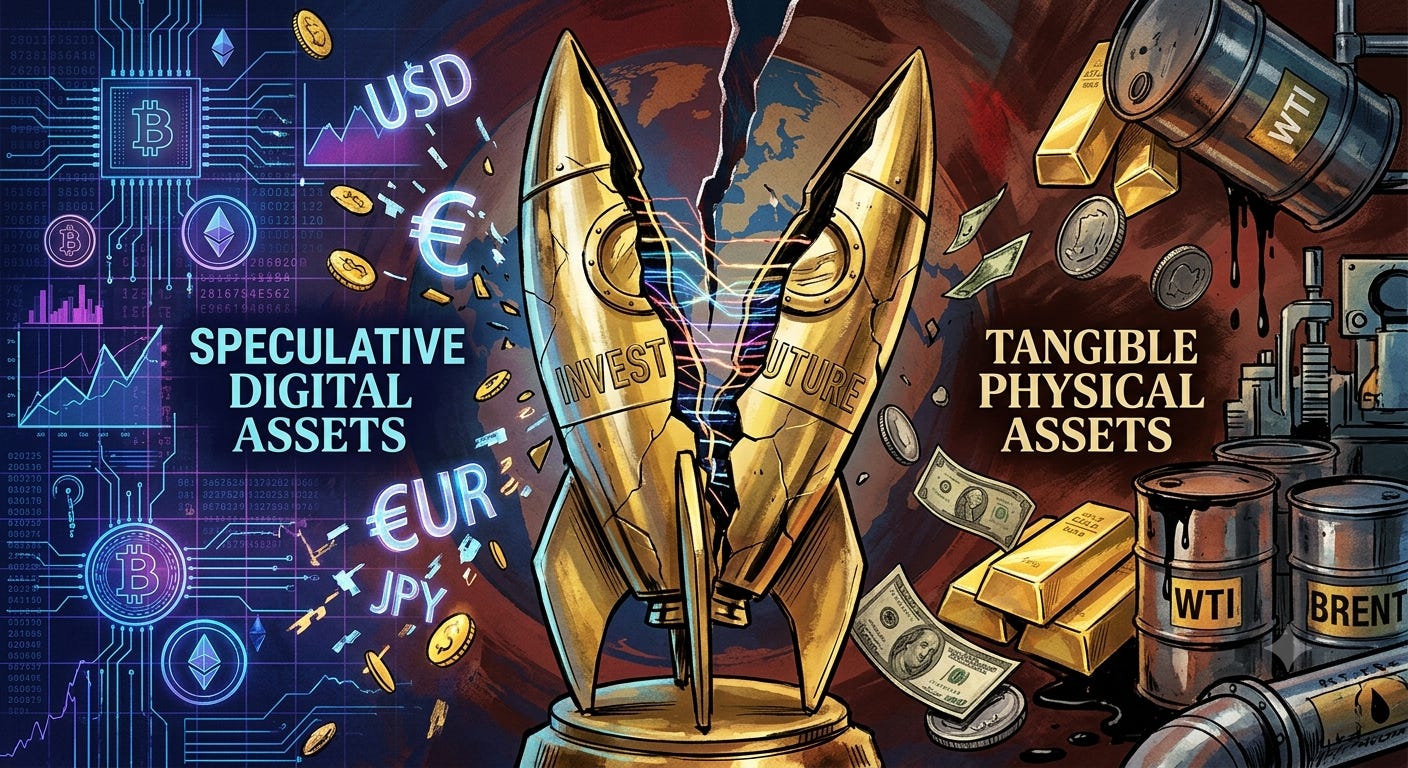
The financial headlines are beginning to mirror a structural reality that the architecture of global capital has quietly understood for years. When market analysts warn that SpaceX’s stock threatens to slip below its IPO floor, the surface-level panic centers on standard corporate fallout: late-stage investor exposure, employee options, and private equity liquidation. But the true crisis isn’t a routine market correction. It is a fatal puncture wound in a multi-billion-dollar narrative: the final shattering of the value mirage surrounding the untouchable American champion.
For too long, the West has operated under a recycled, highly financialized twentieth-century playbook, acting as if centralized, single-founder monopolies could serve as durable proxies for national economic dominance. We saw this architecture deployed with Microsoft in the eighties and nineties, Zuckerberg in the 2000s, and Bezos thereafter. But the multi-corridor, multinational reality of 2026 does not respect legacy formulas. The dollar-centric statecraft that insulated American capital after World War II has fractured, leaving highly speculative, aspiration-heavy assets incredibly vulnerable to a multipolar reality.
This is no longer merely a story of over-leveraged tech valuations or private equity extraction. The stumble of America’s legacy proxies reveals a deeper, structural failure of political realignment and industrial statecraft. More critically, it exposes an ongoing surrender of human agency to automated systems and synthetic consensus. To pierce this silicon mirage requires more than an adjustments of asset allocation—it demands a total reclamation of human clarity from digital noise. The glass rocket is cracking, and the economic landscape is forcing a stark choice: remain captive to an intangible illusion, or rebuild the sovereign human shield.
The structural problem with the valuation of companies like SpaceX—and by extension, the current hype cycles surrounding entities like OpenAI or Anthropic—lies in who bears the ultimate weight of the aspiration. When a private corporate entity is treated as an unassailable national proxy, its valuation decouples from standard fiscal realities and enters a state of perpetual narrative inflation.
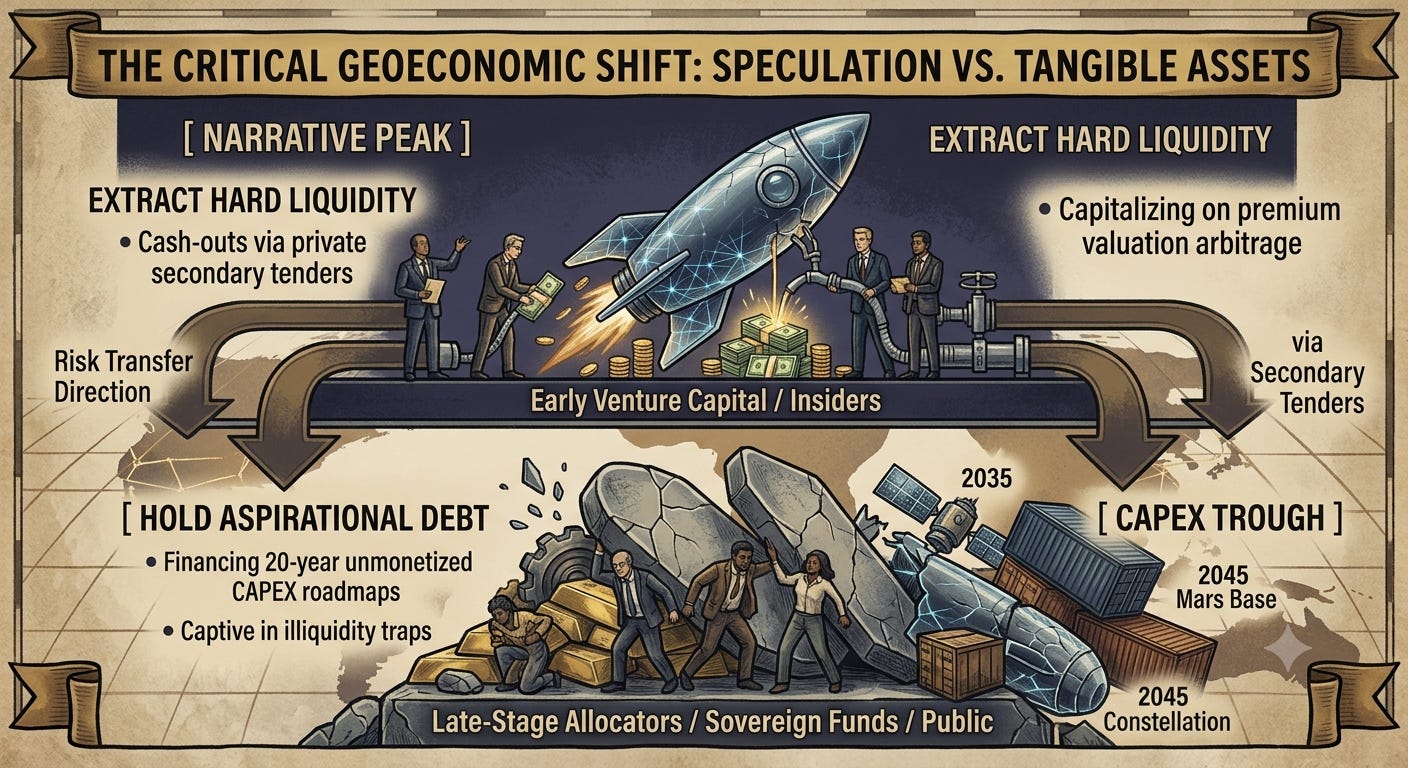
The mechanism driving this is classic late-stage financialization, operating as a highly sophisticated, two-tier wealth transfer system disguised as pioneering statecraft.
In this initial stage, the asset operates within a controlled, secondary market echo chamber. The valuation is systematically driven upward through circular tender offers, private block trades, and periodic inside liquidity events.
Mechanics of the De-Risking Loop: Early institutional backers, original private equity sponsors, founders, and early employees leverage these premium valuation windows to quietly and systematically de-risk. They do not wait for a traditional, transparent public listing; instead, they sell down portions of their equity to hungry, late-stage allocators during private secondary rounds.
Capital Transfer: Through this structured exit, early capital converts volatile narrative equity into hard, liquid fiat currency. They extract their multi-bagger alpha at the absolute peak of the company’s hype cycle, effectively transferring the risk of the future operational reality entirely onto the incoming buyers.
Once the early money has de-risked and secured its liquidity, the holding phase begins. The equity is absorbed by late-stage institutional allocators, mutual funds, sovereign wealth funds desperate for growth exposure, and eventually, public market investors.
The Infinite Capex Black Hole: These late-stage buyers are left holding a highly illiquid asset, forced to carry the staggering financial weight of 20-year aspirational roadmaps. Whether it is the trillion-dollar logistical nightmare of Mars colonization, the endless capital expenditure required to refresh thousands of degrading low-Earth-orbit satellites, or the multi-gigawatt power demands of unproven AI clusters, the late-stage investor funds the capex while receiving zero near-term dividend yield.
The Illiquidity Trap: Unlike the early extractors, these investors cannot easily exit their positions without triggering a massive cascading re-pricing of the asset. They become captive financiers of an intangible future, banking entirely on the hope that a public market listing will eventually bail them out.
When an asset’s valuation is detached entirely from standard cash flow metrics, recurring revenue realities, and traditional price-to-earnings multiples, it requires absolute, uninterrupted global monopoly conditions to survive. The math only works if the champion faces zero friction, commands total pricing power, and operates in a world where no alternative corridors exist.
The moment those monopoly conditions are challenged globally, the entire pricing model experiences a violent, structural collapse. In a multipolar global economy, an asset cannot maintain a premium valuation floor of $135 or higher when foreign, state-subsidized competitors are deploying alternative orbital infrastructure and computing networks at a fraction of the cost.
Analyzed through an unbiased geo-economic lens, that premium is not a reflection of future dominance; it is an indefensible, highly volatile mirage engineered to keep the late-stage capital pipelines flowing.
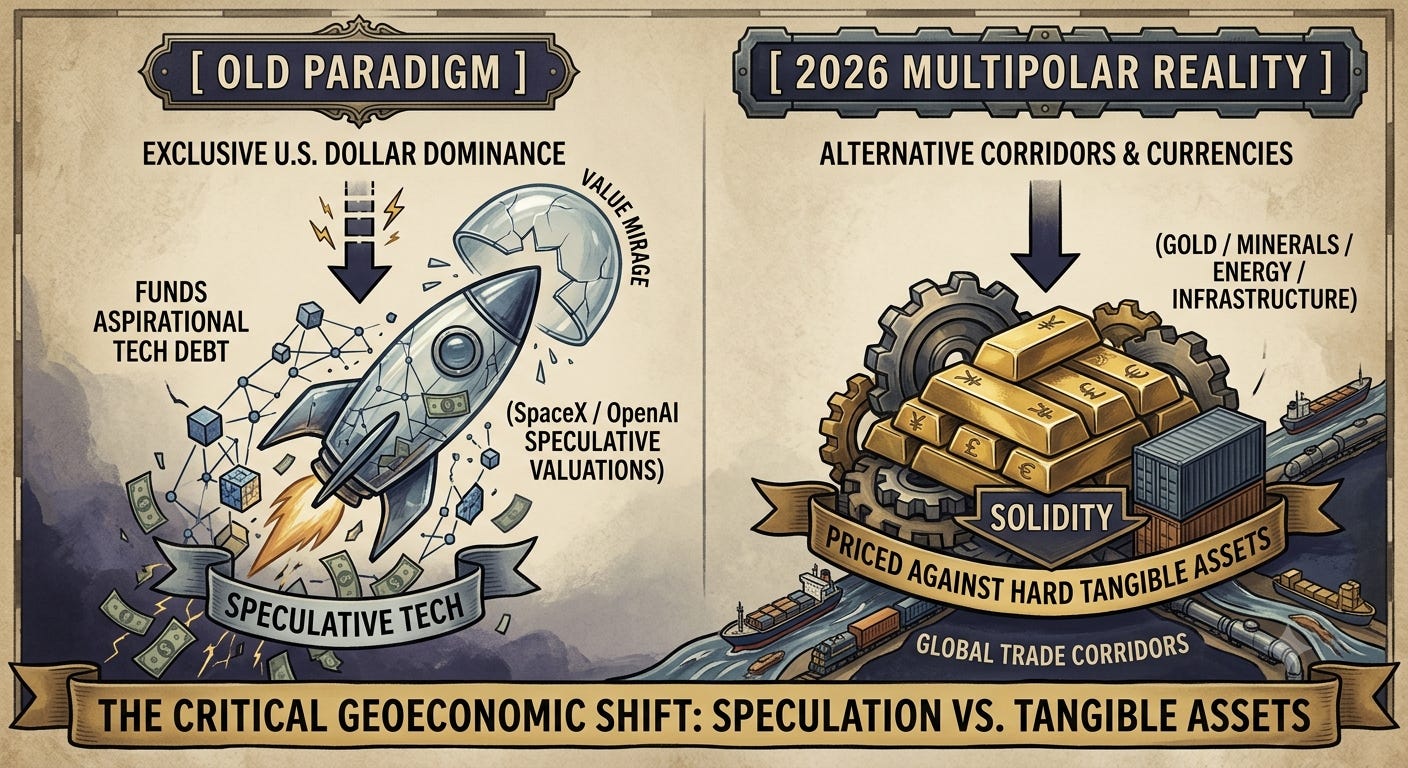
To understand why an inflated valuation for an American space monopoly is unsustainable in 2026, one must look past Wall Street and examine global liquidity flows. Historically, the U.S. dollar acted as an insulated incubator for American tech champions. Foreign central banks accumulated USD reserves, which flowed back into U.S. capital markets, artificially lowering the cost of capital and funding decades of unprofitable, aspirational corporate research.
That cycle has broken down due to three structural shifts:
Global trade architecture is no longer built exclusively around the transatlantic axis. The rise of independent, multi-layered financial infrastructure—such as local-currency clearing systems, alternative interbank messaging networks, and the expansion of the BRICS+ resource framework—means that global surplus capital is bypassing the U.S. equity casino entirely. When capital is retained within regional corridors (e.g., the Eurasian land bridge, expanded Middle Eastern sovereign funds, and intra-Asian trade networks), it flows into tangible, localized infrastructure rather than Western speculative tech.
When valued strictly inside a fiat dollar ecosystem, a speculative asset can maintain an inflated valuation indefinitely through narrative control. However, when priced against a global basket of real, tangible economic inputs—gold, strategic minerals, refined petroleum, and semiconductor manufacturing capacity—the fragility of Western “national champions” becomes glaring.
A sovereign wealth fund or global investor in 2026 evaluates corporate equity by its immediate strategic yield. An asset reliant on a 20-year horizon of unmonetizable orbital infrastructure cannot compete with immediate, hard-commodity yielding assets in a high-inflation, multi-currency global market.
The Asymmetric State-Backed Competitor
The assumption underpinning SpaceX’s valuation was that the rest of the world would remain passive spectators. Instead, global competitors—most aggressively out of East Asia—have treated the commercialization of orbit as a public infrastructure project rather than a venture-backed profit center.
By heavily subsidizing heavy-lift launch capacity, constellation deployment, and satellite communications at a sovereign level, competitors are driving the marginal cost of orbital logistics down to near zero. An American corporation burdened by private debt and the necessity of rewarding secondary-market equity holders cannot structurally survive an asymmetric price war against state-backed entities that do not operate under the mandate of quarterly venture returns.
Are you Interested in Alternative Investment, ie Investing in Private Equity, Private Assets, digital Assets backed by RWA? For Accredited Investors:
https://www.valianttelos.com
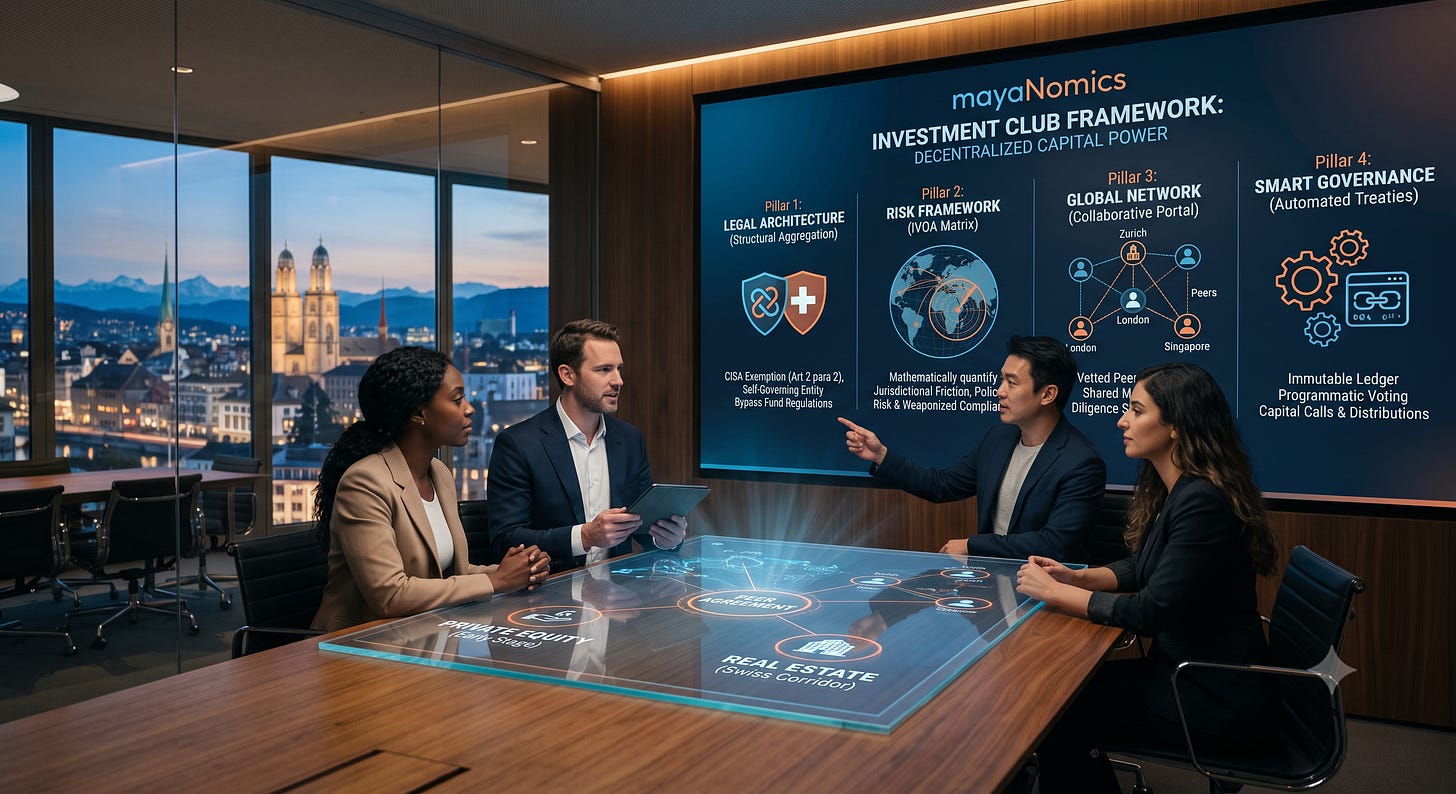
The current split in global statecraft can be conceptualized as a battle between fragile, speculative tech narratives and the hard, unyielding physics of industrial reality.
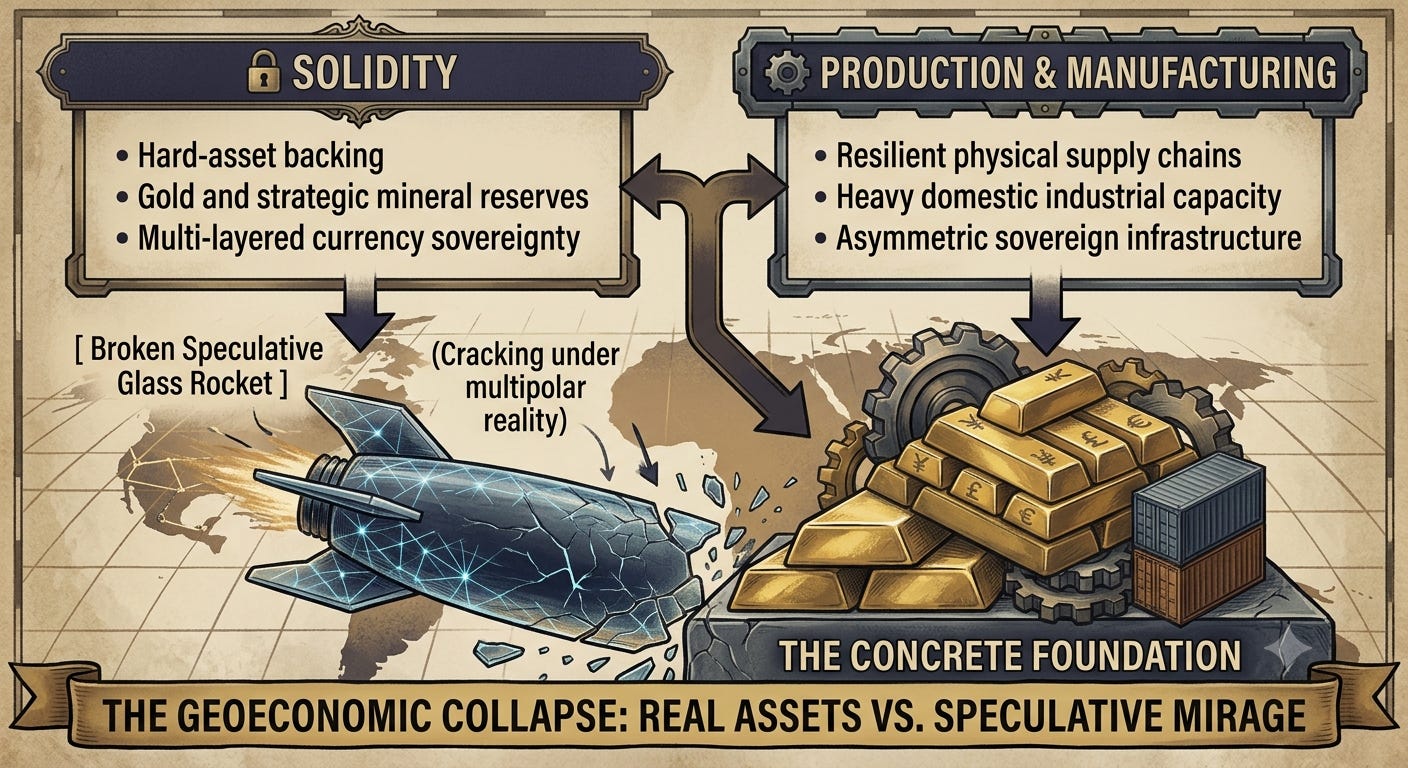
To fully comprehend the structural fragility of legacy monopolies like SpaceX, OpenAI, or Anthropic, one must look at the widening chasm between two diametrically opposed economic philosophies. The current split in global statecraft is no longer a standard ideological debate between capitalism and socialism; it is a battle between fragile, speculative tech narratives and the hard, unyielding physics of industrial reality.
This visual dichotomy exposes the fatal flaw in the modern Western playbook: you cannot defend a global empire using paper leverage when your competitors are building with concrete, steel, and physical sovereignty.Pillar I: Solidity (The Hard-Asset Anchors)
The left flank of this foundational paradigm rests on absolute, non-dilutable economic power. For decades, neoliberal globalization allowed the West to export its manufacturing while importing cheap goods, settling the difference with fiat dollars printed at will. In the 2026 multipolar reality, the global corridor has shifted back to physical fundamentals.
Hard-Asset Backing: Speculative valuations rely on the assumption of infinite future liquidity. Conversely, true solidity requires an economy to be anchored to tangible wealth. When the financial system experiences a systemic shock, capital does not flee to unmonetizable orbital dreams or LLM compute clusters; it retreats to assets with intrinsic physical value.
Gold and Strategic Mineral Reserves: The currency of the multi-corridor world is increasingly tied to the periodic table. Control over lithium, cobalt, rare earth elements, and gold reserves determines a nation’s true sovereign runway. A space program or an AI network is completely impotent if the underlying hardware requires minerals controlled entirely by an economic adversary.
Multi-Layered Currency Sovereignty: The mono-dollar world order has fractured. By developing alternative cross-border payment architectures and local-currency clearing systems, emerging global corridors have achieved immunity from Western financial statecraft. This multi-layered sovereignty allows them to price resources in real-time metrics rather than inflated fiat denominations.
An asset economy that only designs, conceptualizes, and financializes is structurally incomplete. True statecraft requires the kinetic muscle to convert raw minerals into physical power.
Resilient Physical Supply Chains: The pandemic era and subsequent proxy conflicts proved that just-in-time supply chains are a critical vulnerability. The new economic paradigm prioritizes just-in-case redundancy—owning, securing, and maintaining the shipping lanes, processing plants, and trade corridors required to keep an economy running under duress.
Heavy Domestic Industrial Capacity: Software cannot build bridges, and financial engineering cannot forge steel. The ability to manufacture heavy machinery, advanced turbines, and industrial infrastructure domestically forms the true baseline of national defense and economic independence. Without this, a nation is merely a consumer, entirely dependent on the production capacity of its rivals.
Asymmetric Sovereign Infrastructure: Instead of viewing infrastructure through the lens of short-term corporate profitability, state-backed competitors treat it as a foundational public utility. By heavily subsidizing mass transit, energy grids, and launch logistics at a sovereign level, they create a low-cost macroeconomic floor that private, venture-backed monopolies cannot match.
The Concrete Foundation vs. The Broken Speculative Glass Rocket
When Solidity and Production & Manufacturing are structurally fused, they create The Concrete Foundation—a dense, unyielding macroeconomic base capable of absorbing geopolitical shocks, high inflation, and currency realignments.
Suspended precariously above this foundation is the Speculative Glass Rocket.
This rocket represents the hyper-financialized, narrative-driven assets of the Western tech stack. Built out of the brittle glass of secondary market liquidity, venture capital hype, and 20-year aspirational promises, it looks magnificent from a distance. It commands staggering, multi-billion-dollar valuations based purely on the belief that it will eventually monopolize the future.
However, as the multipolar reality of 2026 hardens, the gravity of the Concrete Foundation begins to assert itself. The glass rocket requires an endless injection of cheap, dollar-denominated capital to stay aloft. The moment global trade pathways diversify, and capital begins rotating into tangible infrastructure and raw commodities, the liquidity drying up beneath the rocket causes structural fractures.
The glass cracks. The IPO floors begin to give way. The realization sets in that you cannot feed a population, secure a border, or sustain a currency on the promise of an intangible mirage. The rocket does not transition into orbit; it shatters against the unyielding physics of the concrete reality below.
Become a GeoEconomic Savvy individual to not only stay afloat in the Fractured World, but also thrive. Join mayaNomics GeoEconomics Substack at
. And become a Member at
https://www.mayanomics.org
This geopolitical vulnerability is the direct result of a lost decade in American economic statecraft. The structural revolution that began in 2015—a movement intended to dismantle neoliberal globalist dependencies, break the consensus of the Washington Consensus, and restore hard-asset security—was systematically compromised. The promise to re-shore the industrial base and secure supply chains did not fail because the underlying diagnosis was wrong; it failed due to a fundamental breakdown in execution, institutional design, and strategic clarity.
During Trump’s first term, the necessary structural shift was choked out by institutional pushback, administrative ignorance, and the internal inconsistencies of leadership that consistently preferred short-term, televised victories over boring, systemic overhaul. The administration introduced tariffs—most notably the 25% duties on steel and 10% on aluminum under Section 232—but treated them as bargaining chips for transactional trade deals rather than instruments of an enduring industrial policy.
Rather than executing a targeted, multi-layered blueprint to rebuild domestic smelting, forging, and heavy manufacturing, the policy framework suffered from severe design flaws:
The Downstream Tax: While the 2018 tariffs provided a brief, localized uptick in domestic metal production, they acted as a severe tax hike on downstream American manufacturing sectors. Industries reliant on steel and aluminum inputs, such as automotive and industrial machinery, faced immediate spikes in production costs, making them less competitive globally.
The Exemptions Loophole: The process for securing tariff exclusions became hyper-financialized, driven by corporate lobbying rather than geoeconomic logic. Instead of a structural decoupling, the system created temporary supply distortions while the underlying hollowing-out of the industrial core continued unbated.
The Oligarchic Shift: Rather than building a resilient, broad-based economic architecture rooted in blue-collar productivity, the administration merely shifted dependencies. The power center migrated from the old legacy globalists of Wall Street to a new vanguard of Silicon Valley oligarchs who specialized in defense-tech contracts and institutional software monopolies.
The period between 2021 and 2024 amplified this strategic void, characterized by an absolute American absence in both localized industrial policy and macro geo-economics. As alternative global corridors began aggressively coordinating their resource sovereignty, the U.S. remained trapped in an echo chamber of monetary denial.
While foreign entities were actively locking up physical access to the periodic table—monopolizing lithium processing, securing cobalt supply chains, and expanding cross-border, non-dollar clearing mechanisms—Washington focused on domestic narrative policing and greenfield subsidies that lacked the raw industrial muscle to compete globally. The cumulative loss of over 5 million manufacturing jobs since the late 1990s was met not with aggressive, structural re-shoring, but with further financialization.
The strategic decay culminated during the 2024 presidential campaign cycle. Trump, fundamentally misjudging the ceiling of his organic support among everyday Americans and the MAGA base, mistakenly operated under the assumption that he could not cross the finish line without the massive financial backing of institutional legacy capital and Silicon Valley billionaires. This was a profound miscalculation. The populist base had actually expanded between 2021 and 2024, driven by a shared exhaustion with eroding purchasing power and domestic industrial decline.
Instead of trusting this organic baseline, the campaign outsourced a massive portion of its ground operations and state strategy to newly minted tech Super PACs—most notably Elon Musk’s America PAC, which bankrolled over $200 million into the election cycle alongside an additional $194 million from an allied cohort of Silicon Valley executives.
Become a GeoEconomic Savvy individual to not only stay afloat in the Fractured World, but also thrive. Join mayaNomics GeoEconomics Substack at
. And become a Member at
https://www.mayanomics.org
The “America First” objective remains fundamentally correct, but it cannot be achieved through the worship of speculative tech icons or the hyper-financialization of intangible dreams. Real economic sovereignty is a brutal, difficult journey that requires precise, hard-nosed statecraft. It demands an absolute refusal to mistake the paper gains of a Silicon Valley boardroom for the foundational wealth of a nation state.
If the U.S. wants to compete in a multipolar world, it must stop treating volatile corporate entities as national proxies. True geo-economic command is not won by inflating secondary market valuations to bail out early-stage private equity, nor is it secured by subsidizing the interstellar fantasies of a few chosen champions while domestic industrial capabilities erode. It is secured by anchoring the national economy in physical supply chains, heavy domestic manufacturing, absolute resource security, and real, tangible assets that the rest of the world cannot simply choose to ignore.
For too long, the leadership of the West has been seduced by the ease of narrative-driven economics, choosing to inflate bubbles rather than build infrastructure. The distractions of speculative crypto-backing, the erratic antics of billionaire oligarchs, and the unyielding reliance on an outdated, dollar-centric playbook have only served to hollow out the core of the state. While America has spent the last decade managing the public relations of its self-proclaimed champions, the rest of the world has been quietly building the physical corridors of the next century.
The mirage is piercing. The luxury of relying on an untouchable currency premium to fund twenty-year aspirational roadmaps has expired. The multi-corridor, multi-currency reality of 2026 is no longer a distant warning—it is here, and it is actively pricing out the intangible illusions of the old paradigm.
America stands at a final, uncompromising crossroads. It can continue to tether its destiny to the fragile, breaking glass of speculative empires, watching as the global tide systematically collapses its over-leveraged valuations. Or, it can remember what true sovereign command requires. The time for theatrical realignments and digital smoke mirrors is over. The playground of unchecked speculation is closing, the global corridors are hardening, and the economic landscape demands an unyielding foundation. It is time to wake up, abandon the mirage, and finally build on solid ground.
Join mayaNomics GeoEconomics Forum at
https://www.mayanomics.org
As the fragile glass rocket of speculative tech shatters against the concrete foundation of real-world physics, we are left confronting a deeper, more insidious crisis. The over-valuation of companies like OpenAI, Anthropic, or SpaceX is not merely a financial phenomenon. It is the symptom of a profound systemic surrender: the outsourcing of human intellect, agency, and strategy to automated consensus.
In a world where algorithms actively score our thoughts, AI swarms direct our sovereign decisions, and relentless digital noise maintains a state of permanent cognitive paralysis, the ultimate geopolitical battleground is no longer just the geographic trade corridor. It is the human mind.
To survive and thrive in this landscape, we must reject the passive consumption of synthetic intelligence. We must invoke mayaNess—a structured cognitive framework and a private society engineered for one sole purpose: to protect human clarity from digital noise and reclaim sovereign command, 1].
To build an unassailable strategic fortress, an individual must systematically reconstruct their cognitive relationship with technology. The mayaNess framework establishes three non-negotiable pillars to restore human supremacy over the machine:
                     ┌──────────────────────────────────────┐
                     │              MAYANESS                │
                     │    (The Sovereign Human Shield)      │
                     └──────────────────┬───────────────────┘
                                        │
         ┌──────────────────────────────┼──────────────────────────────┐
         ▼                              ▼                              ▼
┌─────────────────┐            ┌─────────────────┐            ┌─────────────────┐
│    COGNITIVE    │            │    COGNITIVE    │            │    COGNITIVE    │
│    COMMAND      │            │  SYNCHRONICITY  │            │   SOVEREIGNTY   │
├─────────────────┤            ├─────────────────┤            ├─────────────────┤
│ • Noise Removal │            │ • Zero Lag      │            │ • Anti-Profiling│
│ • Velocity      │            │ • Adaptability  │            │ • Mental Autarky│
└─────────────────┘            └─────────────────┘            └─────────────────┘
Cognitive Command is the absolute assertion that the human must remain the undisputed architect of the strategy. Most allocators and leaders have surrendered this role, allowing black-box algorithms to dictate what they believe, how they evaluate risk, and how they allocate capital. Under Cognitive Command, you enforce unbreakable rules upon the systems you deploy:
Noise Removal: The aggressive, deliberate stripping away of digital hype, venture-capital media spin, and algorithmic distractions until nothing remains but cold, hard, verifiable reality.
Velocity: The execution of decisions based entirely on your own internal, uncompromised compass, allowing you to move with a speed and decisiveness that automated, trend-following systems cannot replicate.
Standard economic models and algorithmic trading systems suffer from a fatal time lag, relying on stale reports, backward-looking data, and speculative market gossip. Cognitive Synchronicity, 1] is the state of perfect, real-time alignment between your strategic intent and physical, ground-level variables:
Zero Lag: Instantly calibrating your internal strategic logic with raw physical realities—such as real-time transport bottlenecks, actual energy grid limitations, and immediate geopolitical shifts.
Adaptability: The moment physical facts on the ground shift, your strategic posture updates instantaneously. Your digital tools are forced to adapt to physical reality, never the other way around.
Cognitive Sovereignty is your fundamental right to absolute mental independence in an era of cognitive warfare. It requires building a personal “Silicon Curtain” around your mind, your decision-making processes, and your proprietary data:
Privacy from Profiles: Isolating your personal logic so that public tracking systems and predatory corporate AI networks cannot profile your thinking, map your vulnerabilities, or manipulate your execution.
Mental Autarky: Cultivating an independent, self-sustaining intellect that does not seek validation from online consensus, public trends, or automated crowds. You operate out of your own secure, mental fortress.
The mayaNess Society is the operational community that puts this defensive and offensive doctrine into practice. It functions as a vetted, noise-free sanctuary where leaders, builders, and sovereign thinkers assemble to insulate their operations, sharpen their strategic focus, and train their minds to resist external manipulation:
The Inquests: Closed-door, private diagnostic sessions where members systematically audit their digital footprints, identifying and purging algorithmic vulnerabilities and synthetic noise.
The Shielding Protocols: Tactical workshops designed to insulate proprietary business logic and private investment strategies from outside AI predation and corporate espionage.
The Peer Network: A highly secure, trusted circle of global peers who reject the commoditization of thought and value clear, independent human intelligence above all else.
Subscribe: mayaNess Substack -
The true lesson of SpaceX’s fragile valuation, of OpenAI’s unsustainable computing costs, and of the broader decay of Western economic statecraft is that you cannot build a sovereign empire on borrowed clarity.
When we outsource our thinking to machines, we do not gain efficiency; we lose our cognitive command, 1]. The multi-corridor world of 2026 will not be conquered by those with the most complex algorithms, but by those with the clearest, most unyielding grasp of physical reality.
The playground of unchecked digital speculation is closing. The global corridors are hardening. Protect your capital, protect your supply chains—but above all, protect your mind. It is time to step out of the digital haze, join the ranks of the cognitively sovereign, and build on solid ground.
Comments
Nothing yet. Say the first thing.
Sign in to join the conversation.