
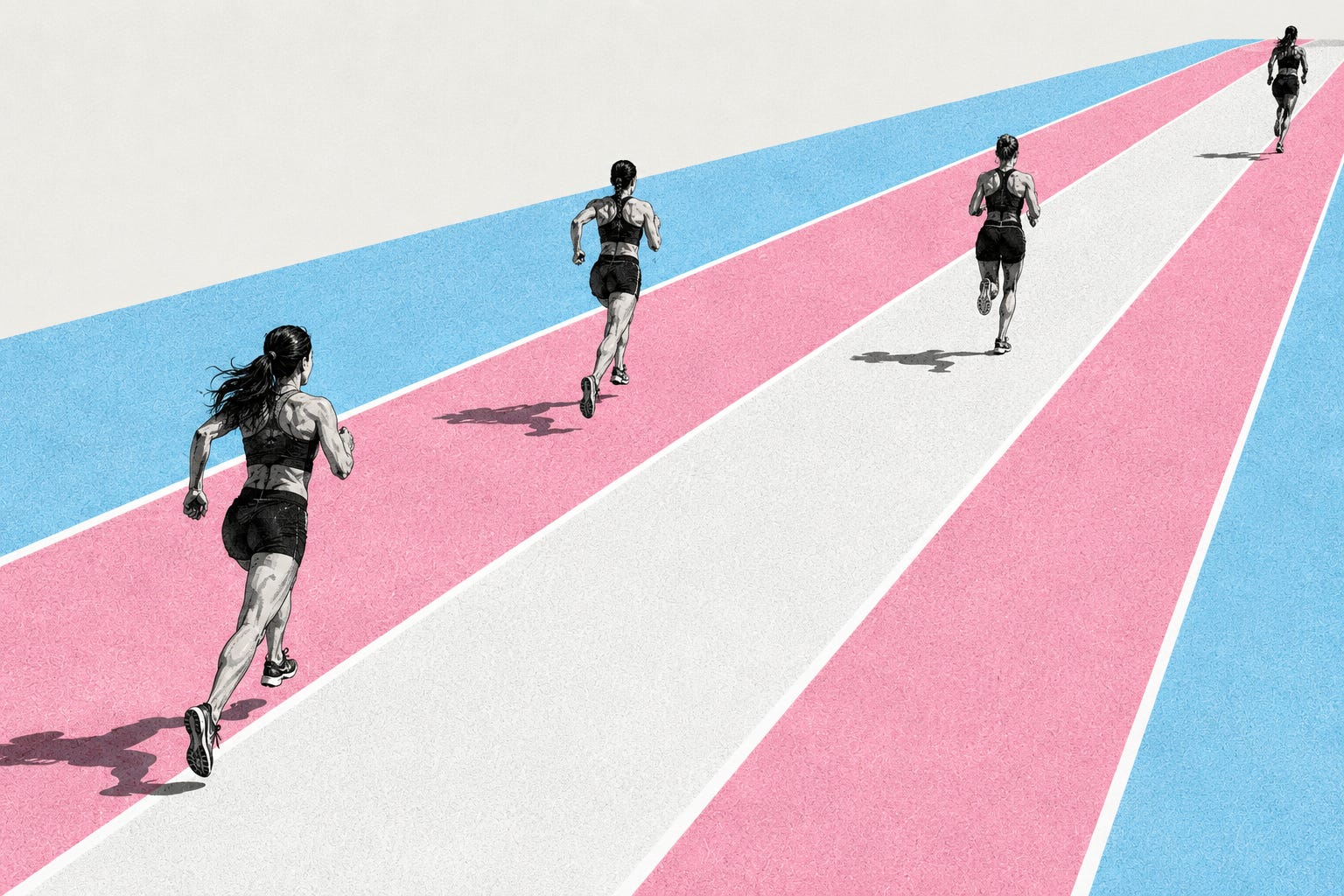
Yesterday, the Supreme Court ruled that states may ban transgender girls and women from participating on girls’ and women’s school sports teams, holding that Title IX allows schools to determine eligibility based on what the Court called “biological sex.”
I’ve seen many trans folks talking about this, like lawyer Chase Strangio, journalists like Imara Jones and Erin Reed, as well as trans athlete Chris Moiser. But something that stands out to me is how little I see cisgender people talking about it.
Now, this isn’t a callout. The supreme court also ruled on Birthright Citizenship, so understandably there’s rightfully been a lot of focus on that decision. But the lack of engagement on the ruling that affects trans folks tells us something important.
“Trans rights” has become a topic that is almost entirely about how people feel about trans people – not about the science, not about the experiences of actual trans people, and not about the real outcomes that follow from attacks on trans rights. Instead, the conversation is entirely about how people feel. How would you feel if there was a trans person in the bathroom with you? How would you feel about a trans person playing sports against you? How would you feel if you found out that someone you know had transitioned in the past?
This frigid atmosphere was certainly intentionally engendered by political rhetoric, where many Republicans targeted a small community that wasn’t particularly well-known or understood by the general public and then simply spread inflammatory lies far and wide. In this way, they dominated the conversation about transgender people and made it about their own weird gross claims rather than about anything inherently true to the lives and experiences of trans people.
It’s bizarre how clearly the “debate” about trans people is so entirely about cisgender people’s feelings. Or is it?
Transition is not something anyone approaches lightly. It’s not a whim nor a trend. For generations, trans people in the US have grown up isolated and alone, wondering if they were the only one like this, praying to God to change them. Today, transition is more known but also much more stigmatized and dangerous within a hostile legal climate. But no matter the time in history, transition has always required one major ingredient: self-knowledge.
When life hands you the default settings on gender and sexuality, you grow up with a set of assumptions. You assume that you will date, fall in love, get married, possibly have children, and that all of these activities will not only be approved of by society but actively celebrated. Your wedding day will be attended by all of your family and by your community of friends, maybe some co-workers, church folks, etc. Anyone you know (and want to invite!) will probably make every effort to be there. You can walk hand in hand with your new spouse down the street without any fear that the mere act of holding hands with the person you love could cause someone to want to harm you.
In short, you don’t have to think about it. You don’t have to think about it because not only does it match the expectations that other people have for you, it also matches the expectations that you have for yourself. And herein lies the difference: for people outside the default expectations of gender and sexuality, this picture looks very different. Gay people may deal with unaccepting family who refuse to attend their wedding. They may avoid holding their loved one’s hand in public due to safety concerns. Asexual people may grow up perfectly content without a partner but field unending questions about why they haven’t “found someone” yet. Transgender people may deal with rejection, employment discrimination, housing instability, and more.
When your life doesn’t match the default settings, it forces you to make a choice. Do you pretend to go along with what everyone else is expecting of you? Do you pretend to be someone you’re not? Or do you choose authenticity and face all the possible consequences? I can assure you, people don’t make this decision lightly. It’s not just social acceptance at stake but very real and serious safety issues. Statistically, trans people are more often the victims of some type of violence than the general cisgender population. And when you’ve been kicked out of your home and are viewed as a social pariah, it can also present obstacles to meeting basic survival needs.
Yet, people still pursue transition. And those people report mental health outcomes so positive that any rational society would celebrate finding such an effective and safe treatment. When scientists and researchers study transgender people, that’s what they keep finding: safe, effective treatments that lead to happier, well-adjusted people. And it’s the self-knowledge needed to get there that certainly provokes an intense reaction from the general public.
Maybe that’s why this debate has become so detached from transgender people’s actual lives. It’s easier to speculate about hypothetical threats than it is to listen to the people who have lived this reality. It’s easier to ask how cisgender people feel than to ask what transgender people have experienced.
The Supreme Court’s ruling will have real consequences for transgender youth. But it also reveals something that has been true for a long time: our culture has become remarkably comfortable discussing transgender people without ever centering transgender voices.
If we genuinely care about truth, fairness, or even good public policy, that has to change. The conversation cannot begin and end with other people’s fears or discomfort. It has to begin with the people whose lives are actually being debated. Before anyone decides what our rights should be, the least they can do is listen to us.
No posts
Comments
Nothing yet. Say the first thing.
Sign in to join the conversation.