
Good morning and happy Saturday! 🙂
I hope you had a fantastic week.
Ivy and I flew back this week from Washington, DC where we got to sponsor and attend the International Conference for Nutrition in Medicine.
We had a blast and also had the pleasure of leading a group workout class on one of the mornings. Check out this awesome group of physicians and health professionals prioritizing their health 👇
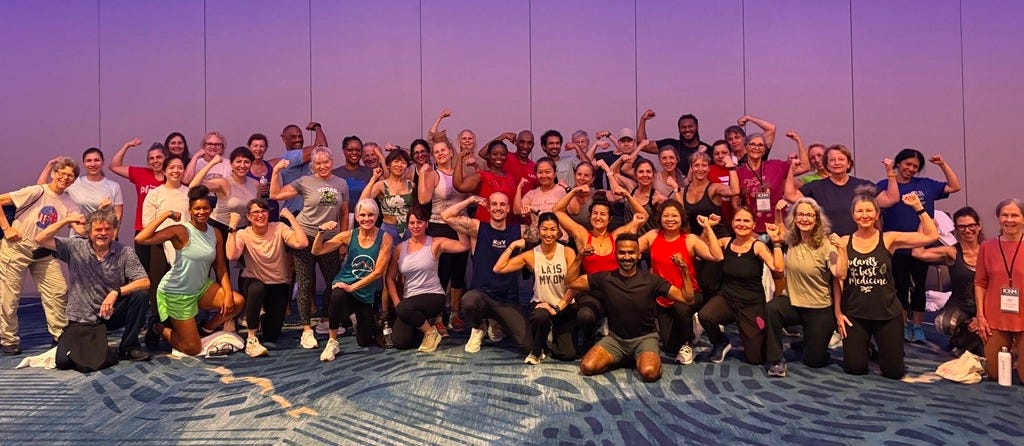
We already sponsored the conference for next year, so be sure to join us! :)
Now, onto this week’s newsletter.
As you know, I’ve been doing this new thing where I answer your submitted questions inside the weekly newsletter. We’ve received a few this week, which I’ll answer below. If you want your questions answered, simply reply to this email or comment below on Substack 🌱
But before I get into answering the questions, I wanted to share something I was reflecting on during my morning run today.
People often share the advice to “just move your body and eat a whole-food, plant-based diet, and everything will be fine.”
To a certain extent, that is true if you are trying to go from level 0 (the Traditional Western diet and a low level of activity, like most people live nowadays) to level 1 of having a healthy baseline.
Going from eating meat and processed food to whole-food, plant-based will get you incredible results. Going from not moving to going for walks and doing some exercise will help you make good progress… until it doesn’t anymore.
I know why, but I think a lot of people struggle to get from level 1 to level 2, 3, or even 4 and beyond.
It’s because they continue to follow that general advice and those basic rules.
Listen, I’ve shared these “general rules” before because, depending on who I’m speaking to or what podcast I’m on, that advice will work for the vast majority of the population. The majority of the population isn’t like you and me (I know you are on my level if you are reading my newsletter).
BUT there comes a time when specificity matters.
As you know, I like to use analogies to explain everything. Let’s use swimming as an example, simply because I can speak on a deeper level about it since it was my best discipline when I used to compete in Ironman 70.3.
Most people say that they can “swim” because they can get in the water, move around, and not drown (level 1). That’s fantastic, not drowning is a great goal.
BUT if you are reading this newsletter and are a part of my world in any capacity, I can safely assume that you want more for your health, your fitness, and your life.
You don’t want to just “not drown.” You want to thrive. You want to be able to get places efficiently and effortlessly.
What most people miss when they want to go to the next level in their fitness and body composition at any age, but more specifically over 50 is that they just focus on moving more (so, just swimming).
But if you’ve ever swam competitively and trained for it, you know that it’s much more nuanced than that.
You have to focus on how your hand enters the water, how your hand catches the water, how you pull it back, how to breathe, and ensuring your head doesn’t pop up to cause drag, but instead turns perfectly sideways like it’s on a pivot.
You have to focus on keeping your hips up so they don’t drag you down in the water, kicking efficiently, and contracting your core to keep a streamlined body shape to glide through the water.
Phew…😅
As you can see, all of those details can be optimized when you are “just swimming.”
Now, it’s the exact same thing for your health and fitness.
The number of calories you consume matters, regardless of the source.
The source of those calories matters to ensure maximum nutrient, vitamin, and fiber intake.
The distribution of your meals throughout the day matters to ensure you get enough protein (aka the building blocks to repair from your training).
Your training needs to incorporate progressive overload every 4–6 weeks to ensure your body doesn’t plateau. You need your workouts to be challenging enough to maximize supercompensation, but not so hard that you burn out and regress.
Even the small technical nuances matter, take a lunge, for example. When pushing back up on a lunge, most people shift their weight toward their toes, which places all the tension on the quad. Instead, you should push through the heel on the way up, which shifts the tension to the glutes and hamstrings which is what you want to train. A small shift like moving the tension from your toes to your heel makes a HUGE difference. Try it out right now and see for yourself.
All this to say: nuances matter. Yes, the general advice works at first moving your body and eating a variety of plant-based whole foods works until it doesn’t.
My guess is that if you read my newsletter, it’s because you want more. Now it’s time to learn the nuances so you can get the transformation you’ve been wanting.
I have two ways for you to do that. (And listen, I know this sounds like I’m “selling something,” but I started doing this work to help and serve people. I put out tons of free content on my YouTube channel, podcast, and newsletter to get you started.)
If you want something that involves me, my coaching team, and our direct expertise, then yes, there is an investment for our time and knowledge.
If you want to learn at your own pace, I have my new course, “Forever Fit,” which I launched last month. We already have 25 people inside this incredible community. It includes over 56 modules, 25+ hours of education, and weekly group coaching calls with Ivy and me → Forever Fit Course
The second option is our world-class 1:1 coaching program that we’ve been running for 6.5 years, which has helped nearly 1,300 people across the world. You can book your free coaching/consultation call here → https://mavywellness.com/
I hope the message above helps you understand what needs to happen for you to succeed in your transformation. Whether you choose to work with us or not, there are plenty of great resources that I put online for you to use.
Alright, now let’s get into the question I received this past week ☺️
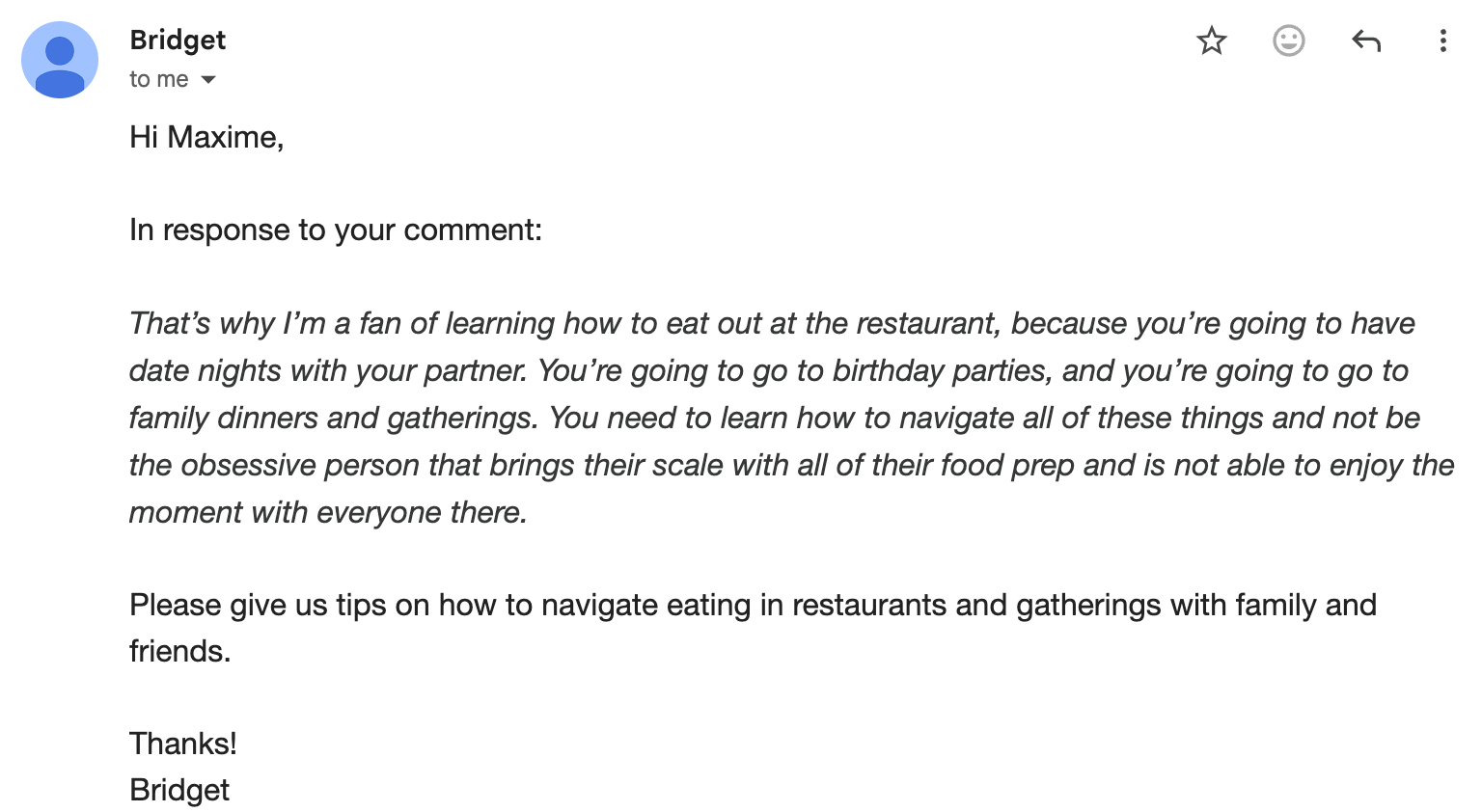
This one is from Bridget, she asked “Please give us tips on how to navigate eating in restaurants and gatherings with family and friends.”
My answer:
Traveling doesn’t mean you have to leave your health and fitness goals behind! With a little preparation, you can easily stay on track without missing a beat.
Core Rules
Plan ahead: Research your destination before you go. Will you have access to a kitchen, mini-fridge, blender, or local grocery stores? Check if nearby restaurants have plant-based options or online menus with nutrition details.
Prioritize protein: Plant protein is often the hardest thing to source on the go. Plan to bring or buy your protein to ensure you meet your daily targets.
Control the controllables: If you have to eat out for lunch or dinner, make sure you win your morning by starting with a nutritious breakfast. Oats are an easy go-to option!
Stay hydrated: Always carry water with you especially when flying or on long drives.
Quick & Easy Snack Ideas
High-quality protein bars
Protein powder with a shaker bottle
Fresh fruit (apples, pears, bananas)
Instant oatmeal packets
Homemade energy balls
Edamame or dried soy beans
Pre-cut fresh vegetables
Game Plan by Travel Scenario
Road Trips: Pack a cooler with prepared meals, fruits, veggies, and snacks. Map out stops at grocery stores or farmer’s markets along your route instead of relying on fast food.
Flying & Overseas: Eat a protein-rich meal before heading to the airport, pack travel-friendly snacks in your carry-on so you don’t get overly hungry, and map out your food options for when you land.
Hotel (No Kitchen): Stop by a local grocery store right after arriving to pick up fresh produce, oats, and plant milk for your mini-fridge.
Rental with a Kitchen: Treat it like home! Stock up on groceries and prepare your meals just like you normally would.
I have grabbed these notes from a guide that our members have access to inside of our one-on-one coaching program. As an additional point, I would say travel with a portable blender. Here’s the one that Ivy and I use Ninja blender .
Also, realize that just because you’re at a restaurant or a family gathering doesn’t mean you need to eat a massive meal. If you can eat a little something beforehand to stay satisfied (so you only need a small dish that isn’t super high in calories while you’re there), do that. If you don’t have the opportunity to eat beforehand, just have a small bite at the restaurant to hold you over until you get home and can make a proper, healthy meal.
I do this a lot of the time: if I am eating out at a restaurant or family gathering, I always overestimate the calories for those dishes by 150 to 200 calories. That little calorie buffer acts as the “cost” of having the freedom to enjoy eating out.
I hope this helps, Bridget! ☺️
And that is it for the questions I received this past week. If you have any questions you’d like me to answer, please reply to this email or comment below on Substack.
I appreciate you taking the time to read this newsletter. If you made it all the way to the end, I hope you have an incredible week ahead 🌱💪
Sincerely,
Maxime
📖 Read the Forever Fit Book → Here
🎓 Forever Fit Course/Community → Here
💪 Custom 1:1 coaching → Here
No posts
Comments
Nothing yet. Say the first thing.
Sign in to join the conversation.