
Hey there,
Welcome to another edition of SaaS GMT Decoded.
Today I want to talk about a common advice. Because everyone says you need more visibility to grow.
But that’s exactly why most B2B companies struggle to convert.
If you’re optimizing for visibility, you’re playing a volume game. If you’re optimizing for believability, you’re playing an authority game.
Company marketing makes you visible. Founder-led content makes you trusted.
And in B2B SaaS, trust is the entire game.
Most B2B marketing teams are obsessed with reach metrics. More impressions, more clicks, more eyeballs. But here’s what actually happens when you optimize purely for visibility:
You attract people who don’t know you, don’t trust you, and need to be convinced from zero.
Every conversation starts cold. Every sales call begins with establishing credibility. Your pipeline fills with leads who need extensive nurturing because they have no context for why your thinking matters.
This isn’t a problem you can solve with better targeting or more ad spend. It’s a fundamental issue with how trust is built in B2B buying decisions.
Trust isn’t created by visibility. It’s created by clear thinking over time.
Buyers don’t trust messages. They trust how someone reasons.
When a B2B buyer evaluates your SaaS, they’re not just comparing feature sets. They’re scanning for clear thinking:
→ Does this founder understand the nuances of my problem?
→ Do they have a perspective on why other solutions fail?
→ Can I follow their reasoning from problem to solution?
This is the filter running in the background of every buying decision. And it’s why founder-led content has such a disproportionate impact on conversion rates.
Company content is designed to be safe. It goes through committees, legal reviews, and brand guidelines. The result is usually:
Polished
Consistent
Risk-free
That makes it safe, but it rarely feels convincing.
Company content claims: “We help teams scale.”
That’s a statement that requires proof. It’s a claim you now have to defend through case studies, testimonials, and feature demonstrations. The buyer is positioned as skeptical, and your entire GTM motion is structured around overcoming objections.
Founder-led content doesn’t claim, it explains.
Founder content shows:
How decisions are made
What trade-offs exist
Where uncertainty lives
Instead of saying “We help teams scale,” founder-led content says: “Here’s how we think about the scaling problem and where it usually breaks.”
One is a claim you have to defend. The other is a framework that defends itself.
This builds credibility because it feels earned, not claimed. The buyer isn’t being sold to, they’re being brought into a way of thinking. And when they adopt that framework, they’ve already bought into your solution architecture.
We worked with StoryChief to transform a founder interview into strategic video content for LinkedIn. The shift from generic company claims to high-quality, founder-led video had an immediate impact.
Within the first 7 to 10 days, the campaign generated two high-quality demo requests directly attributable to the video posts.
As their Chief Revenue Officer noted, the content didn’t just build visibility, it sparked immediate conversations. This is the difference between content that gets views and content that gets meetings. When you explain your reasoning rather than make claims, prospects self-select based on alignment with your thinking. By the time they request a demo, they’re already convinced of the approach, they just need to see how it applies to their situation.
Let’s break down what makes founder-led content more effective:
Company content is claims-based:
“We help teams scale”
“Best-in-class platform”
Feature-focused positioning
Founder-led content is reasoning-based:
“Here’s how we think about the problem”
“Here’s what usually goes wrong and why”
Decision-led positioning
People trust explanations more than claims. When you explain your reasoning, you’re not asking someone to believe you: you’re inviting them to follow your logic and arrive at the same conclusion.
This is a fundamentally different GTM motion.
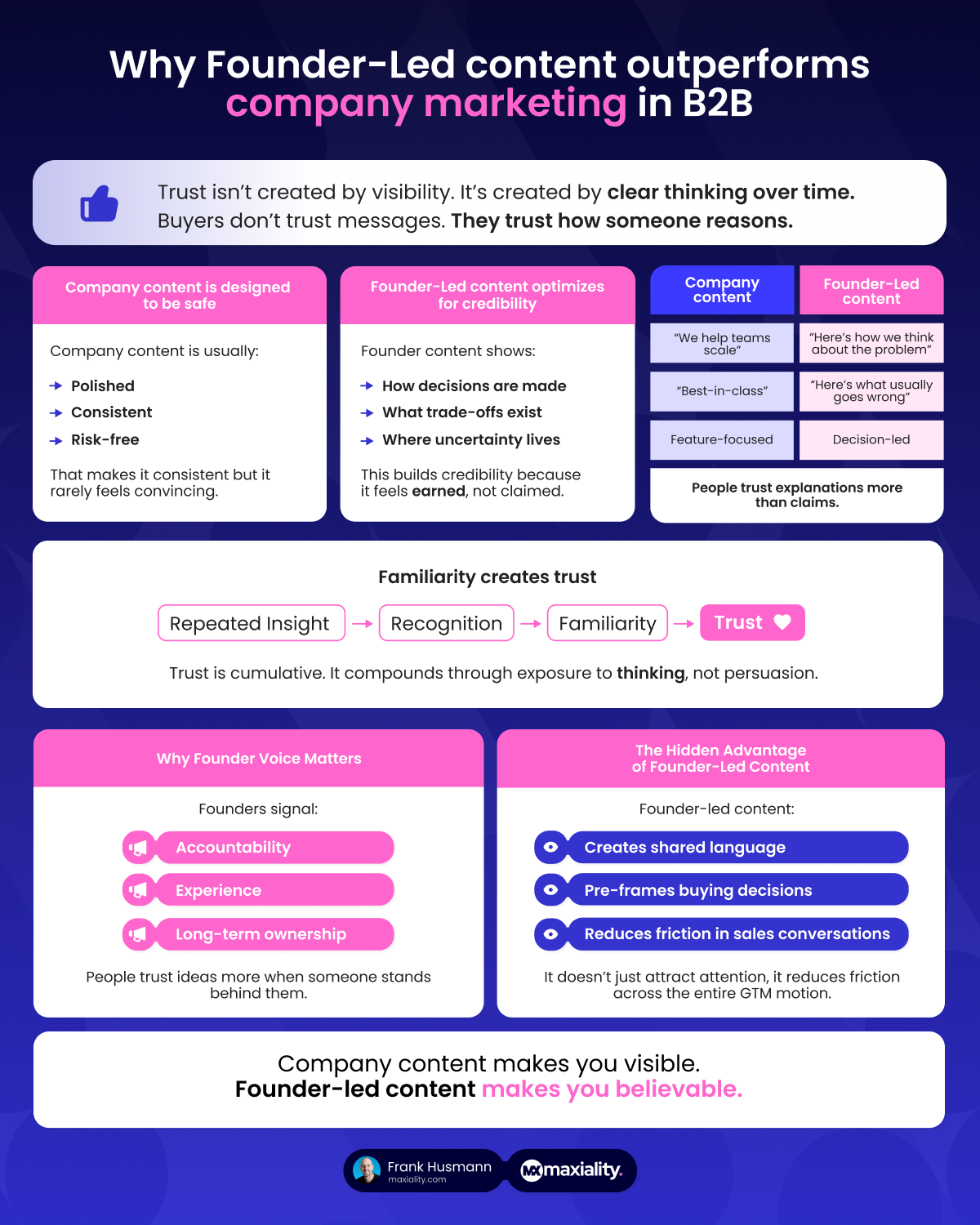
Trust isn’t built through a single moment of persuasion. It’s cumulative. It compounds through repeated exposure to thinking, not persuasion.
Here’s how the cycle works:
Repeated Insight → Recognition → Familiarity → Trust
When someone encounters your content multiple times and sees consistent reasoning, clear trade-offs, and honest uncertainty, something shifts. You move from “another vendor” to “someone who thinks clearly about problems I have.”
This is why founders who publish consistently see sales cycles shorten over time. By the time a prospect takes a sales call, they’re not starting from zero. They’ve already been exposed to your mental models, your frameworks, and your approach to solving problems.
The sales conversation becomes: “I’ve been following your thinking on [topic] - let’s talk about how this applies to our situation.”
That’s a very different starting point than: “Tell me about your platform.”
But here’s what surprised even us: this shift can happen after just one piece of content.
For another SaaS client, the results of posting just one authority-based video were felt instantly in their sales cycle. The founder reported that new clients and interviewees mentioned the video immediately upon jumping on a call, stating that they already perceived him as a “serious authority figure.”
This confirms something critical: when you lead with your thinking, you don’t have to spend the first 15 minutes of a call establishing your credibility, your content has already done it for you.
The conversation starts from a position of assumed expertise rather than earned skepticism. This is the compounding effect in action, even at the earliest stage.
You might be thinking: “Can’t our marketing team create this kind of content?”
Technically, yes. But there’s a reason why it hits differently when it comes from a founder.
Founders signal:
Accountability - They’re putting their name and reputation on the line
Experience - They’ve lived the problem and built the solution
Long-term ownership - They’re not going anywhere; this is their life’s work
People trust ideas more when someone stands behind them. And in B2B, where decisions carry risk and involve multiple stakeholders, knowing there’s a real person with skin in the game makes a material difference.
This doesn’t mean your marketing team is irrelevant, far from it. But the founder’s voice provides a trust layer that’s nearly impossible to replicate through brand messaging alone.
Here’s where this gets really interesting for your go-to-market motion.
Founder-led content doesn’t just build trust, it actively reshapes your entire GTM system:
1. It creates shared language
When prospects adopt your frameworks and terminology, they’re already thinking in your solution’s architecture. Competitive evaluations become harder because other vendors don’t speak the same language.
2. It pre-frames buying decisions
By explaining how you think about the problem space, you define the criteria buyers use to evaluate solutions. You’re not just competing, you’re setting the terms of the competition.
3. It reduces friction in sales conversations
Sales isn’t starting from scratch. Prospects arrive pre-qualified not just by budget and need, but by philosophical alignment. Your team spends less time educating and more time configuring.
4. It creates product-market fit signals
The conversations that happen around your content are gold. You see which ideas resonate, which frameworks get adopted, and which pain points trigger the most engagement. This feeds directly back into product and positioning.
This is why founder-led content isn’t just a top-of-funnel play. It fundamentally changes how your entire revenue engine operates.
When you commit to founder-led content over 6-12 months, here’s what typically happens:
Months 1-3: You’re building the foundation. Content is going out, but traction feels slow. This is where most people quit.
Months 4-6: Recognition starts. People mention they’ve “seen your stuff.” Sales conversations reference specific pieces of content. You start hearing your own frameworks quoted back to you.
Months 7-12: Compounding kicks in. Inbound pipeline quality improves dramatically. Sales cycles shorten. Win rates increase. Your team reports that prospects “just get it” faster.
The difference between company content and founder-led content isn’t just the quality of leads—it’s the reduction in friction across every stage of your GTM motion.
If you’re running a B2B SaaS company and you’re not leveraging founder-led content, you’re leaving a massive strategic advantage on the table.
This isn’t about the founder becoming an influencer or spending 20 hours a week on content. It’s about extracting and publishing the thinking that already exists in how your company operates:
The frameworks you use to explain your product internally
The objections you hear repeatedly and how you think about them
The trade-offs you’ve made and why
The problems you see in the market that others miss
This thinking already exists. The question is whether you’re publishing it consistently in a way that compounds trust over time.
One of the biggest objections we hear from founders is: “I don’t have time to create content every week.”
Fair. But here’s the reality: you don’t need to.
Take our client ISOPlanner as an example. We created a huge amount of content based on just a single one-hour interview with their leadership team. That one conversation gave us enough material to fuel their content pipeline for months, helping them continue to grow their pipeline without requiring a massive weekly time commitment from the founder.
The content is already in your head. You’re already explaining these concepts to prospects, to your team, to investors. The workflow is about capturing that thinking once and distributing it strategically, not inventing new thoughts every week.
Company content makes you visible.
Founder-led content makes you believable.
And in B2B, believability is what converts.
Trust isn’t built by saying the right things. It’s built by explaining how you think, consistently, over time. That’s why founder-led content outperforms traditional brand marketing in B2B and why it should be a core part of your GTM strategy.
If you’re a B2B founder and you’re not publishing your thinking, you’re making your sales team work exponentially harder than they need to.
The content is already in your head. The question is: are you letting it compound?
What’s one piece of thinking from your business that you could turn into content this week? Hit reply, I’d love to hear it.
Until next time,
Frank
P.S. If you found this valuable, forward it to another B2B founder who’s thinking about their content strategy. And if someone forwarded this to you, you can subscribe here.
No posts
Comments
Nothing yet. Say the first thing.
Sign in to join the conversation.