
If you’ve ever poured time or money into paid acquisition only to watch traffic disappear the moment you stop spending, you already know the problem: most growth channels don’t compound.
For SaaS companies, SEO is one of the few channels that actually does but only if you approach it strategically.
Today I’m breaking down a proven SEO framework used by successful SaaS teams that want predictable traffic, qualified leads, and long-term growth without relying on ads.
Most SaaS companies compete not just on product, but on visibility. Every day, potential customers are searching for solutions: “CRM for SMEs,” “HubSpot alternative,” or “best project management software.” If your product isn’t visible when people are actively searching, you’re missing structural growth opportunities.
Paid campaigns bring fast traffic, sure but it disappears when the budget stops. Organic search, on the other hand, builds lasting momentum. The most successful SaaS companies like HubSpot, Buffer, Asana, Salesforce all rely heavily on SEO for this reason.
According to research, after direct traffic, SEO still drives the largest share of website visits for high-growth SaaS companies. When done right, it’s predictable, compounding, and scalable.
Before we dive in, one important note: the “funnel” is just a metaphor. In reality, people don’t flow neatly from top → middle → bottom. Prospects arrive from search at any stage, depending on what they’re looking for.
To make SEO work, you need to align content with each stage of the metaphorical marketing funnel:
Top of the funnel (TOFU) - your prospect knows they have a problem, but not how to solve it.
Middle of the funnel (MOFU) - they understand possible solutions and are evaluating options.
Bottom of the funnel (BOFU) - they are ready to purchase and compare specific products.
So organizing content with the funnel in mind helps create a structured SEO strategy. The key principle?
Start at the bottom. These are the people who are actively in-market and ready to convert. Bottom-funnel content delivers early wins, builds credibility, and validates your SEO efforts. Once this foundation is in place, you can expand upward to middle- and top-funnel content, nurturing longer-term prospects.
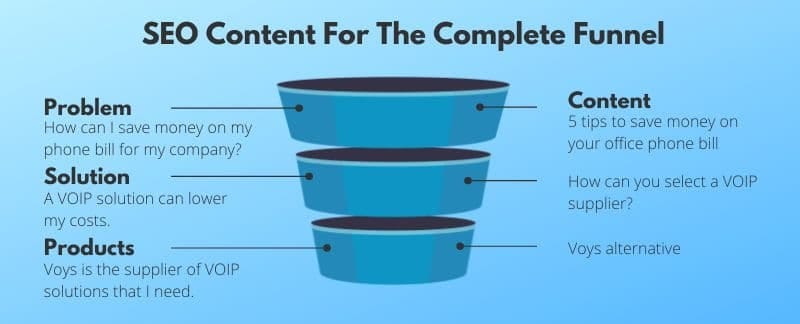
At this stage, people are actively comparing solutions and ready to buy. SEO content should help them choose your SaaS over competitors:
Product comparisons
Competitor alternatives
Reviews and case studies
Example:
“Your SaaS vs Competitor X”
“Best VOIP Solutions for Growing Teams”
Why start here? Because high-intent traffic converts. Every visitor captured here can translate directly into new trials, demos, or sign-ups, giving you tangible ROI early in your SEO journey.
Once your bottom-funnel content is live, MOFU content helps prospects explore solutions and make informed decisions. Focus on:
Product category explanations
Features, integrations, and use cases
Helpful resources that guide decision-making
Example:
“How to Choose the Best VOIP Provider for Small Teams”
“VOIP Software That Integrates With HubSpot”
This content helps nurture prospects toward conversion, building trust along the way.
TOFU content targets people who don’t yet know your product exists, or who are just realizing they have a problem. Here, your goal is to educate, inform, and capture attention:
Highlight common problems your audience faces
Provide actionable tips or insights
Introduce the type of product category, without pushing sales
Example:
“5 Tips to Cut Your Business Phone Bill”
TOFU content is also ideal for email capture and newsletter growth, which feeds your long-term SEO engine.
Start at the bottom by capturing in-market, ready-to-convert traffic.
Use the funnel as a metaphor, not a literal sequence. People arrive at any stage.
Expand upward: MOFU for evaluation, TOFU for awareness and long-term nurturing.
Focus on solving real problems, educating, and building trust and not just ranking for keywords.
Build a content engine that nurtures prospects into paying customers.
Done right, SEO compounds, unlike paid channels, delivering predictable long-term SaaS growth.
That’s it for today. I’m excited to start sharing more frameworks, lessons, and practical tactics here at SaaS GTM Decoded.
If you found this helpful, hit subscribe so you don’t miss future issues we’ll go deeper into Go-To-Market, content strategy, and growth experiments for SaaS teams.
- Frank
P.S. I know SEO can feel overwhelming, especially when you’re juggling product, sales, and marketing. That’s why I’ll keep sharing practical, actionable frameworks like this — stuff you can actually implement without hiring a full SEO team.
No posts
Comments
Nothing yet. Say the first thing.
Sign in to join the conversation.