
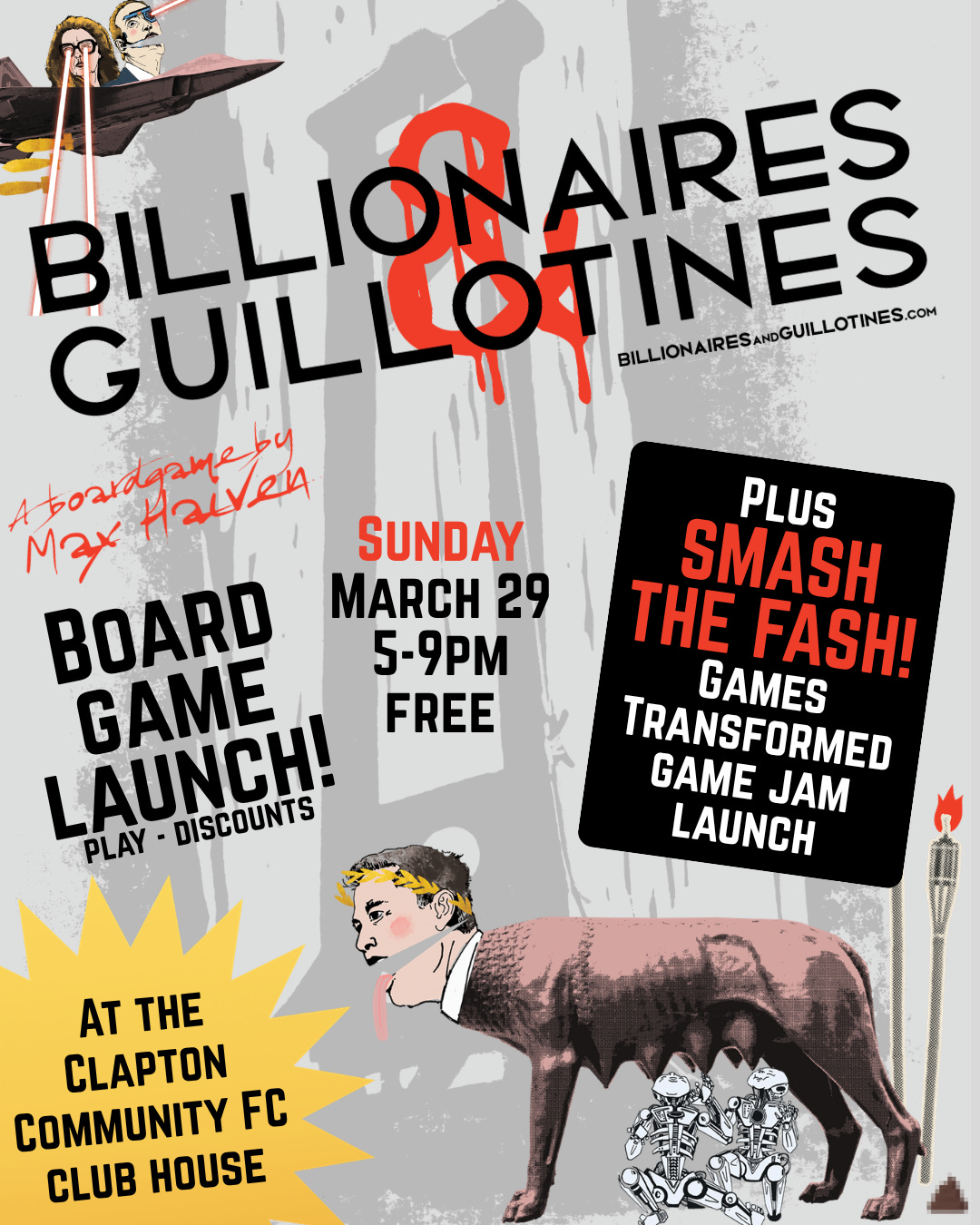
Since late January I’ve been on tour with my new board game Billionaires & Guillotines, offering game-play sessions, public and academic talks and workshops in Paris, Frankfurt, Cologne, Amsterdam, Brussels, Bulgaria, Berlin, Southampton, Utrecht, London, Brighton, Manchester, Durham, Edinburgh, Glasgow and Copenhagen. A HUGE thanks to all my many hosts!
I still have a few events upcoming where I’d love to see you.
March 27, 1pm - public talk at Bristol’s Pervasive Media Studio
March 27, 7pm - playing Billionaires & Guillotines at Bristol’s Spark Space
March 29, 5pm - playing Billionaires & Guillotines at London’s Clapton Community FC clubhouse, also the launch of the Games Transformed 2026 game jam
April 12, 6pm - playing Billionaires & Guillotines at Toronto’s Another Story bookshop
See here for more details.
Meanwhile, you can buy the game from Pluto at a 20% discount using the code GAME20.
OK, here are some of the things I’ve learned or been thinking about while on tour:
First, people really hate billionaires. This is both fortunate and unfortunate.
It’s fortunate because billionaires are genuinely loathsome in the sense that they have hoarded society’s wealth to such a point that not only do they thrive while millions of people suffer and die, that wealth can also be used to essentially break the standard rules of capitalism and exert profound control over the economy. This might actually ultimately might destroy capitalism from the inside, and not in a good way.
It’s especially unfortunate because they might destroy the planet. But it’s also bad because billionaire’s conspicuous villainy mystifies the much deeper systemic problem with a capitalist society that is inherently dependent on its ruling class.
Not all members of the ruling class are billionaires, and even if billionaires were somehow magically taxed into millionairehood (or poverty, which they largely deserve), it wouldn’t actually make a huge difference for the vast majority of workers: We would continue to have to work to survive well we generate profit for more humble capitalists.
The emergence of billionaires might be thought of as a kind of normal glitch within capitalist accumulation. Billionaires emerge as certain capitalists learn how to game the system that enriches them: they act for themselves as individuals, but in ways that often imperil the system that enriched them, which depends on competition between capitalists and the circulation of capital (rather than monopolistic tendencies and hoarding). Thus it always is with capitalism: it is a system largely driven by the decisions of competitive individuals, which leads to inherent and dangerous contradictions and crises. The concentration of wealth and power in the hands of billionaires, then is two things at one: capitalism gravitating towards its inherent tendency and also capitalism breaking its own game. Capitalism is a contradiction, expressing itself violently, and we all pay the price.
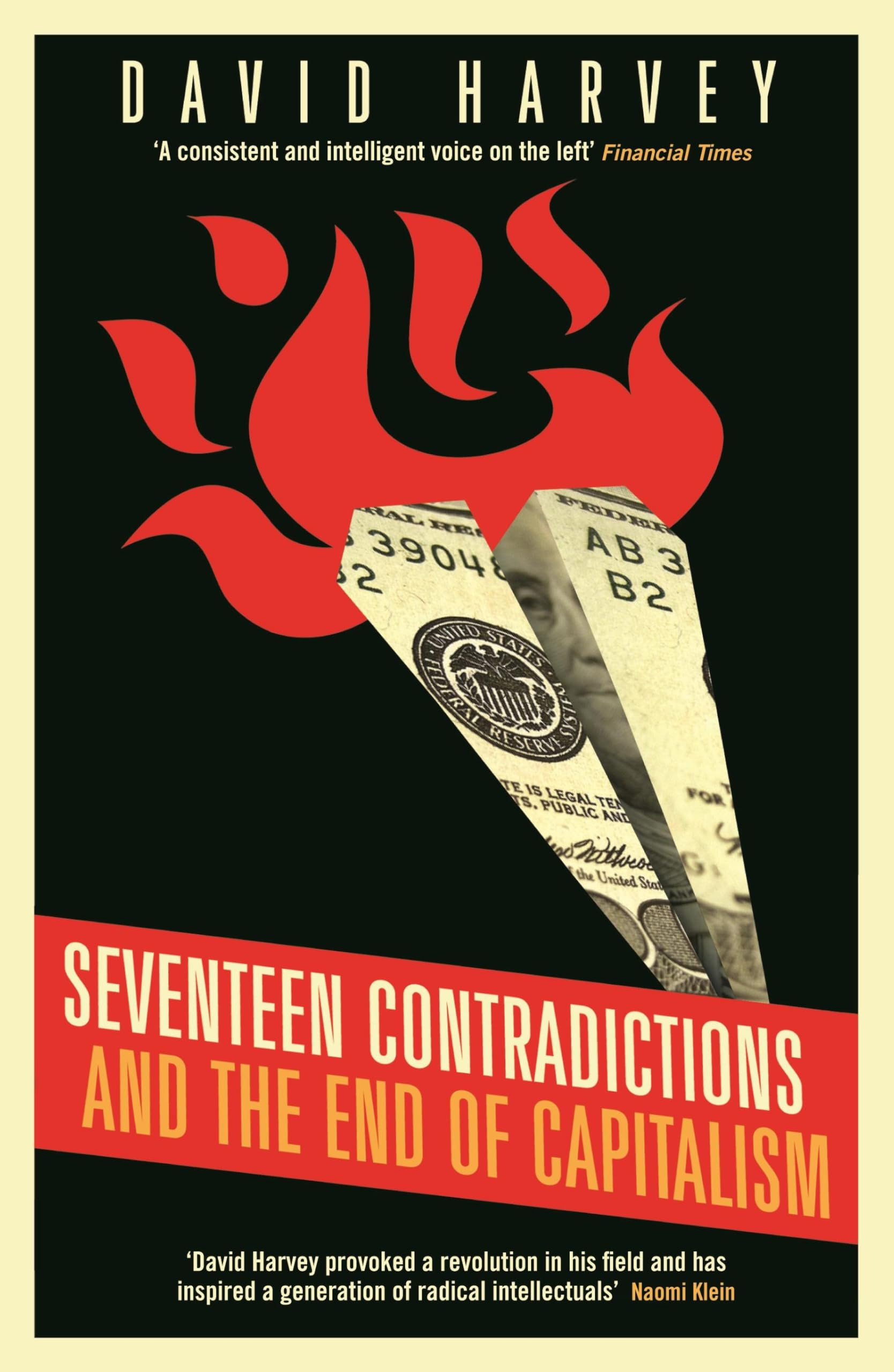
Even if billionaires were eliminated tomorrow, capitalism would still be exploitative and wracked with contradictions and crises, just different ones. But one of the strange benefits of the emergence of a billionaire class is that they earn the contempt, envy and frustration of a much wider cross section of the ruling class, which opens up interesting but fundamentally limited possibilities for temporary alliances. For example, Yanis Varoufakis’s discussion of technofeudalism seems to be oriented primarily towards making other capitalists (who don’t want feudalism) mad at tech billionaires, which is an interesting approach.
But such an alliance is only useful if the “we” making the alliance has some broader strategy (and organization), which would, I presume, see us part ways with our ruling class allies at some point once the billionaires have been brought low.
What we ultimately need are powerful anticapitalist movements that can overcome the ruling class, whether they come in the form of billionaires or as more modest tyrants.
The second thing I learned is that people are desperate to come together, and board games offer a phenomenal way to do this. I’m not saying that board games are the only or best way of socializing, or that everyone ought to enjoy them. But I do think that the opportunity to come together with strangers with the benefit of a temporary set of rules and props that facilitate social intercourse might be particularly useful in this moment
As my friend Sarah Stein Lubrano makes clear in Don’t Talk About Politics: Changing 21st Century Minds, this is a moment where many people suffer from various degrees of social atrophy, in other words, the shrinking of our proverbial social muscles due to lack of use. That lack of use is tied in many ways to the scourge of today’s social media and digital technologies, but much more profoundly it’s connected to the systematic destruction of social infrastructures and public spaces in the name of corporate culture. We tend to want to blame individuals for doomscrolling and living online lives; we ought to blame the ruling class and the politicians who serve them for destroying social life and social space (and building addictive devices, sure).
In this scenario, I observe that people need structured and scaffolded opportunities to come together and meet strangers and, through those meetings perhaps develop friendships and meaningful relationships. I think people are acutely aware of this need and are searching for opportunities. Board games are great for this, for people who enjoy them at least.
This seems to be especially true of people who have “left wing” sensibilities (I don’t love the term “left wing”, but you get what i mean: people who generally believe in peace, equality, care, diversity, abundance). I have some thoughts on why this might be and I’ll elaborate them in a future post, but one of them is that I think that playing games can afford you the insight that the rules that govern us are ultimately arbitrary, that they ought to (at least ideally) be fair, and that if they are not fair (or at least fun), one has the right and the duty to refuse to play and insist on a new game. I think this is in stark contrast to a more right wing or conservative worldview, which tends to fundamentally organize itself around the idea that rules exist for a reason and must be obeyed.
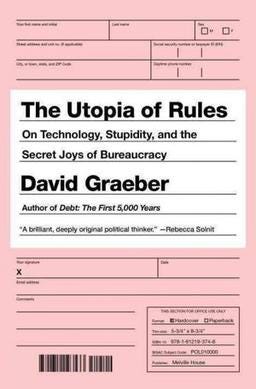
It’s tempting to imagine everyone who plays board games are obsessed with rules. But that’s actually not the case. Some certainly are, but not the majority in my observation. And in any case, rules are not quite what we imagine, as David Graeber argued in his The Utopia of Rules. The ability to consciously and intentionally enter into temporary agreements with others and be bound by the norms that we consent to is an essential part of a radical politics.
More generally, as I argue in my forthcoming book The Player and the Played: From Gamed Capitalism to 21st Century Fascism (coming September), games are so important today not only because literally billions of people play them every day (more than they watch movies, read books or listen to commercial music). RThey are so important because today’s form of capitalism is built on gamified mechanisms that seduce, channel and harness our agency, our ability to act playfully and strategically in the world. We are no longer passive drones of capitalism (if we ever were): our survival is made dependent on our ability to “play” innumerable competitive games, to embrace the disposition of “the player” in a winner-take-all economy ruled by artificial scarcity. But for most of us (even the losers among us), we feel this not as a grim dystopian Hunger Games scenario, but as an invitation to exercise our freedom, creativity and agency.
Unfortunately, a lot of what the “left” does is make people feel overwhelmed by power and like we have very little agency. I think games can help. At very least, we have a lot to learn from games about agency and how to build attractive, interesting, agency-filled experiences for people. I don’t mean that every activist event or movement needs to be gamified in a gimmicky way (please no). I mean that agency is a key dimension of politics in the 21st century. People don’t just want to know things are terrible; we want to feel like we have some control over our fate.
As regular readers note, I’m skeptical to claims that people are motivated towards radical politics by hope. But I do want to argue that it’s important to invite people into movements and activities that lead us to us feel like we have some power over our lives.
The issue is often that, as products of a gamified capitalist society, our imagination of what agency is has been constrained to the level of the individual. In video games and popular culture, even in our history books and novels, we glorify the individual agent. We desperately need visions and experiences of collective agency to familiarize ourselves with the power that comes from acting together, as movements, as a society. Games can help us envision this, but sadly they rarely do.
The third thing I learned on tour is one that I’m grappling with as I rethink how I teach my classes in social theory, political economy and cultural analysis, and it has to do with how people learn games.
I have taught Billionaires & Guillotines now to hundreds of people, and I’ve started to notice a pattern, which I’ve tentatively organized into three types of learners.
First, there’s the vast majority of people who can basically only handle carrying about four or five rules around in their brain at any one time. I’m one of these people. If you explain all of the rules of an elaborate game to me, I zone out after about five minutes. I need to get my hands on the pieces and learn by doing.
The second type of learner is one who needs to hear every single rule and understand how to form a strategy before they can have a good time playing. If you force them to play too early, they get extremely frustrated because they don’t understand the point, and they feel like they’re being manipulated, or that they don’t understand something and are going to let the whole group down.
The third type are the most interesting to me. These are people who can’t understand rules at all unless you frame them as a narrative. These players typically need you to explain how the various mechanics and functions of a game are related to an overall story and characters, and they need to be able to imagine the form of agency of the thing that they’re playing, (in the case of my game, a billionaire). I find these to be the most fascinating and often these turn out to be the best players.
What I take from this is not only the lesson that we all have very different brains and require very different approaches to learning something. It’s also that a good game and perhaps a good teacher can can appeal to all three registers at once. I’ve tried to do this when I teach Billionaires & Guillotines by mixing approaches that will speak to all three kinds of learners: I try and get people playing and practicing physically moving the pieces early on. I constantly remind the players of the overall objectives and give them some information about what I will explain later, to try to satisfy people who need to know everything before they can play. And I try to never forget, no matter how many times I teach the game, to reiterate the story and the narrative and the emotions and the motivations of the characters.
In reality, there aren’t three types of learners. We all have each of these learning forms within us. And probably the most convincing and compelling teachers appeal to all three.
I think this probably has important lessons for activists and political educators as well. It would imply that, when one is speaking or communicating about an issue. More on this soon.
No posts
Comments
Nothing yet. Say the first thing.
Sign in to join the conversation.