
Alex Karp, the coked-up pseudo-intellectual ghoul at the helm of the murder-machine Palantir is in the news again, now with a 22 Tweet manifesto that summarizes points he made in his co-authored 2025 book The Technological Republic.
Make no mistake, it is a fascist manifesto. What it represents is, without exageration, one of the gravest threats to life on earth today.
To recap, Palantir was founded by Karp and Peter Thiel shortly after the September 11 2001 terrorist attacks with the goal of using digital technology to “keep America safe” and make a huge amount of money.
Today, it is probably the world’s most advanced, ruthless and expansionary military-grade techno-surveillance and AI apparatus. Not only does it provide intelligence to the American, Israeli and other allied militaries (it is likely responsible for the American bombing of a girl’s school on the first day of the ongoing war on Iran, as well as tens of thousands of targeted assassinations in Gaza). It also provides data and analytics services to many civilian aspects of governments, for example the British National Health Service, with extremely worrying consequences (where is all the data going?). Palantir is also among the most enthusiastic supporters of the second Trump administration, for example being a key sponsor of its June 2025 parade of weapons celebrating both the impeiralist military and the President’s birthday.
I address Karp’s theories in my forthcoming book The Player and the Played: From Gamed Capitalism to Twenty-First Century Fascism, due out September 15 from MIT Press (the same day as Naomi Klein and Astra Taylor’s highly relevant book End Times Fascism).
In it, I explore Palantir’s activities in Gaza and beyond as part of a fascistic urge towards worldbuilding and worldrazing, now in a technosupremacist idiom where the most powerful tools humanity has ever created are bent towards a profoundly dehumanizing and murderous agenda.
Below is an excerpt, but indulge me a moment first.
By way of setup, it comes from a chapter that takes a long, hard second look at worldbuilding. This term describes a growing trend in speculative fiction, fantasy and other genres of writing (and also film, music, games and more) where the author or authors build highly elaborate, immersive worlds, replete with deep and obscure lore.
The paradigmatic example is the world of Lord of the Rings or the Star Wars universes. Not only do these fictional world delight (and often obsess) fans with their creative nuances, they also, in a digital age, invite fans to collaborate (and sometimes compete) online to create whole encyclopedias, to debate minutia, and to offer their own contributions.
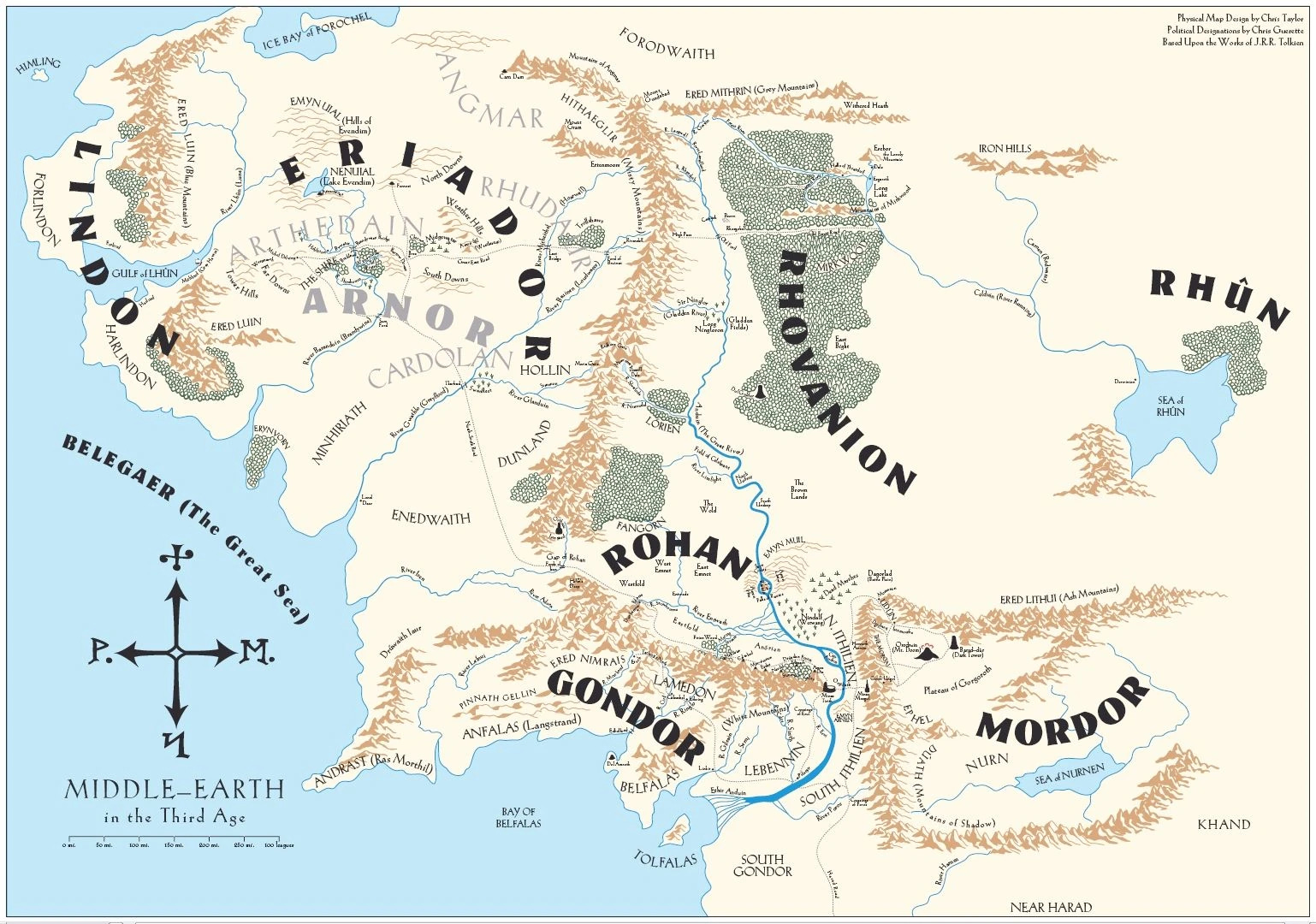
I would argue that participatory worldbuilding isn’t just part of popular culture today, it is popular culture: while it’s not centralized, this kind of fan-produced content is what people do for fun nowadays, even if they don’t call it that.
All authors and creators, even those offering so-called non-fiction, are worldbuilders - that’s what makes their work enjoyable and immersive. If you like or comment on this post, you’re helping build its world in a way. From one perspective, there isn’t a lot of difference in form between, say, going to hear Naomi Klein give a talk and going to a cosplay comic book convention: the audience is part of producing a world in which they invest their imagination.
Yes, I am well aware that there is a major difference: the question of if Black elves belong in Tolkien’s Middle Earth is a matter of vigorous debate among fans, but other than the racism it fosters (which is significant and deadly) it has limited material consequences. We don’t live in Middle Earth. However, the things Naomi talks about in her lectures are grave matters of public concern and action (climate crisis, conspiracy, fascism). We don’t go to her talks to escape the world, but to be a better part of it.
Sure, yes. But I’m speaking about something at work in our digitally-mediated culture. We are all, increasingly, escaping into worlds that we are co-creating, whether we like to admit it or not. Klein’s excellent book Doppelganger is all about how authors and their fans co-create a conspiracist “mirror world” that is made up of weird and deranged interpretations. But the thing that set’s her book apart is that it’s deeply introspective: she meditates, with undue humility, on if she herself might be someone else’s weird doppelganger, if she is making a parallel world for her readers and followers.
She comes to her own conclusions, but mine is this: indeed she is. One of the reasons she is such a compelling writer is that, like all writers, she calls the reader into the world she is depicting. If you’re a fan of her work (and you should be), it’s not just because of what it says about the world, but what it says about you: you, like she, are a smart, compassionate, introspective person awake to the horror and the beauty of the world.
The history of modern art can be told as one where artists slowly begin to conspicuously recognize that the artwork is only ever completed in relation to its viewer. Thus it has always been: an image includes not only the scene depicted, but implies the viewer, whether it is the lecherous misogynist aristocrat who gains perverse joy from feasting his eyes on the the coquettish nude or the bourgeois nationalist who looks over his shoulder at Liberty leading the people, imagining himself at the vanguard of a revolution he will never have to risk being part of, with the rabble he’d rather never associate.
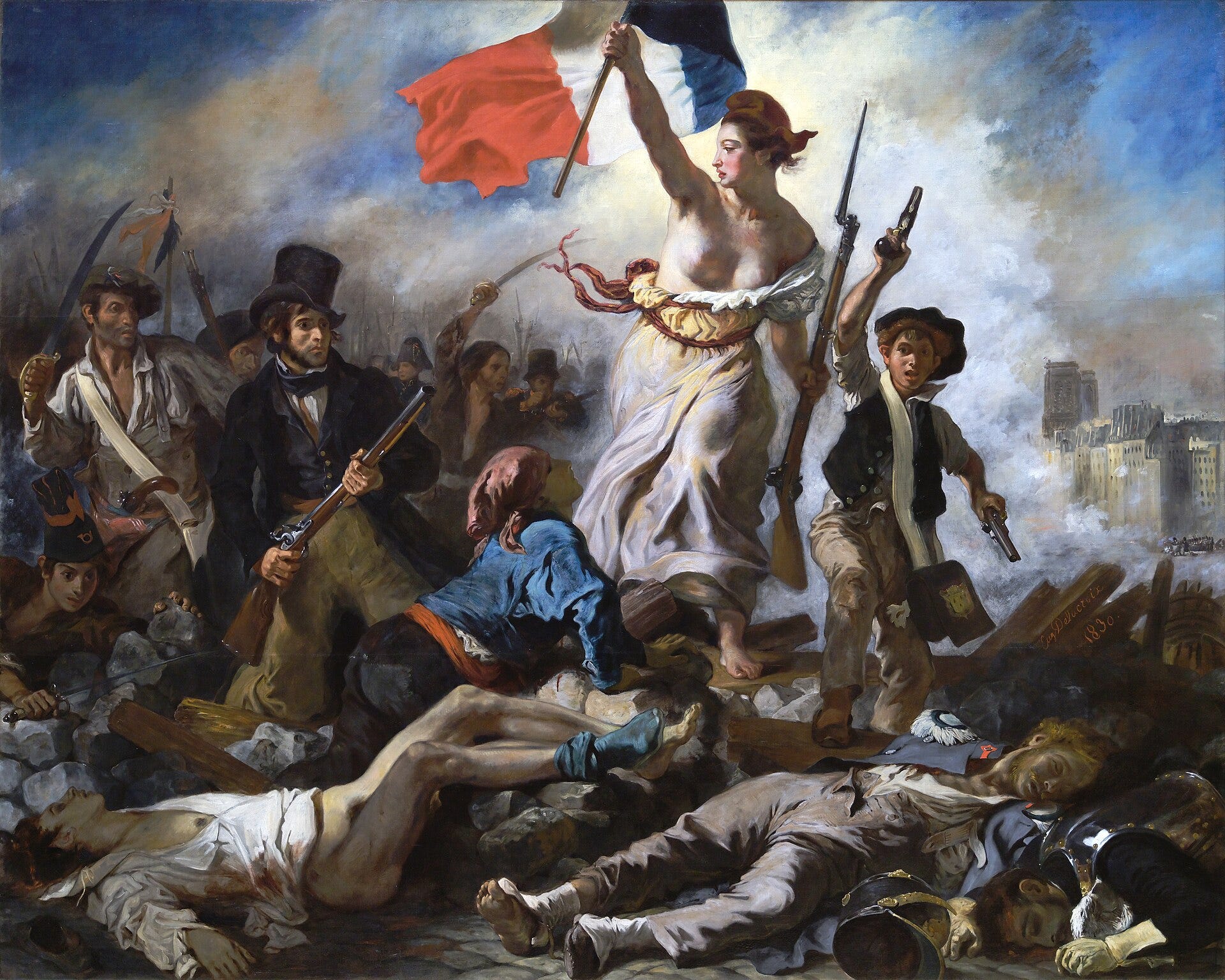
So too with any work of art: it is always making a world, and we, its audience, enter into and consummate that world, like it or not. But the full seductiveness of worldbuilding could only really be realized in art, literature and culture in a digital age, when we can discover other millions of other fans, where we can each fragment into our own bespoke niche, and together and debate the lore of everything from the extended Star Wars universe to the performance of our favourite sports team, from the nuances of Jane Austen’s imaginary worlds to the obscure debates in last century’s Council Communism, from the forgotten B-sides of a long-dead Tibetan punk rock genius to…
…the Qanon conspiracy fantasy, where millions of people around the world participated in co-creating an epic globe-spanning fantasy/adventure story about a cabal of elite pedophiles (not the actual ones, interestingly enough).
So let me actually revise my earlier assertion: worldbuilding isn’t just part of politics today, it is the dominant idiom of politics today. What is “Make America Great Again” other than a statement that worldbuilds: in spite of its chunky brutalism, it implies an America that was great, an America that is no longer great, and an America that may yet be great. It invites the addressee into a community of the imagination. It presents no policies or plans, but creates a world where the adherent may imagine themselves, and it fosters a participatory culture of the imagination. In this case, the fascist imagination.

The Argentine fabulist Gorge Louis Borges in many ways anticipated this. For someone who basically lived for many years inside a library, it’s not perhaps a coincidence that many of his stories concern how readers can get swallowed by the imaginary worlds they find in books, or the way that imaginary worlds make themselves real. Perhaps the most famous of these is his 1940 short story “Tlön, Uqbar, Orbis Tertius.” The plot is delightfully convoluted, but essentially it takes place in a parallel reality to the author’s own, where the narrator (another Borges) and his friend discover an singular copy of a common encyclopedia that, unlike any other copy, contains an entry on a nation in Asia Minor called Uqbar, about which nothing else has ever been written. The mystrerious entry relates that the Uqbarians are infatuated with an fantastical imaginary planet called Tlön.
As the story progresses (into the fictitious future, past the 1940 publication date) the narrator finds himself in possession of one volume of an Encyclopedia of Tlön, which details the mind-bending physics, science, astronomy, culture and religion of the otherworldly Tlön, which is clearly a work of the imagination. But whose?
We learn that an early modern secret society Orbis Tertius assembled with the sole purpose of the systematic worldbuilding of Tlön, just for the joy of it, passing down the game generation to generation. In the 1800s, With the help of a rich American slaver who wants revenge on God, the secret society was able to complete a multi-volume Encyclopedia of Tlön, which is not only rich in obscure, fantastical lore, but tantalizingly systematic: all the aspects of the fictitious world make sense together: its impossible physics explain its unearthly geology, which in turn renders logical its alien flora and the fauna who eat them, and so the inhuman anatomy of the intelligent Tlönians who eat them and the literature and laws and archeology the Tlönians practice.
But the narrator relates that, almost as soon as he discovers the complete Encyclopedia of Tlön, objects from this imaginary world begin to “insert” themselves on his earth, first here and there, obscurely, then with increasing frequency. When the Encyclopedia is finally leaked to the public in the speculative 1948 (eight years after the story’s publication) the imaginary Tlön begins to, virus-like, captivate humanity.
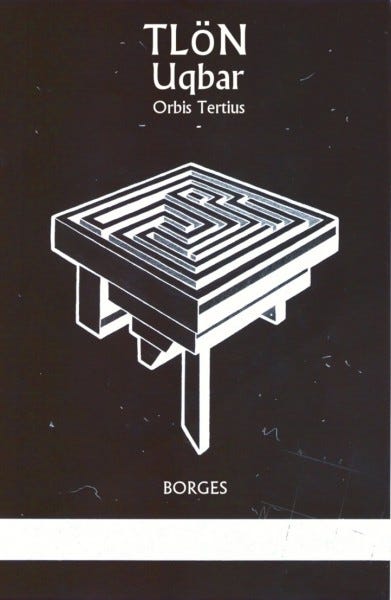
“Almost immediately,” the narrator tells us, “reality yielded on more than one count.” “Manuals, anthologies, summaries, literal versions, authorize re-editions, and pirated editions” flooded the eager market. Schools began teaching the invented but captivating language and history and sciences of Tlön. “Already a fictitious past occupies in our memories [in] the place of another, a past of which we know nothing with certainty.” Soon, the narrator mourns, the Terran languages will disappear and “the world will be Tlön.”
But, the narrator reflects, the truth is that the world “longed to yield” to this fiction that makes itself real. Why? “Ten years ago [i.e. in the story’s 1938] any system with a semblance of order—dialectical materialism, anti-Semitism, Nazism—was sufficient to entrance the minds of men.” Thus prepared, “how could one do other than submit to Tlön, to the minute and vast evidence of an orderly planet?” In the face of the inscrutable forces that govern our planet and our lives, humanity becomes “enchanted by [Tlön’s] rigour” but “forgets over and again that it is the rigor of chessmasters, not of angels.”
It is an enigmatic story to be sure, but it speaks to something profound that has only been realized in our own times: for many people, especially people for whom this world hurts and makes no sense, escaping into the “rigor” of “the minute and vast evidence of an orderly planet” is utterly and devastingly enchanting. Borges here sadly reproduced the liberal canard that conflates “dialectical materialism” [i.e. Marxism] with “anti-Semitism [and] Nazism,” but if we confine ourselves to thinking merely about the most doctrinaire versions of so-called “scientific” socialism and Stalinism (which, to be fair, was what was being pushed by the USSR in 1940), then the point perhaps stands: these ideologies do present, with the diabolical “rigor of chessmasters” a rigid framework for understanding the world. Or, from another perspective, they offer a portal into a parallel world, where the events can be interpreted and acted upon with (the illusion) of certainty. And, like Tlön, these worlds seek to make themselves real.
I would not be alone in interpreting Borges’ famous story as an allegorical warning about the lure and power of the totalitarian imagination, totalitarian in the sense that it fantasizes about submitting all of society, all of reality, even, to the imagination of an individual or party or group. Without nuance, such an allegory lends itself to boring liberalist moralism about the danger of any revolutionary program.
How do imaginary world make themselves real? This is a question of what some accelerationist thinkers call hyperstition (like superstition, by hyper).
For those not in the know, accelerationists believe that we must accept, adapt to and in some cases celebrate the way capitalism is transforming the world, notably through economic integration and advanced computing technology. For left-wing accelerationists, these changes can be appropriated and harnessed towards the common good in order to liberate humanity from the shackles of work, to allow us to transform our bodies and our minds, to create a world of abundance and exploration, but not until capitalism is tamed or abolished in favour of a different system, one not ruled by the profit motive and private property.
For right-wing accelerationists, like for instance the megalomaniacs at influential Silicon Valley venture capital firm Andreesen Horowitz, authors of the Techo-Optimist Manifesto, capitalism’s technololgical revolutions are essentially good in and of themselves: their effects may indeed be destructive (even genocidal), and their benefits will be unequal, but this is the price of progress.
In the theories of Nick Land, a once-leftish accelerationist luminary whose dalliance with edgy European nihilism sucked him into a reactionary black hole (he is today a big influence on Peter Thiel and presumably Alex Karp, though I have not seen evidence of the latter), hyperstition names a process where a speculative conjecture makes itself real, kind of like a self-fulfilling prophesy.
This isn’t mere “manifesting” gobbledygook: in its most compelling theorization, hyperstition is a historically unique phenomenon that emerges from late stage, digitally-augmented capitalism.
Even for Marx, capital is, ultimately, an abstract thing that makes itself real. But even Marx could not have imagined the profound influence of capitalism on all aspects of life such as we see today. And he could not have imagined how, when tied to computing and network technology, capitalism could produce something like the hyper-specialized, state-of-the-art speculative financial trading algorithms that, today, shape the prices and distribution of much of today’s wealth (a long time ago, I wrote about the finance sector as “capital’s imagination”).
Under this moment of computerized, financialized capitalism, is we observe daily how hype manifests wealth, how fictions and prophesies insert themselves into reality. We need look no further than the career of Elon Musk (the subject of a brand new must-read book from Quinn Slobodian and Ben Tarnoff), who seems to understand this all intimately and who has mobilized hype, narrative and futuristic promises to materialize profound and dangerous wealth and power.
The gaming of today’s unregulated “prediction markets” by people in or near the Trump administration is also an example: are they betting on decisions they know will happen (attacking Iran, announcing tariffs, etc?), or are they acting to confirm the bets?
Either way, the circuits of technocapitalism allow them to fulfill a dream that has always been at the core of the fascist idiom: the power to make one’s imagination real, to usurp the world-as-it-with the worldbuilding impulse, the triumph of the will, the ultimate narcissistic apotheosis of sovereignty.
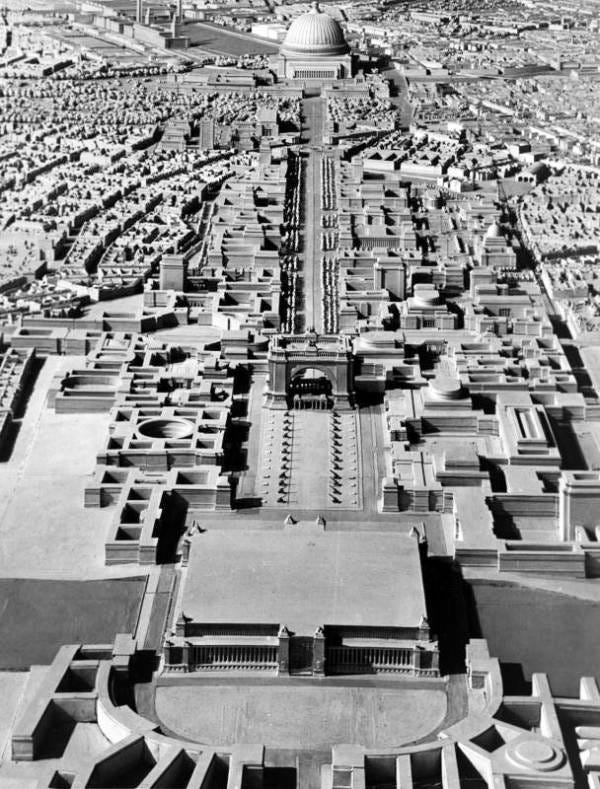
Let me be provocative and say that worldbuilding, as a 21st century cultural phenomenon, is symptomatic of this technofascist turn in capitalism. (Brent Bellamy has made a similar observation, with greater nuance).
Many, many critics and authors have celebrated worldbuilding as a form of resistance or imaginative activism against systems of domination, pointing towards Afrofuturism, Indigenous futurism, queer speculative fiction and more. I don’t disagree with this, and indeed one of my own recent projects encouraged Amazon workers to use short speculative fiction to worldbuild as part of the broader struggle against Amazon.
I’m not disputing that worldbuilding as an individual or collective practice can be an important part of a practice of liberation and the radical imagination, although I’m not sure it always is, and I think our enthusiasm is often a bit hasty.

What I am saying is that our efforts and desire to worldbuild, our whole conception that an imaginary world might be able to affect the world, is so appealing now because we live in the shadow (indeed, in the world) where capital and capitalists are worldbuilding so profoundly and so disastrously. We are the unhappy products of this worldbuilding power, and we envy that power which created us and the world in which we are forced to live.
But my argument is that it is the particular historical, technological and political economic juncture we are at now that makes worldbuilding so current, and we need to recognize that, in the worldbuilding game, we who believe in collective liberation are at the disadvantage.
OK, on to the excerpt from the book
The promise from [Karp’s] Palantir is that the world will be one of data-driven peace. The corporation’s massive hoard of data, plus its state-of-the-art analytics engines and artificial intelligence will, they argue, produce a weapon so powerful none will dare threaten its coercive peace. The reality is the hellscape of Gaza, where Palentir’s technology is being used in multiple ways by Israel’s ongoing genocidal campaign, not the least of which is the selection of targets for murderous rocket or drone strikes.
In his 2025 book The Technological Republic, Palantir CEO Alex Karp, a mixed-race atheist with a PhD in social theory, argues that Silicon Valley must abandon both its relentless profiteering and its knee-jerk patrician disdain for the theological needs of the masses and, instead, recognize itself as the child of American (and Western) civilization, with responsibilities to its (sometimes embarrassing, but ultimately noble) parents. In contrast to its soulless, valueless rivals of Silicon Valley, Palantir will boldly mobilize its powerful edge on security-oriented AI to support a US government that is not afraid to kill in the name of freedom, innovation, and capitalist prosperity (notably, democracy typically only appears as a qualifying adjective in the book, as in “Western democratic capitalist states,” but rarely as a core value that needs to be defended).
For Karp and company, the new techno-Spartans must have the power and also the moral courage to make engineering-style decisions about life and death. When confronted about his company’s role in Gaza by a protester at a talk in May of 2025, Karp was gleeful at the opportunity to lecture his heckler (after she was evicted) as “an unwitting product of an evil force, Hamas. She’s unwittingly part of their strategy. She’s a product.” In other words, a disposable NPC (non-player character). He proceeded to explain that
“the obvious solution to war is to have the West have strongest and most precise deadly weapons possible so we can minimize unnecessary deaths, and the best way you minimize those deaths is that you’re so strong that nobody attacks you.”
In the world Palantir is building, there are only ruthless but ultimately benevolent authoritarian realists and sanctimonious useful idiots who are too stupid to even realize which side they are on, who live in a fantasy world and who are, at best, a distraction and, at worst, a dire internal threat.
Palantir as an entity is, in a sense, an insurgent world that is making itself real: a data doppelganger of reality who murders and replaces its double. […] On the obverse side of the worldbuilding coin is the specter of world razing. To create the illusion of Terra Nullius on which the worldbuilding impulse depends, that which existed on the physical or imaginative terrain must be eliminated. So too must the bodies, human or otherwise, who might object. Fascist worldbuilding is not a negotiation or compromise or creative collaboration with the world. It is the remaking of the world through conspicuous violent power. It occupies the world so thoroughly that the world that existed previously no longer exists except as a fantasy.
It can, of course, be tempting to react to the threat of fascistic worldbuilding and worldrazing with calls to return to reality. But such approaches fail to recognize that it is a continuation, rather than a departure from, the trajectory of financialized, “gamed” capitalism that incubated fascistic politics in the first place. Built on centuries of colonial precedents, the antidemocratic worldbuilding/worldrazing power once reserved for the market is now being claimed by figures that this same market has enriched and empowered beyond almost any precedent.
Thiel, Musk, and others who wield worldbuilding/razing power imagine themselves as what I have elsewhere called angels of creative destruction: uniquely blessed by capitalism with unimaginable potency and also called to do the market’s work here on earth. They sound the trumpets of a techno apocalypse, and we, lesser beings, join the host or die.
Their fantasy worlds are participatory games in which we are each asked to compete for our place or be left behind in a “reality” that is being torn apart. Calls to “return” to that unenchanted reality will likely fail to sway many people who find more safety, coherence, joy, hope, and agency in the megalomaniacal dreams of these modern-day financialized demigods. How can we do other than submit to the minute and vast promise of an orderly planet, constructed with the rigor of chessmasters?
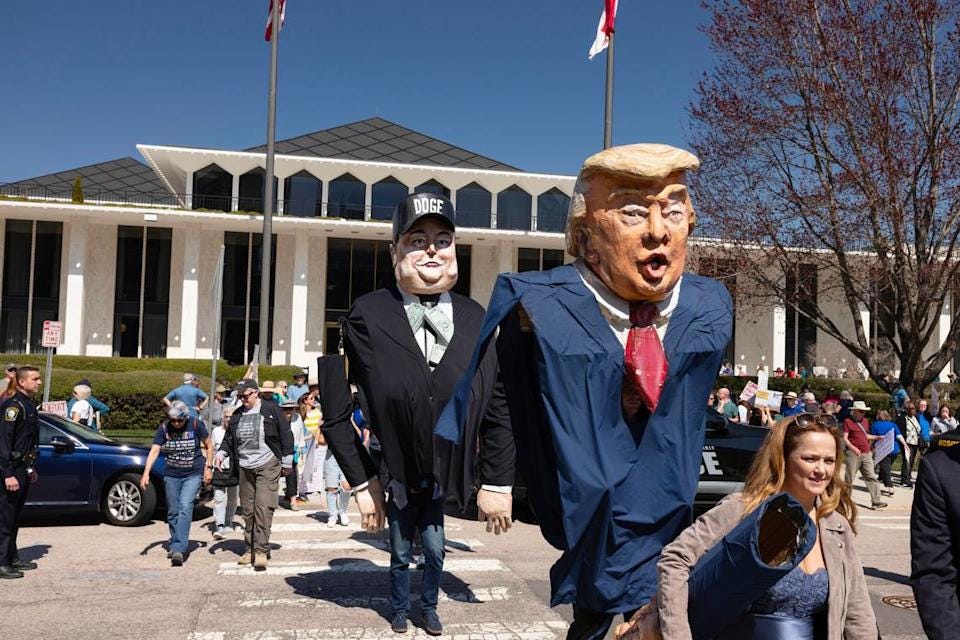
We are always building the world, although not in the conditions of our own choosing.
I think the promise of the concept of worldbuilding, and worldbuilding not merely as escapist entertainment but as an effort to transform our world, is that it reveals “the ultimate hidden truth of the world is that it is something that we make, and could just as easily make differently,” as David Graeber now-famously put it. But elsewhere in my book I reflect on David’s work and the way it opens us up to looking at the power of the imagination in at least two different ways.
For Graeber, the police hate giant puppets and, more generally, radical irreverence [because] The (fascistic) work of the police is to enforce the “imposition of a narrow range of pre-established schema to a social reality that is, usually, infinitely more complex,” which is also a good description of the animating logic of fascistic politics.
For Graeber, the violence of the police is, ultimately, about imposing will without identification; it is a form of communication without empathy, the objectification of the other. And for the institution of police and for the fascist imaginary, this is the only power that exists: coercive power that ultimately resolves in violence.
By contrast, for Graeber, protesters’ giant puppets (and the “tactical frivolity” of demonstrations more generally) represent the power of the imagination, “the power to [collectively] recreate and redefine institutions.” The protagonists of such demonstrations are, at best, fundamentally challenging the paradigm [of fascists and the police]: the self-willed, individualistic, unaccountable power to make and break worlds in the name of some fundamental sacred ideal.
Sometimes that ideal is organized around patriarchy, racism, or nationalism. Sometimes it’s money. Sometimes that ideal is ultimately this nihilistic worship of power itself. But power is scarce, and the competition for it defines reality. In the face of this murderous truth, everything and everyone else is a joke.
By contrast, the kind of joyful collective protests that Graeber has in mind create a sacred ritual of collective cooperative becoming that celebrates and instantiates the reality that a “we” who is always in the process of forming itself make our world together, and we can make worlds where we can all thrive. Power, in this view, is beautifully, monstrously, playfully abundant.
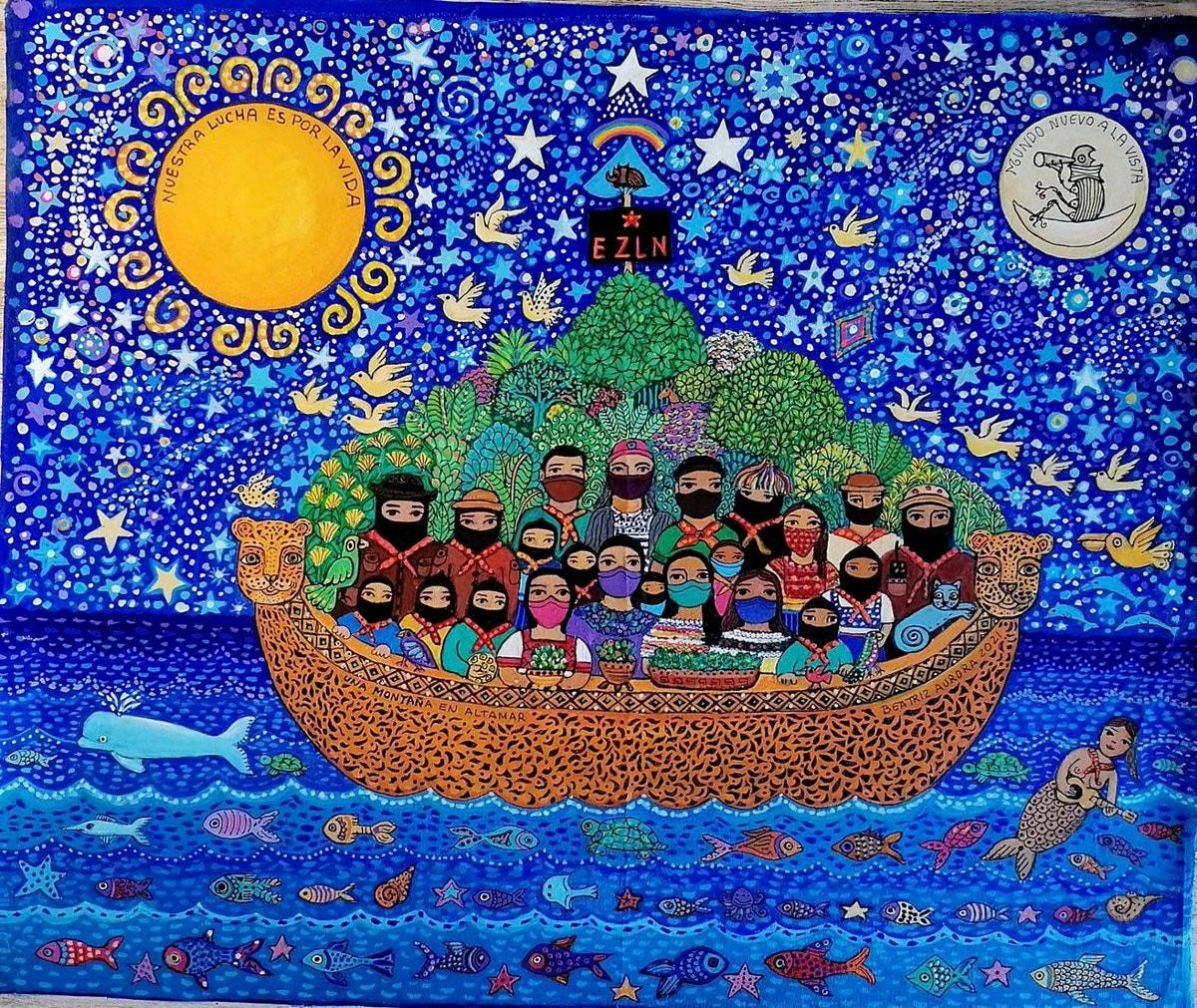
In other words, yes to worldbuilding, but not as the triumphant actualization of the individual imagination, but rather as a reflexive part of broader militant struggles to, in the words of the Zapatistas, make a world where many worlds fit.
No posts
Comments
Nothing yet. Say the first thing.
Sign in to join the conversation.