
Last fall, I shared my thoughts on the future of aesthetics, outlining how teledermatology walked so that aesthetics could run. The first wave of companies (Hims, Ro, Thirty Madison) proved that customers would seek out and pay for dermatological care online, and that the cultural stigma around it was cracking. That infrastructure and normalization has since opened the door for a second wave of aesthetics companies to go further, reach more consumers and build bigger brands.
We’ve seen the same pattern in wearables: Garmin and early Fitbit were built for athletes and the quantified-self consumer. Apple followed, putting health monitors on the wrists of consumers who wanted to know how many steps they took that day. Oura came next, putting sleep trackers on consumers’ fingers, selling 5.5M rings since launch, with over half sold in the last 18 months, primarily to women tracking their own health. The core clinical value prop of owning your health data hasn’t changed through these examples; the packaging and core customer profile did.
I keep coming back to that framework when I think about longevity. Prenuvo, Function Health, Grail – these companies have proven the model. They’ve shown that consumers will pay for preventive diagnostics, that the science is compelling and that a real market for preventive care exists. Just like in aesthetics, the first wave longevity core customer is a highly activated, health-literate early adopter who was already going to find these solutions. In other words, longevity is still largely focused on its initial biohacking customer base.
McKinsey’s 2025 Future of Wellness survey estimates that consumers most likely to seek out cutting-edge health solutions (aka the highly activated consumers) represent just 25% of the market. Although early, the demand beyond that base is real: the same McKinsey survey found that up to 60% of consumers say healthy aging is a top priority, yet nearly half fall into segments defined by skepticism of new technology or difficulty following through on health goals. These are consumers who are motivated to be healthier, want better information and want to stay ahead of potential health declines, but are still largely operating in a sick-care framework. They go to the doctor when something is wrong, trusting their primary care physician more than they trust any app. They’re nowhere near the ultra-optimized, peptide-injecting, supplement-maxxing customer profile that most longevity companies are building for today.
Maveron’s data backs this up – our Consumer 2026 Report found that health and wellness carries the largest intent gap of any category we surveyed. Only 21% of respondents use AI for health today, but more than half say they are likely to try AI tools in this category over the next year.
Preventive care, including longevity, has been siloed to the most privileged, not just because of cost but because of cultural proximity. Biohacking is something consumers must opt into, rather than something they habitualize, like brushing their teeth or putting their socks on before their shoes. But, just as the future of aesthetics is starting to materialize, the cultural wall around longevity is coming down. The brands and platforms that drive the next wave of longevity will meet the average consumer where they are, not where the biohacker already is.
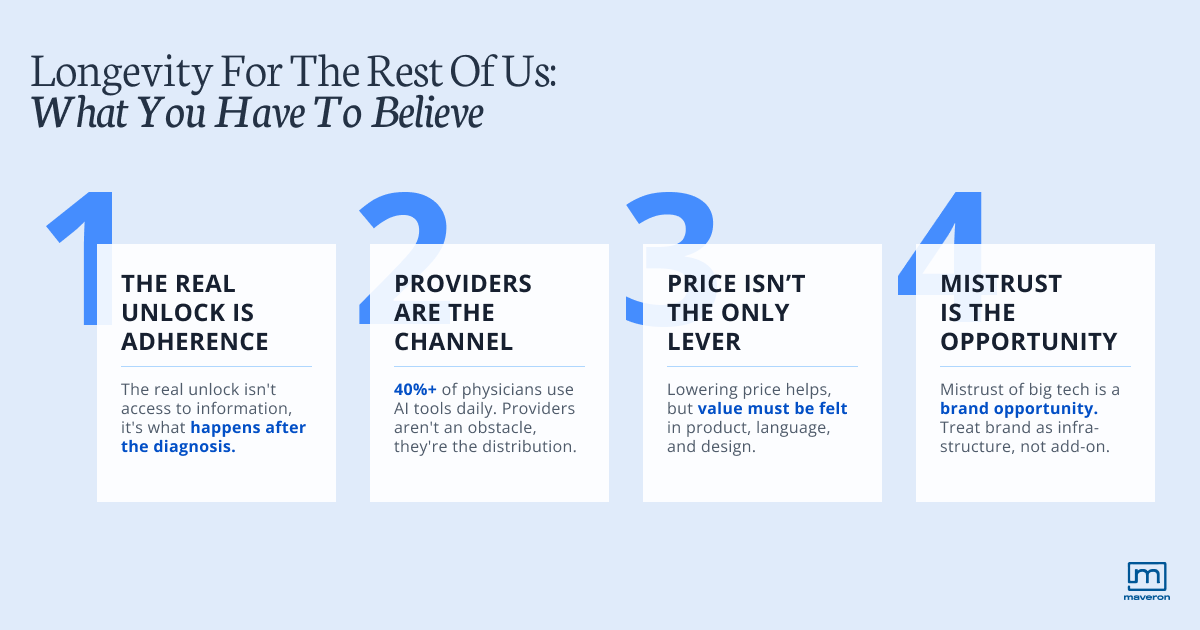
As always, there are a few core beliefs I’ve distilled as I’ve thought about investing against this trend:
The real unlock is adherence. A major point of friction for mass consumers isn’t access to health information, but what happens after they receive the diagnosis. Does the advice stick? Do they follow through on the referral, take the medication and change the behavior? The first wave of longevity companies solved for discovery and diagnosis. I believe the next wave will solve for continuity by focusing less on replacing doctors and more on making sure doctors’ advice actually lands.
Providers aren’t an obstacle if they become the distribution channel. There’s a persistent assumption in digital health that providers and consumer apps are in tension. Physicians are actually adopting AI tools faster than most people expect, with over 40% using OpenEvidence daily and over 200 major US health systems integrating Abridge. What most providers haven’t done is recommend consumer-facing longevity and preventive care tools to their patients, in part because those tools haven’t been built to fit their workflows or earn their trust. The companies that crack provider distribution will have an enormous advantage in gaining widespread consumer trust and loyalty.
Price isn’t the only lever. Lowering price makes longevity more accessible, but only up to a point. Messaging that is too “optimized human” may not cross over to someone who believes that understanding their biological age is a luxury compared to making sure they can fill their regular prescriptions in a cost-effective way. Value that is immediately felt in the product experience, language and design has a higher likelihood of driving meaningful adoption compared to pie in the sky rhetoric.
Mistrust of big tech is a brand opportunity in disguise. As we found in our Consumer 2026 report, consumer AI has crossed the adoption threshold, but not the trust threshold. In health and wellness, that gap is enormous. The founders who treat brand as infrastructure, not an afterthought to lower prices, have a real shot at capturing the middle of the market where consumers are ready for a longevity tool that feels safe, human-centered and worthy of their most personal data.
As of today, there are a few types of business well-positioned to unlock this new market segment:
Longevity x Primary Care: there is an overlooked opportunity to bring biomarker measurement and tracking into the primary care relationship, rather than asking consumers to build a parallel health system outside of their doctors. If these businesses can uncover legitimate clinical data and insights, they could potentially unlock providers as a distribution channel.
Clinical Infrastructure-as-a-Service: on the flip side of the same coin, many first-wave longevity companies have amassed large customer bases, but lose the patient after the initial diagnostic. There’s an opportunity to sell that continuity layer back to them by helping them embed physicians within their offerings to keep patients engaged and adherent long after their scan or panel.
Ambient AI for Patients: the provider-facing ambient AI market is scaling fast, with a few multi-$b businesses already emerging. Businesses like OpenEvidence, Ambience and Abridge are deeply focused on providers, leaving a major gap for consumers, especially those navigating complex conditions. Patients don’t need another tool to replace their doctors, but one that helps them understand, organize and act on what their doctors say.
The first wave of longevity proved the model and the next wave will prove the market. After diving deep into the state of the consumer, I’m not sure that the only companies that win will be the ones going deepest on biohackers. There will be winners who figure out how to take the same science, strip out the jargon and make it feel as essential as your morning coffee. It’s a harder design problem than building for the power user, but it’s also a much bigger business.
If you’re building this space or have thoughts on this post, shoot me a note!
No posts
Comments
Nothing yet. Say the first thing.
Sign in to join the conversation.