
Six Films, One Morning in Locarno: A small preview of what Swiss cinema is becoming
By Mauro Mueller / El Suizo
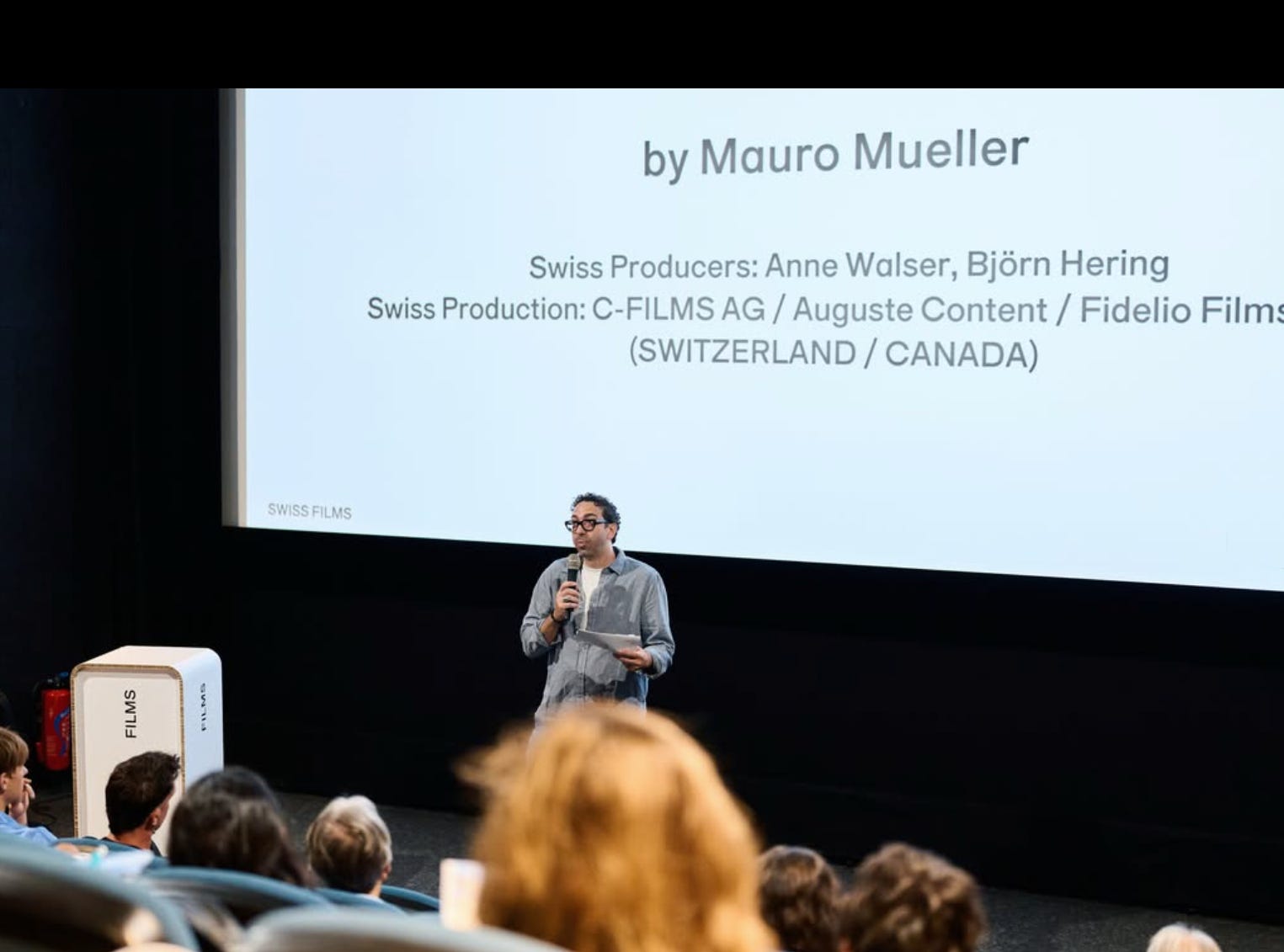
On Friday morning, I had the privilege of showing the first images from 111: Echoes from Halifax at the SWISS FILMS Previews. This is an event organized by SWISS FILMS in partnership with Locarno Pro.
A quick bit of context, because this is one of those slightly invisible parts of the film world. Many countries that have public film funding also have a national agency whose job is to promote their cinema internationally. France for example has Unifrance, Germany has German Films, and Switzerland has SWISS FILMS. They help films travel: to festivals, markets, distributors, programmers, and audiences abroad.
In Switzerland, your film enters that ecosystem once it receives its certificate of origin, essentially the film’s Swiss passport. It sounds bureaucratic, and technically it is, but I find there is something quite meaningful about it too. Suddenly your film isn’t only your film anymore; in a small way, it becomes part of the cinema of a country.
I wrote about this idea in my essay on national cinema: what it actually means for a film to belong to a country, especially when so many of us making films today live between countries, languages and cultures. So being invited by SWISS FILMS to present 111 in Locarno felt like a real privilege and, for me, a strangely moving one.
Now, there is something incredibly exciting about showing images from a film that almost nobody has seen yet.
111: Echoes from Halifax tells the story of the aftermath of the real-life crash of Swissair Flight 111, which went down off the coast of Nova Scotia in 1998, claiming the lives of all 229 people on board. But rather than making a disaster film, we wanted to look at the lives touched by what happened. Like a stone falling into water, the crash created ripples that spread through families, rescue workers, the local fishing community, Swissair employees, and complete strangers whose lives unexpectedly became intertwined. Through several interconnected stories, the film is ultimately about grief, resilience, healing, and the celebration of life. If people leave the cinema wanting to call someone they love, spend a little more time with their family, or simply appreciate the present more, then I feel the film has done what we hoped it would do.
The film is finished. After living with it for years, through writing, shooting, all the post production stages, and all the thousand decisions that eventually turn a project into a film, suddenly you put a couple of minutes of it on a large screen in front of producers, directors, distributors, exhibitors, sales agents and festival people. And there is nothing left to change. You simply get to watch people discover it and that’s beautiful (and a bit nerve-racking).
I think ours connected. I had some beautiful conversations afterwards about 111, which meant a lot. But what stayed with me just as much was seeing the other five films presented that morning.
Each project had twelve minutes to introduce the film and show selected scenes. Some were finished, others were still in post-production, and at least one still had shooting ahead of it. And everyone had come to Locarno looking for something slightly different: a sales agent, an international distributor, a festival premiere, new partners, or simply that last piece of financing needed to get the film across the finish line.
For a brief morning, we got to see six films at six different moments in their journey.
Nicolas Steiner’s new film, The Flying Mountain, immediately took us somewhere else. The images from the Tibetan Himalayas were extraordinary, cinematic in the fullest sense, vast yet somehow intimate. Two brothers searching for truth, traveling from the cliffs of Ireland to the Himalayas, toward questions of death, love, and where we come from. Even in those few minutes, you could feel the pull of this distant landscape. The images were poetic and powerful, with a sense of mystery that made you want to follow these characters deeper into the mountains. The footage was truly stunning.
I have a particular affection for Nicolas’s work. We both passed through the Filmakademie Baden-Württemberg (though I only did a quick exchange semester and shot a short there), and I first met him in Guadalajara in 2015, when Switzerland was the festival’s guest country. His longtime collaboration with cinematographer Markus Nestroy continues to produce images of remarkable beauty. Stefan Jäger presented the project in Locarno, with Nicolas appearing by video message, in his characteristically sympathetic way.
The production still has a final stretch to shoot and is looking for partners to help close its financing. I’m rooting for them. Grandiose. It certainly will be a poetic and moving film.
Then came Bastardo, by Villi Hermann, who was just honored with the Swiss Film Award’s Quartz for his lifetime achievement. Villi is a filmmaker who has spent decades looking deeply at his home territory of Ticino rather than constantly searching for somewhere more exotic to point the camera. I admire that. There is something quietly radical about going deeper instead of farther.
The film brings together several seemingly minimalist stories, an unpaid debt, a pregnant teenager, young love, a son visiting his father in prison, into a mosaic of contemporary Ticino. It was presented by Michi Pini, one of those Swiss producers who seems to carry both an enormous amount of experience and an equally enormous amount of sunshine into every room.
Michi mentioned something I particularly liked about Villi’s approach. Some of these characters may be petty criminals, or people making questionable choices, but the film doesn’t reduce them to those choices. Villi looks at them with sympathy and curiosity, capturing people at a particularly difficult moment in their lives rather than passing judgment on who they are. That generosity toward characters is something I always respond to.
Another discovery for me was Stéphane Riethauser’s Into the Blue. Stéphane presented alongside actor Clemens Bobke, and told us something about the film’s origin that I found particularly moving. After spending years developing another project that ultimately did not receive the financing it needed, he decided not to enter another long cycle of waiting. Instead, he asked himself what he could actually make. Quickly. Independently. With the means available to him. The answer became Into the Blue, an intimate relationship drama about Noé, a trans actor, and Kito, his boyfriend, whose three-year relationship begins to unravel during a stay on the Côte d’Azur. What struck me in the images was precisely what the film wasn’t doing. Noé being trans is part of who he is, but the relationship is allowed to be a relationship. Desire, ambition, resentment, tenderness, incompatibility. In other words, life.
And I loved the story behind the film almost as much as the footage itself. A project falls apart, so you make another one. Disappointment becomes fuel. That, to me, is filmmaking. Bravo!
Serra, the first feature by Aulona Selmani, took us somewhere completely different. The film follows a family in a remote village in Kosovo after they receive devastating news: the father has suffered a serious accident abroad. But the clips and the film focus on something more intimate: the relationship between the mother and her teenage daughter. In the first clip, the mother is frustrated by what she sees as her daughter’s lack of responsibility, only for the daughter to turn the accusation back on her: perhaps her mother isn’t being so responsible either. It was a small exchange, but one that immediately revealed the tension, affection, and complexity between them. When the mother accuses her daughter of never even asking about her father, the daughter quietly pushes back: she does ask about him, when she prays. It’s a simple response, but one that opens a small window into the daughter’s inner world and reminds us how differently two people can carry the same worry.
In a second excerpt, the mother is outside, dancing, lost in thought. The camera moves from her face to her hand and back again, and suddenly her husband is there. It’s a beautifully understated moment, blurring absence and presence without making a spectacle of it. The film moves switches perspectives of mother and daughter, allowing us into both of their inner worlds. Simple. Precise. Emotional. Those are often the hardest things to pull off. Julia Schäbiger introduced the film together with Aulona, and I’m very curious to see where it goes.
Finally, Ufuk Emiroglu presented Sevda with producer Philippe Coeytaux, one of Switzerland’s most prolific and experienced producers, with an impressive ability to move between feature films and television while consistently backing ambitious projects and filmmakers. The film takes us into Istanbul’s brutal real-estate market through Sevda, a developer actively participating in the city’s gentrification until an old cemetery keeper, and her own buried family history, complicate the story.
The subject immediately resonated with me. Gentrification is certainly not unique to Istanbul. It’s an enormous issue in Mexico City and in major cities around the world. I remember witnessing the transformation of Harlem firsthand when I lived in New York. When Whole Foods arrived on 125th Street, it felt like more than a new supermarket opening. It was a very visible sign that the neighborhood, and who it was being built for, was changing.
That’s partly why Sevda caught my attention. The images looked terrific, and the cast includes Tülin Özen, Mert Fırat, Macit Koper and Ercan Kesal. Even from the excerpt, you could sense a film interested not only in what happens when a city changes, but in who gets to shape that change, who benefits from it, and what gets buried along the way.
What I loved about the morning was the range. The Himalayas. Ticino. The Côte d’Azur. Kosovo. Istanbul. Switzerland and Halifax. Films about grief, family, love, identity, money, memory and belonging. Completely different filmmakers, budgets and approaches, sitting in the same cinema and showing work at different stages of finding its way into the world.
Film festivals can sometimes make cinema feel strangely competitive. Who got selected. Who got financed. Who has sales. Who has the premiere. Who is moving forward and who is still waiting. But sitting there on Friday morning, I didn’t feel much of that. Mostly, I felt admiration. Because I know enough about filmmaking to understand what sits behind five to ten beautiful minutes on a screen. The years of development. The financing plans. The rejected applications. The impossible schedules. The conversations with actors. The weather that didn’t cooperate. The scene that finally worked. The producer who refused to give up. The director who found another way.
Six films were previewed that morning. Soon enough, they’ll go off and have lives of their own: premieres, reviews, audiences, successes, and perhaps a few disappointments along the way. But maybe the real success is simpler than all of that: having made a film, and seeing it out there, alive.
And for one morning in Locarno, they were simply six films sharing a dark room, made by people trying to get them to the next stage of their journey, whether that means finishing the film, finding the right partners, or finally meeting an audience.
Taken together, they also felt like a small snapshot of where Swiss cinema is in 2026, or at least of the stories filmmakers are drawn to right now. Most were dramas, reflective and intimate, interested in people, relationships, love, memory, and the complicated ways we try to understand one another. Very different films, but there was something quietly beautiful about seeing them side by side. We’re a small country, but a remarkably diverse one, with different languages, backgrounds, perspectives, and ways of looking at the world. And, clearly, we have something to say.
I felt lucky that 111 was among them. And even luckier to get an early glimpse of what everyone else is making.
Now I want to see the finished films too. And I hope that soon, wherever you are, you’ll get the chance to see some of them as well.
—Mauro / El Suizo

———————————————————————————————
Seis películas, una mañana en Locarno:
Un pequeño adelanto de hacia dónde va el cine suizo
Por Mauro Mueller / El Suizo
El viernes pasado por la mañana tuve el privilegio de mostrar las primeras imágenes de 111: Echoes from Halifax en los SWISS FILMS Previews, organizados por SWISS FILMS en colaboración con Locarno Pro.
Un poco de contexto, porque esta es una de esas partes del mundo del cine que casi siempre permanecen invisibles. Muchos países que cuentan con fondos públicos para apoyar al cine tienen también una agencia nacional dedicada a promover sus películas en el extranjero. Francia tiene Unifrance, Alemania tiene German Films y Suiza tiene SWISS FILMS. Su trabajo es ayudar a que las películas viajen: que lleguen a festivales y mercados, que encuentren distribuidores y programadores y, finalmente, que conecten con públicos fuera de sus fronteras.
En Suiza, una película entra oficialmente a ese ecosistema cuando recibe su certificado de origen, que viene siendo una especie de pasaporte suizo de la película. Suena burocrático, y técnicamente lo es, pero a mí siempre me ha parecido que también hay algo bonito en ese momento. De pronto, la película deja de ser únicamente tu película. De alguna manera, aunque sea pequeña, pasa a formar parte del cine de un país.
Escribí sobre esta idea en mi ensayo sobre el cine nacional: ¿qué significa realmente que una película pertenezca a un país? Sobre todo hoy, cuando tantos de quienes hacemos cine vivimos y trabajamos entre distintos países, idiomas y culturas. Por eso, que SWISS FILMS me invitara a presentar 111 en Locarno fue un verdadero privilegio y, para mí, también algo extrañamente emotivo.
Y hay algo increíblemente emocionante en mostrar imágenes de una película que prácticamente nadie ha visto todavía.
111: Echoes from Halifax cuenta las consecuencias del accidente real del vuelo 111 de Swissair, que cayó frente a las costas de Nueva Escocia en 1998 y en el que murieron las 229 personas que iban a bordo. Pero nunca quisimos hacer una película de catástrofes. Lo que nos interesaba era mirar las vidas que quedaron marcadas por lo ocurrido. Como una piedra que cae al agua, el accidente generó ondas que se fueron expandiendo y alcanzaron a familias, rescatistas, pescadores de la comunidad local, empleados de Swissair y también a completos desconocidos cuyas vidas, de pronto, quedaron entrelazadas. A través de varias historias que se cruzan, la película habla, en el fondo, del duelo, la resiliencia, la sanación y también de celebrar la vida. Si alguien sale del cine con ganas de llamar a una persona que quiere, de pasar un poco más de tiempo con su familia o simplemente de apreciar más el presente, sentiré que la película logró lo que esperábamos de ella.
La película ya está terminada. Después de vivir con ella durante años —la escritura, el rodaje, todas las etapas de postproducción y las miles de decisiones que poco a poco convierten un proyecto en una película—, llega un momento extraño: pones unos minutos en una pantalla grande frente a productores, directores, distribuidores, exhibidores, agentes de ventas y gente de festivales. Y ya no hay nada que cambiar. Solo te queda observar cómo la descubren. Y eso es algo muy bonito (y también un poco aterrador).
Creo que la nuestra conectó. Después de la presentación tuve conversaciones muy bonitas sobre 111, y significaron mucho para mí. Pero algo que se me quedó igual de presente fue haber podido descubrir las otras cinco películas que se presentaron esa mañana.
Cada proyecto tenía doce minutos para presentar la película y mostrar algunas escenas. Algunas ya estaban terminadas; otras seguían en postproducción y al menos una todavía tenía rodaje por delante. Y todos habíamos llegado a Locarno buscando algo ligeramente distinto: un agente de ventas internacionales, un distribuidor, un estreno en algún festival, nuevos socios o simplemente esa última pieza de financiamiento necesaria para poder cruzar la meta.
Durante unas horas, en una sola mañana, pudimos asomarnos a seis películas que se encontraban en seis momentos distintos de su camino.
La nueva película de Nicolas Steiner, The Flying Mountain, nos transportó de inmediato a otro mundo. Las imágenes del Himalaya tibetano eran extraordinarias: cine en el sentido más pleno de la palabra, inmensas y, al mismo tiempo, extrañamente íntimas. Dos hermanos en busca de respuestas, viajando desde los acantilados de Irlanda hasta el Himalaya, siguiendo preguntas sobre la muerte, el amor y de dónde venimos. Incluso en esos pocos minutos se sentía la fuerza de ese paisaje lejano. Las imágenes eran poéticas y poderosas, con un misterio que te daba ganas de seguir a los personajes cada vez más adentro de las montañas. El material que vimos era realmente impresionante.
Tengo un cariño particular por el trabajo de Nicolas. Los dos pasamos por la Filmakademie Baden-Württemberg, aunque yo solo estuve ahí durante un breve semestre de intercambio, en el que rodé un corto, y lo conocí en Guadalajara en 2015, cuando Suiza fue el país invitado del festival. Su larga colaboración con el director de fotografía Markus Nestroy sigue produciendo imágenes de una belleza extraordinaria. Stefan Jäger presentó el proyecto en Locarno, mientras Nicolas apareció a través de un mensaje en video, con ese encanto y sentido del humor tan suyos.
A la producción todavía le queda una última etapa de rodaje y están buscando socios que los ayuden a completar el financiamiento. Espero de verdad que los encuentren. Es un proyecto ambicioso, bellísimo, de esos que piden ser vistos en una pantalla grande. Todo apunta a que será una película profundamente poética y conmovedora.
Después llegó Bastardo, de Villi Hermann, quien acaba de ser reconocido con el Quartz del Premio del Cine Suizo por el conjunto de su trayectoria. Villi es un cineasta que lleva décadas observando profundamente su propio territorio, el Tesino, en lugar de buscar constantemente algún lugar más exótico hacia donde apuntar la cámara. Eso es algo que admiro. Hay algo discretamente radical en decidir ir más profundo en lugar de ir más lejos.
La película reúne varias historias aparentemente minimalistas —una deuda sin pagar, una adolescente embarazada, un amor joven, un hijo que visita a su padre en prisión— y las convierte en un mosaico del Tesino contemporáneo. El proyecto fue presentado por Michi Pini, uno de esos productores suizos que parece llevar consigo una enorme cantidad de experiencia y, al mismo tiempo, una dosis igualmente enorme de buen humor y energía positiva a cualquier lugar al que llega.
Michi mencionó algo sobre la mirada de Villi que me gustó especialmente. Algunos de estos personajes pueden ser pequeños delincuentes o personas tomando decisiones cuestionables, pero la película no los reduce a esas decisiones. Villi los observa con empatía y curiosidad, retratándolos en un momento particularmente difícil de sus vidas en lugar de juzgarlos por quiénes son. Esa generosidad hacia los personajes es algo con lo que siempre conecto.
Otro descubrimiento para mí fue Into the Blue, de Stéphane Riethauser. Stéphane presentó la película junto al actor Clemens Bobke y nos contó algo sobre su origen que me pareció especialmente bonito. Después de pasar años desarrollando otro proyecto que finalmente no consiguió el financiamiento necesario, decidió no entrar otra vez en un largo ciclo de espera. En cambio, se hizo una pregunta mucho más sencilla: ¿qué película puedo hacer realmente? Rápido. De manera independiente. Con los medios que tengo a mi alcance.
La respuesta fue Into the Blue, un drama íntimo sobre la relación entre Noé, un actor trans, y Kito, su novio, cuya relación de tres años empieza a desmoronarse durante una estancia en la Costa Azul. Lo que más me llamó la atención de las imágenes fue precisamente lo que la película no estaba haciendo. El hecho de que Noé sea trans forma parte de quién es, pero la película permite que su relación sea, simplemente, una relación. Deseo, ambición, resentimiento, ternura, incompatibilidad. En otras palabras: la vida.
Y la historia detrás de la película me gustó casi tanto como las imágenes que vimos. Un proyecto se cae, así que haces otro. La decepción se convierte en combustible. Para mí, eso también es hacer cine. ¡Bravo!
Serra, el primer largometraje de Aulona Selmani, nos llevó a un lugar completamente distinto. La película sigue a una familia en un pueblo remoto de Kosovo después de recibir una noticia devastadora: el padre ha sufrido un grave accidente en el extranjero. Pero tanto los fragmentos que vimos como la película misma se concentran en algo mucho más íntimo: la relación entre una madre y su hija adolescente.
En la primera escena, la madre está frustrada por lo que considera una falta de responsabilidad de su hija, hasta que la hija le devuelve la acusación: quizá su madre tampoco está siendo tan responsable. Es un intercambio pequeño, pero que revela de inmediato la tensión, el cariño y la complejidad que existen entre ellas. Cuando la madre le reprocha que ni siquiera pregunta por su padre, la hija responde tranquilamente que sí lo hace: pregunta por él cuando reza. Es una respuesta sencilla, pero abre una pequeña ventana hacia su mundo interior y nos recuerda que dos personas pueden cargar con la misma preocupación de maneras muy distintas.
En un segundo fragmento, la madre está afuera, bailando, perdida en sus pensamientos. La cámara pasa de su rostro a su mano y luego vuelve a ella, y de pronto su marido está ahí. Es un momento bellísimo y muy sutil, que desdibuja la frontera entre la ausencia y la presencia sin convertirlo en un gran espectáculo. La película va alternando entre las perspectivas de la madre y la hija, permitiéndonos entrar en el mundo interior de ambas. Sencilla. Precisa. Emotiva. Y esas suelen ser algunas de las cosas más difíciles de lograr en el cine. Julia Schäbiger presentó la película junto con Aulona, y me quedé con muchas ganas de ver hacia dónde lleva esta historia.
Finalmente, Ufuk Emiroglu presentó Sevda junto al productor Philippe Coeytaux, uno de los productores más prolíficos y experimentados de Suiza, con una impresionante capacidad para moverse entre el cine y la televisión sin dejar de apostar por proyectos y cineastas ambiciosos. La película nos sumerge en el brutal mercado inmobiliario de Estambul a través de Sevda, una desarrolladora que participa activamente en la gentrificación de la ciudad, hasta que un viejo cuidador de cementerio —y la propia historia familiar que ella ha mantenido enterrada— empiezan a complicar las cosas.
El tema conectó inmediatamente conmigo. La gentrificación, por supuesto, no es algo exclusivo de Estambul. Es un problema enorme en la Ciudad de México y en muchas de las grandes ciudades del mundo. Recuerdo haber visto de cerca la transformación de Harlem cuando vivía en Nueva York. Cuando abrió Whole Foods en la calle 125, se sintió como algo más que la llegada de un nuevo supermercado. Era una señal muy visible de que el barrio estaba cambiando y, sobre todo, de para quién estaba cambiando.
En parte por eso Sevda me llamó tanto la atención. Las imágenes se veían estupendas y el reparto incluye a Tülin Özen, Mert Fırat, Macit Koper y Ercan Kesal. Incluso en el breve fragmento que vimos se podía percibir una película interesada no solo en lo que ocurre cuando una ciudad cambia, sino en quién tiene el poder de decidir cómo cambia, quién se beneficia de esa transformación y qué queda enterrado en el camino.
Lo que más me gustó de aquella mañana fue la variedad. El Himalaya. Tesino. La Costa Azul. Kosovo. Estambul. Suiza y Halifax. Películas sobre el duelo, la familia, el amor, la identidad, el dinero, la memoria y el sentido de pertenencia. Cineastas, presupuestos y maneras de hacer cine completamente distintos, compartiendo una misma sala y mostrando obras que se encontraban en diferentes etapas de su camino hacia el mundo.
Los festivales a veces pueden hacer que el cine se sienta extrañamente competitivo. Quién fue seleccionado. Quién consiguió financiamiento. Quién tiene agente de ventas. Quién consiguió el estreno. Quién avanza y quién sigue esperando. Pero sentado ahí ese viernes por la mañana, no sentí demasiado de eso. Lo que sentí, sobre todo, fue admiración. Porque conozco lo suficiente este oficio para saber todo lo que hay detrás de cinco o diez minutos hermosos proyectados en una pantalla: los años de desarrollo, los planes de financiamiento, las solicitudes rechazadas, los calendarios imposibles, las conversaciones con los actores, el clima que no cooperó, esa escena que finalmente funcionó, el productor que se negó a darse por vencido, el director que encontró otra manera de hacerlo.
Se presentaron seis películas aquella mañana. Muy pronto cada una seguirá su propio camino: tendrán sus estrenos, sus críticas, sus públicos, sus éxitos y seguramente también alguna que otra pequeña decepción. Pero quizá el verdadero éxito sea algo mucho más sencillo que todo eso: haber logrado hacer una película y verla ahí afuera, viva.
Y durante una mañana en Locarno, eran simplemente seis películas compartiendo una sala oscura, hechas por personas intentando llevarlas a la siguiente etapa de su recorrido, ya fuera terminar la película, encontrar a los socios adecuados o, finalmente, encontrarse con un público.
Vistas en conjunto, también parecían ofrecer una pequeña fotografía del momento que vive el cine suizo en 2026, o al menos de las historias que están atrayendo a sus cineastas ahora mismo. La mayoría eran dramas íntimos y reflexivos, interesados en las personas, las relaciones, el amor, la memoria y las complicadas maneras en que intentamos entendernos unos a otros. Eran películas muy distintas, pero había algo discretamente hermoso en verlas una al lado de la otra. Somos un país pequeño, pero extraordinariamente diverso, con distintos idiomas, orígenes, perspectivas y maneras de mirar el mundo. Y, claramente, tenemos algo que decir.
Me sentí afortunado de que 111 estuviera entre ellas. Y todavía más afortunado de poder echar un primer vistazo a lo que están haciendo los demás.
Ahora yo también quiero ver las películas terminadas. Y espero que pronto, estén donde estén, ustedes también tengan la oportunidad de descubrir algunas de ellas.
— Mauro / El Suizo
No posts
Comments
Nothing yet. Say the first thing.
Sign in to join the conversation.