
In the year leading up to our departure from Hong Kong, every moment spent on the island took on a new significance. Each tread on a leafy trail. Each cup of milk tea. Each exchange of pleasantries with the security guard at our building. Each smile to a cardboard granny shuffling along a busy street. Each of these instances were now also (Possibly) The Last Time.
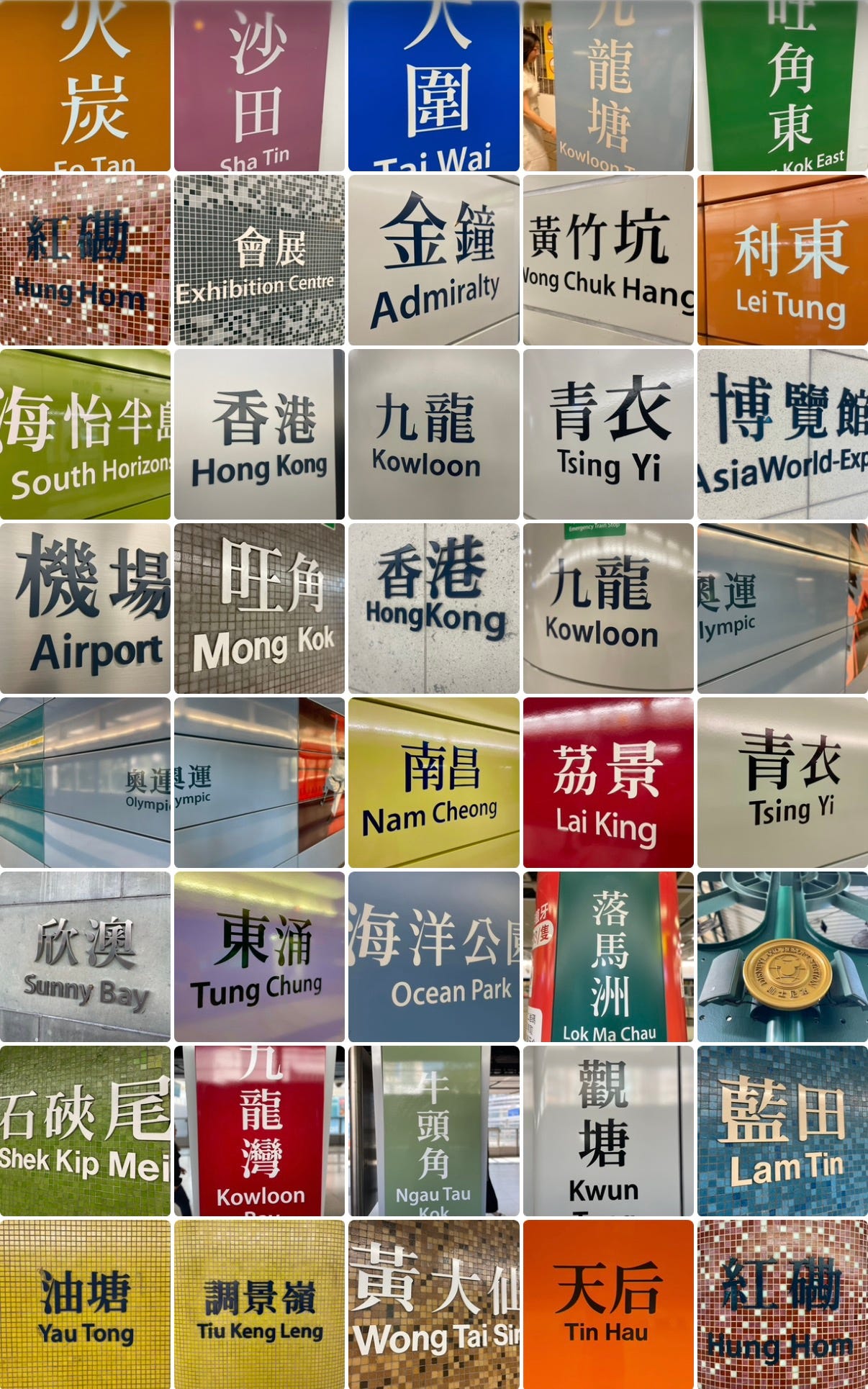
And so it passed, as I stood waiting on a familiar platform, that I began to look, really look - for the first, and (Possibly) The Last Time - at the Chinese characters that spelt out the station’s name. As I’m wont to do (evidenced by the 170,109 items - and counting - in my photo library), I raised my smartphone and took a picture. In portrait mode of course (sorry, kids). This practice started with the stations I habitually visited; HKU 香港大學 , the station closest to where we lived; Admiralty 金鐘 , the interchange station; and Sham Shui Po 深水埗, the station in the heart of my favourite neighbourhood. As my collection grew, I challenged myself to photograph the names of stations on particular lines, beginning with the one I used the most often. The Island Line, a dark blue horizontal thread that ran from one end of the MTR map to the other, connected the district of our home, Kennedy Town 堅尼地城 with Chai Wan 柴灣, a district where we never had any business. I followed it up with the vibrant red Central Line that snaked under the harbour, linking Central 中環 on the island with Tsuen Wan 荃灣 on the mainland. And so on and so forth. Admittedly, it became a bit of an obsession. I collected station names like I caught Pokemon.
In the following days, weeks and months, I would visit all of the MTR stations in Hong Kong, some for the sole purpose of capturing the image of the station’s name but also some to explore previously unknown neighbourhoods. I eventually perfected a method for the quickies. I’d suss out the most deserted carriage, usually the one right at the end of the train. I’d quietly take up my position by the side of the doors. The second the doors opened, I’d jog up to the wall with the station’s name, position my smartphone to click a picture, then hop back onto the train before the doors closed, all the while trying to look as casual and unobtrusive as possible. There was nothing illegal about what I was doing. Yet, for those fleeting seconds, my heart would thump furiously and the back of my neck would prickle. I imagined the curious gaze of other passengers, the stern surveillance of the mounted CCTV cameras. The reality was that no one was looking, at least not at me. Everyone’s eyes were too busy elsewhere, glued to small handheld screens.
Back at my desk, in the privacy of our 49th floor living room, I’d revisit the day’s haul. My Chinese is Duolingo-inspired and therefore, rudimentary, which meant I could only behold the pictographs’ intricate beauty and guess their meanings from their disparate parts. Ultimately, I’d be forced to run searches on Google to uncover the names’ layers of history. As expected, there was always some connection to a geographical feature or use of the land where the station was located. Yau Tong 油塘 or “oil pond” was in an area historically known for ship repairing and shipbuilding. Hung Hom 紅磡 or “red cliffs” paid homage to the formerly steeply sloping hills running down to the sea. Tsing Yi 青衣 or “green/blue/black clothes” was a nod to a species of fish, most likely the blackspot tuskfish, once abundant in nearby waters. Many of the names harkened back to a time before Hong Kong’s urbanization, before the permanent erasure of the city’s shorelines and features through land development and reclamation. The station names were lessons in history of a place that was constantly evolving and reinventing itself, of a people who were ever resilient in the face of the island’s changing fortunes. The station names were reminders of a forgotten past. I’m glad I chose to remember.
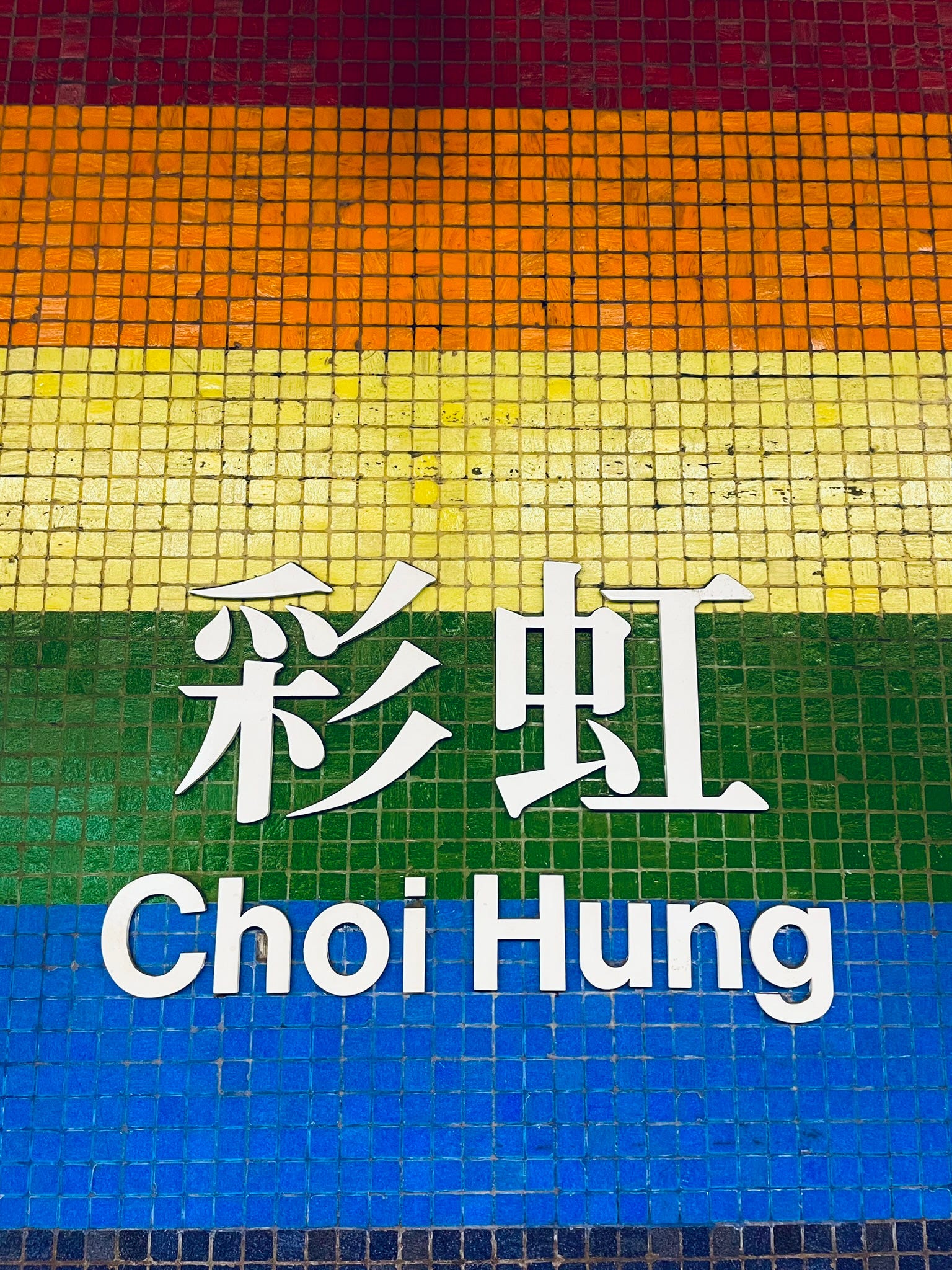
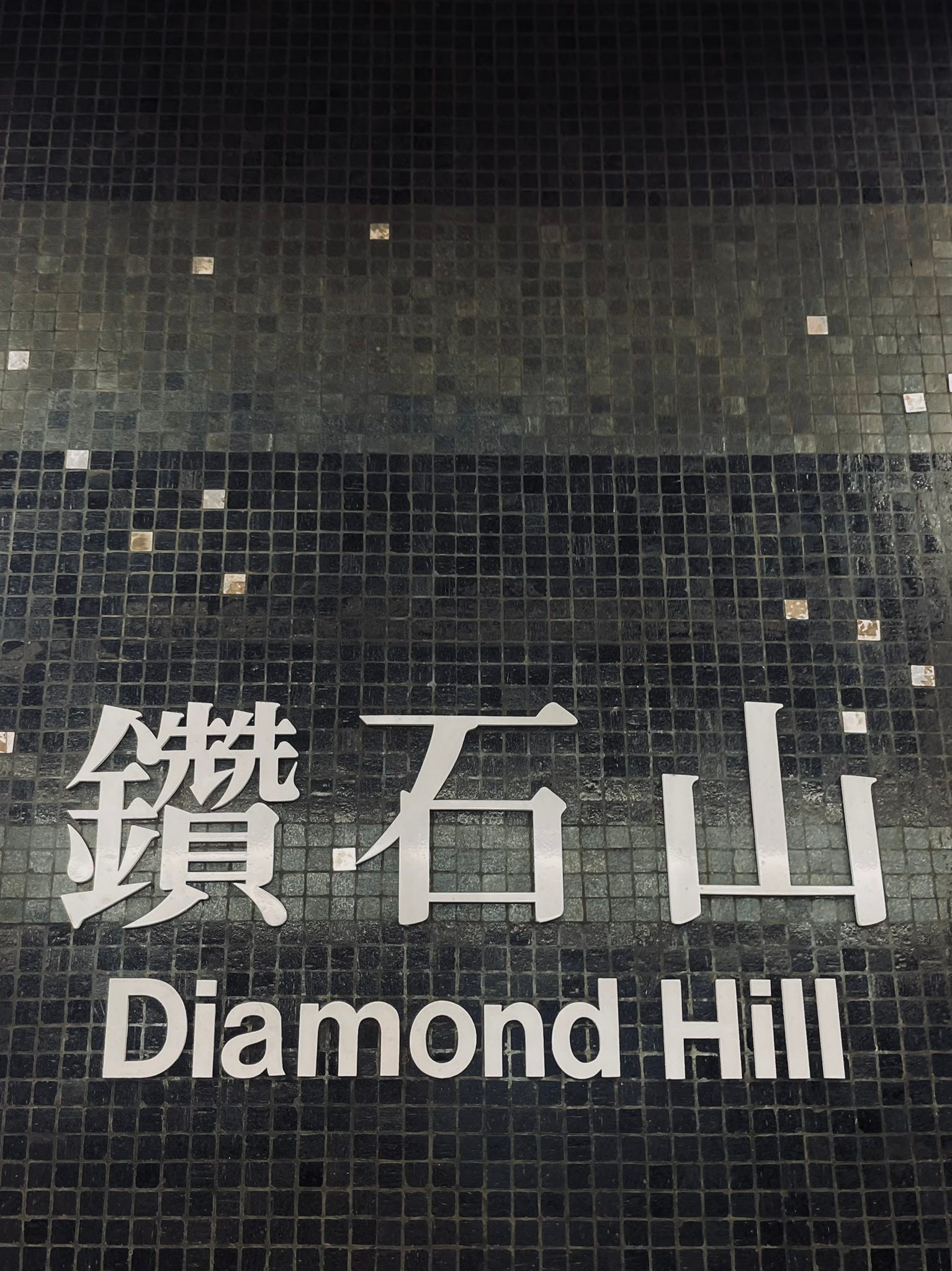
By the time we left Hong Kong, I’d visited and taken pictures of over 100 station names. I’d isolated two favourites as the most aesthetically pleasing: Choi Hung 彩虹 or “rainbow," named after the nearby Choi Hung Estate, a highly Instagrammable, multi-coloured public housing complex, and Diamond Hill 鑽石山, named as such despite having no gemstones in the area (reminiscent of Hong Kong’s famous Por Lor Bao which is a soft bun that contains not even a whiff of the fruit). When I lamented that I’d been unsuccessful in collecting Racecourse 馬場 (it was only open during race days at the Sha Tin Racecourse and anyone who knows me, knows I’m not a betting person), my son patted me on the shoulder. “Something to look forward to next time, Mama,” he comforted. And so it has come to pass that I have a final station to collect, (Possibly) Next Time. I look forward to it.
No posts
Comments
Nothing yet. Say the first thing.
Sign in to join the conversation.