
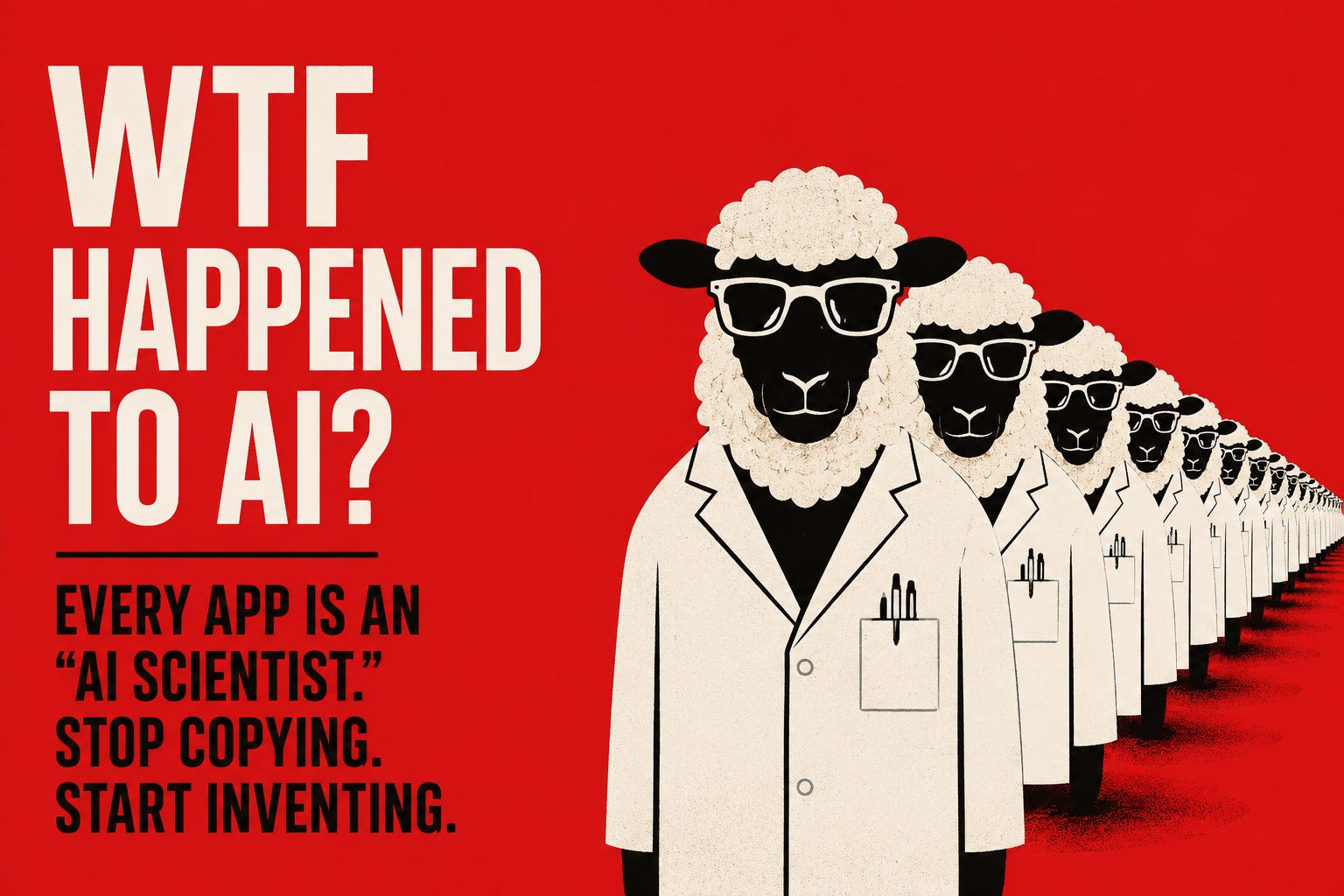
Strange things tend to happen when an industry runs out of original ideas. It stops inventing new products and starts inventing new ways to describe the same old ones. In drug discovery, people have reached the point where almost everything aspires to be an AI Scientist. Literature search? AI Scientist. Workflow automation? AI Scientist. A chatbot with access to PubMed? AI Scientist. Apparently, all it takes to build an AI Scientist these days is a marketing team vibe-coding for a day with a good copywriter.
The irony is that building an AI capable of truly contributing to scientific discovery is genuinely hard. We know because, at Deep Origin, we built one of the earliest systems we called an AI Scientist over two years ago. We learned quickly that the problem was never about connecting a large language model to a handful of tools. The hard part was reasoning, experimentation, uncertainty, validation, and all the messy realities that exist in real science. We also learned something else. The first generation was only the beginning. So we moved on. What we called an AI Scientist two years ago is old news.
The market, however, seems reluctant to do the same.
Every week yet another company announces its own AI Scientist. Sure, many are thoughtful products solving real problems. Some are excellent research assistants. Others automate repetitive tasks that scientists would happily avoid. None of that is a criticism. The problem is that almost everything now wears the same label, regardless of what it actually does, and most copy each other and slap an “innovation” label to look cool. And then you add yet another ChatGPT wrapper with an AI scientist logo, and the market drowns in noise.
Here’s the challenge: when every product is an AI Scientist, the phrase stops meaning anything.
This isn’t unique to AI. Jonas Ridderstråle and Kjell Nordström described the phenomenon years ago in Karaoke Capitalism (great book! highly recommend!). Companies imitate success because imitation feels safer than invention. Once a category appears to work, everyone rushes to produce their own version. Eventually, the market becomes a giant karaoke bar where everyone is singing the same song while insisting they’re performing an original.
The drug discovery industry is beginning to sound very familiar.
Innovation is not about arriving late with a slightly different user interface. It is not about taking an existing idea, changing the logo, adding “agentic” or “scientist” to the homepage, and declaring it a major breakthrough. Real innovation usually does something much less glamorous. It changes the underlying assumptions. It solves problems people didn’t realize could be solved. Sometimes it even invents an entirely new category because the old words no longer fit.
That is exactly what drug discovery needs right now.
Some of the most interesting companies being built today probably shouldn’t call themselves AI Scientists at all. They deserve different names because they’re solving different problems. Others might benefit from dropping the label altogether and simply explaining what they actually do. Clarity is underrated. Marketing buzzwords have a remarkably short half-life. And pure copycats… Well, let’s just say they have to go back to the drawing board and re-examine their management approach. Simple copying doesn’t generally work well long term.
Science advances because researchers challenge existing ideas instead of endlessly reproducing them. Perhaps AI researchers should borrow that habit as well.
Instead of asking how to build the next AI Scientist, maybe we should be asking a different question: What would you build if you weren’t allowed to call it AI?
No posts
Comments
Nothing yet. Say the first thing.
Sign in to join the conversation.