
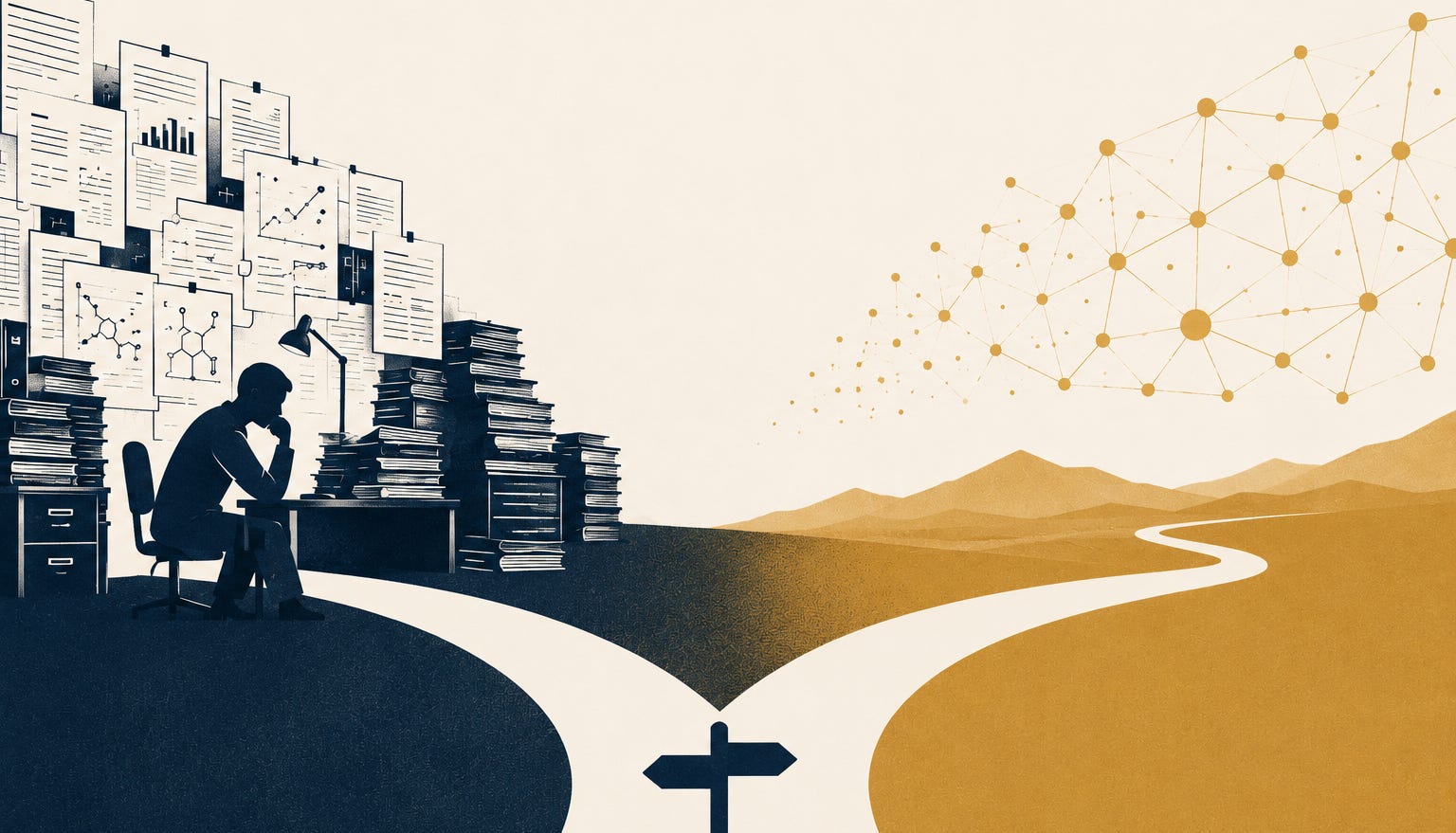
If aliens visited Earth and watched how we discover drugs, they would scratch their heads wondering why we try to teach computers how to be mediocre scientists.
Imagine hiring Isaac Newton and then spending the next five years teaching him how to fill out grant applications, format figures for Nature, write polite reviewer responses, and remember to cite paper #347 before paper #512 because one of the reviewers might get upset. Congratulations! You have successfully recreated modern science while simultaneously destroying the only reason you hired Newton in the first place.
But the funny thing is that’s exactly what much of the AI industry appears to be doing.
Every week yet another company announces an “AI Scientist.” The demonstrations are becoming increasingly impressive. The model reads papers, proposes hypotheses, designs experiments, writes reports, and occasionally even generates code to analyze the results. Investors applaud. Pharmaceutical executives nod approvingly. Researchers debate whether their jobs are about to disappear. Somewhere in the background, an LLM patiently summarizes another PDF.
Yet another Claude with a different lipstick was released and raised a billion dollars with a promise of turning biologists into gods.
The assumption hiding beneath all of this activity is rarely questioned. We have decided that the objective is to reproduce a human scientist as faithfully as possible. We teach AI to follow the scientific method exactly as humans do, almost as if the scientific method were a law of physics rather than an adaptation to the peculiar hardware between our ears.
But what if the scientific method looks the way it does because humans are spectacularly limited?
Consider what scientists actually spend their careers doing. They read papers because no one can remember twenty million of them. They specialize in one tiny corner of biology because understanding everything is impossible. They build hypotheses because the brain cannot simultaneously evaluate millions of competing explanations. They look for patterns because processing every variable in a biological system exceeds what evolution prepared us to do. Humans simplify, compress, and approximate. We tell ourselves stories that fit inside our tiny working memory and then spend years testing whether those stories survive contact with reality. And then of course we have bias. We use it to write articles and train LLMs to reproduce it with great precision, while claiming that the AI scientist provides an unbiased view.
There is nothing irrational about the general intent. Human civilization was built by approximation. Newton approximated gravity. Mendel approximated inheritance. Pharmacologists approximate biology every single day. Every model is wrong, as George Box famously observed, but some are useful. Science has always been an extraordinarily successful process of deciding which simplifications deserve to survive another experiment.
But that observation becomes way more interesting once the scientist is no longer human.
An AI scientist does not become tired after reading ten papers. It does not need to choose between immunology and structural biology because it cannot fit both into memory. It has no emotional attachment to the pathway it has studied for fifteen years. More importantly, it does not necessarily need to reduce biology into the same convenient patterns that humans rely upon.
Then here’s the question: If the computational resources exist, why approximate interactions among dozens of variables when hundreds of thousands can be evaluated simultaneously? Why compress the world into an elegant story if the machinery can operate directly on the complexity itself?
Perhaps the greatest advantage the AI scientist can deliver over humans is in how it handles approximation.
Imagine two detectives investigating the same crime. One detective interviews witnesses, notices recurring themes, and gradually develops a theory because there is no other practical option. The second detective watches every security camera in the city, tracks every phone, every vehicle, every bank transaction, every conversation, and reconstructs events without ever needing the comforting shortcut called intuition. Both reach conclusions. Only one depends on pattern recognition because reality had to be squeezed into something a human brain could manage.
Drug discovery today resembles the first detective.
We search for biomarkers because we cannot observe everything. We isolate pathways because whole organisms are too complicated. We classify diseases into categories because continuous biological variation refuses to fit neatly into PowerPoint slides. Every abstraction makes progress possible while simultaneously discarding information. Most of the time, that tradeoff is worthwhile. Occasionally it leads us down a dead end that consumes billions of dollars and a decade of work.
It’s tempting to believe that an AI scientist simply performs these same steps much faster. Sure, it can read more papers, design more molecules, and run more simulations. It can certainly produce more hypotheses before your breakfast than a postdoc manages in a year.
And while speed is certainly valuable, it’s also the least interesting possibility.
The more unsettling possibility is that an AI scientist eventually abandons entire parts of our workflow because they only existed to compensate for human cognitive constraints. Perhaps hypotheses become less central because millions of mechanistic possibilities can be evaluated directly. Perhaps literature reviews fade into the background because scientific knowledge no longer lives inside PDFs but inside continuously updated computational models. Perhaps experiments cease to be fishing expeditions and become carefully selected measurements whose sole purpose is to reduce uncertainty in the model where uncertainty matters most.
Even our language begins to feel strangely human. We speak about “discovering” drugs, as though molecules were hidden somewhere in nature waiting to be found behind a particularly stubborn tree. Engineers rarely describe bridges as discoveries. They build them by working within the constraints imposed by physics. One wonders whether future pharmacology will feel less like exploration and more like engineering once biology itself becomes sufficiently computable.
This raises an interesting possibility. We often celebrate the scientific method as though it were the destination rather than the vehicle. Yet, every generation quietly replaces parts of it. Telescopes changed astronomy. Microscopes changed microbiology. DNA sequencing changed genetics. Machine learning changed protein structure prediction. None of these innovations merely accelerated existing science. They changed what questions could reasonably be asked in the first place.
Perhaps AI belongs in that category. Or perhaps it belongs in an entirely different one.
There is an old habit in technology of assuming that progress means building machines that imitate humans. Cars replaced horses by refusing to gallop. Airplanes conquered the sky without flapping their wings. Calculators became useful precisely because they ignored how mathematicians perform arithmetic in their heads. We accepted those differences without much philosophical discomfort.
For reasons that are less obvious, we seem determined to teach AI scientists to think exactly like us.
Maybe that’s a good decision. Biology is humbling, and humility has an excellent safety record. Or perhaps, many years from now, historians of science will smile at our first generation of AI scientists in much the same way we smile at early airplanes covered in decorative wings and feathers, carefully engineered to resemble the birds they had already surpassed.
If that happens, the biggest breakthrough in drug discovery may not be a molecule, a model, or an algorithm. It may be the day we stopped asking artificial intelligence to become a better scientist and instead asked a far more unsettling question.
What if science itself has been optimized for human limitations all along?
No posts
Comments
Nothing yet. Say the first thing.
Sign in to join the conversation.