
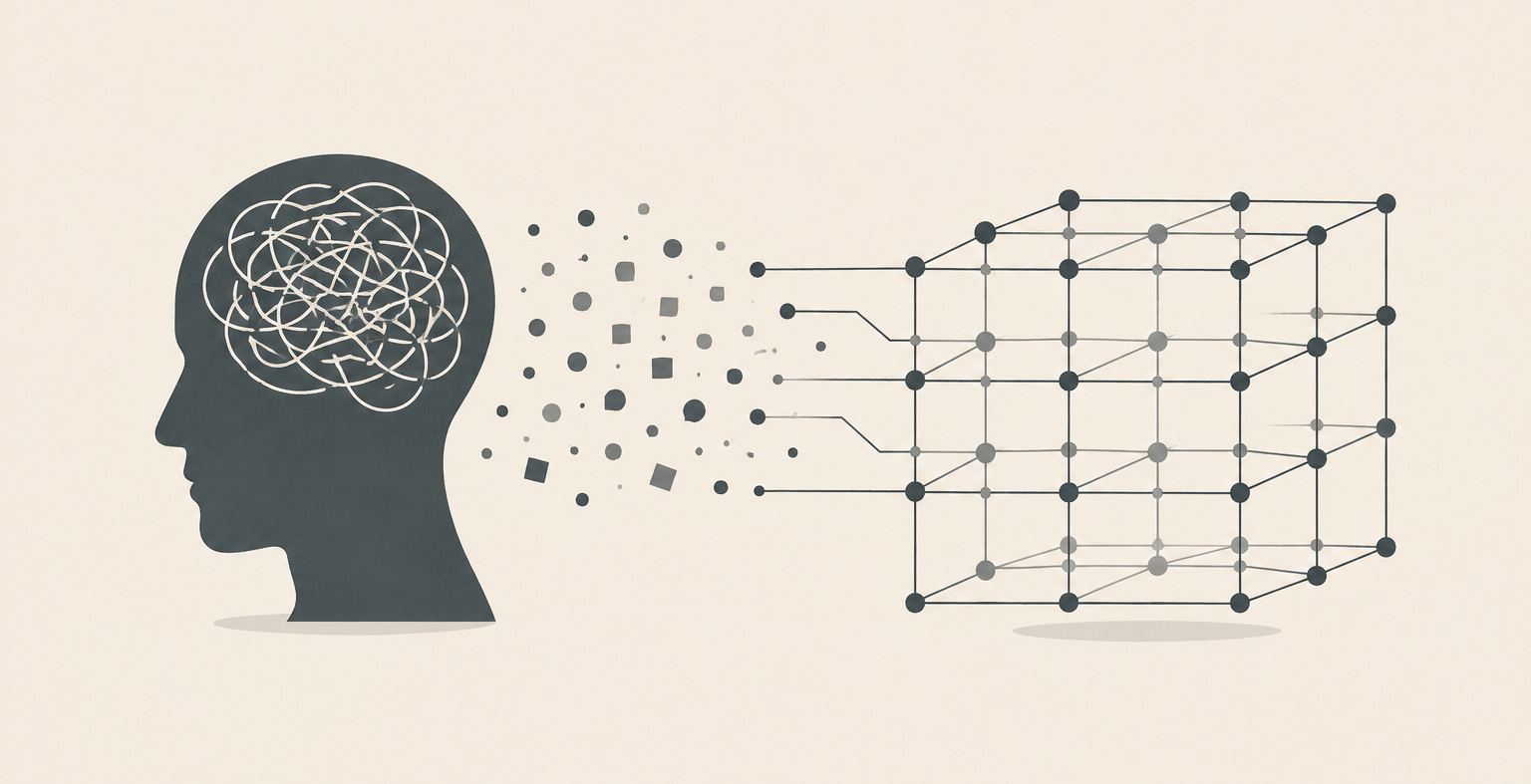
Forget the AI Scientist. I’ve got a better idea.
Let’s start by imagining the impossible: tomorrow comes and every scientific paper ever written disappeared. Would medicine continue to advance? Slowly, painfully and at enormous cost, but it would most likely would. Now imagine the opposite. Every paper survives, every journal remains online, every citation is perfectly preserved, yet nobody understands how the world actually works. Oddly enough, that is much closer to our present reality.
Scientists love to think of their jobs as a noble search for truth. In practice, their job is also an elaborate exercise in information compression. Millions of researchers spend their lives reducing the complexity of nature into papers, diagrams, equations and models that fit inside a PDF. Other researchers read a tiny fraction of them, remember an even smaller fraction, and make decisions based on the handful of ideas that magically remain in memory after several years of conferences, coffee and random family torture, augmented by social media distraction and political misinformation. Our civilization, one might conclude, is held together by remarkably optimistic assumptions about human recall.
I started programming when I was 13 and got my first software engineering job at 17. One lesson has remained surprisingly constant throughout my career: computers are astonishingly literal. They do not misunderstand instructions because they are tired, biased, emotionally invested or secretly convinced they already know the answer. They misunderstand instructions because the programmer told them something stupid, which is certainly a much more comforting form of failure.
Many people casually assume computers were designed to resemble the human brain. The comparison is understandable but mostly backwards. Modern computers were built from mathematics, logic and engineering, not neuroscience. Artificial neural networks borrowed inspiration from biology decades later, but the computer itself is not a mechanical brain. In fact, it excels precisely where the brain struggles.
Human memory is less like a hard drive and more like a novelist with a deadline. We do not store exact copies of events. We reconstruct them. We fill gaps, simplify details and quietly edit inconvenient facts until the resulting story feels internally consistent. Psychologists have spent decades demonstrating that confidence and accuracy are distant cousins rather than close relatives.
What’s even more important is how humans think. Contrary to popular mythology, we don’t reason by searching through everything we know. In fact, our brains don’t even record what we know. We record high level versions of what we perceive, adjusted for our flaws, biases, and sleep schedules. We reason through compressed patterns. The brain constantly throws away detail in exchange for speed. That’s not necessarily a flaw, but an evolutionary optimization that somehow made us survive and thrive. A hunter who stopped to analyze every piece of grass did not remain a hunter for very long.
Suppose you once read an article claiming that a particular manufacturing process used by a factory somewhere in China introduced a harmful chemical into certain metal utensils. You probably believed it. You may even remember discussing it. Yet when a waiter hands you a spoon at a restaurant, your brain performs no forensic investigation into its country of origin. The pattern you retrieve is simple. Spoon. Safe enough. Continue eating. If every meal required reconstructing global supply chains, lunch would become a three-day event.
Scientists are no different. They are brilliant, disciplined and remarkably inventive, but they remain gloriously human. No oncologist simultaneously considers every signaling pathway, every failed clinical trial, every obscure protein interaction, every unpublished experimental result and every contradictory paper buried inside an archive from 1987. The human brain just can’t juggle billions of interconnected facts. It was never designed to.
The obvious human response has been to recruit computers. We built databases. And then we created search engines. Then recommendation systems. Today we have large language models capable of reading more papers in a day than any scientist could digest in several lifetimes. Yea, it’s impressive. But it’s also insufficient.
Giving an AI access to every scientific paper ever written is not the same as giving it an understanding of biology. Papers are high level observations about the world, filtered through experiments, interpretations and human language. They describe fragments of reality. They are not reality itself.
Current language models perform a remarkable feat of statistical compression. They absorb an enormous amount of human writing and learn relationships between concepts. Ask the model about a disease and it often produces a coherent explanation because similar explanations appeared many times in its training data. Yea, it’s useful. But it’s not the same thing as maintaining an explicit computational model of biology.
The distinction matters more than it first appears.
Imagine a system that does not merely know that Protein A is frequently mentioned alongside Disease B. Instead, it explicitly represents that Protein A phosphorylates Protein C under specific cellular conditions, altering Pathway D, which increases the probability of Response E only when concentration thresholds and environmental variables satisfy particular constraints. Every interaction is represented as part of an executable model rather than an anecdote extracted from a paper. New experiments update the model itself, not merely the collection of documents describing it.
Such a system would not search for answers. It would simulate them.
That’s not simple LLM and it’s certainly not a knowledge graph with additional boxes and arrows. Knowledge graphs excel at recording relationships. Language models excel at recognizing statistical patterns. What’s missing is an architecture capable of representing the world’s causal structure with enough precision that reasoning becomes computation rather than recollection.
Biology, unfortunately, didn’t receive the memo requesting simplicity. Living cells resemble a city designed by several committees who never met each other, continuously renovated without planning permission and maintained by contractors paid according to the number of pipes they could reroute before unions tell them to go on a break. Yet, despite the chaos, biology follows rules. The difficulty lies in representing enough of those rules simultaneously without drowning in complexity.
If such a computational model became practical, drug discovery would change in ways that resemble engineering more than lab archaeology. Researchers could ask not merely whether two proteins appear together in published literature, but what happens to an entire biological system if one interaction changes under precise conditions. Failed experiments would become data points that refine the model rather than expensive disappointments filed away in forgotten supplementary material.
The scientific method itself would remain unchanged. Hypotheses would still require experiments. Reality would continue exercising its constitutional right to ignore our expectations. But what would change is the quality of the questions. Instead of relying primarily on compressed human intuition, researchers could interrogate an explicit representation of accumulated biological knowledge that no individual mind could ever hold.
Perhaps this sounds impossibly ambitious. Then again, every major leap in computing has involved replacing an activity humans considered fundamentally intellectual with one machines performed relentlessly and without complaint or going on strike. Math was once a profession. So was mapmaking. Chess was supposed to be safe. We have a poor historical record when predicting which forms of intelligence are uniquely ours.
The next great breakthrough in computer science may not be a machine that creates better social media posts or searches for molecules faster. Instead, it may be a machine that finally stops pretending to think like us. And when that machine arrives, the most surprising discovery may not be what it teaches us about biology, but what it quietly reveals about the peculiar way humans have been thinking all along.
No posts
Comments
Nothing yet. Say the first thing.
Sign in to join the conversation.