
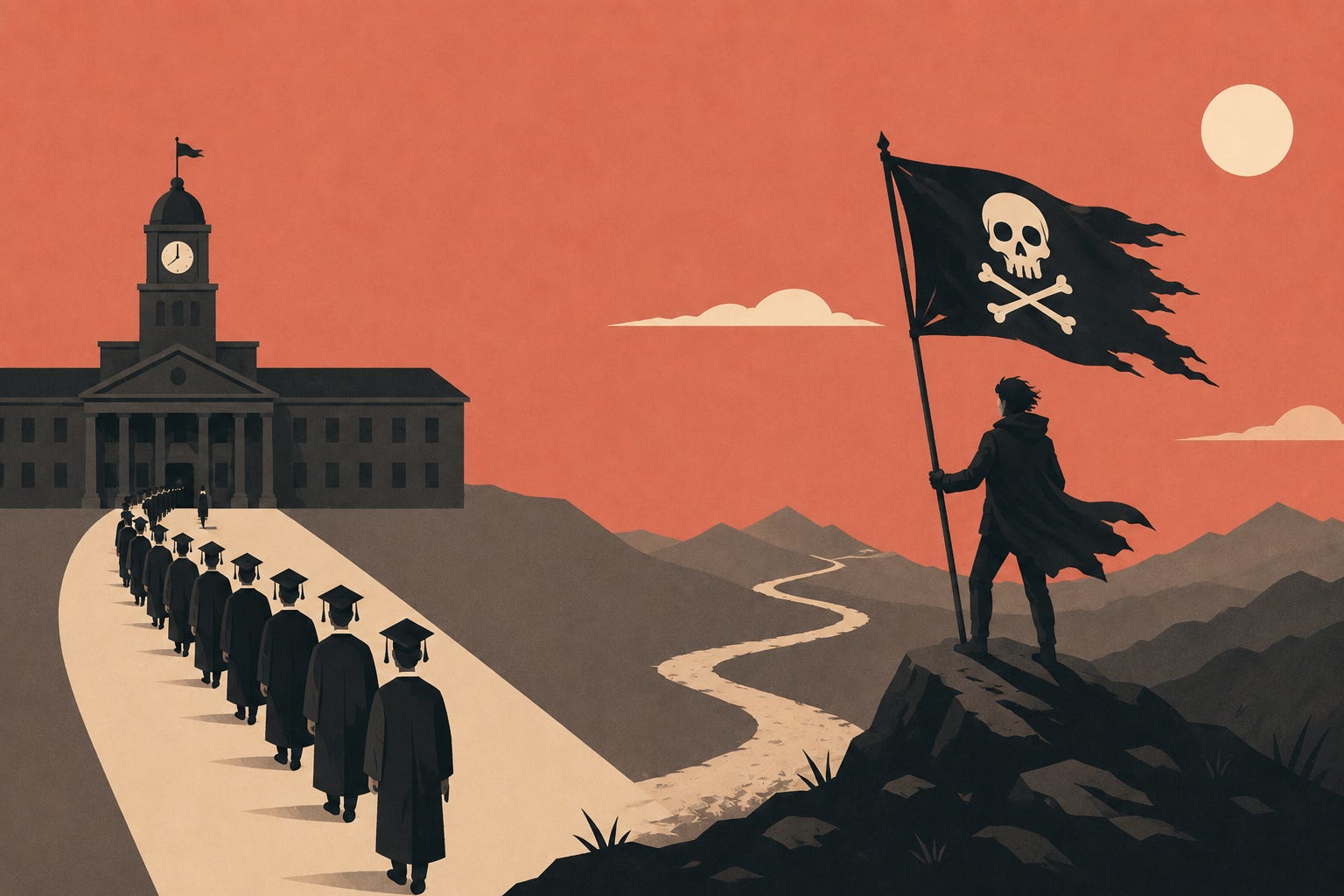
“Congratulations, son!”
He was genuinely proud. Proud of his son’s newly earned PhD, proud of the dissertation whose title he could barely pronounce, and proud of the years of sacrifice that had finally culminated in a black gown and a framed diploma. The only number that impressed him more than the title of the thesis was the balance of the student loan, which he sincerely hoped had been calculated in yen rather than dollars.
“I am really proud of you. I truly am!”
Having no scientific background, he imagined his son joining the ranks of history’s great minds. Perhaps he would discover a cure for Alzheimer’s or maybe he would invent a new class of antibiotics or possibly add years to the average human lifespan. As the family celebrated over dinner, they spoke with the confidence reserved for graduation ceremonies and lottery winners. The world had gained another scientist. Surely humanity would be better now.
This story is beautiful. There is only one problem. It’s the story we like to tell ourselves, not necessarily the one we live.
Most PhD graduates will not become the next Einstein, and we certainly shouldn’t expect them to. Science advances because thousands of researchers make careful, incremental contributions. But there is a bigger question beneath the father’s optimism. If we are producing more scientists than at any point in history, why do transformative breakthroughs still feel so rare?
While the science is certainly hard and full of surprises, I wonder whether we’ve built a system that trains humans to become the wrong type of scientists.
So here’s a question to think about: What if the most expensive bottleneck in modern science is not funding, computing power, or lab equipment, but the way we educate the people who become scientists?
Modern education has been extraordinarily successful at teaching literacy, numeracy, technical competence, and the ability to work within established frameworks. Those achievements should not be dismissed. They enabled industrialization, economic growth, and unprecedented social mobility. But systems were optimized for class attendance, not necessarily outcomes, and when we do focus on outcomes, we optimize more effectively for mastering existing knowledge than for questioning its foundations. Every kid can probably tell you that the moose loses his antlers in the winter but no one knows what to do with this knowledge. High schoolers often stress over biology classes where they learn the words “cell” and “DNA” but they proudly graduate without knowing what these words mean and why they should care.
The same tendency extends into higher education. Doctoral training is vastly more creative than primary or secondary school, yet it still rewards many of the same habits. Students learn to absorb an enormous body of literature, identify gaps that are acceptable to peers, produce work that satisfies reviewers, and build careers through incremental contributions. These are rational incentives. Science depends on rigor, reproducibility, and skepticism. Without them, knowledge quickly descends into speculation. The problem is not that these qualities exist. The problem is that they can crowd out the qualities that produce occasional leaps rather than steady steps.
History offers plenty of examples. Einstein challenged assumptions about space and time. Barbara McClintock’s ideas about mobile genetic elements were dismissed for years before becoming foundational biology. Katalin Kariko struggled for decades before messenger RNA transformed medicine. These scientists didn’t succeed because they ignored evidence. Instead, they were willing to entertain ideas that initially seemed improbable. Scientific revolutions require both disciplined reasoning and intellectual courage. Remove either ingredient and progress slows.
But our current approach is as effective as asking a human to study rubber friction against the road and then expecting him to design a car.
This is not an argument that scientists lack intelligence. Quite the opposite. Many researchers display astonishing creativity within their fields. And it’s not an argument that scientific consensus is inherently suspect. Consensus often reflects the best available evidence. The concern is more subtle than this. Institutions and incentives naturally shape behavior. When promotions, grants, publications, and prestige depend primarily on extending established ideas, researchers have understandable reasons to avoid risks whose rewards may arrive only after their careers have ended.
Education could do more to cultivate productive disagreement. Students can spend more time designing experiments rather than merely reproducing them, defending unpopular hypotheses with evidence, exploring multiple explanations for the same phenomenon, and learning how to recognize their own cognitive biases. They should certainly question every assumption and fact imaginable, even when accepted by the industry as an axiom. Original thinking is not a mysterious talent bestowed upon a fortunate few. Like statistical reasoning or mathematical proof, it can be practiced, criticized, and refined.
Innovation rarely comes from abandoning rigor. It comes from combining rigor with imagination and bravery to question established facts and group think. Our current educational model excels at producing competent experts. The next challenge is producing more people who are equally capable of asking questions that nobody else thinks to ask. This requires an education system that prizes curiosity alongside correctness, rewards thoughtful risk-taking alongside precision, and recognizes that the future belongs not only to those who know the answers, but also to those who discover entirely new questions.
But until then, I wonder if Pink Floyd was right about our education system: “All in all you are just another brick in the wall.”
No posts
Comments
Nothing yet. Say the first thing.
Sign in to join the conversation.