
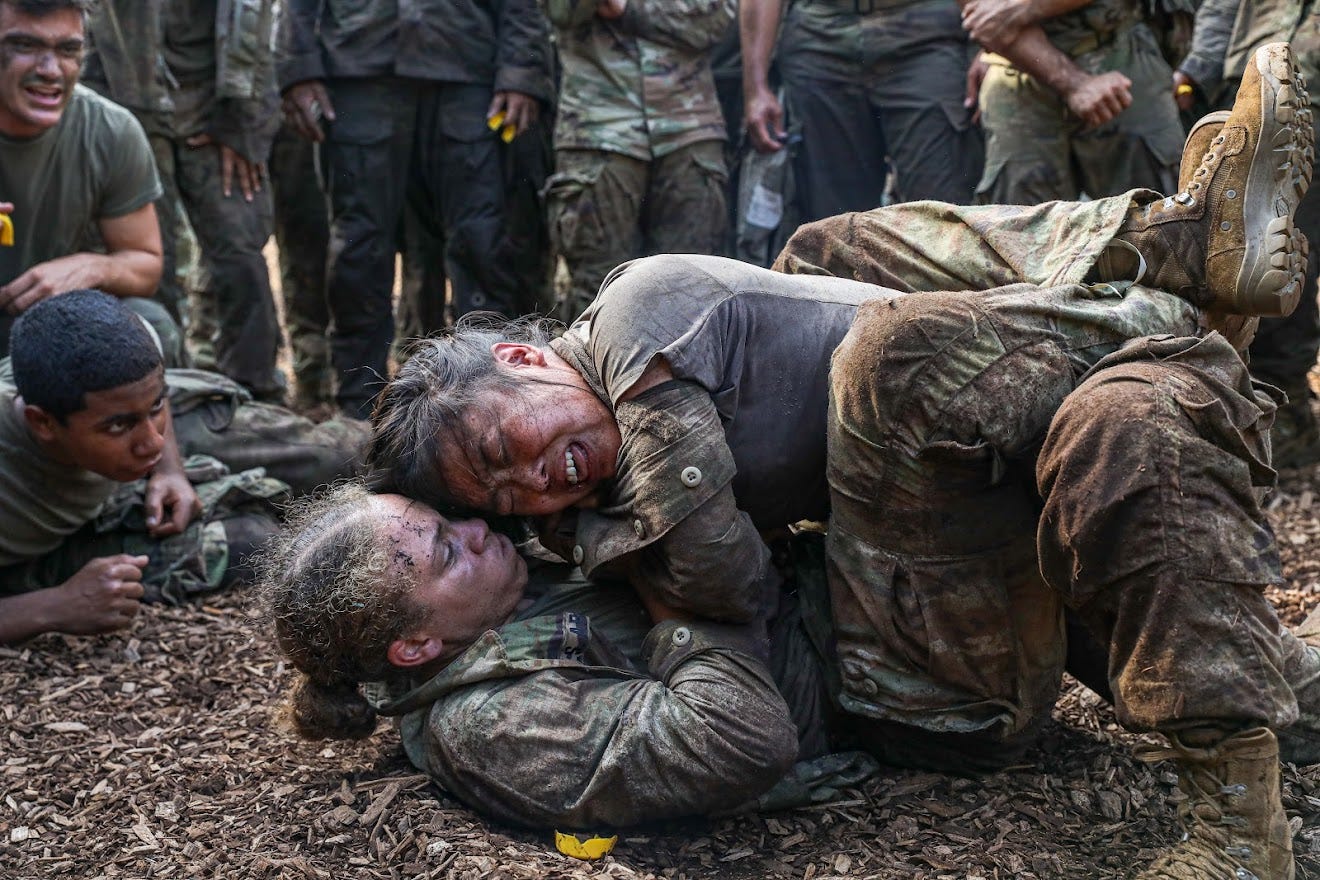
The purpose of the Army Combatives School is widely misunderstood.
People often mistake an expert in Army Combatives for an expert martial arts instructor. They are not the same profession. Of course, every Combatives expert must first be an expert fighter. Fighting ability is a foundational skill because individual fighting ability establishes credibility. They must also be an expert instructor, capable of developing fighting skills in others. These are essential prerequisites, but they are not the profession itself. The profession of Army Combatives is the science and art of helping commanders build successful Combatives programs that improve the fighting ability of the average soldier and strengthen the Warrior Ethos throughout the unit.
This distinction is fundamental because it defines the purpose of the Army Combatives School.
The school does not exist simply to produce expert fighters or expert instructors. It exists to educate professionals capable of helping commanders employ the Army Combatives Program as a tool for building combat capability and developing warrior culture within their organizations.
The Army Combatives Program is not an end in itself. It is a commander’s leadership tool. Everything described above exists for one purpose: to provide commanders with a tool capable of simultaneously improving the fighting ability of the average soldier and strengthening the Warrior Ethos throughout their formation.
Like any leadership tool, its value is measured not by the skill of the instructor, but by its effect on the organization.
Two questions determine whether a unit’s Combatives Program is successful.
Does the average soldier become a better fighter?
Does the unit develop a stronger Warrior Ethos?
Those are the measures of success. Understanding this distinction is the beginning of professional expertise.
One of the most common misconceptions about the Army Combatives Program is that successful unit programs are identified by thriving Combatives clubs or by producing individual champions.
Neither is an adequate measure of success.
Every unit contains a small number of highly motivated soldiers who will seek additional training regardless of the quality of the unit’s program. They attend civilian academies, train after duty hours, compete on weekends, and often become exceptional fighters. Their success is admirable, but it tells us very little about the effectiveness of the commander’s Combatives Program.
Likewise, a successful Combatives club may provide valuable opportunities for those who choose to participate, but voluntary participation by a small percentage of the unit does not substantially improve the fighting capability of the formation. A commander’s responsibility is not to develop a few elite fighters. It is to develop the entire unit.
A unit with a successful Combatives competition team, but average soldiers who have never been seriously developed has not built a successful Combatives Program. Conversely, a unit with no higher level champions may possess an outstanding program if the average soldier is demonstrably more capable in close combat and the Warrior Ethos has become more deeply rooted throughout the organization.
In a properly functioning Army Combatives Program, future instructors are identified within successful unit programs. Through regular training and competition, commanders recognize soldiers who have demonstrated exceptional fighting ability, maturity, leadership, and commitment to the Warrior Ethos. Their fighting ability gives them credibility. Their experience teaching within the unit develops them as instructors.
The Army Combatives School exists to build upon that foundation.
Understanding the purpose of the Army Combatives Program is only the beginning of professional expertise. A second essential body of professional knowledge is understanding the distinct purpose and culture of the Combatives profession itself.
Many of the Army's finest individual fighters develop their skills in civilian martial arts such as Brazilian Jiu-Jitsu, wrestling, boxing, and mixed martial arts. The Army benefits enormously from that experience and should encourage soldiers to pursue it. Those schools produce highly skilled fighters and provide an invaluable source of technical expertise.
Yet the purpose of a civilian martial arts academy differs fundamentally from the purpose of the Army Combatives Program. Confusing those two purposes has been one of the greatest obstacles to the development of the Army Combatives profession. Civilian schools exist to develop the individuals who choose to attend them. The Army Combatives Program exists to improve the fighting ability of an entire formation and strengthen the Warrior Ethos throughout the unit.
Consequently, one of the Army Combatives School's most important responsibilities is not merely to improve technical skill but to enculturate accomplished fighters into the profession of Army Combatives. Graduates must learn to think like professional advisors to commanders rather than fight coaches or martial arts teachers. Those who remain committed to the assumptions, methods, and culture of civilian academies naturally tend to recreate them inside military units, building voluntary clubs for highly motivated soldiers rather than commander-led programs that develop the entire formation.
The Army benefits enormously from civilian martial arts because they produce skilled individual fighters. The responsibility of the Army Combatives School is to transform those accomplished fighters into professionals capable of helping commanders build successful Combatives programs.
Understanding the profession itself is only part of a Combatives expert's education. They must also understand the scope and purpose of the Army Combatives Program.
Like every profession, Army Combatives possesses a distinct body of professional knowledge. An expert instructor therefore requires far more than technical proficiency. The Army Combatives School must teach the professional knowledge required to advise commanders, design successful unit programs, develop instructors, integrate training into the unit's battle rhythm, strengthen organizational culture, and understand the limits of the program itself. Technical fighting skill establishes credibility, but professional knowledge is what makes an instructor valuable to a commander. The Army Combatives School exists to teach that body of knowledge.
The Army Combatives Program is designed to develop fundamental fighting ability and strengthen the Warrior Ethos across the force. It is not intended to teach the tactics, techniques, and procedures that individual units employ to accomplish their specific missions. Those requirements are determined by each unit’s Mission Essential Task List (METL).
This distinction is essential to understanding the profession of Army Combatives.
Every unit in the Army fights according to the same fundamental principles. Fire and maneuver, mutual support, and the ability to dominate an opponent through superior skill and coordinated action are universal. What differs from one unit to another is not how human beings fight, but the missions they are expected to accomplish and the tactical situations in which they must apply those universal principles. Consequently, each organization develops tactics, techniques, and procedures appropriate to its mission.
The Army Combatives Program serves the same role for close combat. It teaches the universal principles of fighting upon which all mission-specific applications are built. Units then develop and train the tactics, techniques, and procedures necessary to apply those fundamentals in the context of their own missions.
The development of the Special Operations Combatives Program (SOCP) illustrates this relationship well. Following the introduction of the Army Combatives Program into the John F. Kennedy Special Warfare Center and School, Greg Thompson, and the Combatives Instructors in the cadre at the Special Forces Advanced Reconnaissance, Target Analysis, and Exploitation Techniques Course (SFARTAETC), who had just completed MACP levels I-IV in the last six months, developed SOCP to address the mission-specific requirements of units conducting direct action operations. Rather than replacing the Army Combatives Program, SOCP assumed soldiers already possessed its fundamental fighting skills taught through the Combatives Program and built upon that foundation by teaching the tactics, techniques, and procedures appropriate to those missions.
The relationship between fundamental skills and tactical procedures is no different elsewhere in the Army.
Consider the infantry drill for crossing a linear danger area. The procedure is valuable because it places the unit in a position to employ fire and maneuver effectively if contact is made with the enemy. But if the soldiers have never learned how to conduct fire and maneuver, the technique of how to cross a danger area provides little advantage. They may execute the crossing perfectly, but they still cannot fight.
The same principle applies in law enforcement. Handcuffing techniques are designed to place an officer in a position of advantage if the subject begins to resist. But those techniques assume the officer already possesses the ability to control and defeat a resisting opponent. Without that foundation, memorizing the procedure offers little real advantage because the officer cannot exploit the positional advantage it creates.
One of the most common mistakes made by commanders unfamiliar with the purpose of the Army Combatives Program is attempting to build mission-specific capability before developing fundamental fighting ability. Tactical procedures do not create fighting ability; they multiply it. The foundation must come first. Only then do mission-specific techniques achieve their intended effect.
This mistake persists because specialized training is inherently attractive. Mission-specific techniques appear more advanced, more operationally relevant, and more exciting than mastering the fundamentals. They also allow experienced soldiers and leaders to remain within areas where they already possess confidence and professional identity. Fundamental training, by contrast, often exposes weaknesses. It requires experienced personnel to become students again, sometimes learning alongside or even from junior soldiers who possess greater technical skill. That demands humility. Yet the more specialized a technique becomes, the more it assumes competence in the fundamentals.
A Combatives expert understands how the Army Combatives Program undergirds mission-specific training. The purpose of the program is to develop universal fighting ability and strengthen the Warrior Ethos across the force. Unit Combatives instructors then help commanders develop, refine, and teach the tactics, techniques, and procedures that apply those universal skills to their unit's specific mission. In other words, the Army Combatives Program provides the foundation; unit training builds the mission-specific applications.
An effective Combatives instructor must therefore be competent in both. They must understand how to build universal fighting ability across an organization, and they must be capable of adapting that foundation to the tactical requirements of their own units.
This distinction also explains why technical fighting ability should be a prerequisite for attendance at the Army Combatives School rather than its primary focus. Individual fighting ability establishes the credibility necessary to advise commanders and teach soldiers. The school's responsibility is to build upon that foundation by educating graduates in the broader profession of Combatives: designing unit programs, integrating training into the commander's battle rhythm, developing instructors, strengthening organizational culture, and helping commanders apply fundamental fighting skills to their unit's mission.
Professional soldiers understand that mastery always begins, and continually returns, to the fundamentals. As expertise increases, so does appreciation for their importance. The Army's elite organizations are not exceptional because they possess fundamentally different skills from the rest of the force. They are exceptional because they demand a higher standard of mastery in the fundamentals. The 75th Ranger Regiment exemplifies this principle. Organizations that neglect the basics in pursuit of advanced techniques often become proficient at rehearsing procedures without ever developing the underlying fighting ability required to execute them effectively.
A second essential body of professional knowledge is understanding not merely what the Army Combatives Program teaches, but why it was deliberately designed to function as it does.
It was deliberately designed to solve one of the commander’s greatest challenges: how to develop fundamental fighting skills across an entire formation without competing for additional training time. Rather than existing as a separate training event, the program’s foundational drills were designed to become part of the unit’s normal physical training routine.
Equally important, the Army Combatives Program was designed to complement physical training, not replace it. A Combatives class is not physical training. During technical instruction, much of the time is necessarily spent watching demonstrations, receiving coaching, and practicing techniques cooperatively. Those activities are essential for learning but contribute relatively little to developing strength, endurance, or cardiovascular fitness. By integrating Combatives drills and competitive grappling into an existing physical training session, before or after the primary conditioning event, the Army develops fighting ability without sacrificing physical readiness.
The first three drills consist of continuous partner movements in which every repetition naturally returns both soldiers to the starting position. Like throwing a baseball before practice or swinging a golf club before a round, they can be performed continuously as warm-up exercises before the day’s workout. Because the movements are repeated every day, instructors can focus attention on a single detail during each session. One day the emphasis may be proper grips. Another day it may be posture, weight distribution, or finishing mechanics. Over months and years, thousands of repetitions produce steady technical improvement.
Yet technical refinement is only one purpose of the drills.
The drills were also designed to teach the underlying schema of fighting. They are constructed from the fundamental positions of ground combat and the proper transitions between them. As soldiers repeat these movements day after day, they unconsciously learn the positional hierarchy of grappling, where they should be trying to move from every major position and why those positions matter. Likewise, the inclusion of fundamental submissions such as the bent arm bar and the rear naked choke teaches not merely how to execute those techniques, but from which positions a fighter possesses the leverage necessary to attack an opponent’s joints or neck. Rather than memorizing isolated techniques, soldiers gradually internalize the conceptual structure of ground fighting itself.
The same principle applies to instruction. Combatives has remained a Level I Soldier task in the Soldier's Manual of Common Tasks for decades. Like every other fundamental Soldier task, responsibility for teaching it belongs to the unit's NCOs rather than a small number of specialists. If many NCOs do not feel adequately prepared to teach Combatives, it is evidence that the Army has not built a system that routinely develops and sustains Combatives proficiency throughout the NCO corps. Integrating Combatives into the unit's regular physical training corrects this problem by providing the repetition, experience, and daily involvement necessary for NCOs to build and maintain that proficiency while simultaneously developing every soldier in the formation.
Integrating these drills into daily physical training produces another important effect. The Army already understands the value of common physical exercises. When a leader commands, “The High Jumper,” every soldier immediately knows what movement to perform because those exercises are part of the Army’s shared professional language. The Combatives drills were designed to achieve the same result. Every soldier is expected to know them. If they do not, the deficiency is immediately visible and corrected through the chain of command. Fundamental fighting movements therefore become part of the common professional knowledge expected of every soldier rather than the specialized knowledge of a few enthusiasts.
Understanding why the drills were designed this way is as important as learning to perform them. A Combatives expert is not merely someone who can demonstrate the movements. They understand the educational principles behind them and how those principles allow commanders to improve the fighting ability of an entire formation without requiring additional time on the training calendar.
A third essential body of professional knowledge is understanding how organizational culture is built and sustained.
The Army Combatives Program works because it deliberately shapes the social environment of a military unit. Soldiers naturally respect courage, competence, perseverance, humility, and the willingness to embrace difficult challenges. A properly designed program creates repeated opportunities for those qualities to be demonstrated before peers.
This is why informal competitions are indispensable.
Regular grappling conducted as part of unit physical training, for example after a unit run, ruck march, or other demanding physical event, does far more than improve fighting ability. Like physical training itself, fundamental Combatives skills are too important to leave to individual motivation. Every commander understands that if physical training were conducted only as an optional activity after duty hours, many soldiers would simply choose not to participate. The same is true of Combatives. By integrating it into the unit's normal battle rhythm, participation becomes an expected part of soldiering rather than an activity reserved for enthusiasts. This is one of the program's most important design features.
Because everyone participates, these events create a culture in which toughness and competence earn respect. Soldiers become motivated not merely by instruction from leaders but by the desire to meet the standards established by their peers. Over time, peer pressure encourages every soldier to become both tougher and more technically competent because those qualities carry social status within the organization.
Formal competitions accomplish a different purpose.
Company, battalion, and brigade tournaments publicly recognize excellence, establish organizational standards, and create role models for younger soldiers. They communicate what the commander values and reinforce the legitimacy of those who have earned distinction. Informal competitions shape the culture from within. Formal competitions reinforce it publicly. Both are essential, but they accomplish different objectives.
A graduate who cannot explain why informal and formal competitions produce different effects on organizational culture has not yet mastered Army Combatives. They may be an excellent fighter. They may even be an excellent instructor. But they do not yet understand the profession.
Everything described above exists for one purpose: to provide commanders with a leadership tool capable of simultaneously improving the fighting ability of the average soldier and strengthening the Warrior Ethos throughout the formation.
The Army Combatives School is therefore not simply a place where soldiers learn to fight or teach fighting.
It is the institution responsible for educating the professionals who help commanders use the Army Combatives Program to build units in which the average soldier fights better, the Warrior Ethos is strengthened, and the capability endures long after individual instructors and commanders have moved on.
That is what an expert in Army Combatives should be.
No posts
Comments
Nothing yet. Say the first thing.
Sign in to join the conversation.