
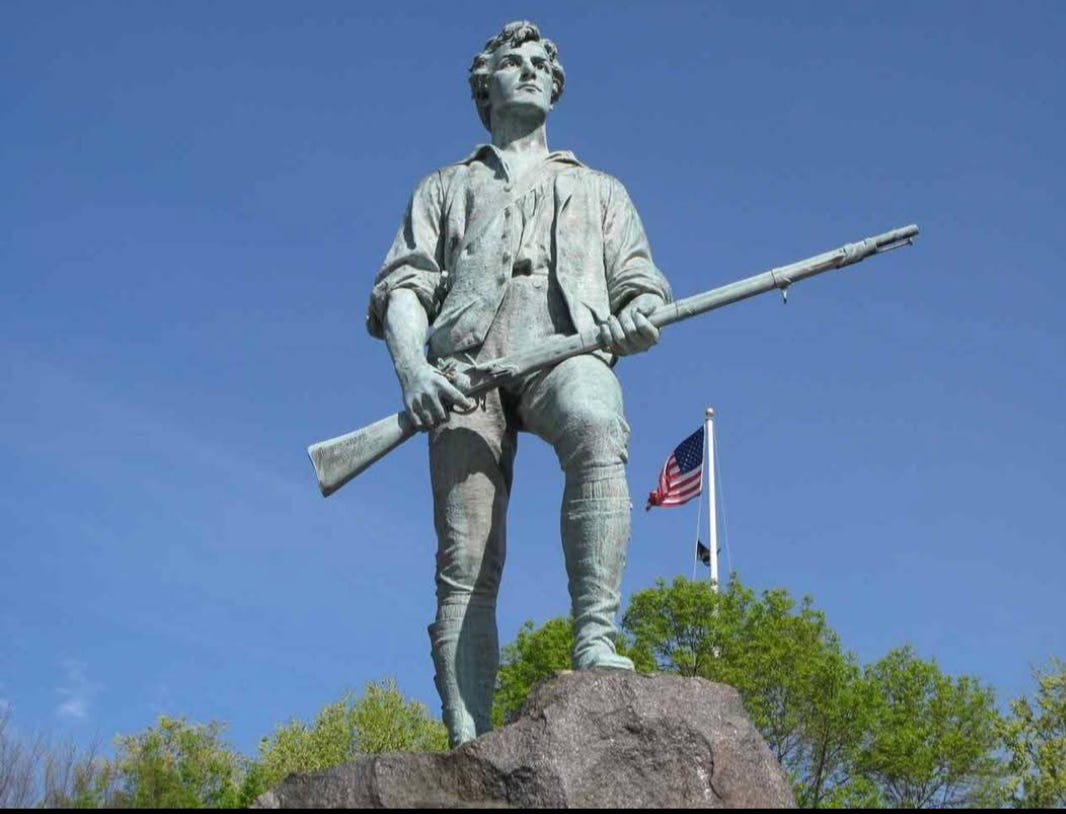
Today Americans celebrate the 250th anniversary of the Declaration of Independence.
We rightly remember the eloquent words adopted in Philadelphia on July 4, 1776. Yet by the time those words were written, blood had already been shed. More than a year earlier, on April 19, 1775, the American Revolution began when the government sent its army to Concord, Massachusetts.
Its mission was not to arrest murderers or suppress a riot. General Thomas Gage, the Governor of Massachusetts, ordered the nation’s professional soldiers to seize the military stores of the common people of Concord, Massachusetts. Their objective included muskets, bayonets, gunpowder, ammunition, entrenching tools, and artillery, including cannon owned by the people through their militia.
The men who stood in their way were not yet Americans. They were British subjects.
Nor did they view the red-coated soldiers as a foreign invading army. Those soldiers were their own national army, acting under the lawful authority. The conflict that began at Lexington and Concord was not initially a war between two nations. It was a conflict between a government and a people who had come to believe that government had violated their liberties.
To understand why ordinary farmers were willing to stand before the government’s army, one must first understand the institution they belonged to: the militia.
Modern Americans often imagine the militia as a small group of volunteers who gathered occasionally to drill with whatever firearms they happened to own. That picture bears little resemblance to the institution that existed in eighteenth-century America.
To the Founding generation, the militia was neither voluntary nor separate from the people. It was a legal institution composed of ordinary citizens, and military service was one of the obligations of citizenship.
Understanding that institution requires understanding four simple principles.
The Virginia Declaration of Rights of 1776 described the militia as:
“A well regulated militia, composed of the body of the people, trained to arms, is the proper, natural, and safe defence of a free state.”
Twelve years later, during Virginia’s convention debating ratification of the Constitution, George Mason asked what should have been an obvious question:
“I ask, sir, what is the militia? It is the whole people, except for a few public officers.”
Those words would have sounded unremarkable to eighteenth-century Americans. The militia was not an elite military organization. It was not a select body of volunteers. It was the people themselves, organized for the common defense.
Today military service is voluntary. In colonial America it generally was not.
Throughout the colonies, militia laws required most able-bodied free men to enroll, attend periodic musters, train alongside their neighbors, and report when called into service. Men who failed to appear or neglected their obligations could be fined.
Massachusetts law made that obligation unmistakable:
“Every listed Souldier and other Householder... shall be always provided...”
The word shall mattered. Militia service was not encouraged. It was required.
Pennsylvania likewise required virtually every able-bodied free man of military age to serve in the militia, while Virginia’s militia laws required enrollment and gave citizens a limited period to acquire the military equipment required by law.
Citizenship carried obligations as well as rights.
The obligation to serve carried with it another obligation: to appear properly armed.
Massachusetts law required every militiaman to possess:
“...a well fix’d Firelock Musket... a Cartouch box, one Pound of good Powder, Twenty Bullets fit for his Gun, and Twelve Flints, a good Sword or Cutlace...”
This was not a recommendation.
It was not advice for hunters.
It was not a suggestion for sportsmen.
It was a legal requirement that every citizen expected to perform militia duty maintain military equipment suitable for war.
The musket hanging above the fireplace was certainly useful for hunting. It was also expected to answer the militia muster. It served two purposes because its owner served two roles: private citizen and member of the militia.
This explains something often overlooked in modern debates. The question was never whether an individual “needed” a military firearm. The law assumed he did, because service in the militia was mandatory. His neighbors depended upon it.
Modern readers often misunderstand one of the most famous phrases in American history.
Today, the word regulated usually suggests government restrictions and administrative rules. That is not how eighteenth-century Americans ordinarily used the word.
Samuel Johnson’s 1755 dictionary defined “regulate” as bringing something into proper order according to rule or method. Noah Webster’s 1828 dictionary similarly defined it as putting something “in good order.”
A well-regulated clock kept accurate time.
A well-regulated household functioned efficiently.
Likewise, a well-regulated militia was one that was properly organized, trained, disciplined, and equipped.
The Virginia Declaration of Rights makes this clear in its own wording. It describes the militia as “the body of the people, trained to arms.” Training, not regulation in the modern bureaucratic sense, was central to the idea.
A militia that lacked discipline, neglected training, or appeared without the required military equipment would not have been considered well regulated.
These obligations reflected the world in which the Founders lived.
There were sheriffs, constables, and town watches, but there were no professional police departments. The first municipal police department in the United States was established in Boston in 1838, more than sixty years after Lexington and Concord, when the city’s population had grown to roughly 90,000 people. New York followed in 1845 with a population approaching 370,000. As American cities became larger and more complex, governments increasingly hired professionals to perform duties that had once rested with ordinary citizens.
The eighteenth century was different.
The same man who might serve on a jury, answer the sheriff’s call to pursue a criminal, or stand a turn on the night watch was also expected to appear with his musket when the militia assembled.
Security was not primarily a government service.
It was a civic responsibility.
Understanding the militia makes the opening of the American Revolution easier to understand.
On April 19, 1775, General Thomas Gage, the Governor of Massachusetts and commander of the government’s regular army in North America, ordered troops to march to Concord.
The soldiers in red coats were not a foreign invading army. They were the government’s professional soldiers, carrying out the orders of their lawful civil governor against what the government regarded as a developing rebellion among its own subjects.
Their mission was to confiscate the military stores assembled by the Massachusetts militia.
Those stores included muskets, bayonets, gunpowder, ammunition, cartridge boxes, entrenching tools, provisions, and even artillery, including several cannon belonging to the people of Concord.
That final point is often forgotten.
The government’s objective was not merely to seize privately owned firearms. It sought to confiscate the military capability of the people themselves, including weapons that no one would mistake for sporting arms.
To eighteenth-century Americans, this was entirely logical. If the militia was the body of the people, and if the law required those people to furnish military arms suitable for service, then disarming the militia necessarily meant disarming the people who composed it.
By the summer of 1776, the Continental Congress concluded that reconciliation was no longer possible. The Declaration of Independence announced to the world that the colonies were assuming “the separate and equal station” to which they believed they were entitled.
The road to that declaration had passed through Concord.
There, the government attempted to seize the military capability of the militia: muskets, powder, ammunition, and even cannon. The men who resisted did so because they believed the militia was not merely another government institution. It was the body of the people, fulfilling a legal duty that free citizens had carried for generations.
The Founding generation left little doubt about what they believed. When a government ceased to protect the liberties of the people and instead sought to destroy the means by which those liberties could be defended, they concluded that the people retained the right to alter or abolish that government and to establish one they believed would better secure their liberty.
That conviction gave birth to the United States.
Today, as we celebrate the 250th anniversary of the Declaration of Independence, it is worth remembering that the Declaration did not begin the American Revolution. It explained why the men who had already stood at Concord believed they had been right to do so.
The Founders lived in a different world. They believed that liberty depended not only upon rights, but upon citizens willing to accept the responsibilities that accompanied them. Among those responsibilities was the duty to be prepared to defend their families, their neighbors, and their communities.
According to the Founders, when a government attempted to strip the people of the military arms they were legally obligated to possess. including even their cannon, it was no longer merely debating policy. It was attacking one of the institutions that secured the liberty of a free people.
Their answer was not another petition.
It was the American Revolution.
No posts
Comments
Nothing yet. Say the first thing.
Sign in to join the conversation.