
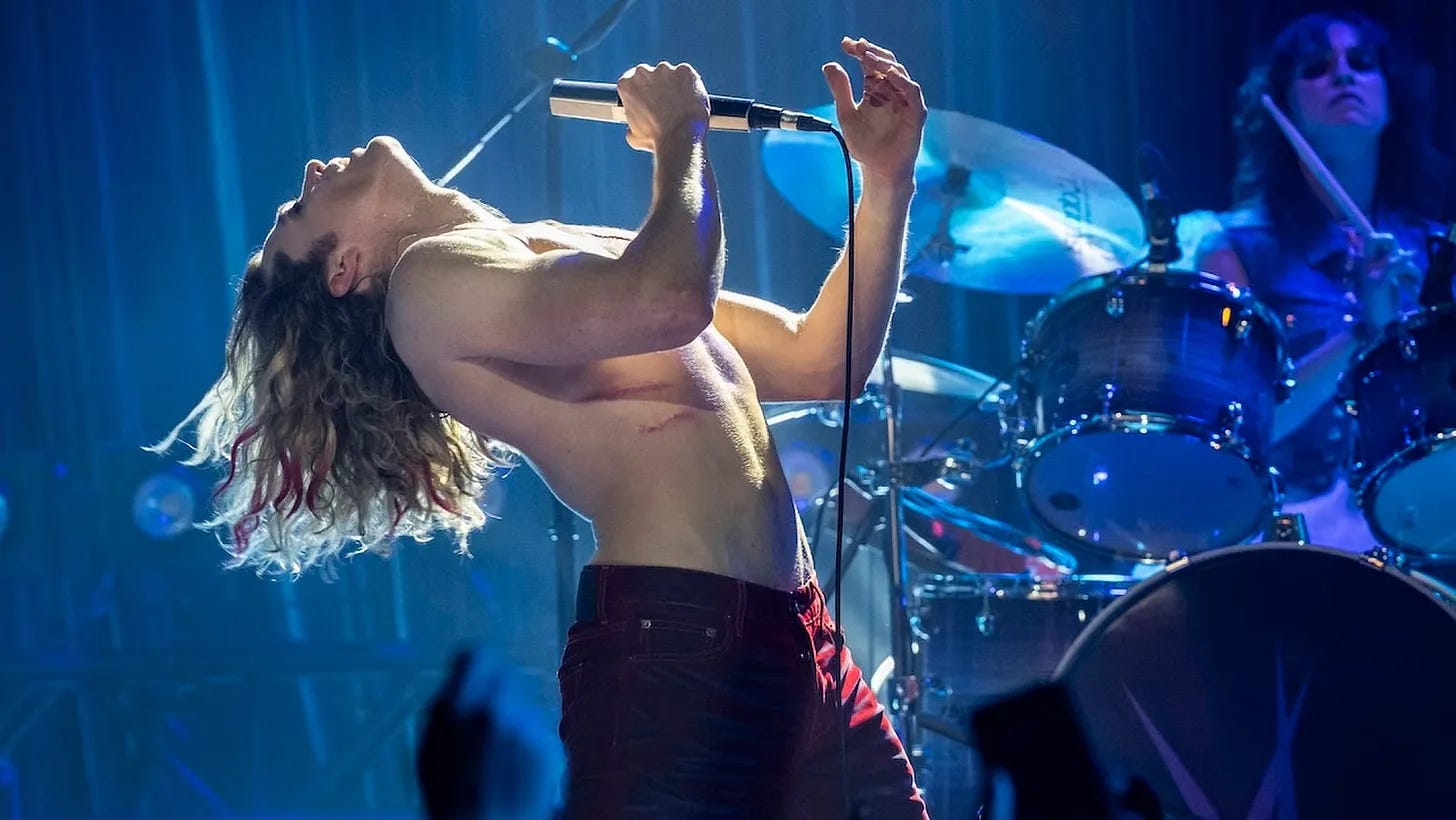
The Vampire Lestat has hit streaming and, as expected, the infamous drama is raucous, melodramatic, and controversial. The critics reviews are generally positive, with many praising Sam Reid’s performance as Lestat and the show as charming, uncompromising, and tragic. And yet, my entire social media feed is filled with passionate debate about whether this season is good or not, with some fans of the previous seasons disparaging the writers, ignoring the books, ruining the characters, inconsistent pacing, and it isn’t queer enough.
The Vampire Lestat is the third season of Interview With The Vampire. This season is an adaptation of the novel of the same name. The first two seasons are narrated by Louis (Jacob Anderson), a 145-year-old vampire who tells the story of his vampiric life to Pulitzer prize winning journalist Daniel (Eric Bogosian). Louis details his life as a closted brothel owner in 1910s New Orleans and how he was seduced and turned by the vampire Lestat. He explains how he and his surrogate daughter Claudia (Bailey Bass (season 1), Delainey Hayles (season 2–3)), his surrogate daughter, attempted to murder Lestat and fled to Europe to find more vampires. He tells Daniel how Claudia died in a trial orchestrated by his current lover, the vampire Armand (Assad Zaman). The first two seasons are a gothic tale told through romantic imagery and prosaic dialogue. They delve into themes of love, monstrosity, and grief. Season 3 follows Lestat as he embarks on his tour with his band, The Vampire Lestat. Lestat’s narration is a chaotic, nonlinear story filled with misunderstood slang and false bravado. It is a complete tonal whiplash from the first two seasons.
Each season in Interview With The Vampire is defined by its narrator. The Vampire Lestat starts in a flash of style over substance, of self-important telling over showing and that is the point. Lestat wants to be in control of his story, he leaves out anything that makes him look weak and vulnerable. Unfortunately, a lot of The Vampire Lestat’s issues stem from it being in Lestat’s perspective. Lestat is judgemental and self-absorbed. He paints people as caricatures, so they are caricatures in the show. Because he is chaotic, his narrative is also chaotic, jumping back and forth and over things he’d like to keep to himself. The show misses out on dramatic scenes and substantive flashbacks that would reveal Lestat’s vulnerability because Lestat is the narrator of his reality.
Because the story is in Lestat’s perspective, viewers expected this season would be all sex, drugs, and rock-and-roll. It would be queer camp perfection. But instead, the main character stumbles his way through words he does not know how to use in an attempt to seem cool and his most explicit sex scenes are with his own mother.
The sex scenes in Interview With The Vampire have a purpose. In season 1, Louis discusses his time with Lestat in elaborate and euphoric detail. He does this in front of Armand. He glosses over his sexual relationship with Armand, at this point in time, the two have fallen out of love — or out of the illusion of love. In season 3, Lestat’s mother, the vampire Gabriella (Jennifer Ehle) uses sex to manipulate and control Lestat. His scenes with men are hinted at or in quick flashback. Those scenes are vulnerable, intimate, they are personal. Lestat’s relationship with his mom is a public scandal he wants to control the narrative around. The lack of gay sex scenes does not mean the show is any less queer. What makes Interview With The Vampire great is how complex and messy its queer characters and their queer relationships with each other are. It’s queer because its characters are queer, explicitly so. It does not matter how much sex they are having and who they are having it with. They are gay and that informs how they walk through the world.
The Vampire Lestat is not as romance driven as season 1 and even season 2 of Interview With The Vampire are. It is about domestic abuse. It is about parents and creators having children, finding partners to fill a hole in their hearts, to make themselves feel better. They want a person they can shape, and use to fix them, who will love them the way they want to be loved, who will absolve them of their guilt, who will not fault their flaws, who they can control. This season reckons with Louis and Lestat’s treatment of their daughter Claudia and — how their guilt is more about them than it is about her. Lestat uses the vampires he created — his mother and Louis — to love him the way he wants to be loved, he wants to be their world, and when he isn’t “enough” for them he lashes out. The show shines when it is exploring the complex parent/child, maker/made relationships. It asks interesting questions about parenthood, abuse, love, grief, and creation.
But, The Vampire Lestat contends with the intersection of identities that Anne Rice did not concern herself with when she wrote the books. Louis and Armand are both white in the novels and people of color in the show. Interview with the Vampire adapts its characters to their casting. Louis does not happen to be black and gay, he is black and gay and that informs the way he interacts with the world and how the world interacts with him. And how the viewers react to him and the viewers reaction is very mixed. I believe that some of the criticisms of this season and its writing may have been mitigated if there were people of color in the writers’ room.
The Vampire Lestat explores these themes through a queer cast of characters and this can be problematic. Queer people are drawn to monsters, we see ourselves in them, not because they are evil, but because they are outcast, because they are deemed monstrous by the perfect, white heteronormative protagonists. You cannot portray a gay person as evil — or many gay people as abusive and evil — because people will assume we are abusive and evil. I don’t have a solution for this. There will always be people who misinterpret art or use art in bad faith to justify their prejudiced world view. But gay people can be bad, they can be immoral and selfish, and horrible, because gay people are people. And it is nice to see a story that has rich thematic things to say work out those things in queer stories as opposed to an easier, less controversial heterosexual one.
Lestat is not a good male, but he is, like the rest of the cast, an empathetic character. He faced abuse at the hands of his maker and his mother. He works as a character because he is attractive, quick-witted and a drama-queen. Sam Reid plays him with a magnetic charisma that draws in viewers, making them forget that Lestat is a violent, cruel egomaniac. He wants your love and affection and he will do anything to make himself seem worthy of that love without looking desperate for it. Lestat weaponizes his trauma and empathy to manipulate other characters like Louis and to degrade other characters like Armand.
I, maybe optimistically, choose to not see any empathy I have for Lestat as proof that he is the good guy, the morally righteous one, the truth teller. He is not the vampire, rockstar, god, nor is he a mustache twirling villain, he is a human monster. All the characters are human monsters. They are broken people who were given the powers of gods, not the wisdom of them.
The Vampire Lestat is messy, its pacing is frantic and parts of its story slip between the cracks of that narrative structure. It stumbles through its identity politics and that’s my good faith interpretation of it. But, through the noise and the chaos, the facade Lestat tries to seduce you with, lies a man, a bad man, but a man. And there is nothing more horrifying, more stomach churning, more heartbreaking than realizing the beast with claws and fangs, that gorges himself on flesh and blood is human.
Anne Gregg is a musician and writer from Northwest Indiana currently pursuing an MFA in Fiction Writing at The Ohio State University. She is also a neurotic, horror-obsessed lesbian who loves all things queer, campy, and whimsically macabre. She loves dissecting queer media and believes, with all her heart, that Regina George from the hit 2004 comedy Mean Girls is a lesbian.
No posts
Comments
Nothing yet. Say the first thing.
Sign in to join the conversation.