
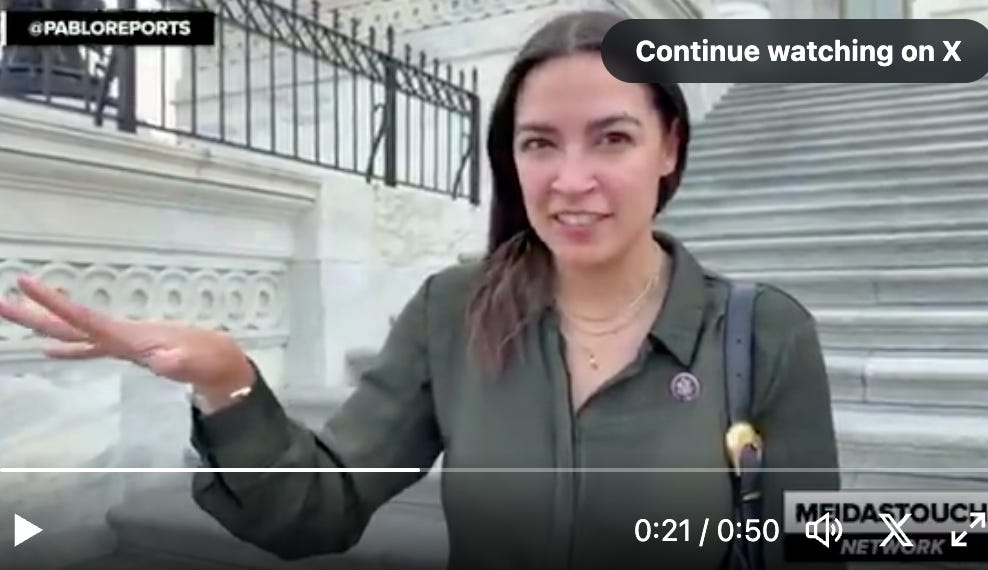
The other day, Rep Alexandria Ocasio-Cortez (D-NY) announced that she was “about to crack open” Boss Lincoln. She indicated to a reporter that she was most interested in what she called Lincoln’s “lost years” when he was “building a political machine before he ran for the presidency.” You can see why many online commentators speculated that this unusual summer reading recommendation was a sign of a possible soft launch for a presidential campaign.
But as the author of this nearly 600-page book that has more than a thousand endnotes, and one that takes about 17 hours to listen to over Audible, I can appreciate why someone as busy as the congresswoman also seemed a little hesitant to commit to finishing the whole thing. “I mean … we’ll see how long it takes,” AOC confessed during the exchange, with almost Honest Abe-level candor. So in the spirit of being accommodating, and acknowledging that I believe all potential Democratic presidential candidates could learn some important lessons from Lincoln’s partisan activities during the 1850s, here are three key insights from his “lost” period.
The main reason why the book is called “Boss Lincoln” is because Abraham Lincoln always saw himself foremost as a party leader and not merely as a candidate. Early in his career, when he was still just an Illinois Whig seeking a seat in Congress and caught up within a bitter local party nomination contest, Lincoln complained about selfish candidates who divided party organizations. “It is certain that struggles between candidates do not strengthen a party,” he wrote, “but who are most responsible for these struggles, those who are willing to live and let live, or those who are resolved, at all hazards, to take care of ‘number one?’”1 We live in a partisan age where almost any presidential candidate focuses on taking care of “number one.” Yet AOC or any of the would-be Democratic presidents in 2028 would be wise to follow Lincoln’s more farsighted model. Yesterday’s New York Times article about the escalating troubles inside Ken Martin’s DNC only illustrates how desperate the national party structure has become. That was Lincoln’s greatest accomplishment as a leader of the emerging Republicans during the 1850s —he found a way to unite a party struggling with what he termed “strange, discordant, and even hostile elements” in order to face down “the constant hot fire of a disciplined, proud, and pampered enemy.”2 That sounds like exactly the right kind of advice for AOC, made even more resonant when you realize that Barack Obama quoted those very same (otherwise obscure) lines from Lincoln’s 1858 “House Divided” speech when he launched his presidential campaign at the Old State Capitol in Springfield in 2007.
But preaching party unity is different than achieving it. Democratic partisan elements or factions are “hostile” and “discordant” for some deep-seated reasons. I don’t pretend to know exactly how AOC or any 2028 Democratic presidential candidate might bring together opposing forces like Democratic Socialists with “Abundance” moderates, but Lincoln’s hard-won path toward the presidency in the 1850s offers plenty of inspiration for how to approach such work. “Stand with anybody that stands right,” Lincoln advised in 1854, “Stand with him while he is right and PART with him when he goes wrong.” On the surface, this sounds like pure pragmatism, but the key was in Lincoln’s execution of that tricky balancing act. He denounced bad policies and ill-considered statements, not people, and usually found a way to appear both tough and forgiving at the same time. That’s what I mean by “coalition culture” (in contrast to the ubiquitous and self-defeating “cancel culture”). Now, of course, even Lincoln occasionally stumbled in these efforts. He despised nativist bigotry, for instance, but sometimes muted his opposition to Know Nothings in order to cultivate them as allies. Yet what redeemed his various pragmatic tradeoffs —and what ultimately made him president— was his ability to simultaneously embrace what his peers called an “ultra” strategy. Lincoln defined a fixed principle for the Republican party —slavery was wrong— and stuck to it with tenacity. How best to deal with that wrong was a matter of sometimes calculated policy choices, but as a candidate and party leader in the 1850s, Lincoln never let his fellow Republicans waver in their fundamental antislavery belief (and believe me, some of them tried). Today, in some ways, politicians have it harder. Finding a North Star of principle to guide an otherwise balky partisan coalition like the Democratic party (or the Republican party for that matter) is even more elusive in our fragmented political landscape. But it must be done. Lincoln understood that politicians should not make principled stands out of every policy difference —that drives away too many potential allies. Yet they must still promote and sustain some powerful guiding ideal for any political party to be worth holding together in the first place.
We tend to remember Lincoln for his great speeches, but Boss Lincoln reminds us that Lincoln spent most of his time on other more mundane forms of political communication. And not only was he relentless and disciplined about his messaging across all channels, but he was also innovative in his techniques. Lincoln wrote thousands of short confidential notes, some marked “Burn This” (and yes, they did not always get burned), which reveal him to have been a commanding behind-the-scenes party leader. During the 1850s, he also traveled constantly (by horse, carriage, steamboat, railroad, etc.), meeting with voters and colleagues, speaking in public and in private, and generally engaging his political peers. And as my book demonstrates, he used the relatively new visual medium of photography to help enhance his political image, such as by offering a campaign portrait as a “fusionist” in 1854 (when he was pictured as a former Whig holding an antislavery Democratic newspaper). During the 1856 election, he even pioneered the use of lithographic prints of his handwritten letters (with the salutation name left blank) to help him engage in a form of mass mailing that targeted independent voters (the nativist-leaning “Fillmore men”). He produced dozens of ghostwritten articles for newspapers and even went so far as to purchase a German language newspaper when he became determined to improve Republican strength with that key immigrant demographic.3
No period better illustrates Lincoln’s practical communication genius better than the period BETWEEN the famous Lincoln-Douglas Debates of 1858 and his equally well known Cooper Union speech of 1860 (sometimes called “the speech that made Lincoln president”). Throughout 1859, Lincoln sent countless political letters, drafted numerous statements, sat for interviews, prepared for his first book publication (an edition of his recent debates with Stephen Douglas) and delivered well-received speeches across the country. He had one message: party unity was essential to repel the twin threats of slavery and disunion. One exchange with Indiana Republican (and future Speaker of the House) Schuyler Colfax reveals the deft nature of Lincoln’s relentless outreach. In a “for your eye only” letter, Lincoln urged Colfax to guard “against divisions in the Republican ranks … particularly for the contest of 1860.” “In every locality we should look beyond our noses,” he warned, “and at least say nothing on points where it is probable we shall disagree.” Colfax responded by agreeing with the Machiavellian advice but questioning whether anyone would follow it. Whoever could pull such “men of all shades & gradations” into “a victorious phalanx in 1860” would be “worthier of fame than Napoleon,” he said.4
But “Smiler” Colfax, as his opponents called him, was mostly teasing Lincoln. He certainly didn’t view his Illinois rival as a Napoleonic figure. And, of course, nobody today views AOC or the other potential Democratic presidential contenders as either Napoleonic or Lincolnian —not yet anyway. But that should not stop them from studying the past and trying to learn from great examples as much as their busy schedules allow. That’s what Lincoln would do —and that’s what he did.

Acyn@Acyn
PabloReports: Do you have any book recommendations? AOC: I was just gifted a book that I’m about to crack open called Boss Lincoln. It’s about the lost years when Lincoln was building a political machine before he ran for the presidency. 👀
12:52 AM · Jul 15, 2026 · 546K Views
72 Replies · 209 Reposts · 4.68K Likes
NOTE TO READERS: Past performance by Abraham Lincoln (or any historical figure) is not indicative of future results. But it’s worth thinking about and arguing over. This article is part of the series Boss Lincoln and about topics pulled From the Headlines.
Matthew Pinsker, Boss Lincoln: The Partisan Life of Abraham Lincoln (New York: Norton, 2026), 42.
For these and other examples, see Chapters 4-8 in Boss Lincoln.
No posts
Comments
Nothing yet. Say the first thing.
Sign in to join the conversation.