
This fall, on November 19, 2026 —the anniversary of the Gettysburg Address— I will be delivering the Fortenbaugh Lecture at Gettysburg College. It was an invitation from my friends at the Civil War Institute, that wonderful organization founded by the late Gabor Boritt, whom I’ve written about here earlier. The title of my talk will be “Twelve Score and Ten: Lincoln, Gettysburg, and America 250.”
When Lincoln first contemplated the meaning of the national anniversary in 1863, he struggled to find the right words. “How long ago is it -- eighty odd years,” he said, just days after the turning point victories at Gettysburg and Vicksburg, in response to a crowd at the White House that had gathered on July 7. He continued with slightly better command: “since on the Fourth of July for the first time in the history of the world a nation by its representatives, assembled and declared as a self-evident truth that ‘all men are created equal.’” Then he added, a little awkwardly: “That was the birthday of the United States of America.”
He went on to recall in thoughtful terms how Thomas Jefferson, the author the Declaration, and his great friend and rival, John Adams, later both died on the 50th anniversary, July 4, 1826 —a coincidence that Lincoln attributed to “Almighty God” and which he labeled “an extraordinary and remarkable event in our history.” And then he pivoted to the Union’s recent battlefield victories and how they had come together, once again, seemingly by divine intervention on the Fourth of July. “Gentlemen, this is a glorious theme, and the occasion for a speech,” He said, “but I am not prepared to make one worthy of the occasion.” He closed by alluding to the “many brave officers and soldiers” whom they had been reading about in the newspapers —like Bayard Wilkeson, the young artillery officer whose death had been reported by his own father, Sam Wilkeson, for the New York Times— but insisted that he should not name anyone. “I dislike to mention the name of one single officer, lest I might do wrong to those I might forget,” he said.
Lincoln eventually found the occasion to give a brief address about this “glorious theme” on November 19, 1863 at the dedication of the Soldiers’ National Cemetery in Gettysburg. In his ten sentences, partially revised from his impromptu July remarks, he certainly improved the language. “Eighty odd years” now became “Four score and seven years ago.” But he also notably tightened his meaning. This time, Lincoln mentioned no individuals at all —no explicit references to either Founding Fathers or heroic soldiers. Instead, he devoted himself to extolling American democracy itself and reminding his audience that as they remembered the sacrifices of “these honored dead,” they should rededicate themselves to the importance of our collective “unfinished work” in preserving the republic.
The words that Lincoln used to close his address were not entirely his own. They were evocative more than original. Historians debate the sourcing of the phrase: “government of the people, by the people, for the people.” Senator Daniel Webster, one of Lincoln’s early favorites, said something like it on the floor of the Senate in 1830: “It is, Sir, the people’s Constitution, the people’s government,” Webster said in his Second Reply to Hayne, “made for the people, made by the people, and answerable to the people.” Then in 1858, Boston abolitionist Theodore Parker offered a stirring version of this sentiment in a sermon he delivered that Lincoln also read. “Democracy is Direct Self-government,” said Parker, “over all the people, for all the people, by all the people.”
But for me, the most direct sourcing of the Gettysburg Address phrasing comes from Lincoln’s own version of the expression offered in his Message to Congress at the outset of the Civil War, delivered in writing on July 4, 1861. He wrote that the American slaveholders’ rebellion “embraces more than the fate of these United States. It presents to the whole family of man the question whether a constitutional republic, or democracy--a government of the people by the same people--can or can not maintain its territorial integrity against its own domestic foes.”
Unlike some present day politicians, Lincoln did not distinguish between a “constitutional republic” and American “democracy” —he defined them both as “a government of the people by the same people.” This was what he meant by union as well —the union of electoral majorities and minorities embodied by the peaceful transition of power following an election and thrown into jeopardy in 1861 by secession and rebellion. For him, this was the essential question of the Civil War and his central message at Gettysburg —the need to preserve democracy.
In his July 4, 1861 message to Congress, Lincoln asked, “Is there in all republics this inherent and fatal weakness? Must a government of necessity be too strong for the liberties of its own people, or too weak to maintain its own existence?” He essentially repeated that question after he won reelection in 1864. On November 10, 1864, responding to yet another crowd that had gathered outside the White House to celebrate a victory, Lincoln noted: “It has long been a grave question whether any government, not too strong for the liberties of its people, can be strong enough to maintain its own existence, in great emergencies.” He was deliberately reaching backward to his original July 4 1861 message, before concluding that “We can not have free government without elections.” At Gettysburg, the way he put it was “that government of the people, by the people, for the people, shall not perish from the earth.” Lincoln was nothing if not consistent.
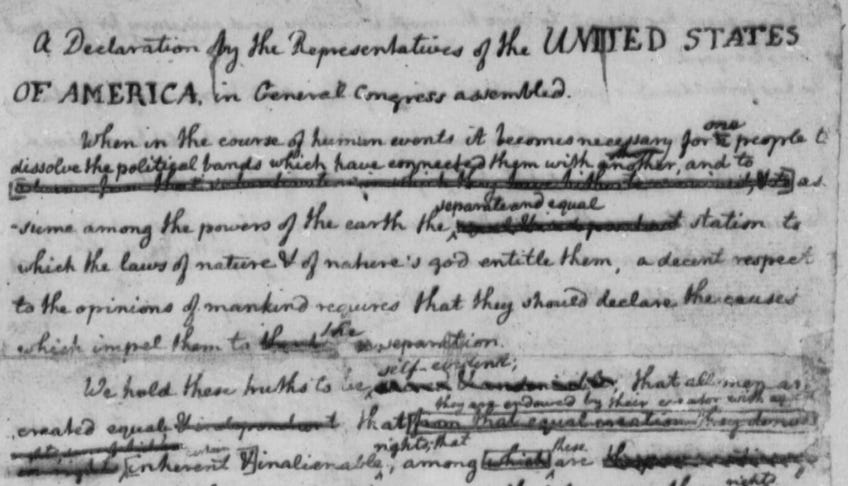
And now on the 250th anniversary —at twelve score and ten— we should aspire to that same kind of determination. There is always “unfinished work.” People always make mistakes. Democracy is never perfect. Jefferson’s first draft of the Preamble called “these truths” “sacred and undeniable.” Apparently it was Benjamin Franklin who convinced him to tighten that phrasing into “self-evident.” And now we celebrate it as if there was never any doubt. But there was always doubt and struggle, just as there is today. What I remind my students is that we live in a country founded on principles that are embodied in documents. That means that Readers are just as important as Authors or Framers. They wrote, but we interpret. We will argue over those interpretations for sure, but debate and disagreement are the essence of our democracy and have been —and will be— the strength of our enduring republic.
NOTE TO READERS: Past performance by Abraham Lincoln (or any historical figure) is not indicative of future results. But it’s worth thinking about and arguing over. This article is part of the series Lincoln’s Speeches and about topics pulled From the Headlines.
No posts
Comments
Nothing yet. Say the first thing.
Sign in to join the conversation.