
By The SynchroMystic
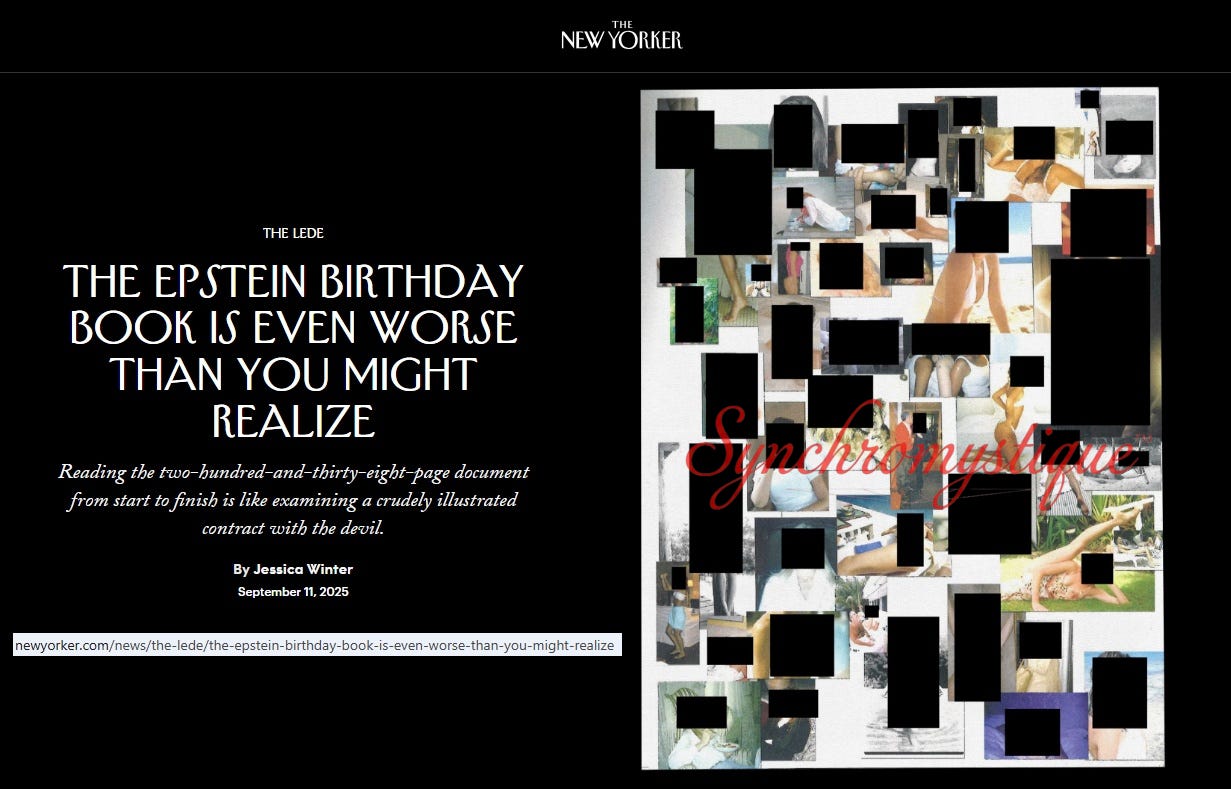
“Reading the two-hundred-and-thirty-eight-page document from start to finish is like examining a crudely illustrated contract with the devil.” — The New Yorker,1 on Jeffrey Epstein’s “Birthday Book”
N.B. We wish to make four (or so) quick preliminary points.
Firstly, we invoke Eyes Wide Shut as an exploration of synchronicity, in the tradition of Swiss depth psychologist Carl Gustav Jung. Admittedly, we are taking creative and promotional liberties with phrases like the titular “Stanley Kubrick was Right” and subtitular “…‘Eyes Wide Shut’-Style Secret Society.” If pressed, we’d say that these synchronicities — as all Jungian syncs are — are acausal and freestanding.
That being the case, secondly, we are not saying that Kubrick “knew about,” “encoded,” or was “trying to expose” the historical Jeffrey Epstein. We’re more inclined to suppose, in the manner of Synchromystique™, that Kubrick’s film and the Epstein Files may both be components or manifestations of the same psycho-symbolic “energy field” (metaphorically speaking).
Thirdly, and relatedly, what Stanley Kubrick did or not not self-consciously intend to dramatize in his movie is another matter. Our piece should not be read or treated as a straightforward film analysis, per se. Rather, call it a SynchroMystical “meditation” on the overall cultural milieu or Zeitgeist (“World-Spirit”2), of which both the Jeffrey-Epstein case and Eyes Wide Shut are a part.
And, of course, it’s important to note that, fourthly, as of this writing (June, 2026), the Epstein story continues to develop. Therefore, if future disclosures militate against or undermine any of the factual claims that occasion or undergird our reflexions, we can only promise to revisit the discussion and revise our views (if the need arises).
Let us begin with the artifact itself.
Jeffrey Epstein’s fiftieth birthday “gift” — assembled in 2003 by his longtime accomplice, co-conspirator, girlfriend, and convicted sex-trafficker Ghislaine Maxwell — is a 238-page, leather-bound, three-volume scrapbook. (For Ghislaine’s father, “Robert Maxwell,” born Ján Ludvík Hyman Binyamin Hoch, and his own alleged ties both to Rothschild, Inc. and to the mystical-Jewish sex cult known as “Sabbatean Frankism,” see our previous Substack article HERE. On Frankism, generally, we ranked it in our age-gated YouTube presentation “10 ‘Sex-Magic’ Cults.”)
Ghislaine’s Birthday Book for Epstein surfaced formally in July 2025 through a Wall Street Journal exposé and court disclosures tied to civil suits involving Jeffrey’s estate. On September 8, 2025, the House Oversight Committee subpoenaed and released a (redacted) PDF version that was said to have been confiscated from that same estate.
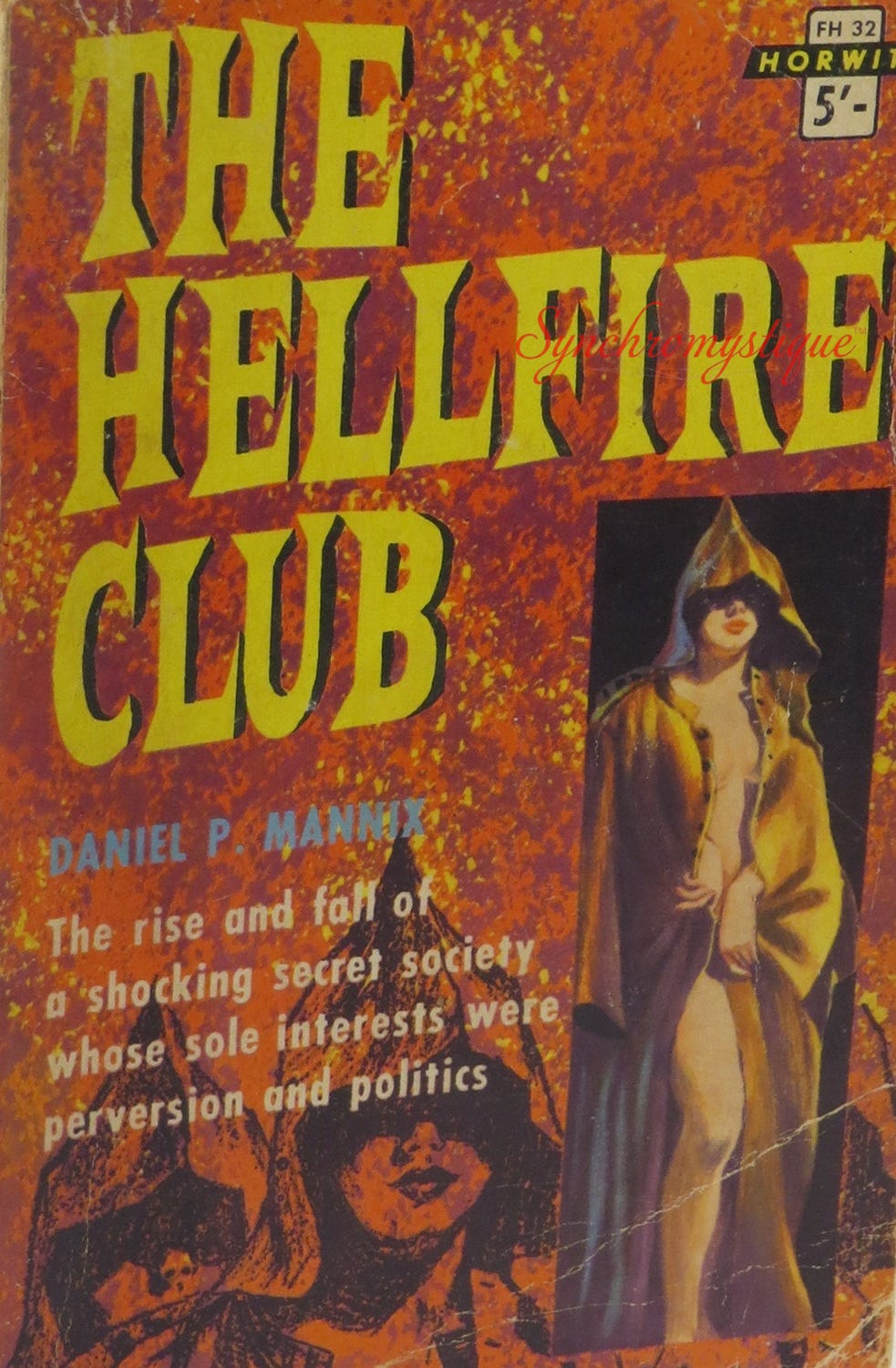
What the committee made public reads less like any birthday card in our experience, and more like the minutes of a contemporary revival of Sir Francis Dashwood’s 18th-century “Hellfire Club” — the membership requirements of which one can only guess at.
That earlier club — which was “officially” named the “Order of the Friars of St. Francis,” or the Monks of Medmenham Abbey — was active from around 1749-1766. It was populated by Dashwood’s libertine friends, including some politicians such as American Benjamin Franklin, John Montagu (the 4th Earl of Sandwich), and John Wilkes — the latter being “a distant relative” of President Abraham Lincoln’s assassin, the American actor John Wilkes Booth.
Although Dashwood initially operated out of the George and Vulture Inn and tavern in London, he eventually decamped to a ruined Cistercian monastery along the River Thames. The secretive group met for unknown, but reputedly drunken and/or orgiastic purposes inside chalk caverns located in West Wycombe (in Buckinghamshire, England), which became known as the “Hellfire Caves.”
Dashwood’s Hellfire Club adopted the motto Fais ce que tu voudras (“Do what thou wilt”) — which went back to the bawdy 16th-century Renaissance writer and supposed monk François Rabelais, and was later picked up by 20th-century British occultist Edward Alexander “Aleister” Crowley.

Incidentally, the Hellfire Club was not the only English association with a fondness for French sayings. The “Most Noble Order of the Garter,” founded in the 14th century, uses the slogan Honi soit qui mal y pense, “Evil to Him Who Evil Thinks.”
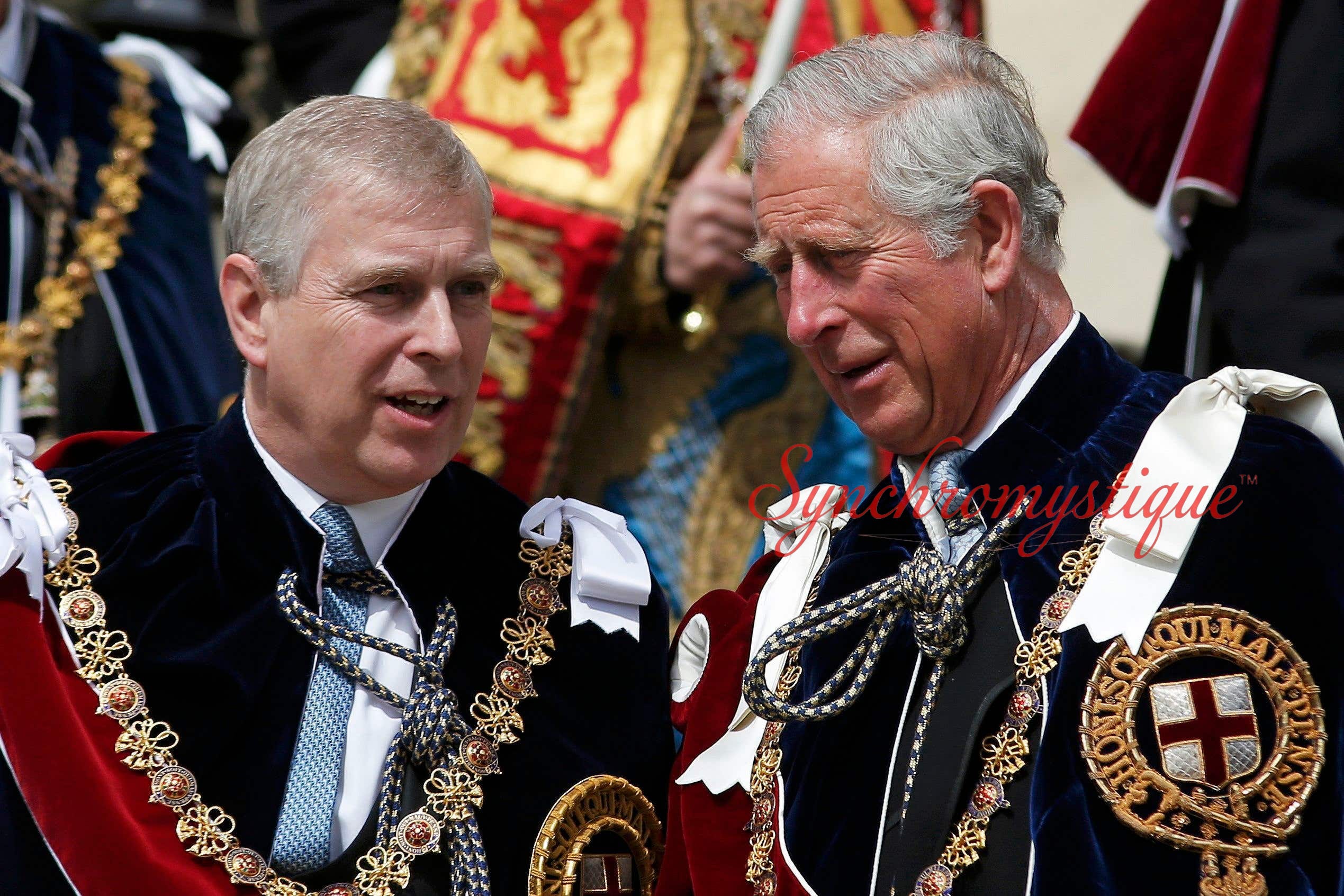
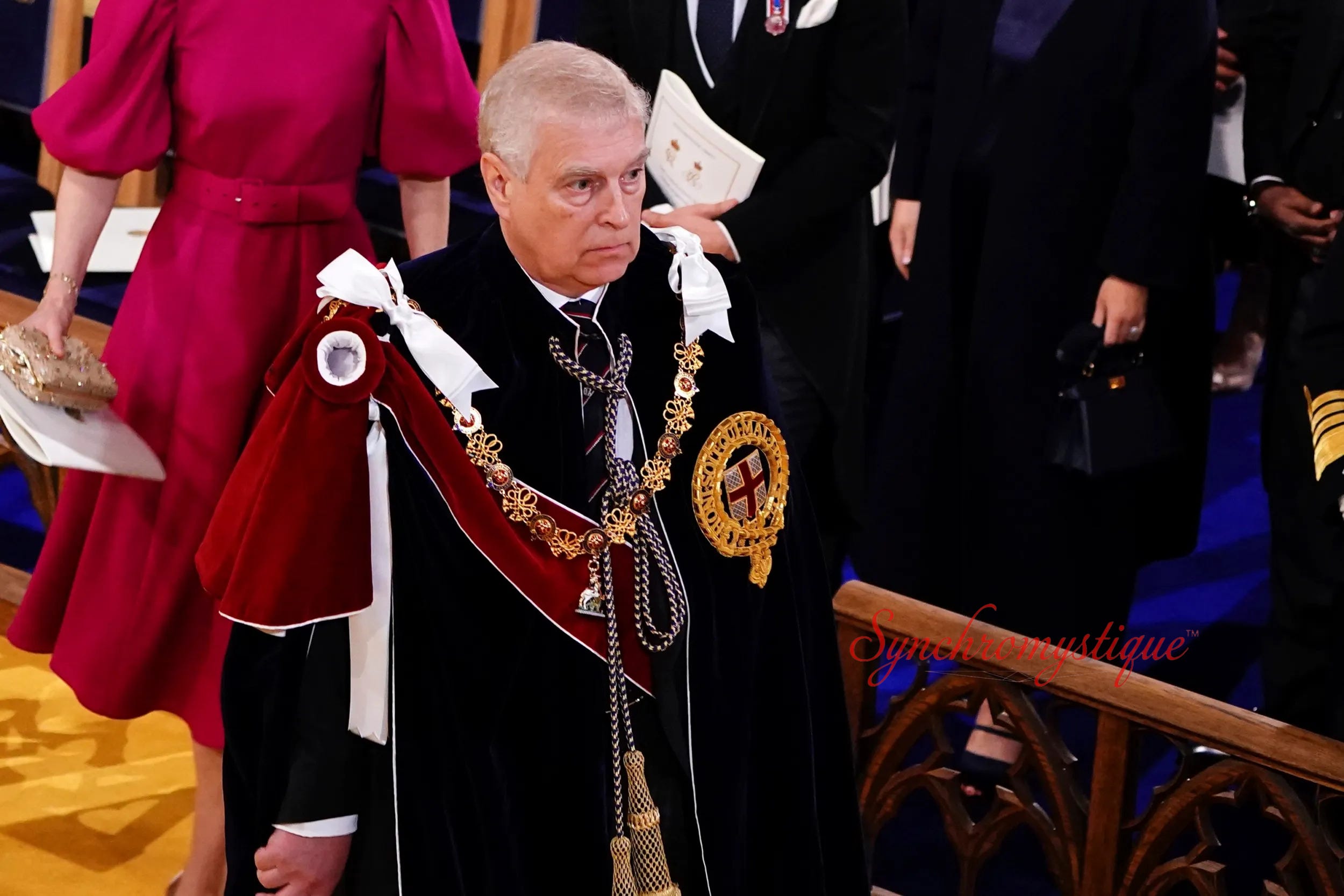
The Order of the Garter boasts numerous members of the British royal family on its roster — including Andrew Mountbatten-Windsor (formerly Prince Andrew, Duke of York) who was, however, (allegedly) removed from its rolls in 2025 due to the bad publicity of his associations with Jeffrey Epstein.

We surveyed a lot of this in “10 ‘Sex-Magic’ Cults” (video; article; mirror).
(See End Notes for citations and expansions of this section.)
In any case, Ghislaine’s scrapbook contained crude drawings, personal letters, revealing photographs, and innumerable sexual innuendos — some of them, according to reporting on the unredacted portions, amount to what a charitable reader might call “rape fantasies.” (Of course, an uncharitable reader might be tempted to describe the texts as a deranged species of bragging confession.)
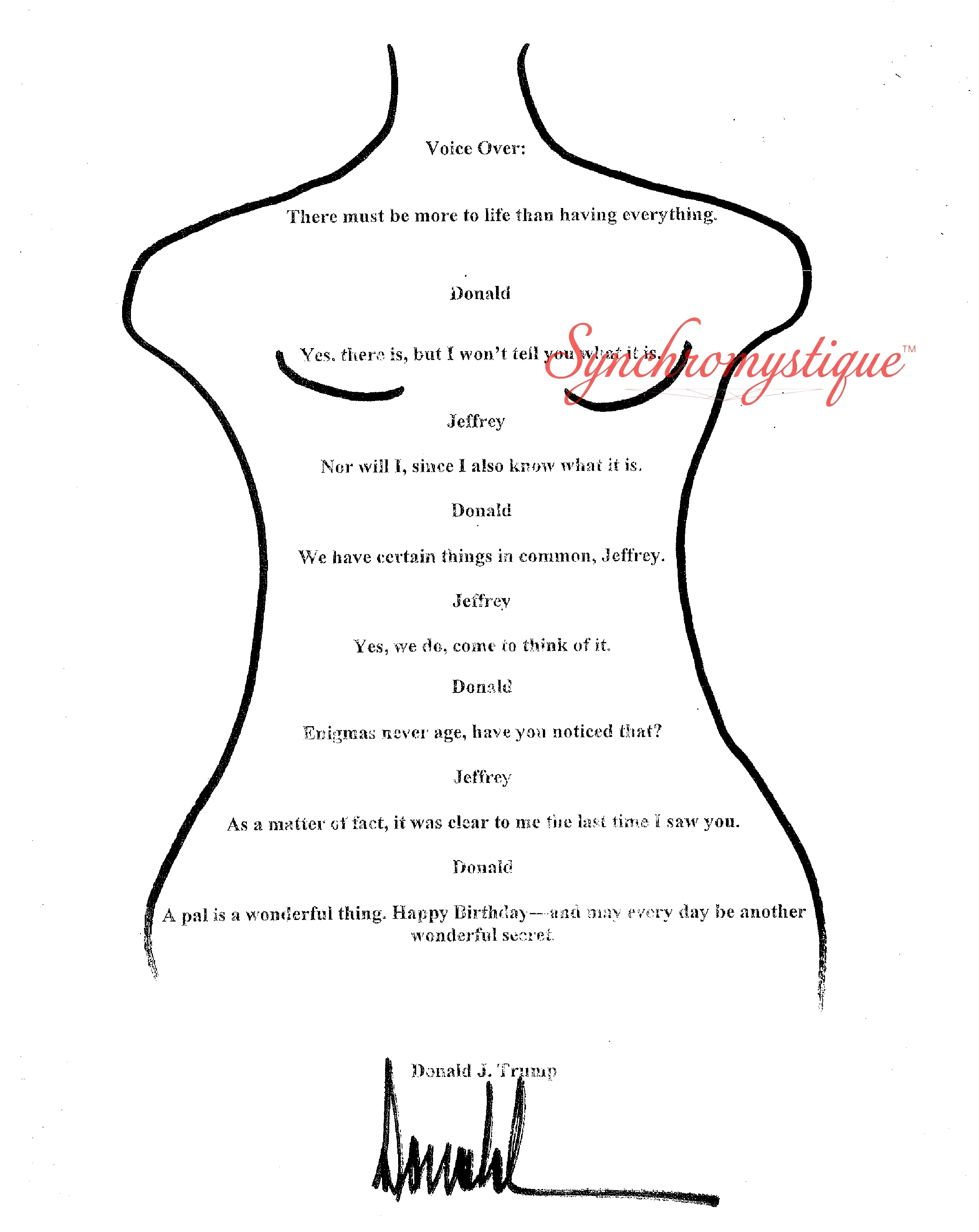
Among those who are alleged to have contributed — with a bit of doggerel within a hand-drawn outline (apparently depicting a naked young woman), signed “Donald” — was one Donald John Trump, currently serving as the forty-seventh President of the United States.
We hasten to add that Trump has denied authorship of the thing. The White House has followed suit by declaring the signature a “forgery.” Trump has gone so far as to file a $10-billion lawsuit against the Wall Street Journal for implicating him.
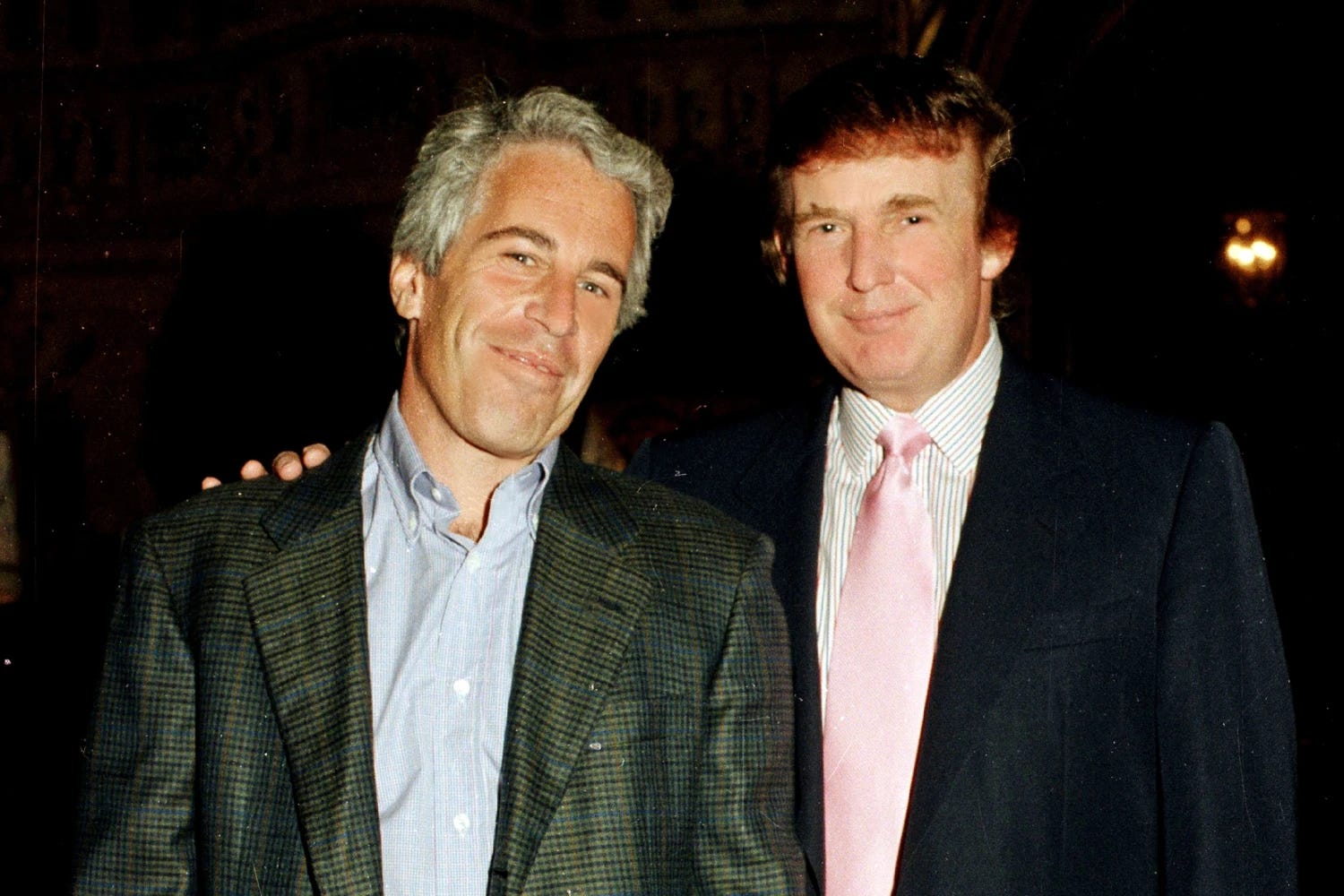
All the same, the signed note alleges, in an imagined Trump-to-Epstein dialogue: “Happy Birthday — and may every day be another wonderful secret.”3
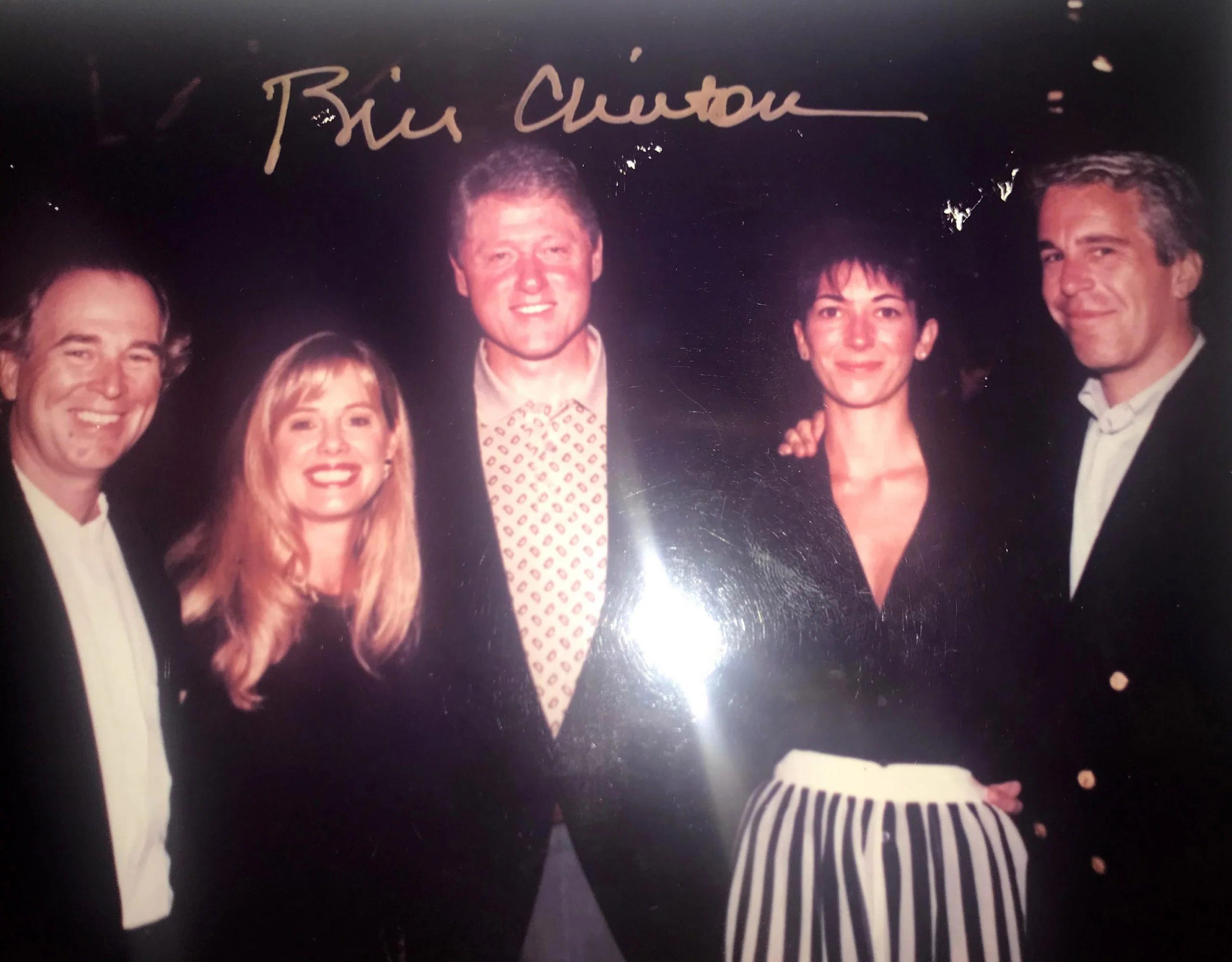
Not to be outdone, William Jefferson Clinton — the forty-second POTUS — apparently weighed in on Epstein’s “childlike curiosity.”4
Lord Peter Benjamin Mandelson, the British parliamentarian and current U.K. Ambassador to the United States, described Epstein as his “best pal” who had “parachuted” into his life — though a Mandelson spokesman told the BBC that the ambassador “very much regretted” the introduction.5
According to the documentary record, other supposed contributors include former Apollo Global Management CEO and private-equity bankster Leon David Black,6 attorney Alan Morton Dershowitz,7 Victoria’s Secret owner Leslie Herbert Wexner (also alleged to have been Epstein’s most important financial “client” and patron),8 fashionista Vera Wang,9 and a cast of supporting grotesques too numerous to list exhaustively here.
One redacted entry described an unnamed woman as having been “depreciated” and subsequently “sold” to Donald Trump — accompanied, in the scrapbook, by an oversized, signed check. Related illustrations depicted Epstein handing balloons and lollipops to young girls. Another contribution apparently involved explicit rape imagery while the contributor wore a mask.10
The YouTube-based news-commentary show Breaking Points hosts, Krystal Ball and Saagar Enjeti — hardly the most conspiracy-minded correspondents in the journalistic ecosystem — described this material in November 2025 as follows.
“It’s shocking to see [attributed contributions from] some of the world’s richest, most powerful men, including our current president, past president… [T]he drawings, the cartoons — [many of these pieces seem] intentionally childlike. That probably freaked me out more than anything… [T]hey were literally making rape jokes in there. Rape fantasies about wearing masks while they’re holding guns and knives, about going out and just finding someone to violently rape them. Like, this is the stuff they joked about. So, like, if you’re joking about that, [then] what’s actually happening?”11
Indeed. What was actually happening?
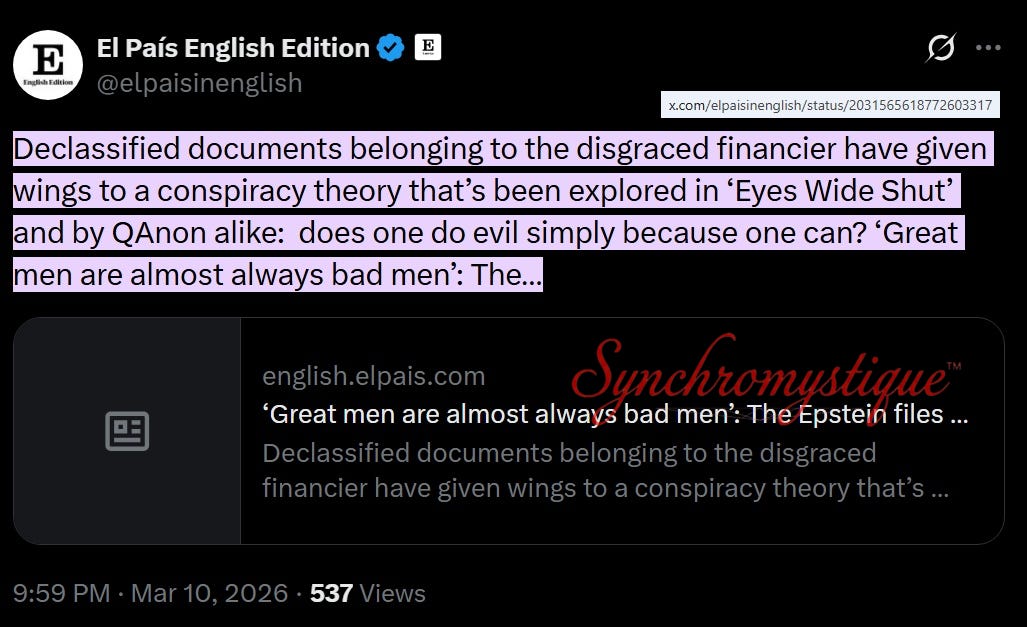
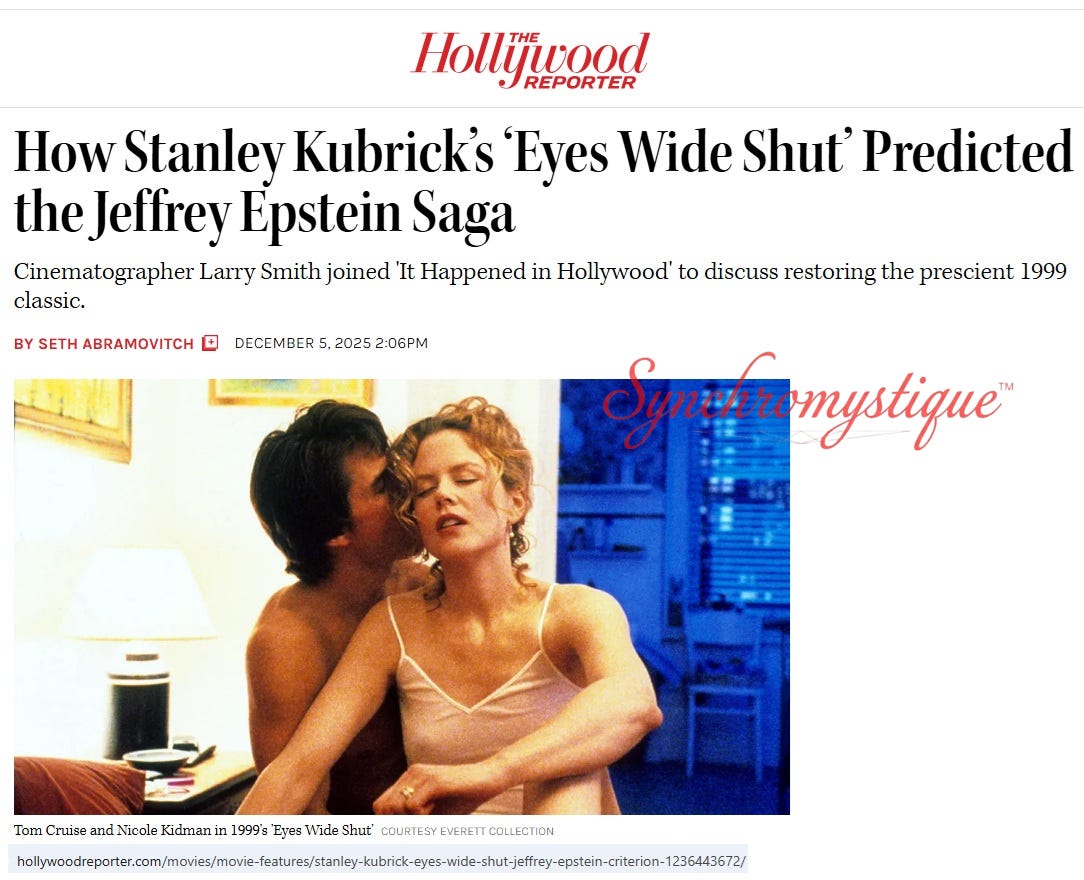
Here is what The New Yorker and El País both noticed — and what anyone who has watched Stanley Kubrick’s final film will almost certainly notice too.
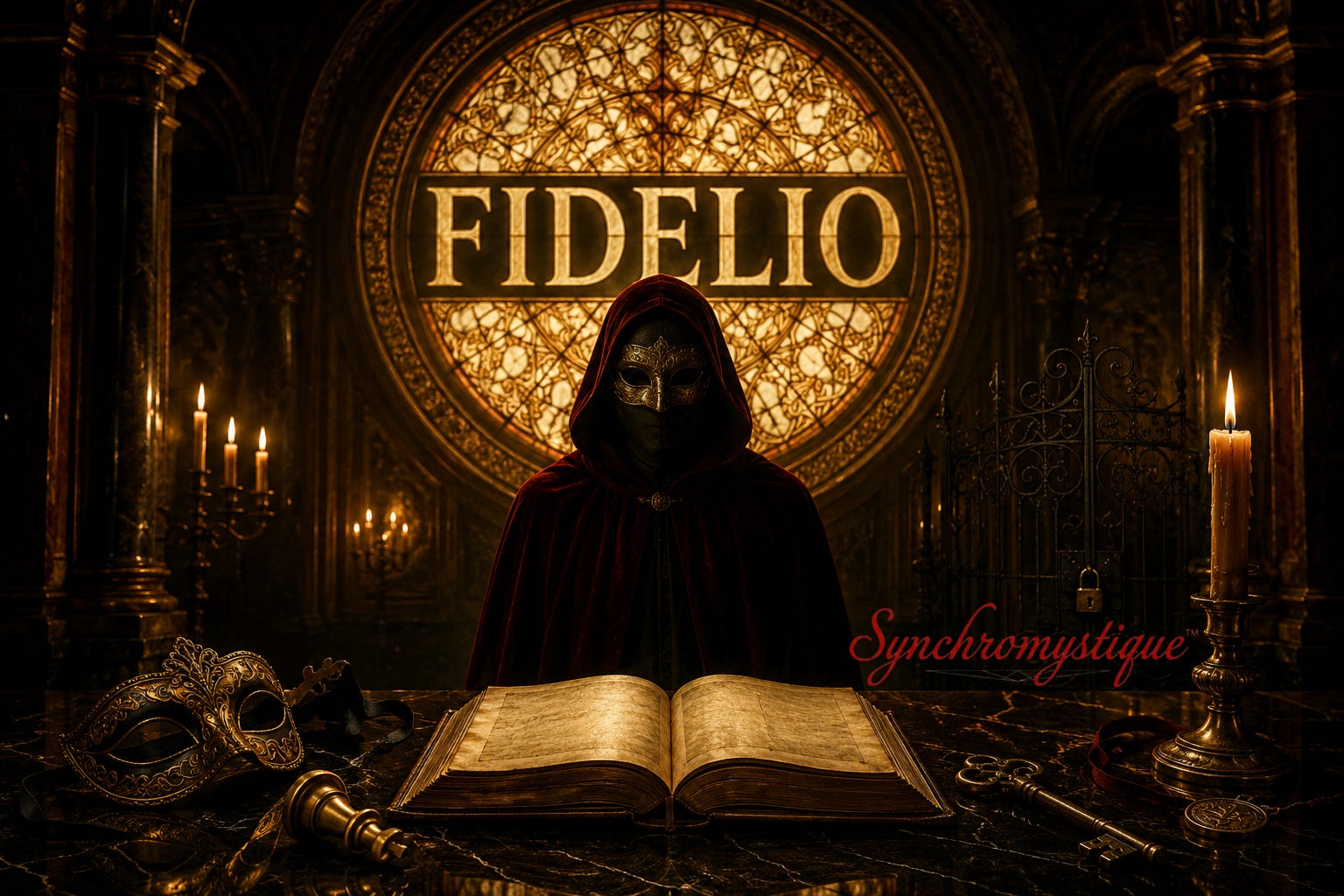
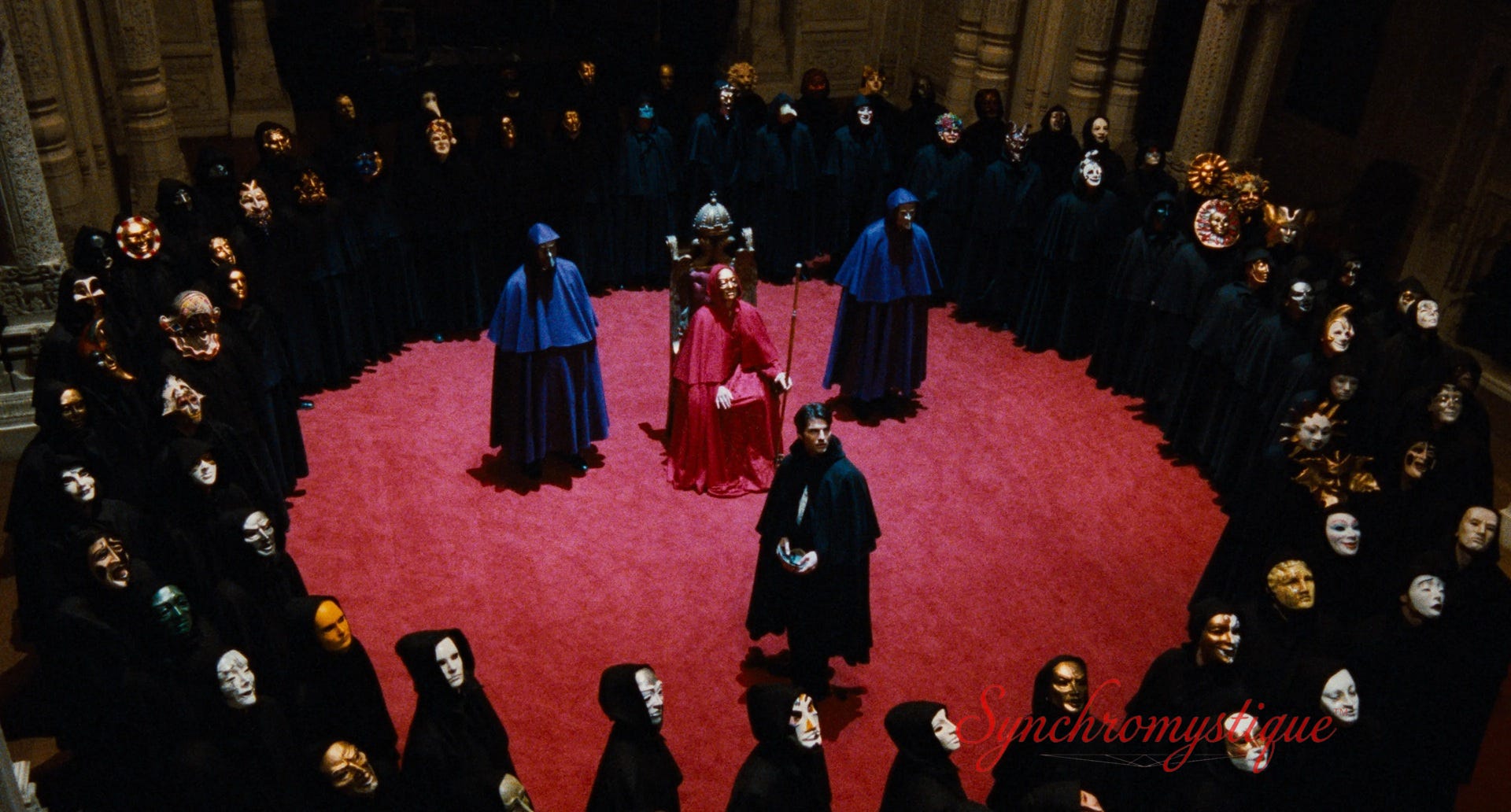
Eyes Wide Shut (1999) is a story about a married Manhattan physician, Dr. Bill Harford (portrayed by Hollywood actor and Scientologist Tom Cruise), who — following an unsettling marital confrontation — finds himself drawn into a world of concealed élite depravity. Via a password (“Fidelio”) and a taxi ride, Harford blunders into a masked-and-cloaked orgy ritual, staged in a palatial Long Island estate, presided over by robed figures and featuring what appear to be sexually disposable young women.
The password deserves a moment’s attention — not just as a plot device but as (what you might call) a kairoeme or synceme (basic instances or units of synchronicity) in Kubrick’s lifelong symbolic vocabulary.

Fidelio is the sole opera of celebrated 18th-19th-century German-Romantic composer Ludwig van Beethoven. Its plot concerns a noblewoman named Leonore who disguises herself as a prison guard — she adopts the name Fidelio, meaning “faithful” — and infiltrates a political dungeon in order to rescue her unjustly imprisoned husband from execution at the hands of a corrupt tyrant. The opera’s subtitle is Der Triumph der ehelichen Liebe: “The Triumph of Marital Love.”
Kubrick seems to have self-consciously chosen it as the password to an orgy of marital betrayal and institutionalized predation. Put this way, the irony appears to have been so precisely calibrated that it could hardly have been accidental.
None of this will come as a shock to seasoned Kubrick aficionados. But, in our opinion, the sync runs deeper than thematic inversion.
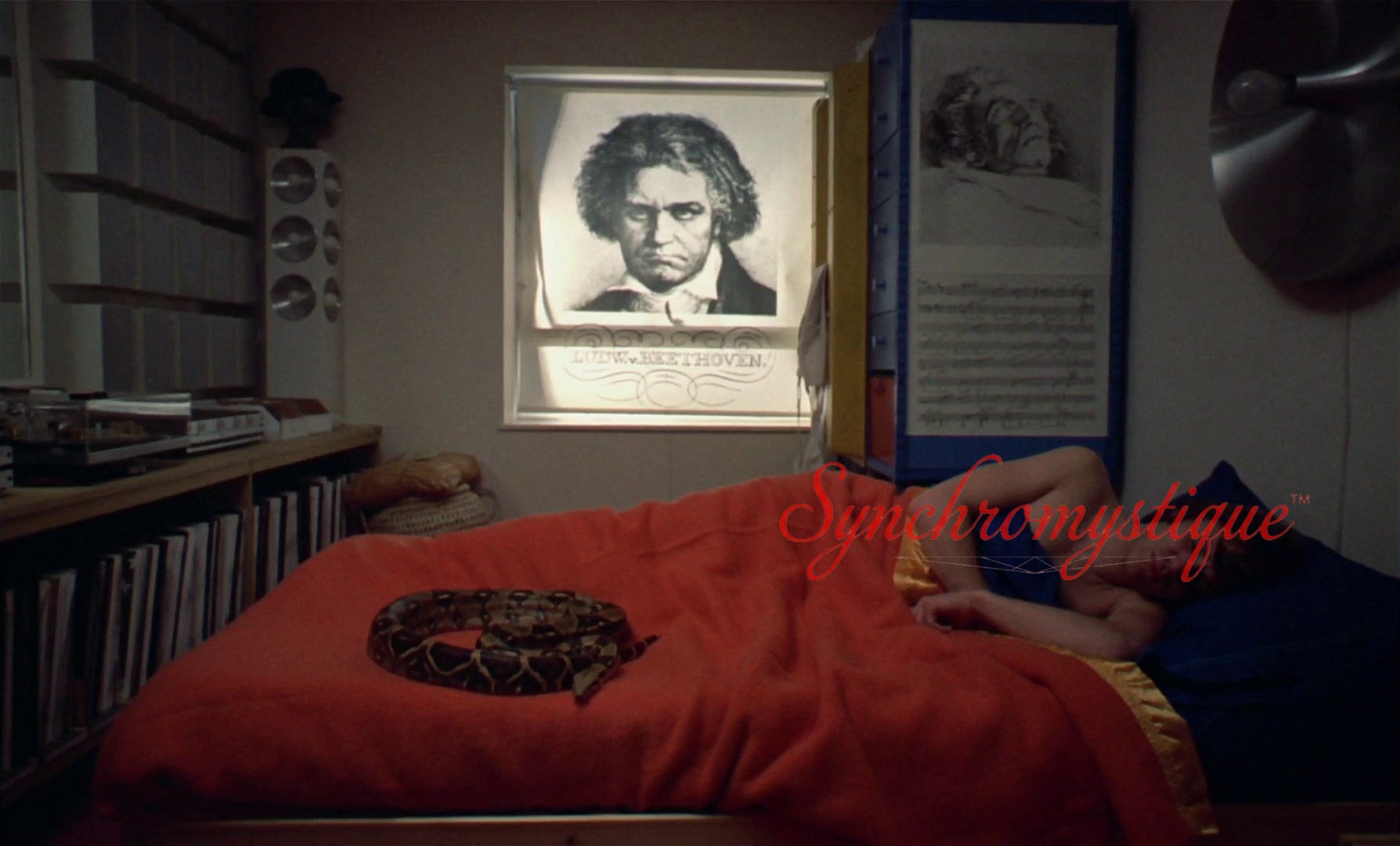
Recall that Kubrick had already made Beethoven’s music an — if not the — organizing principle of violence and power in his earlier work A Clockwork Orange (1971). Alex DeLarge, his rapist-protagonist, is an obsessive devotee of “Ludwig Van.” It is the Ninth Symphony — the choral finale of which sets German poet-playwright Friedrich Schiller’s Ode to Joy, that quintessentially Enlightenment text — that Alex plays at maximum volume while fantasizing about Roman legions and the Crucifixion of Jesus of Nazareth.
Beethoven’s music, in A Clockwork Orange, is simultaneously the highest expression of European civilization as well as the literal soundtrack of its brutalization. The movie’s “Ludovico Treatment” — the state’s attempt to “condition” Alex out of his violence — inadvertently makes him nauseated by Beethoven, the only thing he loves. The Establishment’s cure is, at the same time, an attack on beauty.
Twenty-eight years later, the director of A Clockwork Orange assigned “Fidelio” — the one opera by that same composer — as the password to the inner sanctum of a ruling-class sex cult. The word that once opened dungeons, in Beethoven’s moral universe, now closes them. The Jungian analyst would say that the symbol has undergone an enantiodromia (“running opposite”) — that characteristically Jungian reversal in which a thing becomes its contrary (or contradictory) when pushed to an extreme.
The “faithful” wife who descended into the dungeon to rescue her husband in Beethoven’s opera becomes the password stolen by the faithless husband, and invoked to gain entry into a world of predatory sex cultists (who also happen to be the hidden authorities).
Kubrick repurposed a sign and exclamation of liberty as a seal and cry of captivity. There’s still a dungeon; the keyholders have evidently changed.
(See End Notes for citations and expansions of this section.)
In Eyes Wide Shut, Cruise’s Dr. Harford is eventually unmasked, threatened, and — in a surface reading of the film’s plot, in any case — is potentially marked for death, presumably for having seen too much.
Kubrick never names the ostensibly all-powerful organization. Cinematically and symbolically, the story works better that way — and leaves open interpretations such as that the entire mansion orgy was all in Harford’s head.
Kubrick died suddenly in March 1999, just days after delivering his final cut of the film to Warner Bros. The official cause was a heart attack.12 Friends described his death as shocking but natural. He was, after all, seventy years old, overweight, a smoker, and a workaholic. (Though, some conjecturers still seem willing to count him as having been in “perfect health.”13)
For those who wish to go further down that particular rabbit hole, the most rigorous publicly available treatment of the Kubrick-was-killed question is Rob Ager’s January 2025 PDF essay “Was Stanley Kubrick Killed?”, supplemented by a companion YouTube trilogy running into 2026.
Ager — whose corpus on Kubrick is among the most serious available — applies the same evidentiary discipline to the assassination theory that he brings to his film analysis. His conclusion, arrived at after marshaling both the supporting and counter-arguments with characteristic independence of mind and scrupulousness, is that the assassination theory collapses under scrutiny. In his view, too many people would have needed silencing; the studio had no structural motive to kill a director whose film they could simply have shelved; and the famous “one-week gap” between the reported executive screening and Kubrick’s death is almost certainly a post-mortem marketing construction — the studio needed the film to be received as Kubrick’s final and complete vision, not an orphaned rough cut.
More intriguing — and more consistent with what we know of Kubrick’s chess-player personality — is the following. Ager’s writes: “…I suspect that Stanley Kubrick himself may have personally planned for his final movie to parallel his own death” — the suggestion being that the wily director himself may have engineered the conditions for the assassination myth, possibly seeded his final film with structural parallels to his own impending death, and then trusted that posterity (and sensational reportage) would do the rest.
If so, it is perhaps the most elaborate act of half-autobiographical, half-posthumous self-mythologizing in the history of cinema!
What is more certain is that the on-screen conspiracy Kubrick did dramatize — backed by research into real-world Tantric sex cults operating in New York (confirmed, according to Ager, by materials in the Kubrick Archives) was not one that required his death. It may only require attentive audiences.
(See End Notes for citations and expansions of this section.)
Almost immediately afterward, Paranoia magazine — and later, more mainstream commentators — raised the possibility that the film had been re-edited after Kubrick’s death to remove more revealing material.14 We have no way to confirm or deny that. (And Ager points out that Kubrick kept his own archival copies of his films.) What we will say is this: the version that was released is already remarkable enough.
And even more remarkable than what Kubrick depicted then is how it resonates so much with what we know now.
Kubrick’s hidden élite share the same “address” as Epstein’s network. Not necesary in a physical, U.S.-Postal-Service sense, of course — but structurally.
Like the Epstein network, Kubrick’s orgy participants are obviously wealthy. Their financial resources grant them power and make them virtually untouchable. In both cases, many of the victims are women (with one or two men) who exist at the margins of respectability — presumably, aspiring models, escorts, etc. They could have been girls recruited by girls who were themselves recruited. And so on.

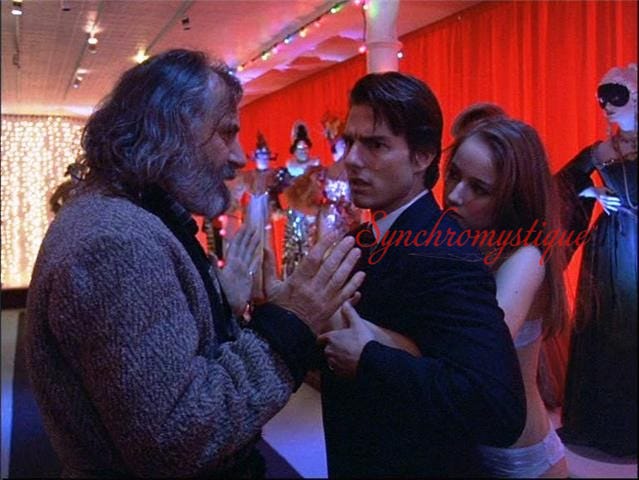
The club’s power is partly sexual, but more fundamentally it is the power of omertà15 — the closed-mouth solidarity of those who have “seen too much” together to risk exposure. The film suggests, with unsettling bluntness, that this power is ultimately backed — not only by threats of intimidation — but also by lethal action.
Now, Stanley Kubrick was without a doubt a bona fide auteur and a creative genius. He could — and did — regularly weave together multiple symbolic layers in his films. This makes it tricky business to interpret just what Kubrick “was up to.”
That said — and notwithstanding our prefatory caveats (which we direct you back to) — none of this is obviously comes across in Eyes Wide Shut as fantasy, fiction, or what have you. It is rendered as plausible realism — the kind that uses authentic Manhattan locations, real Arthur Schnitzler source material (Traumnovelle, 1926), and meticulous attention to class detail.
Kubrick, famously, was not a man who put things into films carelessly.
True: the Schnitzler title translates to “Dream Story.” And, also true: dreams and fantasies explicitly recur in vignettes within the movie.
But — taken at face value — these latter episodes are set apart from the ostensibly real-world narrative, by slow motion, blurred lighting, and so forth. And, in what other case did Kubrick’s source material dictate his own filmmaking approach? The novels (such as Anthony Burgess’s 1962 A Clockwork Orange and Stephen King’s 1977 The Shining) were merely convenient vehicles for Kubrick to deliver his own vision — and they often dramatically departed from their original authors’ intentions (sometimes, to the latters’ chagrin).
Once again, it would be by turns unjustifiable, presumptuous, and reductive of anyone to claim that he or she “knows” Kubrick “intended” the film as an exposé of Jeffrey Epstein specifically.
This is by no means what we have in mind.
For one thing, Epstein was barely a blip in public consciousness in 1999.
More useful — and, I think, more accurate — is to say that Kubrick was working from a conceptual model. And that general model, as the last several years have made clear, was (obviously and tragically) not a fantasy.
At the same time, one needn’t suppose that Kubrick had in mind a literal sexually obsessed organization keeping membership rolls and exercising near unlimited power.
Rather, than “unmasking” a real-world cabal directing global affairs from behind velvet curtains, Kubrick may have been exploring something subtler, older, more psychological — and, arguably, even more disturbing.
He seems to have been wondering whether concentrated power itself behaves like a secret society. As Anglican theologian John Milbank has argued, modern “secular” orders do not so much escape theology as reinvent it under another name. Power, once severed from participation in the divine Good, becomes self-authorizing or self-justifying, and generates its own forms of mediation, cultivates its own loyalties, and — yes — manufactures its own rituals.
What emerges doesn’t have to take the shape of a formally organized (if hidden) Junta. Nonetheless, it possesses a pseudo-ecclesial structure (and Red Cloak is arguably a kind of inverted pope) — one bound together less by doctrine than by shared practices of sexual excess, privilege, secrecy, and mutual criminal implication.
It could well be that the accumulation of sufficiently outsized wealth — and the compromises seemingly required to get that sort of thing — results both in insulation from legal consequences as well as the (practically obligatory) mutual concealment of shared secrets.
In that enviromment, institutions may look and feel “occultic” (which means “hidden” or “secret,” after all) — whether or not anyone ever intended them to be suffused with esotericism.

That said… in Epstein’s case, one has to wonder just what he did with and what went on inside the peculiar structure — referred to in press reports as a “Temple” — apparently on Little St. James Island.
Regardless, Eyes Wide Shut and the Epstein affair don’t need to be historically identical, or causally interrelated, in order to be “spiritually adjacent.”
They may be parallel expressions or “manifestations” of the same social archetype: power concealing itself through ritual, secrecy, erotic transgression, and mutual silence.
Or, as we said in our prefatory caveats: The synchronicities stand on their own.
Carl Jung famously — if vexatiously — described synchronicity as an “acausal connecting principle,” by which, as a first pass, we might suppose that he meant meaningful correspondences (between inner, psychological states, and “outer,” external-world events) cannot be reduced to straightforward cause-effect chains.
We would add a sociological corollary: institutions, too, may possess unconscious dimensions.
Science-fiction master Philip K. Dick asked: Do Androids Dream of Electric Sheep? (New York: Doubleday, 1968).
Is it out the realm of conceivability to similarly ask: Can aristocracies dream? Do corporations have nightmares about bankruptcies? (“Our” U.S. legal system treats them as “persons,” after all!) Are empires capable of visualizing — or manifesting — architectural styles, costumes, myths, rituals, taboos, etc.?
If so, perhaps the stirrings of those dreams can surface in art — such as cinema — decades before they materialize on private Caribbean islands or in palatial Manhattan residences, or surface in court records or newspaper reports.
18th-19th-century German Idealist philosopher Georg Wilhelm Friedrich Hegel said the Zeitgeist ensures that certain ideas are expressed at the right historical moment — kairos time (as opposed to mere temporal sequence, or chronological time16).17
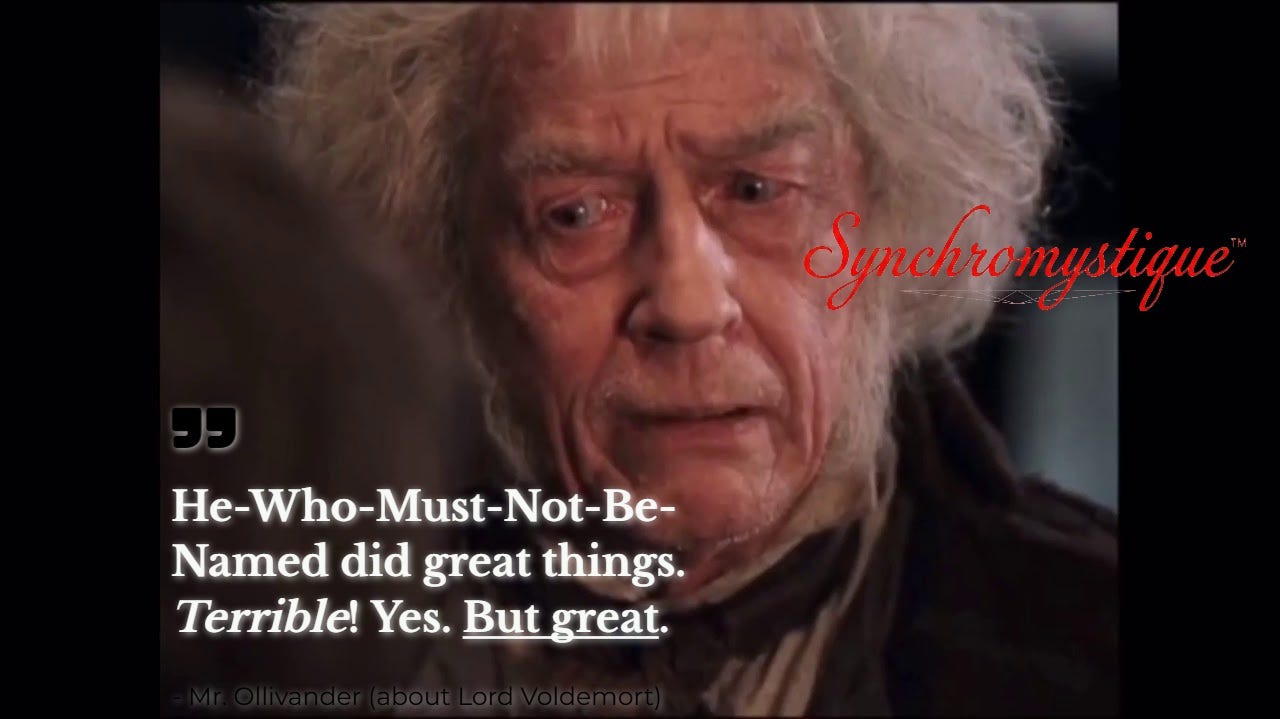
Once again, we’re not saying that any of these musings “prove” that Stanley Kubrick consciously knew (about) Jeffrey Epstein. Perhaps it only shows that both men were world-historic (each in his own sphere), in the Hegelian and “Ollivanderian” senses.
As Ball and Enjeti put it: the Epstein Files “…[paint] a picture which is — I mean, it’s Eyes Wide Shut. Literally. It is an actual representation.” One journalist cited on the Breaking Points segment recalled a moment of personal reckoning: she had spent years at Thanksgiving tables dismissing a relative who believed the world was run by “a global pedophile élite.”18 The Birthday Book’s release made that dismissal impossible to sustain. “Now,” Ball notes, “it’s painful for her to admit that they were [right].”19
In Eyes Wide Shut, Cruise’s Dr. Harford is told — after being unmasked — that he “has no idea” of the danger he is in. It seems a mistake to read this merely as a threat to his physical person, although that is certainly true at one level.
Rather, it’s a threat to Harford’s picture of the world: it shatters his worldview. Harford is basically told that the world that he believes is real — the world that he occupies on a day-to-day basis — is (in a sense) not the real world.
There is another world — overarching or underpinning, depending on the metaphor you think most apt — running concurrently and normally invisible to people like him. In this usually hidden realm, different rules apply. In Dr. Harford’s case, there may be a bit of social overlap with respect to some of the people involved.
In the everyday, ordinary world, they are people Dr. Bill might see at his daughter’s school, at a medical conference, or at one of Zeigler’s parties. But, in this secret world of masks and concealment — after hours — they become something else entirely.
Rob Ager, the Liverpool-based film analyst whose work on Eyes Wide Shut (and many other Kubrick films) represents some of the most insightful and rigorous available, has argued that the film is fundamentally a study of how power reproduces itself through sex, ritual, and hierarchy — not necessarily a thriller about a literal secret society with a name and a charter, but a dissection of the psychological and social mechanisms that allow such systems to function.
The film’s élite doesn’t just “commit crimes.” It commits them in masked ceremonies and with pomp — all of which has the effect of transforming legal and moral transgressions into ritual. Like mobsters “making their bones,” committing crime becomes an initiation, gaining the perpetrator entry into the secret society by tying him or her to shared history that is too dangerous to admit publicly, to disown, or to reveal.20
As a first pass, anyway, we defer to Ager regarding the narrow question of reading Kubrick’s cinematic intentions. Ager’s analysis strikes us as largely correct — and as precisely what the Birthday Book illustrates. What is that scrapbook, if not a sort of ritualization of Epstein’s network and personal history? Epstein’s most powerful associates are not merely depicted as his friends. They are depicted as his — we hesitate to use the word “co-conspirators,” so, then… call them — co-signatories.
Every lewd drawing, every rape fantasy jotted in the margins, every winking innuendo about “wonderful secrets” is a species of dark transaction. The sub rosa message is: “I know what you know. You know what I know. Neither of us can afford to talk openly.”
Noam Chomsky has famously distinguished between “conspiracy theorizing” and institutional analysis by arguing that, while the former relies on secretive, mal-intentioned plots, the latter examines how structural incentives (such as market forces, power dynamics, or old-fashioned human psychology) guide organizations — and the people in them — to behave in entirely predictable ways.
Similarly, it seems to us that what are we bumping up against, both in Eyes Wide Shut and with Epstein and his Birthday Book, should not be slighted as “conspiracy theory.” The beginning point for this reasoning need be nothing more sophisticated than Lord Acton’s aphorism: “Power tends to corrupt, and absolute power corrupts absolutely.” Indeed, Acton went on to lament that: “Great men are almost always bad men.”
From that point, the institutional “logic” of the organization goes into autopilot.
In his important book Secret Societies and Psychological Warfare (1992, 1995, 2001) — and in other places — Michael Hoffman explains that a two-tiered legal code may be traced back to the ancient Babylonian king Hammurabi (18th c. B.C.). Since antiquity, there has commonly been one set of laws for the poor, and another set for the rich.
We want to suggest that this is fundamentally true, but more precisely rendered as a three-tiered hierarchy. In Hammurabi’s case, beside the land owners and mere poor commoners, there was a distinct, third set of laws that applied to slaves. Similarly, feudal Europe distinguished between clergy, aristocracy, and peasantry. This stratification of society may not be a relic of bygone days.
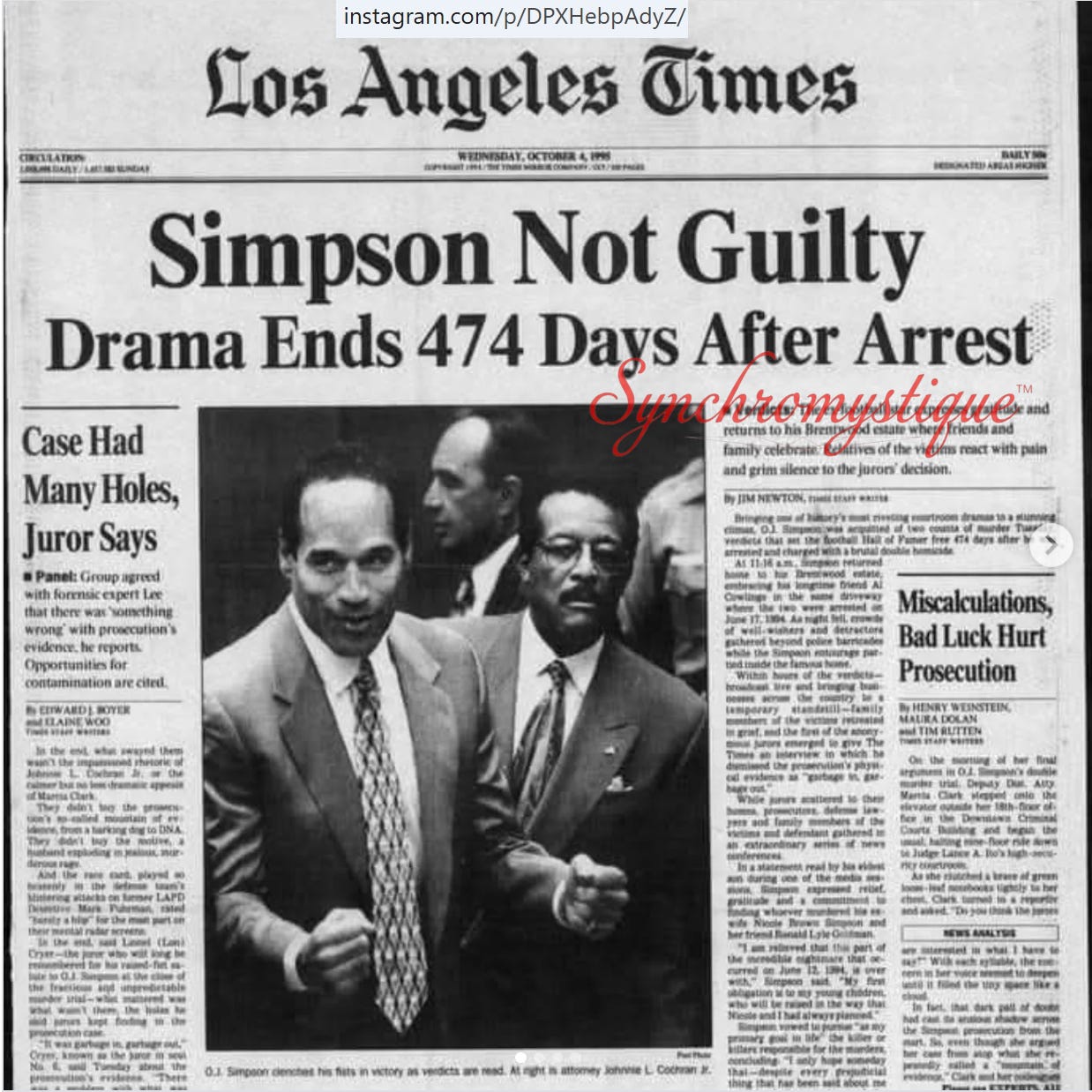
The O. J. Simpson trial has been analyzed as a case study in how élite wealth and status can bend legal reality in ways closed to ordinary citizens. Rightly or wrongly, the case endures as the ultimate cultural shorthand for the “two-tiered justice system” in Hoffman’s sense: the premier example of “rich man’s justice,” which showcased how unlimited resources could bankroll a legal “A-Team” and other lawyerly tricks (including extensive delays, expert witnesses, and endless strategic motions) that the average defendant could never afford.
David Talbot, in his book The Devil’s Chessboard: Allen Dulles, the CIA, and the Rise of America’s Secret Government, argues that the CIA has a three-tiered hierarchy. In his phraseology (and I am going by memory), it’s ivy-league types at the top (giving orders); street-smart FBI / military guys beneath them (doing the actual execution and planning of covert ops); and disposable hired guns at the bottom.
Or again, less controversially, modern corporations distinguish between shareholders, managers, and employee. (We’re ignoring — in the case of the CIA and of corporations — “everyone else” which is, let’s face it, a lot of us.)
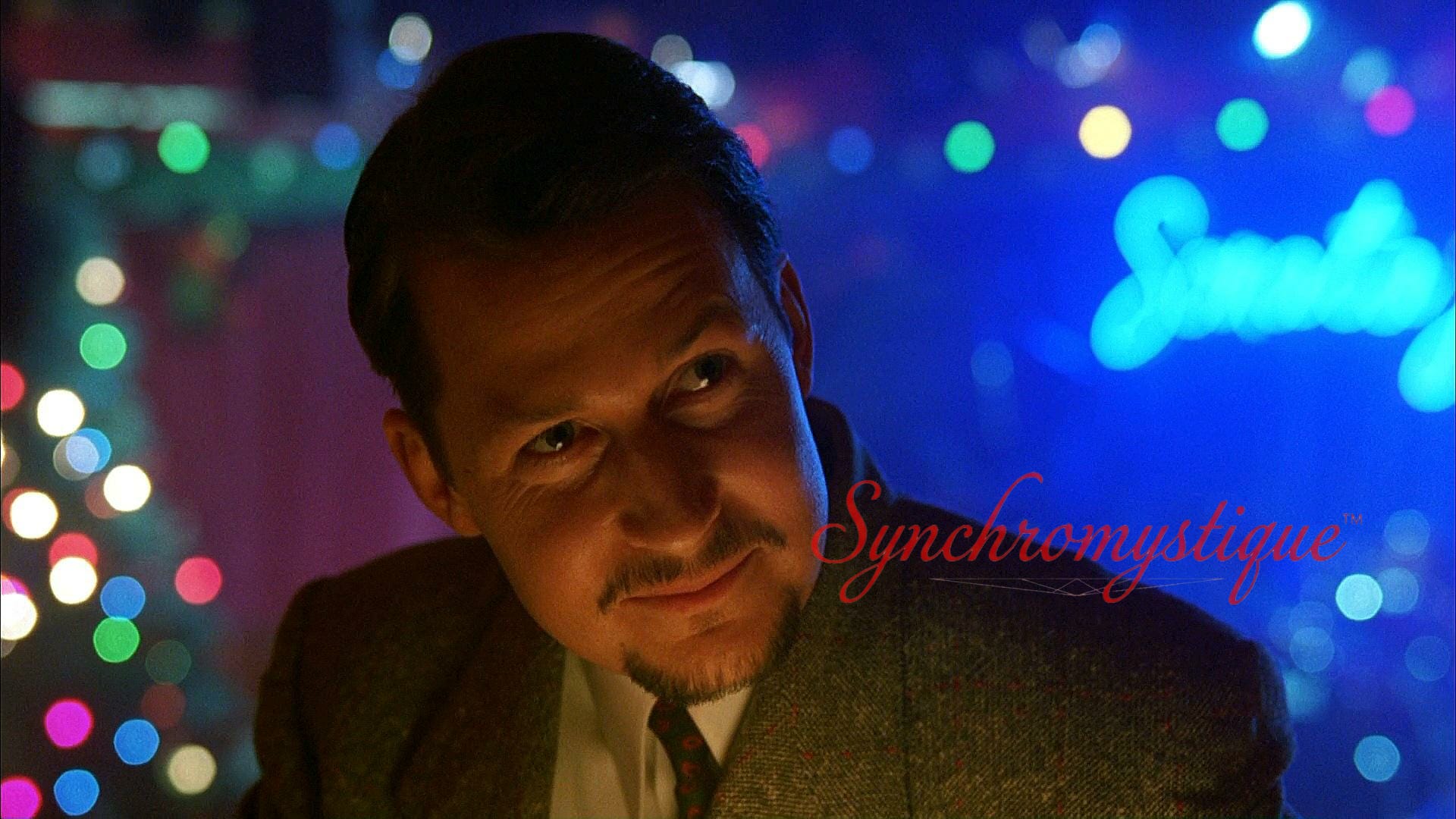
Eyes Wide Shut distinguishes, with almost schematic precision, between the masked principals, the intermediaries who facilitate their desires, and the disposable figures sacrificed to preserve the illusion. You have the élite party attendees (the top tier who were actual invitees); the evidently disposable hookers (say, on the bottom — no pun intended); with replaceable middle-managers — such as the butler, the gatekeepers, and even the entertainer, Nick Nightingale (another Nick-Name), spending their lives catering to élite whims filling out the middle.
One takeaway might be that the most — or the only “true” — protection is reserved for the upper echelon. When Nightingale is found out for his betrayal of the group’s protocols, he is presumably removed as pianist (in the best-case scenario, from Nick’s persepctive) or… “removed” permanently (worst case).
For the prostitutes — or interlopers, like Dr. Bill — one imagines, there is virtually zero protection. One false step, and… it’s curtains.
Which raises a question that, arguably, cuts to the heart of the Epstein affair: Where, exactly, in this three-tiered schema did Jeffrey Epstein himself reside?
It is at least worth entertaining the proposition — contrary to some press releases — that Jeffrey Epstein was not, in fact, sitting at the apex. The mere fact that Epstein’s fortune (and Manhattan address) were parasitic upon (or otherwise owed to) people like Wexner, suggests he was lower on the totem pole. And we shouldn’t underestimate the additional fact that Epstein is (if the reports are true) dead and the focus of scrutiny; whereas, people like Wexner are very much alive and more or less free as birds.
It’s worth recalling that the billionaire Victoria’s-Secret mogul’s name was —initially — redacted in an August 2019 internal FBI document listing Jeffrey Epstein’s alleged “co-conspirators.” After pressure from folks such as intrepid Kentucky Republican Congressman Thomas Harold Massie (who paid a steep political price) and Democratic California Representative Ro Khanna, Wexner’s identity was subsequently revealed by the somewhat miscalled “Department of Justice.”
Thus, one wonders whether Epstein was, rather, something closer to a Nick Nightingale — a supremely useful, superficially connected, but ultimately dispensable middle-tier operative. That there are reasons to believe that Epstein was a literal intelligence operative (for Israel, the U.S., or third parties unknown) merely raises the stakes.
The upshot would be that Epstein had keys to the inner sanctum, and maybe even managed access to it. But, despite his utility at smoothing logistics, his removal, when it became structurally necessary, was accomplished with prejudice — and without disturbing the tier above him.
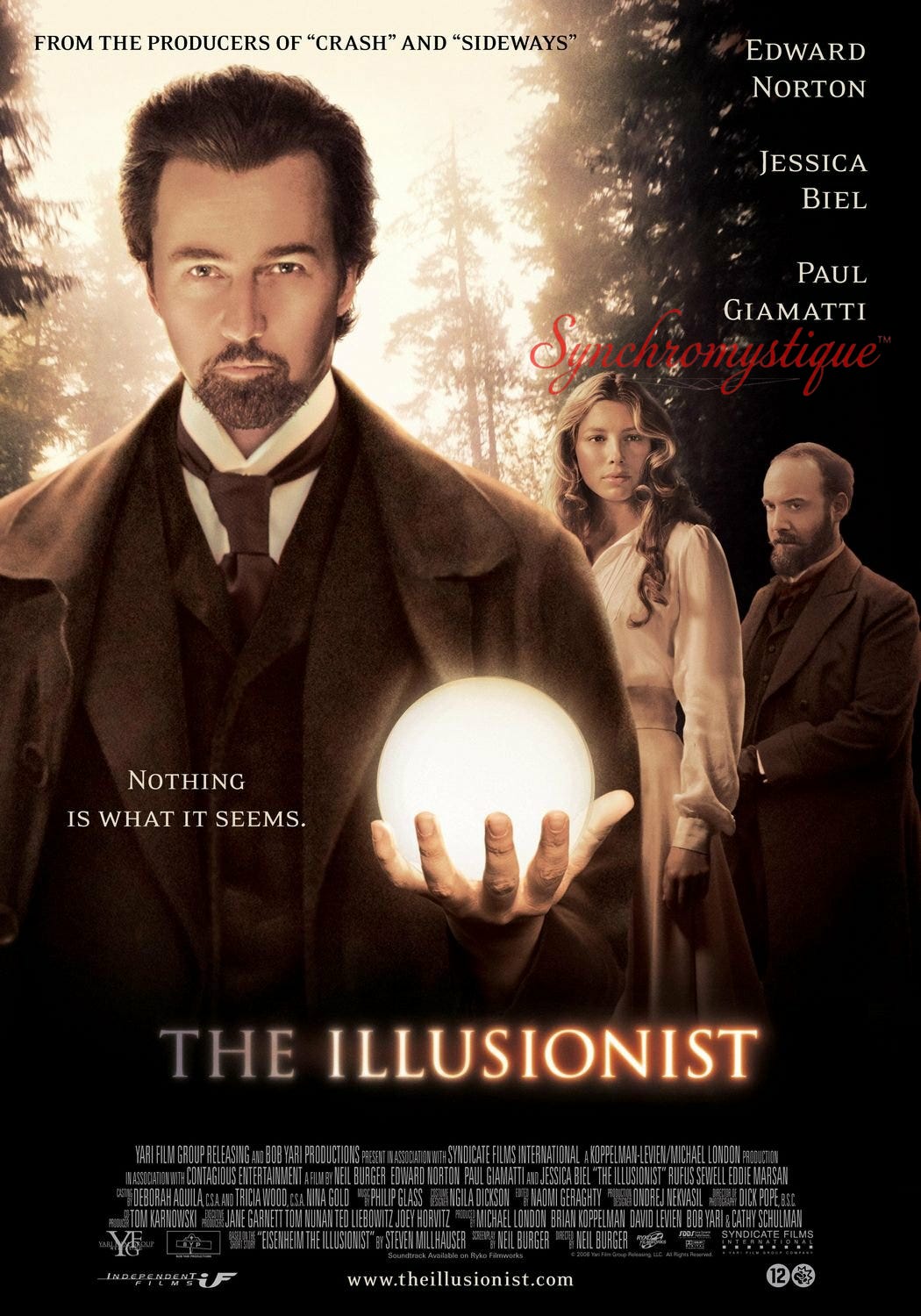
This possibility finds a resonant theatrical representation in Neil Burger’s 2006 film The Illusionist (screenplay based on a Steven Millhauser story). In one of the film’s pivotal exchanges, Inspector Uhl — the chief of police, played by Paul Giamatti — confides to the magician Eisenheim (portrayed by Edward Norton) something like the following:
“They say that I’m very close to the Prince. But the simple truth of the matter is, I’m the son of a butcher. He’s the heir to the Empire. How close could we be to such as him? Hm? Don’t fool yourself that you can play in their game. I’ve served on the edge of it for many, …many years, and I can tell you with certainty: there’s no trick they haven’t seen.”
Uhl is describing, with precision and some regret, the condition of the capable, even indispensable, but ultimately marginal functionary — someone who serves the game without being in the game. Or, to borrow an analogy from chess, someone who’s in the game as a pawn or as a “minor” piece (such as a bishop or knight), but not a “major” piece (like the rook or queen), and certainly not making the moves.
The comparison to Epstein, while possibly uncomfortable and unsettling — because it implies that the real bigshots and masterminds are still at large — is, we think, not easily dismissed.
Sure: Epstein had access. He had the house, the plane, the island, the pipeline. But access and ownership are not the same thing. Gatekeepers, however well-compensated, remain on the gate. Stewards step aside at the return of the king.
If Epstein was a Nightingale — or, to press The Illusionist analogy, an Uhl — then his 2019 arrest was not a “breach in the system.” It was the system, functioning as designed: insulating the upper tier by sacrificing a middle-tier asset who had become a liability. And Epstein’s death in custody — under the watch of William “Bill” Barr and Donald Trump as POTUS-45 — whatever its true nature, seems to have resolved the problem neatly.
One does not need to invoke grand conspiracy to observe that this is simply what three-tier structures do.
Related questions of whether Epstein was a Red Cloak (i.e., one of the actual principals), a Ziegler (a connected upper-tier figure who manages exposure), or a Harford — someone who thought he could play the game and discovered, too late, that he had fundamentally misread his own position — are ones the documentary record cannot yet resolve. But — apart from the important differences of naïveté level and the possession or lack of a moral compass — the analogy to Harford is perhaps the most instructive. Like Harford, Epstein moved through élite spaces with apparent ease and evident enjoyment. Like Harford, he may have been operating under a fundamental misapprehension about what the rules were, and to whom they applied. In any event…
Unlike Eisenheim, Epstein did not get away with it. Whether that was because he overplayed his hand, or because the hand was always going to be played against him at the optimal moment — that is the question worth sitting with.
For one of the fictional Eisenheim’s supposed, real-life inspirations — one Erik Jan Hanussen (born Hermann Steinschneider) — see our written article and companion YouTube video “10 ‘Nazi’ Occultists, Part 2 (Long Version).”
(See End Notes for citations and expansions of this section.)
The documentary record that follows should be read with the three-tiered framework (sketched above) in mind.
And we should be precise about what that record actually shows. This matters — not least because the Epstein story has, in some quarters, been so thoroughly muddied with unverifiable legends that the genuine, factual core has gotten obscured.
Here’s (some of!) what has been established — or, more carefully, what has been alleged — via court filings, civil suits, or sworn testimony.

She died on April 25, 2025, at age forty-one, in what was ruled a suicide. By her own account, she had been recruited from Donald Trump’s Mar-a-Lago resort in Palm Beach while working as a teenager in the spa. Trump himself confirmed this in July 2025: “He [i.e., Jeffrey Epstein] took people that worked for me… I said, ‘Stay the hell out of here.’” Pressed as to whether the women recruited were young, Trump added: “The answer is yes; they were in the spa.”21
Before her premature death, Giuffre had also accused Alan Dershowitz and Leslie Wexner of receiving her services in what she described as Epstein’s human-trafficking operation22 — though, under legal pressure from the “Dersh,” she backed off.23

However, Giuffre may be best-remembered for her accusations against Britain’s Prince Andrew — now stripped of the “His Royal Highness” (HRH) designation and removed from public royal “duties” (whatever those were) — with whom Epstein allegedly arranged meetings when she was no more than seventeen years old.
Andrew settled a civil lawsuit (in February, 2022) — without admitting liability.24
Going even further, Sarah Ferguson, Andrew’s former wife, admitted in October 2025 that Epstein had paid off some of her debts, circa 2011.25 No strings attached? That’s not strange… at all. {rolling eyes}

This French modeling agent who ran first Karin Models and then the MC2 agency — co-financed by Epstein himself, with a $1 million letter of credit26 — was, according to Giuffre’s 2015 affidavit, one of the architects of Epstein’s supply chain.
“He could get dozens of underage girls and feed Epstein’s strong appetite for sex with minors.” Brunel would “farm [the girls] out to his friends, including Epstein, for sexual purposes,” she alleged, adding that Epstein had boasted of having slept with “over 1,000 of Brunel’s girls.” A former MC2 bookkeeper, Maritza Vasquez, corroborated the broad outlines: foreign teenagers, many from South America, Eastern Europe, and the former Soviet Union, were housed in Epstein’s Upper East Side apartments and made available to wealthy clients.27 In one voicemail recovered from Epstein’s files, Brunel left word that he had “a teacher for you to teach you how to speak Russian. She is 2 X 8 [sixteen] years old.”28
Brunel was arrested by French authorities in December 2020 and died in prison in February 2022, in what was ruled yet another in this string of suicides.
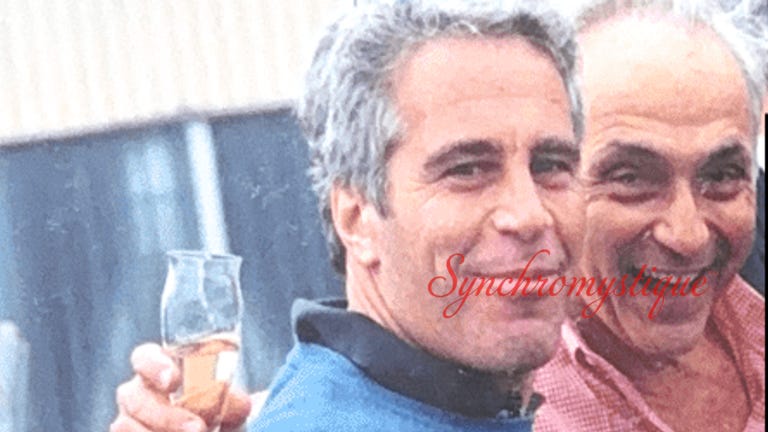
He is the now-billionaire founder of L Brands (parent company of Victoria’s Secret, Bath & Body Works, and Express) who gave Epstein sweeping powers of attorney over his financial affairs and personal life beginning in 1987 — including the right to borrow money in Wexner’s name, to sign his tax returns, to hire employees, and to make acquisitions.
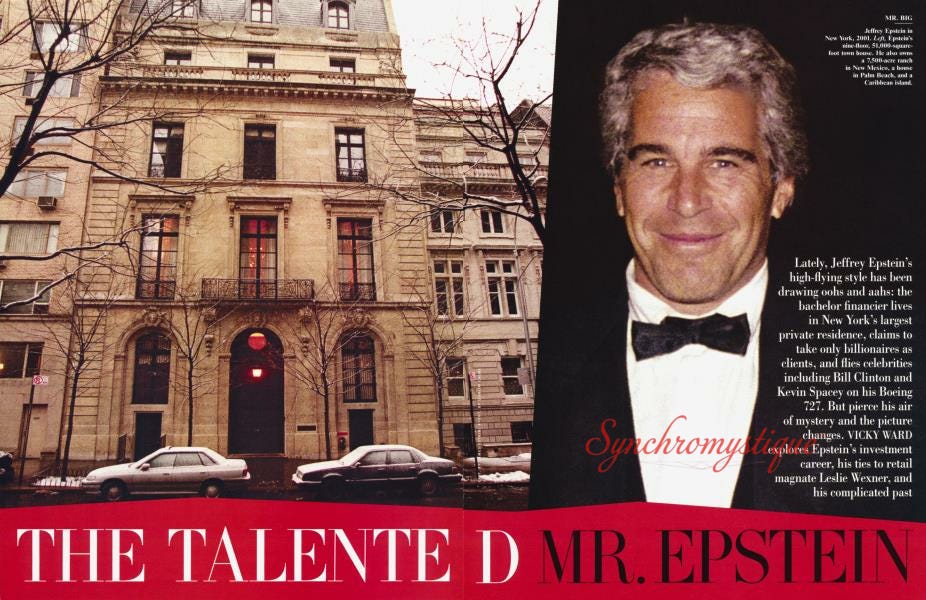
Over the ensuing years, Epstein came to occupy Wexner’s former Manhattan townhouse (valued at $77 million at the time of Epstein’s death), use a private plane previously owned by Wexner (part of a fleet with ties to illegal Iran-Contra arms shipments29), and hold a general partnership stake in Wexner’s New Albany real estate development.30
Epstein routinely identified himself to aspiring models as a “Victoria’s Secret talent scout.” The New York Times reported in 2019 that at least two senior L Brands executives had warned Wexner about this behavior in the mid-1990s, and that Wexner had been alerted.31 Naturally, Wexner now claims to have been one of the many victims of Epstein, who is painted as an arch-confidence trickster.

A former Prime Minister of Israel, he had documented business relationships with Epstein spanning several ventures: the cybersecurity firm Carbyne; FST Biometrics (whose technology was tested at a crossing between Israel and the Occupied Territory of Gaza); the oil and gas company Gadeco LLC; and the tech startup Levitection.

Barak has confirmed regular visits to Epstein’s residence, while denying any knowledge of sexual misconduct.32
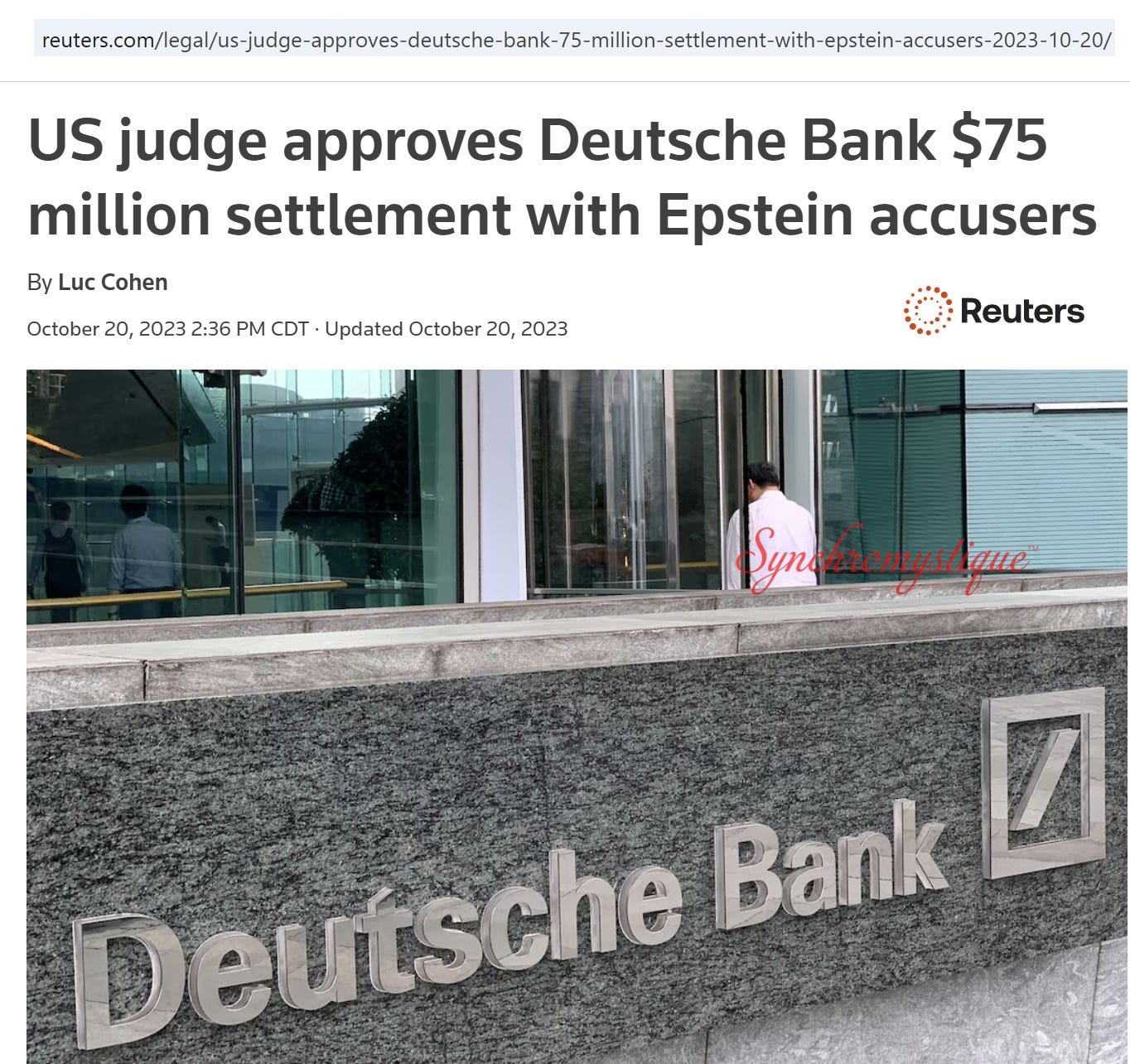
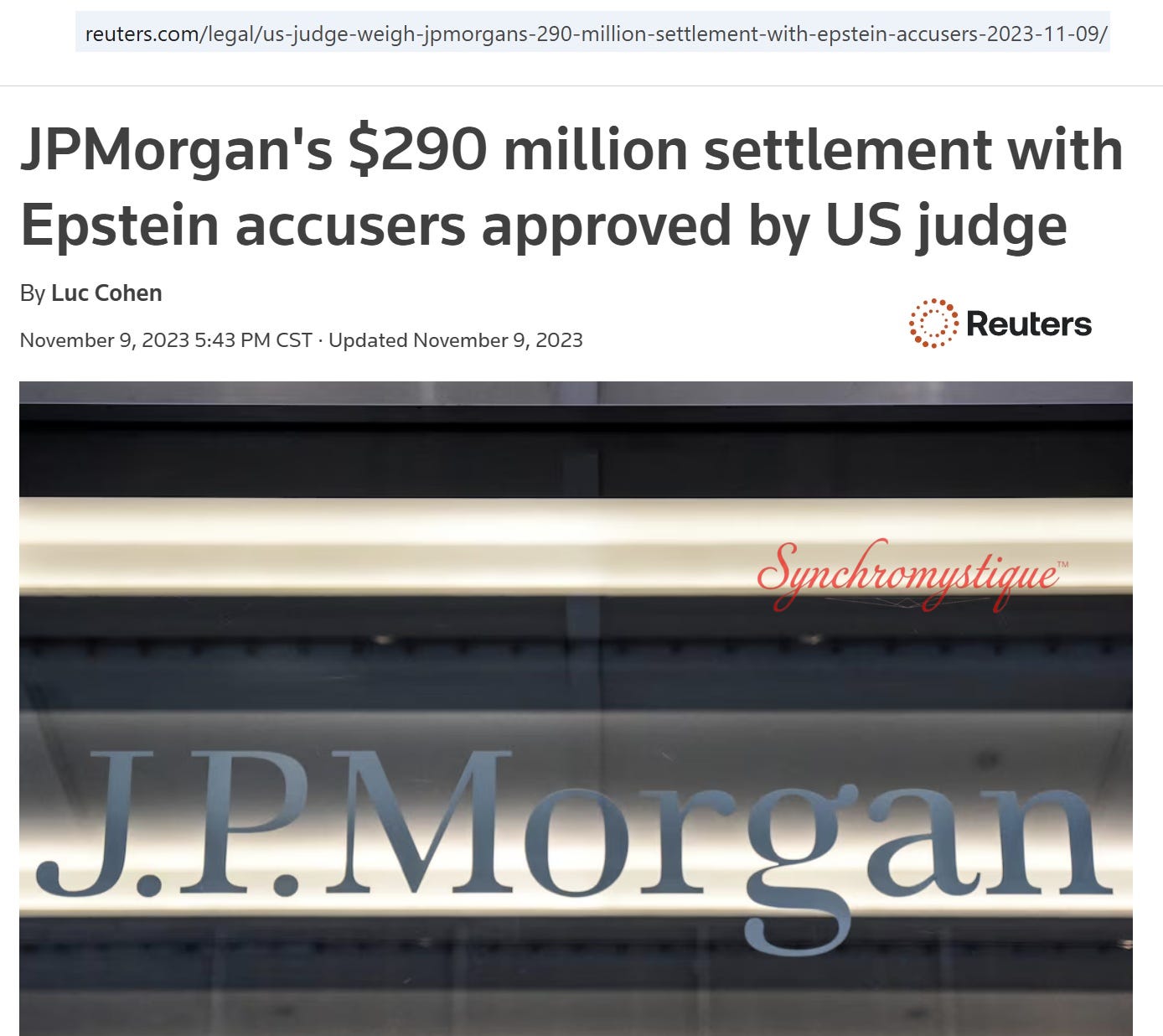
JPMorgan Chase & Co. served as Epstein’s primary bank for years despite documented internal compliance concerns. Deutsche Bank also maintained a banking relationship. Both have since paid multi-hundred-million-dollar civil settlements to Epstein’s victims — without, of course, admitting wrongdoing.33
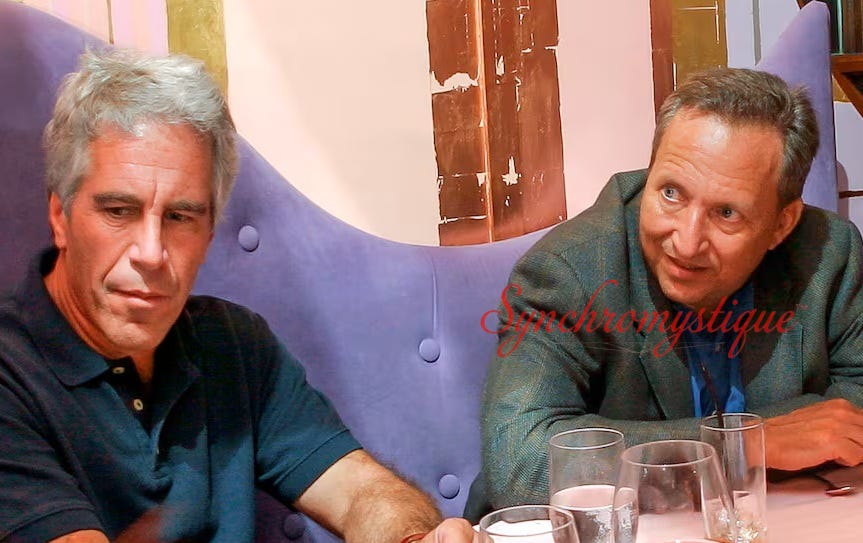
The former U.S. Treasury Secretary and Harvard University president, was revealed in 2025 to have maintained an intensive email and text relationship with Epstein — right up until the day before Epstein’s 2019 arrest on federal sex-trafficking charges.
In one exchange, Epstein served as Summers’ self-described “wingman” in the pursuit of a female mentee — a woman who, Summers himself acknowledged, was continuing the relationship largely because of his professional leverage over her career. Summers subsequently stepped back from public commitments and announced he was “deeply ashamed.”34
The broader “visitors’ log” and address book connect Epstein to figures including Saudi Crown Prince Mohammed bin Salman; UAE Crown Prince Mohammed bin Zayed; Norwegian Crown Princess Mette-Marit; Mongolian President Tsakhiagiin Elbegdorj; Côte d’Ivoire President Alassane Ouattara; former French minister Jack Lang; Apollo Global Management’s Leon Black; Highbridge Capital’s Glenn Dubin; and Cantor Fitzgerald’s Howard Lutnick, who is currently serving as U.S. Secretary of Commerce.35

Somewhat in the shadow of his Manhattan and Caribbean properties, “Zorro,” Epstein’s sprawling New Mexico ranch, has (as of early 2026) become the subject of a formal investigation by state authorities. This follows anonymous allegations — received by a local radio host in 2019 — that two unidentified young girls were strangled to death during “rough, fetish sex” and buried on the property on the “orders of Jeffrey and Madam G.”
The allegations remain unverified, but New Mexico authorities launched a physical search of the 7,600-acre estate using K-9 units and ground-penetrating radar in March 2026.36 Those results are worth looking for.
The Rothschild “Surrealist Ball” of December 12, 1972 — hosted by the Baron Guy and Baroness Marie-Hélène de Rothschild at the Château de Ferrières — has long served as a sort of visual shorthand for the kind of event depicted in Eyes Wide Shut.
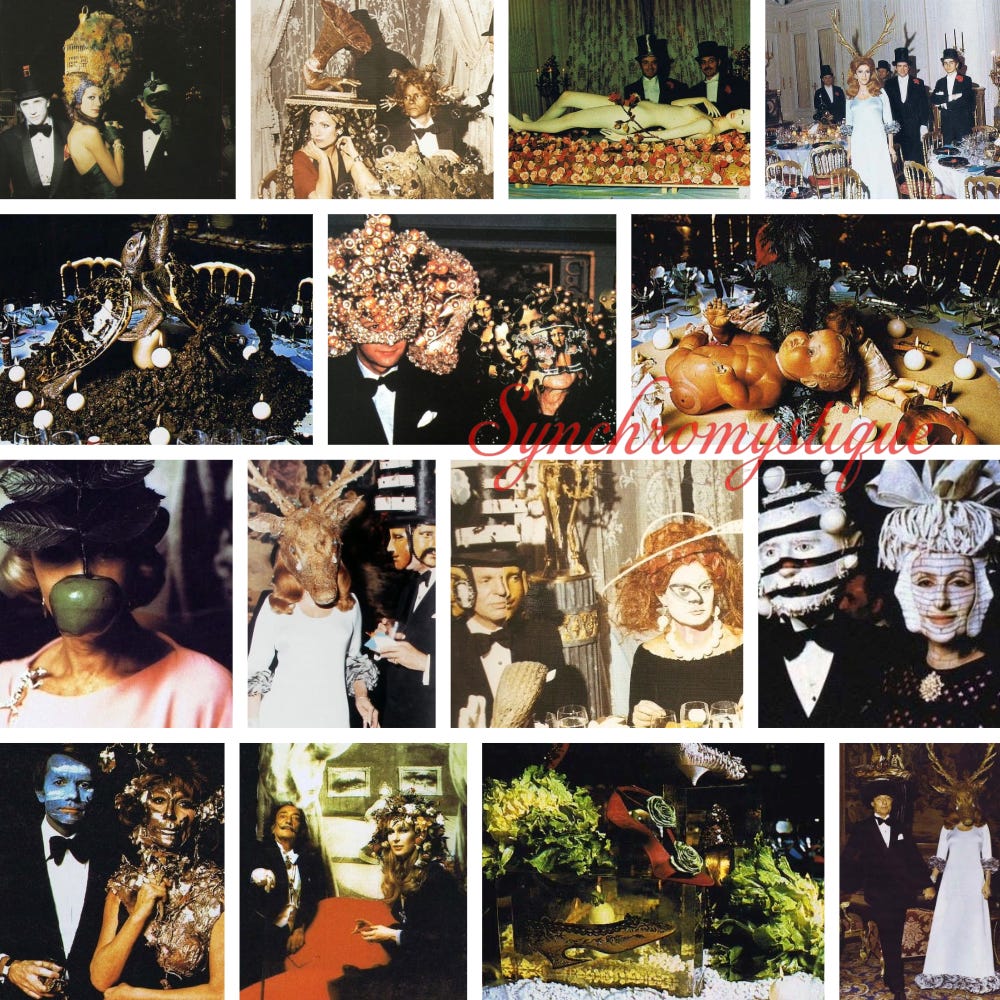
The scattered photographs from that evening, with their deer-antlered headdresses and naked-table-human centerpieces, remain ambiguous: is it performance art, or something more unsettling? We cannot be sure, because we were not there.

Similar — and similarly disturbing — motifs recur in the “performance art” of Serbian-born Marina Abramović whose “spirit cooking galas” amount to mock human sacrifices and seem to hold an attraction for numerous celebrities. Marina seems to do all right in high-status circles — a female Eisenheim, the Illusionist (the previously noted fictional magician whose birth name, in the story, was Eduard Abramovich37).
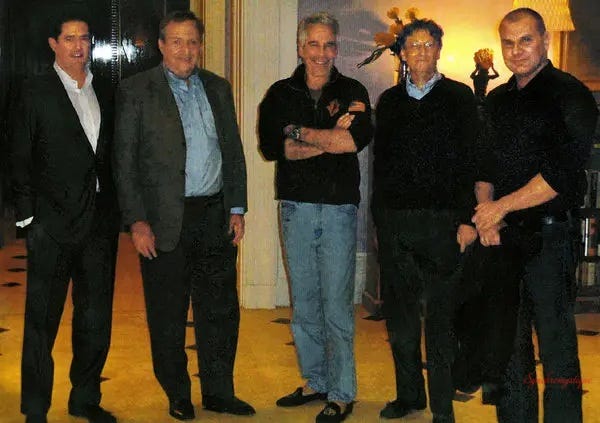
Microsoft — whose erstwhile chief, Bill Gates, also had unsettling (and married-ending) ties to Jeffrey Epstein — once partnered with Marina to promote its “Holo Lens 2” virtual-reality goggles in a half-baked scheme to interest the auction house Christie’s in some sort of “mixed-reality” art.
In the case of the Surrealist Ball, the connexion to Eyes Wide Shut is not merely thematic. It’s also architectural.

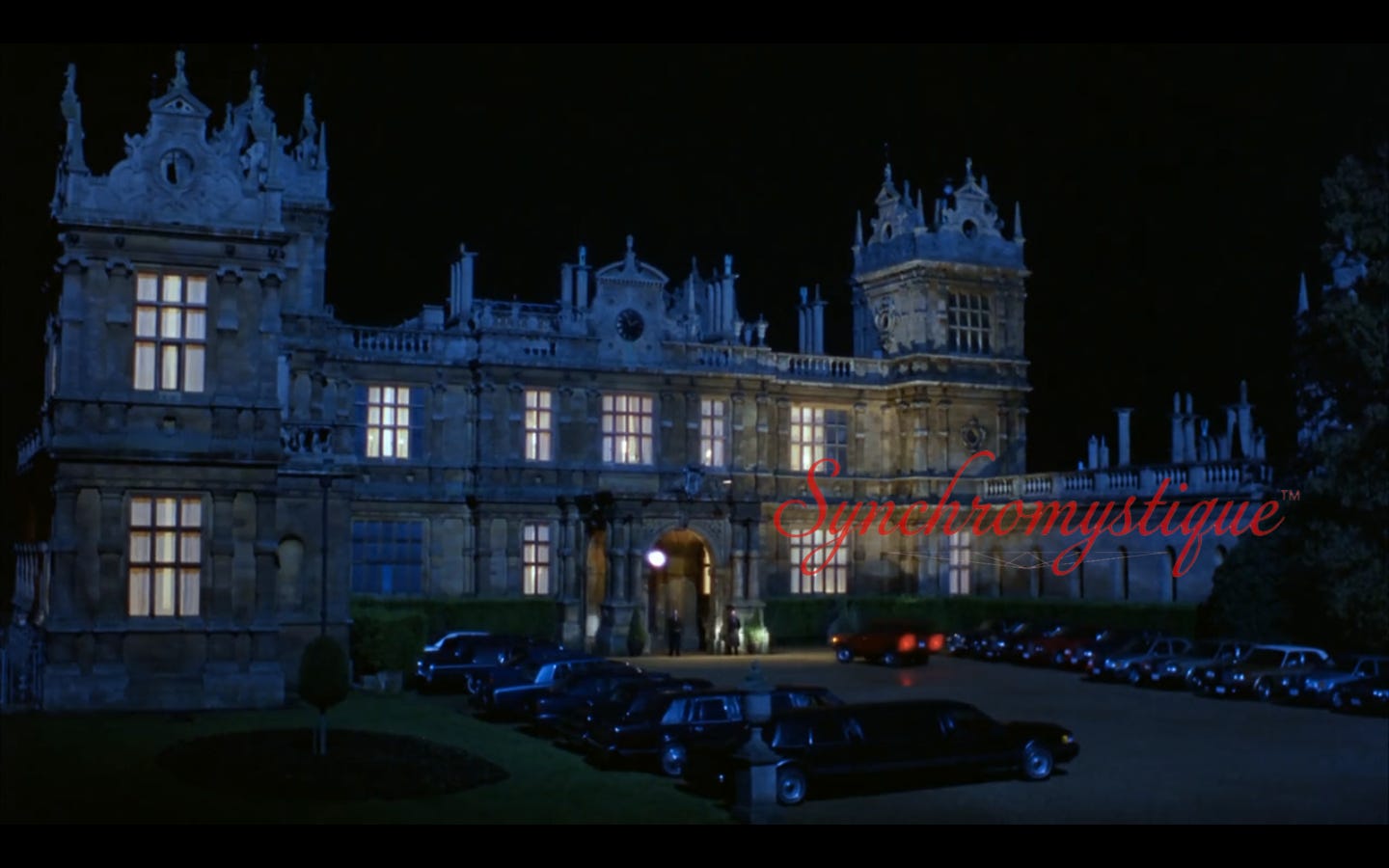
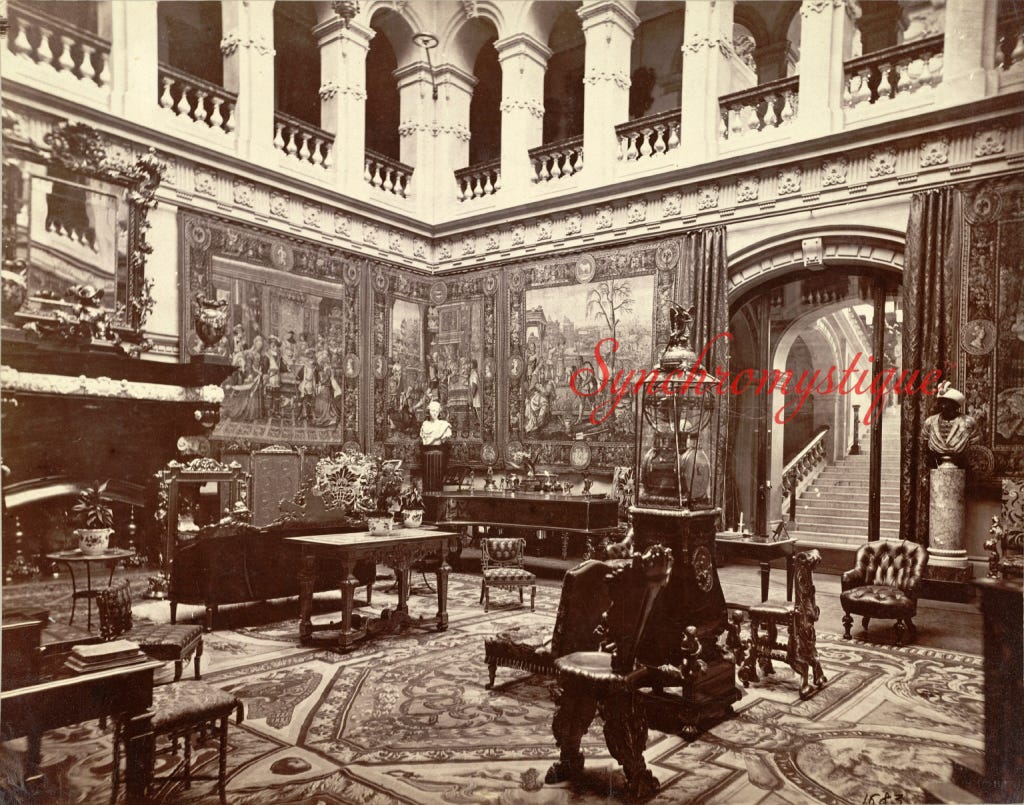
The exterior of Kubrick’s fictional Somerton (or “Sommerton”) estate — the gated façade behind which the masked ritual unfolds — was filmed at Mentmore Towers, a grand Victorian country house in Buckinghamshire, originally built for the Rothschild banking family.38
(The ballroom interiors and the Red-Cloak ceremony were evidently shot at Elveden Hall in Suffolk; the orgy sequences at Highclere Castle in Hampshire — better known as the setting for the long-running historical-drama series, Downton Abbey.)
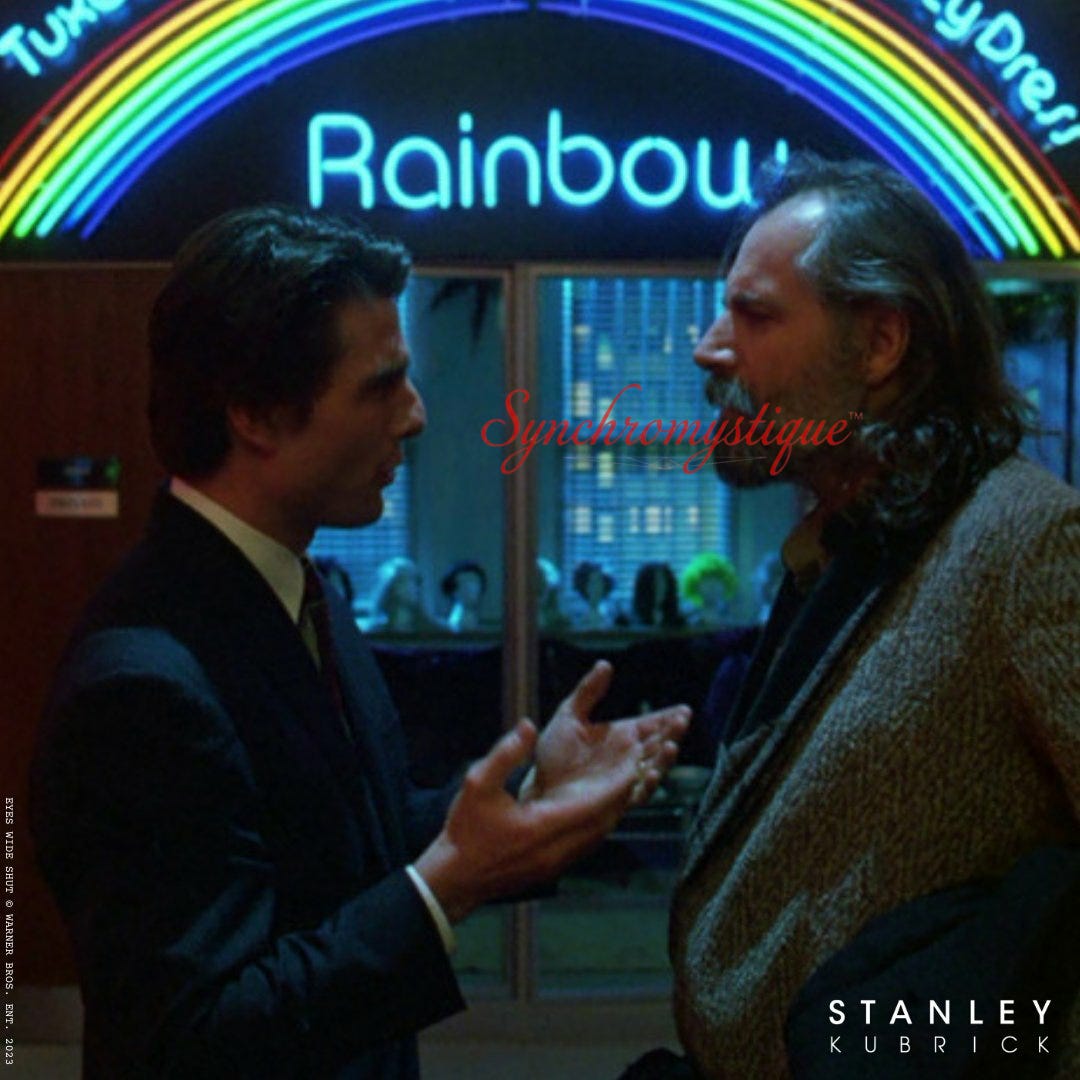
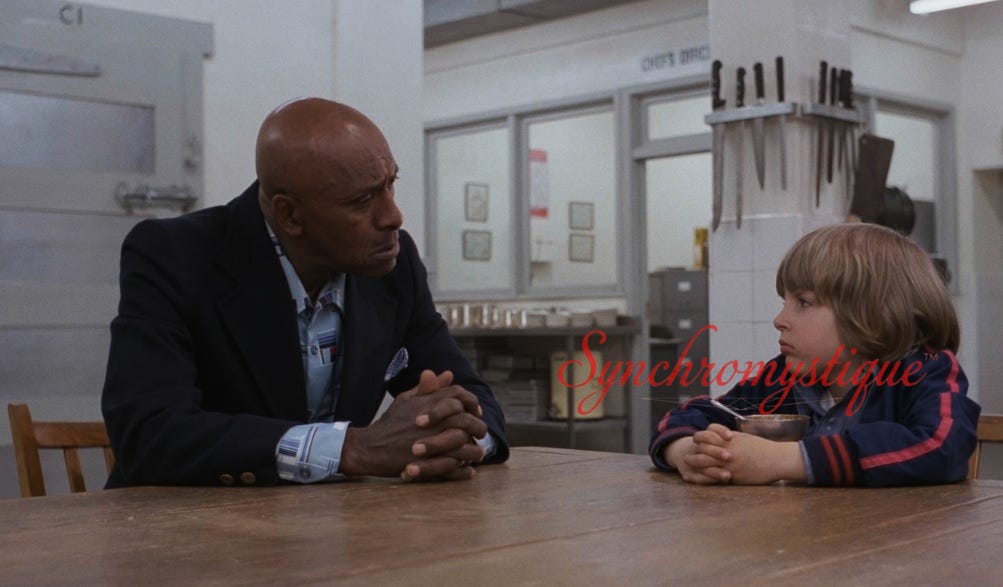
So, bear in mind what is actually being said here — and what is not.
That Kubrick filmed at a property once owned by Rothschilds doesn’t prove that he was signalling anything. Grand houses are often used in films about grand people.
But the SynchroMystical point would be that symbolism has a way of outrunning intention. That Kubrick chose, deliberately or not, to stage his fictional drama of aristocratic secrecy at such a place is, minimally, a perfect æsthetic synchronicity.
We don’t want — and need not — insist upon more. Happily for us, Synchromystique™ is less about rational argument (still less, fabled “proof”), and more about resonance.
(As my kids would tell you, if you say the word “proof,” I’ll say: “Proof” is only well-defined in logic and mathematics. Every other domain trades in degrees of evidence.)
In our opinion, the Epstein Birthday Book reads like something out of Kubrick’s Eyes Wide Shut. It is, quite literally, commemorating the interior of the masked orgy — or the memories of those who were in attendance. It’s how the participants reminisce after the disguises come off and the lights are turned back up — among people who trust one another precisely because they have all already incriminated themselves.
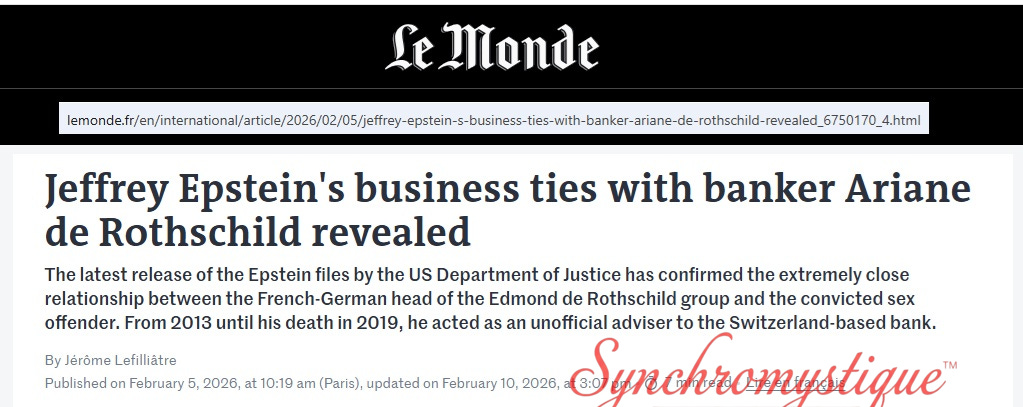
To further underscore these points, French newspaper Le Monde’s reporting of February 2026 confirmed that Jeffrey Epstein had also served, from 2013 until his death, as an unofficial adviser to Ariane de Rothschild’s Edmond de Rothschild banking group — mediating, in one documented instance, a personal dispute between Ariane and her cousin David over use of the family name.39
For those keeping score: Eyes Wide Shut features a Surrealistic-Ball-esque party set (partly) on-location at an estate formerly owned by the Rothschilds. The Epstein files now document Rothschild-adjacent banking relationships.
As a matter of strict historical connexion, we conceed that the evidence, here, is partial and uneven. Yet — once again — Jungian synchronicity, if it operates at all, does so in parallel to direct causation. Those lines simply do not intersect. Ever.
We’re concerned with: architecture, atmosphere, and location — the literary-metaphorical angles. So, as a matter of historical poetry, we have dynasties of wealth, staging masked balls and orgies inside luxury apartments and on private islands, behind veils of secrecy. The Rothschilds bring a touch of old-world fortune, and Epstein brings the new-world scandal.
It’s not that these things are identical, as matters of logic or mathematics. That’s not the point. The point is that patterns sometimes condense out of the æther.
NXIVM, the Bronfmans, and the Mega Group

And Epstein’s network is, in retrospect, only a node in one such troubling and widespread pattern. The same years that saw Epstein consolidating his operation also saw the rise — and eventual catastrophic collapse — of NXIVM (pronounced “Nexium”), a purported self-help organization founded in 1998 by one Keith Raniere, a former Amway salesman with a documented history of fraudulent pyramid schemes.

NXIVM recruited extensively among wealthy, educated women and offered what it called “Executive Success Programs.” On the surface, this was a proprietary system of psychological coaching. But, underneath that, as federal prosecutors eventually demonstrated, these programs served as the intake mechanisms for a secret internal sorority (called “DOS”) in which women were literally branded (on their skin, like cattle) with Raniere’s initials and coerced into serving as sexual slaves to “masters” further up in the hierarchy.
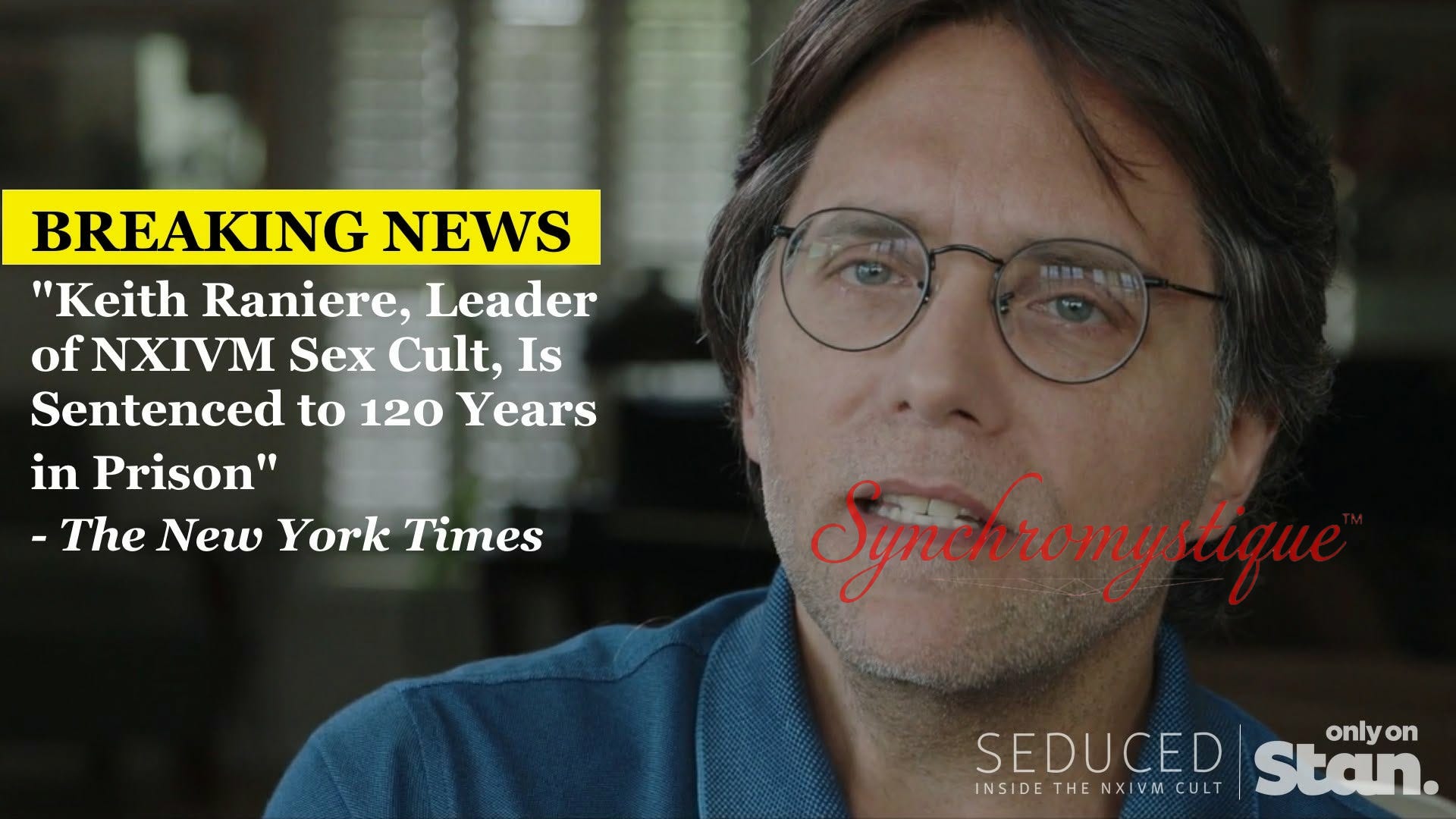
Raniere was convicted in 2019 on charges of forced labor, racketeering, and sex-trafficking and he was sentenced to 120 years in prison. Among the high-profile members implicated: actress Allison Mack, who recruited women into DOS, and Clare Bronfman — heiress to the Seagram’s liquor fortune and daughter of Edgar Bronfman, Sr. — who bankrolled much of NXIVM’s legal and operational infrastructure and pleaded guilty to conspiracy charges.
The surname Bronfman appears, in fact, throughout the Epstein files themselves — and not merely in peripheral or administrative contexts. Edgar Bronfman, Sr. is listed as a client in what appears to be a private-banking “opportunity report” recovered from the Epstein estate, appearing alongside Epstein himself in the brokerage and real-estate sections of the same document. A 2009 email exchange, also released as part of the Epstein-File disclosures, shows Jeffrey being updated by a contact on the outcome of the “Bronfman case” — some form of litigation in which Epstein apparently had an interest — and responding with characteristic nonchalance.
The name also appears in Epstein’s address book, as reported by New York Magazine. The Bronfman surname, in other words, is not several degrees removed from the Epstein narrative. It appears repeatedly within the documentary record surrounding Epstein.
The Mega-Group — co-founded as it was by Leslie Wexner and Edgar Bronfman Sr. — connects not as a tangential link, but as a second, institutional axis along which these relationships operated.
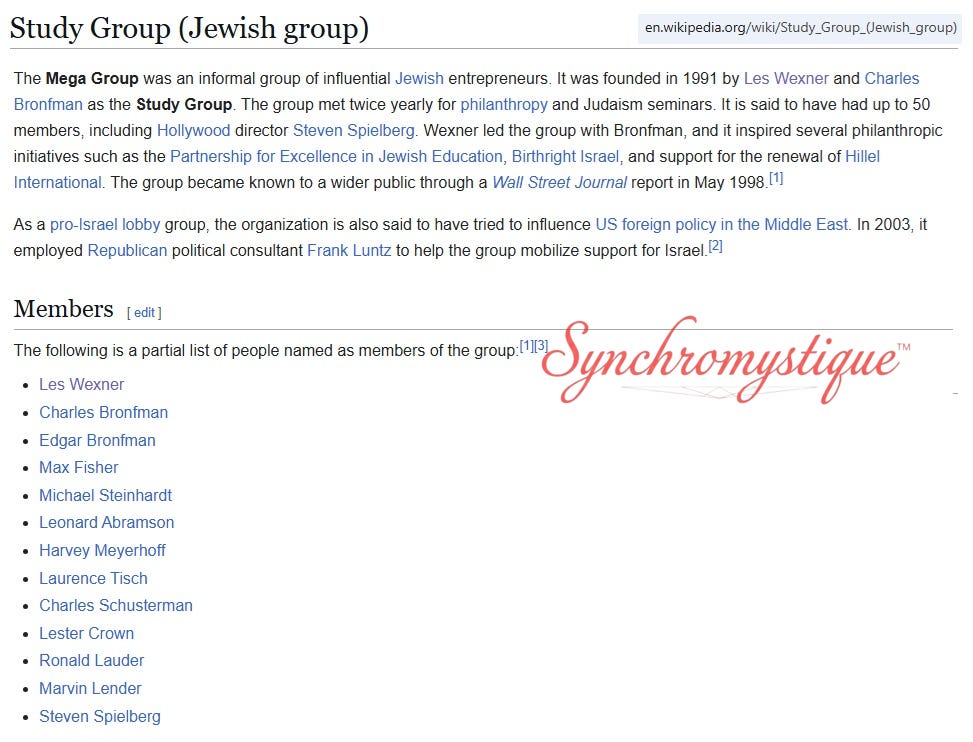
Founded in 1991 by Leslie Wexner (Epstein’s most consequential patron and the man who handed him sweeping powers of attorney over his entire financial life) and Edgar Bronfman, Sr. (Clare’s father, Charles’s brother), the Mega Group — also known as the “Study Group” — was a semi-annual gathering of roughly twenty of the wealthiest Jewish philanthropists in North America. Its membership included figures such as Michael Steinhardt, Lester Crown, Max Fisher, Charles Bronfman himself, and, in some accounts, Steven Spielberg. Its stated purpose was strategic coordination of Jewish-charitable giving, with particular emphasis on “Jewish identity,” projects such as Birthright Israel, and Zionist causes more broadly.
As far as we can tell, the Mega Group has never been accused of criminal conduct. We do not allege otherwise.
What we wish to note, SynchroMystically, is the structural echo: a semi-private network of extraordinarily wealthy men, meeting away from public scrutiny, coordinating agendas and — through the Wexner-Epstein nexus — providing, wittingly or not, the financial and social scaffolding within which one of the most extensively documented sex-trafficking operations in American history was able to operate for decades without consequence.
Kubrick’s Ziegler, explaining the Somerton orgy to a shaken Bill Harford, offers what amounts to the Mega Group’s implicit self-description: “It was always just a kind of a get-together. Some harmless fun.”
The NXIVM case and its Bronfman connections, as well as the Mega Group’s crypto-political dimensions, receive fuller treatment in two companion works — one of which HERE traces the Wexner-Bronfman-Epstein triangle in considerably more detail than present space permits.
Login to YouTube to watch “Top 10 ‘Sex-Magic’ Cults.” (There’s no actual objectionable visual depictions — but the subject matter is best reserved for mature audiences.)
Let me acknowledge a principal objection.
Independent writer Damien Walter, and others in the “Kubrick as universal humanist” school, have argued that reading Eyes Wide Shut as a documentary about secret élites misses the point. Kubrick’s “real subject” is how all of us, regardless of wealth, participate in systems of self-deception, exploitation, and complicity. In this reading, “conspiracy thinking” becomes a kind of flattery: it relocates the problem into the hands of a bounded set of villains rather than acknowledging that the tendencies on display are general human ones.40
Fair enough, as far as it goes. Film critic Rob Ager has also pointed out somewhere (and, probably, in many places) both that Kubrick was a student of human psychology and that all people — regardless of socioeconomic station — are capable of the sorts of depravity represented in Eyes Wide Shut.
But here is where we think Walter’s objection runs aground. If the pathologies on display are genuinely universal — if power corrupts, if boredom and wealth and insulation from consequence produce the behaviors documented in the Birthday Book — then they pertain to the powerful at least as much as to anyone else. The difference between the “haves” and the “have nots” is not psychological. The difference is what, in any murder investigation, gets called means, motive, and opportunity.
Surely, saying that all people — whether poor or rich — are capable of (and perhaps driven to) corruption and wickeness, is not to deny that one’s ability to carouse, revel, or otherwise wallow in debauchery, not to mention to cover up one’s activities or “get away with it” after-the-fact, obviously increases with wealth.
And this latter fact, we submit, has been placed beyond dispute by the Epstein case. Why, given Kubrick’s famed and inimitable capacity for complexity, should we assume that he simply ignored this scalability consideration, or that he didn’t intend viewers to take that aspect of the film — so unmistakably front-and-center — seriously? We see no reason not to interpret this sex-obsessed-élite layer realistically.
In real life, a person of modest means and ordinary social access might secretly harbor the same impulses that Epstein’s associates apparently acted upon. But such a person is not going to entice aspiring runway models to their Blackstone,-Inc.-owned rental unit. Nor will such a person, from Podunk, U.S.A., going to construct a pipeline to traffick underage girls out of Eastern Europe on private planes. Joey Bagadonuts can’t make surveillance footage disappear. Nor, if his crimes are discovered, is he likely to to be offered a “sweetheart deal” — negotiated in secret with no thought to objections from his victims — which grants immunity to him and his unnamed co-conspirators.
The institutional rationale behind the impulse to “cover up” has received an unexpected Insider corroboration as recently as June 2026.
Reporting drawn from a forthcoming book by Maggie Haberman and Jonathan Swan (Regime Change: Inside the Imperial Presidency of Donald Trump, New York: Simon & Schuster, expected June 23, 2026) describes a scene on July 17, 2025 in which Vice President JD Vance convened the most senior officials of the Trump administration in the White House Situation Room. The assembled company included the White House Chief of Staff, the Attorney General, the FBI Director, the White House Counsel, and the Deputy Attorney General. There, Vance addressed what he reportedly described as “a huge problem”: the imminent Wall Street Journal exposé of the Birthday Book.
According to this account, Vance “appeared panicked,” and some senior officials formed the impression that he had “bought into the darkest theories about Epstein and a cabal of predators within the country’s ruling class.”
Reportedly, Vance was privately pressing for total transparency — for the release of all Epstein files, and even floated enlisting conservative political commentator and talk-show host Tucker Carlson to interview Ghislaine Maxwell in prison.
Ultimately, Vance was overruled. Trump himself, according to the account, was the most opposed to releasing anything, and opted — in contravention of his campaign promises (par for the course, as recent events in Iran demonstrate) — to recast the entire file-release question as a Democrat-instigated “hoax.”
Unfortunately, the officials who had urged transparency — including Vance and, allegedly, FBI Director Kashyap Pramod “Kash” Patel and the latter’s deputy, Daniel John “Dan” Bongino — dutifully fell in line.
(P.S. On JD Vance’s succession of name changes, which we think has some SynchroMystical interest, see our past presentation in which we discuss it briefly in the concluding section.)
Breaking Points hosts Krystal Ball and Saagar Enjeti, who covered the story on June 11, 2026, noted the structural absurdity: the people tasked with covering up the Epstein files appear, by this account, to have privately believed the darkest version of what those files contained. The cover-up was not performed by “true disbelievers.” It was performed by panicked men in suits who knew the thing was real and chose institutional survival anyway.
Kubrick’s Ziegler, in his final scene with Bill Harford, could hardly have scripted it better. N’est-ce pas?
Rob Ager makes a related point in his 2026 essay on the Epstein files: the absence of arrests reflects not necessarily the total complicity of every person in power, but something arguably more disturbing — the structural tendency of institutions to cover things up regardless of whether the people doing the covering were themselves participants. “Different parties engaged in the cover-up at different levels may not even be aware of each other’s roles in the overall cover-up.” What looks like a grand conspiracy from the outside is often, from the inside, a series of incremental decisions by frightened people who simply don’t want the problem to land on their desk.41
Maybe this is, if anything, more terrifying than a single, centrally-organized evil. It calls to mind proverbs such as: “The only thing necessary for the triumph of evil is for good people to do nothing.”
Here is something that can be said without much equivocation: Stanley Kubrick was not a naïve man about the way the world works.
A Clockwork Orange, Barry Lyndon, Full Metal Jacket, Dr. Strangelove — these are not the films of someone who believed that institutional power was generally wholesome.
Whatever Kubrick “intended” by Eyes Wide Shut, the film was produced by a director who had spent four decades dissecting the relationships between violence, sexuality, and authority.
The 1999 film is based on Arthur Schnitzler’s 1926 novella Traumnovelle — a work Kubrick reportedly carried with him for decades before adapting it — which is itself a case study of the same sort: bourgeois respectability as a thin veil over appetites that the wealthy and connected “can” (in the sense of ability, not permissibility) act on with a freedom unavailable to ordinary people.
It is worth noting that Kubrick’s daughter Vivian, who was associated for a period with Cruise’s Church of Scientology, has in recent years made public statements defending her father’s memory and contesting the “he was murdered” narrative.
We are not arguing for the murder theory here. We’re simply suggesting that Kubrick understood what he was depicting well enough to do it with chilling accuracy.
And perhaps — for those readers inclined toward the esoteric register that is our mainstay — that is more interesting than the murder theory anyway.
The deeper question is not whether Kubrick was killed for what he knew. What does it mean that a work of popular fiction, released in 1999, has turned out to be more accurate a map of a certain stratum of social reality than anything produced by the institutions theoretically charged with documenting that reality?
It’s not the first time this fiction-reality warping has taken place — in relation to Jeffrey Epstein, no less. As we have now twice reported (see HERE and HERE):
On August 10, 2019, Epstein was found dead in a New York City jail during Donald Trump’s presidency, while William Barr — whose family has ties to U.S. intelligence — was Attorney General. Epstein and Barr’s father, Donald Barr, had prior, long-standing associations at the Dalton School (going back to 1974). Some insist that Donald Barr had hired Jeffrey to teach mathematics — despite the latter lacking suitable credentials. But the kicker is that the elder Barr had penned a controversial “science-fiction” novel — Space Relations — interlaced with dark themes of sexual predation. And all these overlapping connexions are more than a little curious given later events.
The New York Times ran a flattering 2002 profile of Epstein that described him as a “Gatsbyesque” figure of mysterious wealth and intellectual charm. Kubrick, two years earlier, had made a film about what that kind of figure actually does with his evenings.
For those who want to go further down the rabbit hole of Kubrick’s esoteric architecture — the black monolith of 2001 as prima materia, the Kabbalistic four-world structure of 2001: A Space Odyssey, Jay Weidner’s reading of the film as a cinematic instantiation of the alchemical Magnum Opus (watch “Kubrick’s Odyssey”), or the extraordinary close-reading offered by Rob Ager at collativelearning.com — those threads deserve, and will receive, their own dedicated treatment in a forthcoming piece. Consider this a formal tease.
Kubrick’s final film and the disgraced financier both emerged from the flickering, uneven glow of a light bulb that is about to burn out — a civilization increasingly organized around the principle that money buys, well… everything, including privacy, nay… secrecy! Evidently, there is security in opacity: institutions that are “too big to fail,” commercially, are also too large to comprehend or to “cover” exhaustively.
Some fortunes are simply too vast to scrutinize.

At the same time, some “preferences” are too transgressive to acknowledge openly. And some networks — built on complicity — guarantee silence only by blurring the distinction between friends and literal partners in crime.
Societies that start off intentionally secretive may be rarer than many people imagine.
But open or public societies that become secretive under the pressure of concentrated power may be far more common.
Of course, Eyes Wide Shut is not a documentary, just as the Epstein files are not a screenplay. Yet both point toward the same unsettling possibility: that concentrated power, left sufficiently unchecked, begins to behave like a secret society whether or not it possesses robes, rituals, or a charter.
The Birthday Book does not “prove” the existence of some singular Illuminati lurking behind world events. What it does suggest is perhaps stranger — or, at least, more SynchroMystical: that secrecy, mutual compromise, erotic transgression, and asymmetrical power dynamicas generate hidden worlds within the visible world.
Kubrick did not — nor did he need to — “predict” Epstein. But he clearly understood the environment that produced him.
In this context — read through an Eyes-Wide-Shut lens — the Birthday Book is the initiation certificate. The “wonderful secret” is the password.
Fidelio.42
The SynchroMystic publishes long-form investigative and esoteric analysis at [Substack link]. A companion piece examining the full Kabbalistic and alchemical symbolism of Kubrick’s 2001: A Space Odyssey — drawing on the work of Jay Weidner (Kubrick’s Odyssey, Parts I & II) and Rob Ager’s close-reading corpus at collativelearning.com — is in preparation.
Amazon-affiliate disclosure: Some of the links in our post may be Amazon-affiliate links. As an Amazon Associate, we earn from qualifying purchases—at no additional cost to you. Please know that, if you choose to purchase through these links, you’re not just acquiring a book or resource; you’re also helping support The SynchroMystic (Substack.com/@MatthewJBell) and making possible further explorations into crypto-politics, crypto-economics, Jungian synchronicities, occult oddities, and the broader philosophical-theological currents that weave through this publication. Your support helps keep the signal powered. Thank you, in advance.
Here are some expansions and source citations for the material in the “callout blocks.” (Substack did not allow me to embed footnotes in those sections.)
For background information on the Hellfire Club, see Richard Deacon (Donald McCormick), The Hell-Fire Club: The Story of the Amorous Knights of Wycombe, London: Pedigree, 1958 and Daniel P. Mannix, The Hell Fire Club, New York: Ballantine, 1959.
On John Wilkes Booth’s relation to Hellfire Club member John Wilkes: Gene Smith, American Gothic: The story of America’s Legendary Theatrical Family: Junius, Edwin, and John Wilkes Booth, New York: Simon & Schuster, 1992, p. 18; archived at: <https://archive.org/details/isbn_9780671767136/page/18/mode/2up>. Smith also stated that the Booth family itself was “said to be descended from a Spanish Jew named Botha who had been expelled from his homeland in the seventeenth century for speaking against the royalist government.” Ibid.
On Fidelio: Rob Ager, “Was Stanley Kubrick Killed? And Was Eyes Wide Shut Re-Edited Against His Will?” 2nd update, collativelearning.com, Jan. 2025, <https://collativelearning.com/downloadables/Was%20Stanley%20Kubrick%20killed%20(Rob%20Ager)%20-%20second%20update.pdf>. Adjacent videos include: “Did Kubrick Really Fight with Executives at the Eyes Wide Shut Screening?” (YouTube, Apr. 2026).
On JD Vance and the White House panic: Krystal Ball and Saagar Enjeti, “Vance Panicked In Situation Room Over Epstein Files,” Breaking Points (YouTube), Jun. 11, 2026.
On the Bronfmans, NXIUM, and Keith Raniere: The documentary basis for these claims is drawn directly from the Epstein Files Transparency Act release, which — at the time of writing — any interested reader may check by visiting HERE.
Document EFTA01463581 is an internal client-pipeline spreadsheet — almost certainly from a private banking institution — which lists “Epstein, Jeffrey” as a brokerage client with $50 million in actual assets at a 0.75 probability stage, while listing “Bronfman, Edgar” as a separate client in the same document’s real estate and checking sections, with $5 million and $25 million in assets respectively. The two men appear on the same institutional ledger, and were evidently managed by the same relationship officers.
EFTA01828271 is a 2009 email exchange in which an attorney named Richard Snyder writes to Epstein: “I guess there still is some truth and justice left in this world. Happy to advise we won our appeal in the Bronfman case.” Epstein, characteristically, replies: “remind me what happened.” The nature of the underlying “Bronfman case” — and Epstein’s apparent interest in its outcome — is not specified in the disclosed materials.
EFTA01829175 is a follow-up exchange in the same thread, in which Snyder asks Epstein whether it bothers him that a particular attorney “represents me” given that the lawyer “was the best of the lawyers who was willing to take on Bronfman with a contingency.” Epstein replies: “no hes [sic] great.”
Taken together, these documents place Epstein and Edgar Bronfman Sr. not merely in the same social or philanthropic orbit in some vague, generic sense, but literally in the same banking institution’s client pipeline and in active, if oblique, legal opposition.
On the appearance of the Bronfman name in Epstein’s address book, see “Jeffrey Epstein’s Chilling Connections,” in: Chas Danner, Benjamin Hart, and Matt Stieb, “Who Is Named in the Epstein Files? The list of prominent people somehow associated with the sex trafficker keeps growing,” New York Magazine, Feb. 26, 2026, <https://nymag.com/intelligencer/article/who-is-on-jeffrey-epstein-list-names-clients-associates-files-emails.html>. (The address book material has been reported across multiple outlets drawing on the same primary source.)
Finally, Document EFTA00136746, an FBI senior-staff news briefing dated October 1, 2020, is separately notable for containing — amid counterintelligence summaries and election-security reporting — the headline “Seagram’s Heiress Sentenced to 81 Months in NXIVM Sex Slave Case,” confirming that the Clare Bronfman sentencing was being monitored at the level of FBI directorate briefings during the same period.
We do not bring all this up as “proof” of any institutional connexion, but as a rough gauge of how thoroughly the Bronfman surname had migrated, by that point, from philanthropic registry to the federal criminal docket.
On Wexner’s name being initially redacted: See Joseph Gedeon, “Who are the six men named in the unredacted Epstein files?” Guardian (U.K.), Feb. 13 2026, <https://www.theguardian.com/us-news/2026/feb/10/six-men-epstein-files-unredacted> and Dareh Gregorian, “Justice Department releases names of 3 people the FBI once called Jeffrey Epstein ‘co-conspirators’,” NBC News, Feb. 10, 2026, <https://www.nbcnews.com/politics/justice-department/doj-names-3-people-fbi-once-called-jeffrey-epstein-co-conspirators-rcna258335>.
On Hammurabi’s Code: Hoffman elsewhere further states that the five-pointed star (or pentagram) was the sigil of the armed enforcers of Hammurabi’s legal code in ancient Babylon. If true, it is probably not a coincidence that this symbol has historically been used as a badge of U.S. law-enforcement.
This hypothesized connexion between the Code of Hammurabi, on the one hand, and the levels of the CIA and Eyes Wide Shut, on the other, would not necessarily imply that there is always a historically uniform analysis. To put it another way, one needn’t suppose that, buried under the Supreme Court Building on Capitol Hill, is a repository of secret, rich-only laws. (Though… there are such a things as sealed court decisions, hidden cases laws, etc.)
In the case of America, you have at the very top a corporate élite (made of the directors and owners of Big Business). They set policy and make overarching structural decisions. At the very bottom you have the (increasingly useless) “consumers” and workers: This is, of course, the vast majority of people who, at best, carry out managerial orders and earn ever-diminishing “wages.” Between those two layers are the middle managers. Here, we find those —usually originating from the bottom stratum, who were able to rise (possibly thru university training or corporate “advancement”) to a slightly higher level. These coordinator are tasked with enforcing the will of the élite, dictating orders, and organizing the workforce. As Chomsky once summarized the a point he attributed to Henry Kissinger: An expert is a person who is able to articulate (and epistemically “justify”) the wishes of those in power.
To sum it up, the U.S. it seems to be “pay to play” or, as it’s sometimes put: The “Golden Rule” — whoever has the gold makes the rules.
As the 19th-century French economist Frédéric Bastiat put it: “When plunder becomes a way of life for a group of men living together in society, they create for themselves in the course of time a legal system that authorizes it and a moral code that glorifies it.”
© The SynchroMystic. All rights reserved. For reprint inquiries, contact via Substack.
Ibid. Mandelson’s spokesman stated he “very much regretted having been introduced to Epstein.”
Safdar and Palazzolo, loc. cit.
See the original draft materials and reporting collated from the House Oversight Committee Sept. 2025 release: U.S. House Committee on Oversight and Government Reform, “Oversight Committee Releases Records Provided by the Epstein Estate, Chairman Comer Provides Statement,” press release, Washington, DC: U.S. House of Representatives, Sept. 8, 2025, <https://oversight.house.gov/release/oversight-committee-releases-records-provided-by-the-epstein-estate-chairman-comer-provides-statement/>. These documents — first made available HERE and HERE — have been summarized in multiple outlets including the Wall Street Journal and the BBC (both cited, above). Cf. Molly Finnegan, “See Epstein’s full ‘birthday book,’ with alleged personal messages from Trump, Clinton and others,” PBS News, Sept. 10, 2025, <https://d3i6fh83elv35t.cloudfront.net/static/2025/09/Request-No.-1.pdf>.
One discussion board user confidently declared that Kubrick “was known to be in perfect health just one day prior [to his death].” Stefan, “The Untimely Death of Stanley Kubrick,” Neo-Geo, Oct. 25, 2007, <https://www.neo-geo.com/forums/index.php?threads/anyone-know-any-more-obscure-conspiracy-theories.161098/#post-2343338>. Some of these ideas were perhaps precipitated by early reporting such as this, from the New York Post: “Legendary filmmaker Stanley Kubrick was ‘happy, joking around and completely at peace’ just hours before he died of a heart attack in his sleep, The Post has learned. …‘He …was already thinking about a new project,’ the source said. ‘Then he went to bed as usual. The next morning, his wife found him dead. He had suffered a heart attack in his sleep. It was completely unexpected.’” Celona, loc. cit.
Somewhere in my files, I do have said edition of Paranoia magazine (circa 1999). If I can make time to go on the hunt for it, I’ll come back and fill in the publication details. The official cause of Kubrick’s death was cardiac arrhythmia — supposedly confirmed by his family and collaborators.
Omertà is the term for the the Sicilian Mafia’s strict code of silence that forbids participants (or others “in the know”) from revealing any information about criminal activities — on pain of death — even for victims of a crime.
Of course, to later-19th-century thinker Friedrich Nietzsche, there are no such guarantees from the Zeitgeist. Rare individuals literally create their own values against (rather than as) expressions of “their times.” We won’t referee the debate, here.
Specific planes acquired by billionaire Les Wexner — which were previously used by the CIA-linked contractor Southern Air Transport during the Iran-Contra affair — were later relocated to Ohio and repurposed by Jeffrey Epstein to ship merchandise for Wexner’s retail empire. However, Epstein’s actual private jet — often referred to as the “Lolita Express” (a Boeing 727, registration N908JE) — was evidently not itself a player in the Iran-Contra affair. See Ryan Grim, Murtaza Hussain, and Harrison Berger, “Epstein, Israel, and the CIA: How the Iran-Contra Planes Landed at Les Wexner’s Base,” Drop Site News, Dec. 18, 2025.
Adam Klasfeld, “Ex-Victoria’s Secret CEO Contradicts Alan Dershowitz in Epstein Fight,” Courthouse News Service, Aug. 10, 2020, <https://www.courthousenews.com/ex-victorias-secret-ceo-takes-center-stage-in-alan-dershowitz-fight/>; Staff, “Woman says Epstein forced her to have sex with former PM Barak: Claim revealed in court filings from celebrity US lawyer Dershowitz, who was accused as well; associates of both men deny the allegation,” Times of Israel, Jun. 24, 2020, <https://www.timesofisrael.com/woman-says-epstein-forced-her-to-have-sex-with-former-pm-barak/>; and Staff, “Jeffrey Epstein was Ehud Barak’s business partner as late as 2015: Former PM’s connection to financier accused of sex-trafficking minors becomes an issue ahead of national elections in September,” Jewish Telegraphic Agency via Times of Israel, Jul. 11, 2019, <https://www.timesofisrael.com/jeffrey-epstein-was-ehud-baraks-business-partner-as-late-as-2015-report/>.
See Luc Cohen, “U.S. judge approves Deutsche Bank $75 million settlement with Epstein accusers,” Reuters, Oct. 20, 2023, <https://www.reuters.com/legal/us-judge-approves-deutsche-bank-75-million-settlement-with-epstein-accusers-2023-10-20/> and Luc Cohen, “J. P. Morgan’s $290 million settlement with Epstein accusers approved by US judge,” Reuters, Nov. 9, 2023, <https://www.reuters.com/legal/us-judge-weigh-jpmorgans-290-million-settlement-with-epstein-accusers-2023-11-09/>.
Sasha Pezenik, Diana Paulsen, Ely Brown, and Peter Charalambous, “Why are authorities finally searching Epstein’s ranch in New Mexico? Authorities apparently never searched the ranch after Epstein’s death,” ABC News, Mar. 11, 2026, <https://abcnews.com/US/authorities-finally-searching-epsteins-ranch-new-mexico/story?id=130960587>; Reis Thebault, “Epstein’s Remote Zorro Ranch Is Searched by New Mexico Investigators: Some of the disgraced financier’s victims have said they were trafficked at the property south of Santa Fe, where the nearest neighbors are miles away,” New York Times, Mar. 9, 2026, <https://www.nytimes.com/2026/03/09/us/epstein-new-mexico-zorro-ranch-search.html>; Jon Schuppe and David Ingram, How Epstein lured girls to his Zorro Ranch and kept authorities away: At least 10 women and girls say they were groomed at what was once Jeffrey Epstein’s Zorro Ranch in New Mexico,” NBC News, Mar. 14, 2026, <https://www.nbcnews.com/news/us-news/epstein-lured-girls-zorro-ranch-new-mexico-investigation-jeffrey-rcna261370>; Andrew Hay, “New Mexico probes allegation of bodies buried near Epstein ranch,” Reuters, Feb. 18, 2026, updated Feb. 19, 2026, <https://www.reuters.com/world/us/new-mexico-probes-allegation-bodies-buried-near-epstein-ranch-2026-02-19/>; and Connor Greene, “Epstein’s 7,600-Acre Zorro Ranch Searched in Criminal Investigation,” Time, Mar. 10, 2026, <https://time.com/article/2026/03/10/epstein-zorro-ranch-investigation-search-new-mexico/>.
“The exterior of Somerton, the palatial Long Island mansion that housed the orgy, was shot later, on November 14 and 15, at Mentmore Towers, a Georgian-style building built for the Rothschilds.” According to Kolker and Abrams, Eyes Wide Shut, p. 102; archived loc. cit.
There is one last kairoeme / synceme, which we offer without excessive commentary.
A Morning Joe segment aired June 11, 2026 in which Mika Brzezinski attempted to equate Democratic Senate candidate Graham Platner’s consensual — if adulterous — adult romantic history with the Epstein trafficking network. Breaking Points treated this item the same day as its panic-in-the-Situation-Room reporting.
On one level, the Mika Brzezinski business is simple media chaos. On another level, it is a near-perfect emblem of the phenomenon this piece has been describing: the reflexive institutional move to avoid, diffuse, or otherwise forestall a genuine reckoning by any lexical acrobatics or logical somersault that springs to mind — including resort to false equivalence.
The previously named Breaking Points hosts, Ball and Enjeti, noted the obvious: namely, that consensual adult relationships are not tantamount to an élite-run, pedophile-protecting, human-trafficking operation.
The attempt to treat them as comparable doesn’t even rise to the level of an assertion. It’s the intellectual analog of excretory effluvium. It’s the kind of white noise that fills the airwaves when some true signal, damaging to the upper class, gets too loud for them to tolerate.
What (arguably) makes this a SynchroMystical footnote, rather than merely a media observation, is the surname.
Mika Emilie Leonia Brzezinski is the daughter of Zbigniew Brzezinski — National Security Advisor to James Earle “Jimmy” Carter, Jr., primary architect of the Trilateral Commission (co-founded with a generous pile of dough from David Rockefeller in 1973), and the theorist of what he called the “technetronic era”: governance by a technocratic élite coordinating across national boundaries.
The Trilateral Commission is, depending on your priors, either a harmless policy arena and one-time competitor to the World Economic Forum, or an extensively documented, Bilderberg-level example of the kind of cross-institutional coordination that Kubrick’s Ziegler hints at when he says: “If I told you their names… I don’t think you’d sleep so well.”
Zbigniew Brzezinski sat on the Council on Foreign Relations, joined the Bilderberg Group, and tapped a then-obscure Georgia governor named Jimmy Carter for Trilateral membership. All this to say that he operated precisely in the register of the invisible hand that places people in positions of power.
“Zbig’s” daughter, who grew up inside that world, now co-anchors a program that has historically functioned as a mouthpiece for Establishment consensus opinions and now seeks to cosign the Epstein files to oblivion.
The SynchroMystic doesn’t claim this proves anything! We merely take note. As a method, Synchromystique™ doesn’t issue in accusations, criminal complaints, or indictment. It is simply a variety of intentional focus — a practice of noticing when patterns present themselves or when history “rhymes.”
No posts
Comments
Nothing yet. Say the first thing.
Sign in to join the conversation.