
Ze’ev Jabotinsky: The Alarm Bell With a Pen
There are some Jews history invites you to admire politely.
Safe portraits. Clean quotations. A face that looks good in a museum hallway beside a paragraph no one reads carefully because the gift shop has better lighting.
Ze’ev Jabotinsky is not that kind of Jew.
Jabotinsky does not arrive with soft edges. He arrives like someone kicking open the door during a committee meeting and saying, “Wonderful discussion, gentlemen. While you were debating tone, the house caught fire.”
Naturally, many of the people he was trying to warn despised him for it.
Which, in Jewish history, is often how you know someone may have been early.
Born Vladimir Jabotinsky in Odessa in 1880, he became one of the most important, controversial, brilliant, and infuriating Zionist thinkers of the twentieth century. Writer. Journalist. Orator. Soldier. Translator. Organizer. Founder of Revisionist Zionism. Founder of Betar. One of the intellectual ancestors of the Israeli right.
Jabotinsky came of age in a Jewish world still trying to convince itself that Europe could be reasoned with. Jews had survived centuries of expulsions, blood libels, ghettoization, pogroms, humiliation, and bureaucratic hatred, yet many still clung to the hope that modernity would cure antisemitism.
Modernity did not cure antisemitism.
It gave it paperwork, newspapers, political parties, and eventually the machinery of a modern state.
Jabotinsky understood something polite Jews often struggle to admit: when people hate you enough, your manners will not save you.
That does not mean manners are useless. Jews should be decent. Jews should be moral. Jews should argue with intelligence, not foam at the mouth like a conspiracy theorist who just discovered a blurry map on Telegram.
But decency without the ability to defend yourself eventually becomes an invitation.
The Kishinev pogrom of 1903 hardened Jabotinsky’s understanding of what Jewish dependency meant. Like many Jews of his generation, he saw that Jewish life in exile rested on a terrifying assumption: that someone else would protect us when the mob came.
And what if they did not?
Nu, welcome to Jewish history. We have been asking that question for a very long time, usually while packing quickly.
His answer was not complicated.
Jews must defend Jews.
Not someday. Not after permission. Not when the world finally agrees that our fear is reasonable.
Now.
During World War I, Jabotinsky helped push for the creation of the Jewish Legion, Jewish soldiers fighting under British command to help remove Ottoman rule from Eretz Yisrael.
Think about that.
For nearly two thousand years, Jews had been cast as guests, victims, petitioners, tolerated minorities, and problems to be managed. Jabotinsky wanted Jews to become actors in history again.
Not footnotes.
Not refugees waiting at borders.
Not the world’s favorite moral test case.
A people with a rifle in one hand, a book in the other, and memory running through the bloodstream.
That was Jabotinsky.
He was not merely a man of force. That is the lazy caricature. He was a man of language. He translated Edgar Allan Poe and Dante into Hebrew. Not exactly the hobby of a thug with a flag.
He believed Hebrew was not merely a prayer language or a museum piece. It was the living language of a reborn civilization.
That matters.
Jabotinsky did not want Jews to become professional survivors, crouched forever behind sandbags. He wanted a Jewish nation that could defend itself, speak in its own voice, create culture, argue in Hebrew, dream in Hebrew, and stop asking hostile societies to validate Jewish dignity.
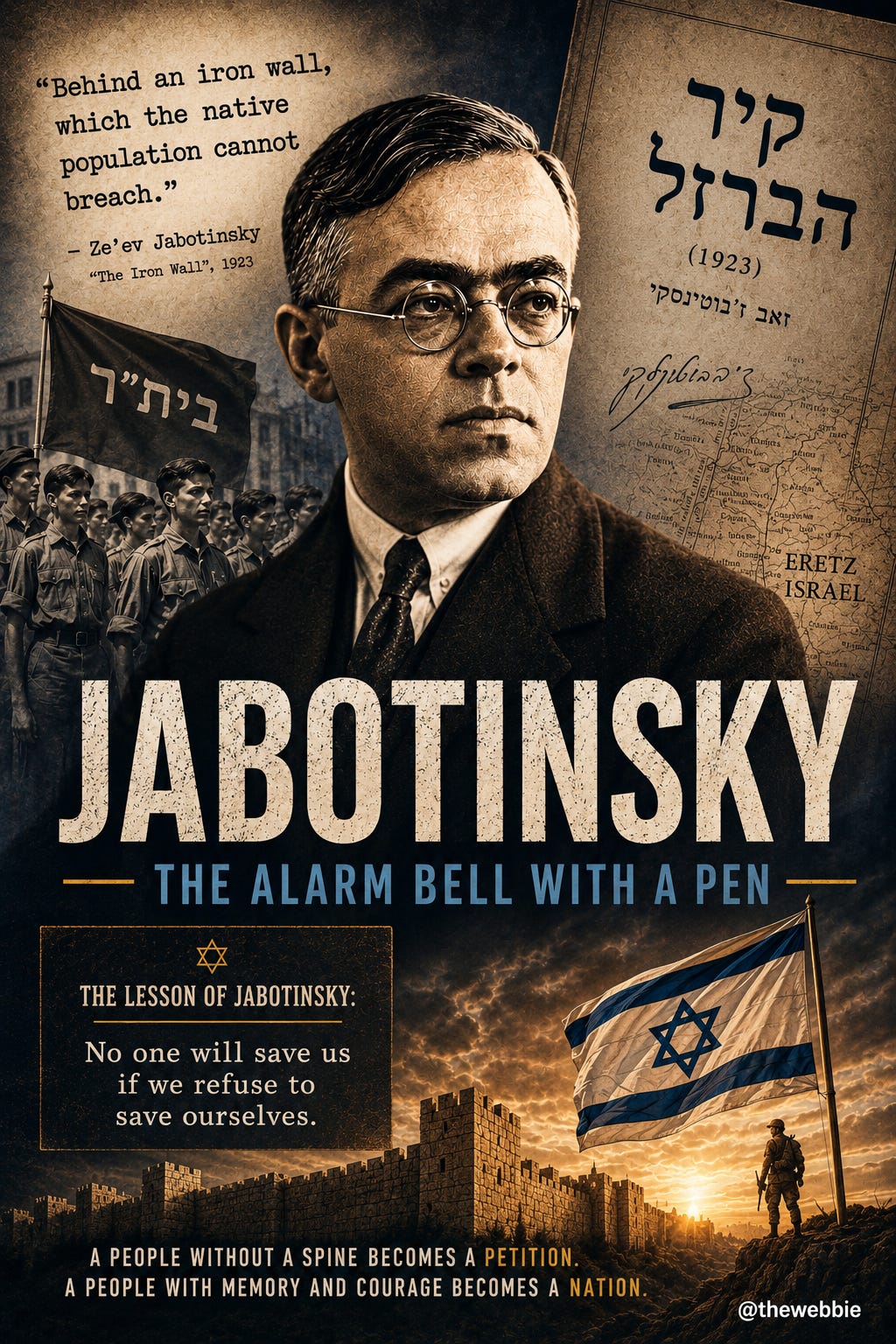
His most famous essay, “The Iron Wall,” written in 1923, is often quoted by people who have not read it, which remains one of humanity’s most popular hobbies.
Critics treat it as proof that Jabotinsky was cruel, militaristic, and allergic to peace.
But the essay is more serious than the bumper-sticker version.
Jabotinsky argued that no native population willingly accepts another national movement gaining sovereignty over land it also claims. That was not hatred. It was realism.
He did not treat the Arabs of the land as fools, props, or savages who could be bribed with slogans. He recognized them as a living people with their own national feelings. He believed they would resist Zionism for as long as they thought resistance could defeat it.
Jewish sovereignty therefore required an iron wall of strength so firm that the hope of destroying it would eventually collapse.
Only then could negotiation become real.
And the iron wall was not his vision of permanent war.
It was the condition he believed would make an honest peace possible. Once the dream of defeating Zionism disappeared, negotiation could begin over Arab rights, protection against displacement, national dignity, and coexistence between two peoples who could finally speak without one believing it could eliminate the other.
Strength was not the destination.
It was what made a destination other than Jewish defeat possible.
Not romantic. Not kumbaya Zionism. Not the kind of thing you embroider on a challah cover.
But history has a cruel habit of making realism sound harsh before reality proves it necessary.
Jabotinsky understood the difference between wanting peace and needing survival.
Peace does not begin when your enemy finally likes you.
Peace becomes possible when your enemy understands that you are not leaving.
That idea offends people who believe every conflict can be solved by better empathy and a grant-funded dialogue circle. Empathy matters. Dialogue matters. But if someone wants you dead, the first moral obligation is not to understand their childhood.
It is to prevent your murder.
By the 1930s, Jabotinsky’s alarm had become a siren.
He was no longer warning only that Jews needed strength. He was warning that millions of European Jews needed escape.
Jabotinsky promoted a plan to evacuate large numbers of Jews from Eastern Europe to Eretz Yisrael. He traveled, organized, argued, and pleaded with Jewish leaders to recognize that the danger was no longer theoretical and that time was running out.
Many rejected him.
Some called him alarmist. Others accused him of defeatism or of assisting antisemites who wanted Jews to leave Europe. They preferred patience, gradualism, political respectability, and faith that civilized governments would ultimately behave like civilized governments.
Jabotinsky heard the alarm.
Too many others heard an unpleasant man raising his voice.
History has a terrible record of explaining, afterward, why the Jewish alarmist was being unreasonable before the bodies appeared.
Jabotinsky died in 1940, before the full scale of the destruction became known. He did not live to see the Jewish state established. He did not live to see Jewish soldiers defending Jewish cities under a Jewish flag.
But he understood the danger of Jewish dependency.
He understood the danger of respectable denial.
He understood the danger of confusing hope with strategy.
After October 7, Jabotinsky feels less like a historical figure and more like a man banging on the walls from the past.
After the massacres, after the hostages, after the street celebrations, after the campus mobs, and after the lectures about “context” began before the dead were buried, his warnings no longer feel theoretical.
The world mourns vulnerable Jews far more comfortably than it tolerates powerful ones.
A dead Jew can become a lesson.
A Jewish state that fights back becomes a controversy.
And the deeper objection to Zionism is often simpler than borders, policies, settlements, governments, or speeches at the United Nations.
Jewish sovereignty itself.
When the demand is that the Jewish state alone must disappear, when every people may have national aspirations except the Jews, the issue is not policy.
It is sovereignty.
That is antizionism.
Antizionism takes one of the oldest demands made of the Jews and gives it academic vocabulary:
Disappear.
Jabotinsky understood that Jewish dignity requires a spine.
Not rage. Not cruelty. Not the worship of power.
A spine.
A people without a spine becomes a petition.
A people with memory and courage becomes a nation.
That is why Jabotinsky matters.
Not because he was always comfortable.
Not because he was always easy.
Not because everyone who later claimed his mantle honored the full seriousness of his thought.
He matters because he told Jews the truth before the truth was socially acceptable:
No one will save us if we refuse to save ourselves.
That is not despair.
That is responsibility.
And responsibility is deeply Jewish.
We pray, but we also build.
We hope, but we also guard.
We teach our children peace, but we do not teach them helplessness.
Jabotinsky was an alarm bell. Loud. Unpleasant. Impossible to ignore. The kind people want silenced because the sound ruins the room.
But sometimes the alarm bell is not the problem.
Sometimes the problem is the fire.
And Jewish history has had enough fires.
Jabotinsky did not ask Jews to worship power. He asked them to stop confusing helplessness with goodness and dependence with morality.
He saw something coming.
And he told us to stand.
Comments
Nothing yet. Say the first thing.
Sign in to join the conversation.