
Elul: The Month Before the Jewish New Year
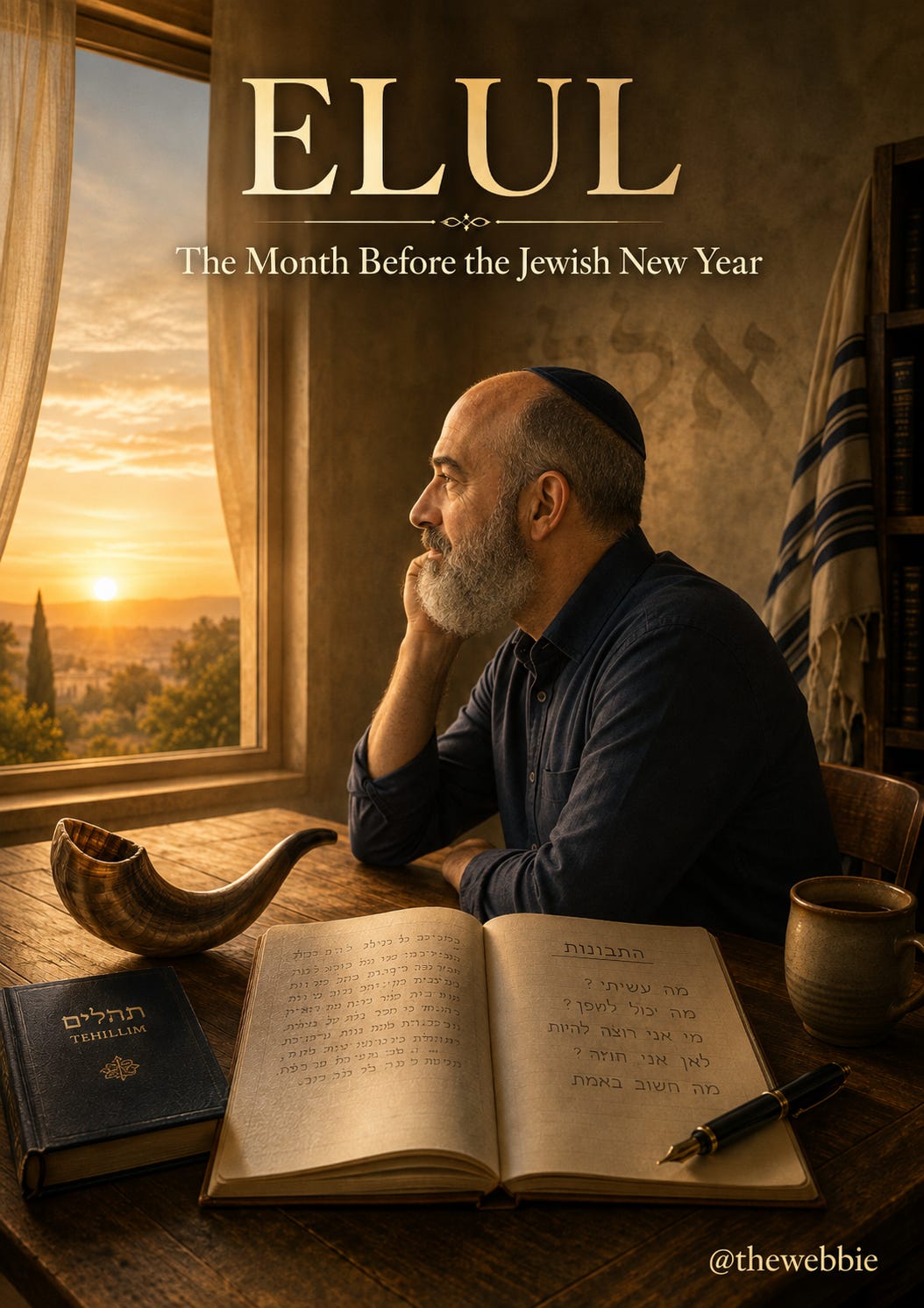
If nobody ever taught you what Elul is, this is for you.
Elul is the final month of the Jewish year, leading directly into Rosh Hashanah and Yom Kippur.
In 2026, Elul begins at sunset on Thursday, August 13, with 1 Elul falling on Friday, August 14, and ends at sunset on Friday, September 11, when Rosh Hashanah begins. Rosh Chodesh Elul is observed for two days this year, starting Wednesday evening, August 12.
There are no elaborate meals or celebrations. Judaism gives us time to prepare.
And by prepare, I do not mean buying apples and honey.
Elul is about taking stock of your life.
Before Rosh Hashanah asks us to begin a new year, Elul asks us to look honestly at the one we are finishing.
An Accounting of the Soul
There is a Jewish concept called cheshbon hanefesh, literally an “accounting of the soul.”
Think of it as an annual audit, except you are examining yourself.
What did I do well this year?
Where did I fail?
Who did I hurt?
Who did I neglect?
What relationships need repair?
What promises did I make and not keep?
What habits have I been excusing?
What am I proud of?
What kind of person am I becoming?
These are not particularly comfortable questions. They are not supposed to be.
Judaism does not approach the New Year by pretending everything is wonderful and making vague resolutions about becoming a better person. It asks you to identify where you need to become better.
That process is called teshuvah.
Teshuvah is usually translated as “repentance,” but the Hebrew carries the idea of returning.
Returning to G-d. Returning to your values. Returning to your responsibilities. Returning to the person you know you are capable of being.
That distinction matters. Teshuvah is not sitting around feeling guilty.
Guilt without change is useless.
The point is to recognize where you went wrong and do something about it.
G-d Is Not Your Loophole
This is one of the most important things to understand about Elul and Yom Kippur.
If you hurt another person, you cannot simply apologize to G-d and consider the matter closed.
Jewish tradition distinguishes between wrongs committed against G-d and wrongs committed against another human being. Yom Kippur does not erase an offense against another person until you have attempted to make things right with that person.
G-d is not your loophole.
That means Elul can involve uncomfortable conversations.
Maybe you owe someone an apology.
Maybe you need to admit you were wrong.
Maybe pride has kept a stupid argument alive for three years.
Maybe there is someone you love whom you have simply neglected.
And an apology is not, “I’m sorry you were offended.”
Acknowledge what you did. Take responsibility without hedging. Try to repair the damage. Change the behavior.
Otherwise, you are not really doing teshuvah. You are just saying words.
Why the Shofar?
During Elul, it is customary in many Jewish communities to hear the shofar, the ram’s horn, sounded each morning.
The sound is raw and piercing. It cuts straight through an ordinary morning.
That is the idea.
The shofar is an alarm clock for the soul.
Wake up.
Pay attention.
The year is almost over.
Stop moving through your life on autopilot.
There are things you need to deal with.
You do not need to be particularly religious to understand that message. Most of us could probably use something that interrupts our routine and forces us to ask whether we are actually living according to the values we claim to have.
“I Am My Beloved’s and My Beloved Is Mine”
Jewish tradition connects Elul with a verse from Song of Songs:
Ani l’dodi v’dodi li.
“I am my beloved’s and my beloved is mine.”
The first Hebrew letters of those four words spell Elul.
Elul is not only about judgment. It is also about closeness and return.
For religious Jews, that means drawing closer to G-d. But relationships between people need returning too.
People drift apart. Resentments accumulate. Important conversations get postponed. Things that should have been said remain unsaid.
Elul asks whether there are relationships worth walking back toward.
What Else Happens During Elul?
Many Jews add Psalm 27 to their daily prayers. It begins, “The Lord is my light and my salvation,” and speaks about faith, fear, hope, and seeking closeness to G-d.
As Rosh Hashanah approaches, Jewish communities begin reciting Selichot, special prayers centered on forgiveness and teshuvah. Customs differ between Ashkenazi and Sephardic communities, but the purpose is the same: preparation for the High Holy Days.
Elul is also traditionally a time for increasing tzedakah, charity, and other mitzvot.
Again, Judaism keeps pushing thought toward action.
Thinking about being generous is not generosity.
Feeling bad about hurting someone is not an apology.
Meaning to call your mother is not calling your mother.
Some Jews also visit the graves of parents, grandparents, relatives, teachers, and other loved ones before the High Holy Days.
Standing in a cemetery during Elul is clarifying in a way few other places are.
Your time is limited.
That does not have to be depressing. It should remind you that if something matters, perhaps stop behaving as though you have unlimited time to get around to it.
What If You’re Jewish but Not Religious?
Then Elul still belongs to you.
You do not need to suddenly become Orthodox. You do not need to understand every Hebrew prayer or pretend to be more religious than you are.
Start somewhere.
Spend five minutes a day thinking honestly about the past year.
Read Psalm 27 in English.
Hear the shofar.
Give tzedakah.
Call someone you have neglected.
Make an apology you have been avoiding.
Go to a Selichot service even if you have never been to one before.
Learn something Jewish that nobody ever taught you.
Do one mitzvah you normally would not do.
Judaism is your inheritance too.
And If You’re Not Jewish?
Elul is Jewish. It comes from Jewish tradition, Jewish theology, and the Jewish calendar. We do not need to turn it into generic self-help to make it understandable to everyone else.
But anyone can understand the questions it forces us to confront.
What kind of person have I been?
Who have I hurt?
What needs repairing?
What am I wasting?
What am I grateful for?
What needs to change?
Most cultures celebrate beginnings.
Judaism does something important before this one.
It makes us prepare.
Rosh Hashanah is coming.
Elul says that before you write the next chapter, you should probably read the one you just wrote.
No posts
Comments
Nothing yet. Say the first thing.
Sign in to join the conversation.