
The Brisket Incident
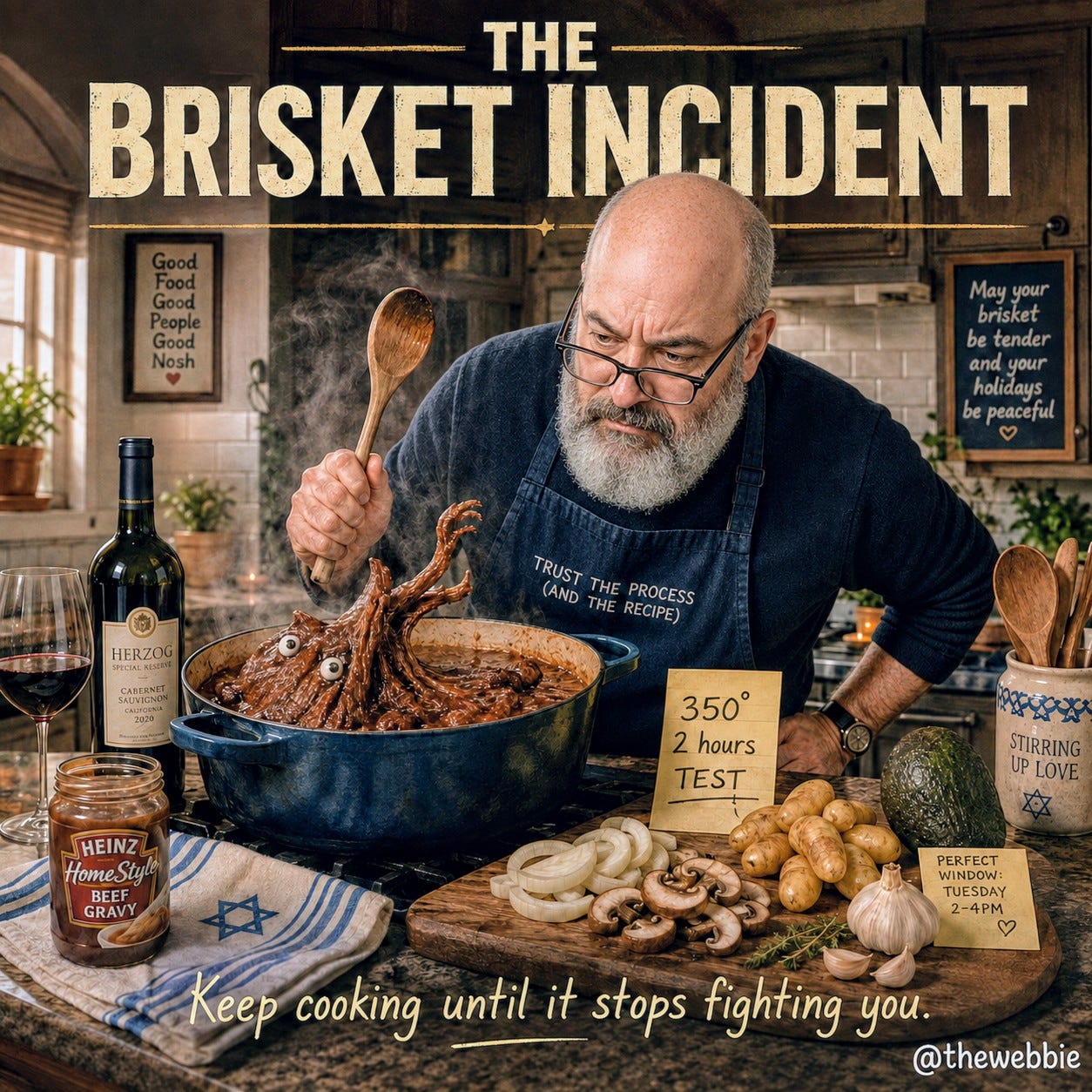
(Did you think I would make it easy for you?)
It started, as many important Jewish events do, with three pounds of brisket and absolutely no written plan.
I had a plan in my head, which is not the same thing.
The plan was brisket, onion, mushrooms, potatoes, garlic, gravy, au jus, red wine. Salt. Pepper. Garlic powder. Oven at 350.
This seemed sufficient.
Generations of Jewish women would have disagreed.
I seasoned the brisket aggressively because brisket is a large, stubborn piece of cow and whispering salt at it accomplishes nothing. Salt, pepper, garlic powder. Both sides. Enough seasoning that it understood we were serious.
Then came the gravy.
I had purchased a large jar of Heinz Savory Beef Gravy because I am a modern man and I see no moral virtue in spending six hours making something Heinz has already put in a jar.
There was also au jus.
How much?
Some.
This is how family recipes are born.
The women in my family would say things like “a little bit” or “until it looks right,” and then act confused when you asked them to define either measurement.
Apparently I have reached that age.
I sliced an onion, chopped garlic, dealt with the mushrooms, and opened a bottle of red wine.
The recipe required somewhere around a cup.
This created an immediate logistical problem because bottles of wine contain considerably more than one cup.
Waste is a sin.
I poured some into the Dutch oven.
I poured some into a glass.
The brisket and I were now both marinating.
I browned the meat first, which made me feel unusually competent. There is something deeply satisfying about putting a large piece of beef into a hot pan and hearing it hiss. For several minutes I stood there feeling less like a guy making dinner and more like a frontier blacksmith.
Then I removed the brisket, softened the onions, added garlic, and poured in the wine.
The kitchen immediately smelled fantastic.
Which is dangerous.
Nothing was actually done yet, but the house smelled good enough that I had already begun congratulating myself.
I added the gravy and au jus, stirred everything together, and put the brisket back into the pan fat side up.
I looked at it.
It looked at me.
We had an understanding.
Into the oven it went.
350 degrees.
Covered.
Two hours.
And then, according to the inherited wisdom passed down through the family:
“test.”
Test what?
Tenderness? Temperature? My faith?
Apparently my great-grandmother had decided Future Matthew would figure it out.
Two hours later I opened the oven and poked the brisket.
It was not tender.
You spend two hours cooking a piece of meat and somehow it has become tougher.
This feels like a personal betrayal.
But brisket has a cruel personality. There is a period during cooking when it seems determined to convince you that you have ruined dinner.
You have not ruined dinner.
The brisket is simply being an asshole.
So I added the mushrooms and potatoes.
Originally, I had considered using a much larger amount of potatoes, until reason prevailed. This was brisket with potatoes, not potatoes featuring a ceremonial appearance by beef.
I settled on roughly three-quarters to one pound.
Fingerlings were ideal because they have the structural integrity necessary to survive an extended encounter with gravy.
Red potatoes would also work.
I nestled them around the brisket, put the lid back on, and returned everything to the oven.
Forty-five minutes later I checked.
No.
Twenty minutes later.
Almost.
And this is where brisket starts behaving like a ripe avocado.
There are rules right up until there aren’t.
An avocado can sit on your counter for four days as a green rock, become perfect sometime between 2:17 and 3:04 on Tuesday afternoon, and be brown pudding by dinner.
Brisket has the same sense of humor.
For hours it is tough.
Then suddenly there is a small, glorious window where the connective tissue has surrendered, the meat is tender, the slices hold together just enough, and everything is exactly right.
Nobody can tell you precisely when that window will happen.
Not the recipe.
Not the clock.
Not your grandmother.
The brisket decides.
Your job is to be standing nearby when it does.
I poked it again.
The fork slid in.
The brisket had surrendered.
A piece of beef with the structural integrity of roofing material was suddenly dinner.
I took it out and let it rest.
This was difficult.
Resting meat is one of cooking’s more unreasonable demands. You spend three hours making something smell incredible and then, at the exact moment you are finally allowed to eat it, every recipe tells you not to touch it.
Fine.
Twenty minutes.
I sliced it against the grain, because slicing brisket with the grain is how you turn three hours of work into shoe leather.
The slices fell apart just enough.
The onions had nearly disappeared into the gravy. The mushrooms had absorbed everything around them. The potatoes had soaked up beef, garlic, wine, and probably several generations of Jewish anxiety.
I spooned the gravy over the brisket and tasted it.
The gravy had gone from something poured out of a jar into something dark and ridiculous, thick with onion, garlic, beef fat, mushrooms, and the red wine that had somehow survived the entire ordeal.
The brisket was soft without being mush, and there it was: that moment when a recipe stops being a collection of ingredients and becomes something you know you’re going to make again.
Of course, the truly annoying part is that brisket is usually even better the next day.
Apparently the reward for successfully making brisket is discovering that yesterday’s version of you was an amateur.
A night in the refrigerator does something to it. The gravy gets richer. The meat settles into itself. You skim the fat, slice it cold, put it back in the gravy, and warm it slowly.
Then somehow the brisket you were proud of yesterday becomes the brisket you were actually trying to make.
It is culinary proof that sometimes sleeping on a problem actually works.
So now I have a brisket recipe.
Sort of.
Three pounds brisket. Onion. Mushrooms. Garlic. Fingerlings. Heinz gravy. Au jus. Red wine.
350 degrees.
Two hours.
Test.
Add things.
Keep cooking until the brisket stops fighting you.
Very scientific.
My grandmother would understand perfectly.
No posts
Comments
Nothing yet. Say the first thing.
Sign in to join the conversation.