
Stop Arguing About Whether They’re Antisemitic
One of the least useful arguments Jews keep getting dragged into starts with a legitimate observation and immediately goes off the rails.
Someone says Zionists are colonizers, Israel is genocidal, Zionism is racism, or Israelis are the new Nazis. A Jew responds, “That’s antisemitic.”
And now the original claim disappears.
The person is offended. They hate antisemitism. They despise Nazis. They oppose racism. They have Jewish friends. Maybe they are Jewish themselves. Within thirty seconds, nobody is talking about Zionism, genocide, colonialism, or Nazis anymore.
We are talking about whether this person is a Good Person.
That is usually where the useful conversation ends.
The problem is not necessarily that calling the accusation antisemitic is wrong. Some antizionist rhetoric is plainly antisemitic, and some people spreading it are plainly antisemites.
The problem is that you have chosen the least useful argument first.
The moment you define the person instead of examining the accusation, you trigger a fight over identity. They stop asking whether what they said is true and start proving that they are not the kind of person who hates Jews.
People are perfectly capable of sincerely believing contradictory things.
Someone can believe antisemitism is disgusting while also believing Zionists are colonialists, racists, genocidaires, or Nazis. Inside their head, there is no contradiction. They do not experience those accusations as antisemitic. They experience them as antiracist, anti-colonial, humanitarian, or antifascist.
You say, “You are repeating an antisemitic accusation.”
They hear, “You are morally equivalent to the Nazis you hate.”
Of course they defend themselves.
So stop making them the subject.
Put the accusation on the table instead.
A Libel Is Not Just a Lie
This is the idea at the center of Dr. Naya Lekht’s framework for decoding antizionist libels.
A libel is not simply a false statement.
A lie can often be corrected with a fact. A libel is harder because it is built from fragments of reality and assembled into a moral verdict. The framework describes a libel as something that uses snippets of truth, spreads through a propaganda campaign, and ultimately assigns moral ugliness to the target.
There really was a war.
There really was displacement.
There really was a civilian death.
There really was an Israeli politician who said something ugly.
There really are checkpoints.
There really are military strikes.
Those are the raw materials.
The libel begins when those facts are stripped of context, reorganized, and turned into something much larger.
A civilian death becomes proof that Israel is genocidal. Jewish migration becomes proof that Jews are foreign colonizers. Security measures become proof of apartheid. A war involving Jews becomes a Nazi analogy.
The accusation no longer tells you what Israel supposedly did.
It tells you what Zionists are.
Colonizers.
Racists.
Genocidaires.
Nazis.
That is the product.
Once someone accepts that verdict, every new event gets interpreted through it. You are no longer dealing only with missing information. You are dealing with a framework that has already decided what the information means.
So dumping seventy-five years of Middle Eastern history into somebody’s lap may accomplish very little. Calling them an antisemite may accomplish even less.
Both can leave the thing actually doing the work untouched.
The libel.
Name the Thing
The response framework is simple:
Name it.
Describe it.
State the consequence.
Take the colonizer accusation.
Them: “Israel is a settler-colonial project.”
You: “That’s the colonizer libel. Versions of that accusation were already circulating before Israel was re-established. If you want to understand what you’re saying, we should look at where that framework came from.”
Then stop.
Do not immediately unload a history textbook onto them.
Let the naming sit.
You have not told them who they are. You have identified what they are carrying.
Now there is something concrete to examine. They do not have to confess that they secretly hate Jews before the conversation can continue. They only have to consider the possibility that an accusation they inherited has a history they do not know.
So check the birth certificate.
Where Did This Come From?
Most people repeating antizionist accusations believe they are using language created by the current conflict.
Often they are not.
The training traces versions of the colonizer accusation to propaganda circulating before Israel’s re-establishment. It traces genocide rhetoric to the 1940s, with later Soviet amplification. The racialization of Zionism became a major Soviet political project and eventually received international legitimacy in 1975 when UN General Assembly Resolution 3379 declared that “Zionism is a form of racism and racial discrimination.”
That creates an obvious problem.
If “Zionism is colonialism” is simply a conclusion produced by later Israeli policies, why was the accusation circulating before the state was re-established?
If Zionism became “racism” because of contemporary Israeli conduct, why were Soviet propagandists building that political framework decades ago?
The point is not that the college student chanting “settler colonialism” secretly reads Soviet propaganda.
The point is that successful propaganda eventually stops looking like propaganda.
A government manufactures a framework. Academics refine it. International institutions legitimize it. NGOs repeat it. Journalists normalize it. Activists turn it into slogans. Social media compresses it into something that fits on an Instagram slide.
By the time an ordinary person encounters it, it feels less like an inherited political argument and more like an obvious description of reality.
Genealogy puts the inheritance back in view.
Propaganda is much happier showing you its evidence than showing you its birth certificate.
How a Libel Travels
A libel needs three things to travel: an apparent piece of evidence, an authority that legitimizes it, and an emotional payload that turns the target into something disgusting.
A photograph or death supplies the evidence. A professor, NGO, international institution, journalist, government, or celebrity supplies legitimacy.
Then comes the verdict.
Nazi.
Racist.
Colonizer.
Genocidal.
Child killer.
The purpose is no longer simply to convince people that Israel did something wrong. It is to make Zionists morally repulsive.
Correct false facts when you must. Challenge the validators.
But force the moral verdict into the open.
What are you actually teaching people to believe about Zionists?
Permission to Treat People Differently
The framework calls a libel a “permission structure.”
People usually need a moral justification before they mistreat somebody and still think of themselves as righteous.
That is why the label matters.
You do not harass innocent students.
You confront Nazis.
You do not exclude Jews.
You exclude racists.
You do not intimidate people because of their identity.
You hold colonizers accountable.
You do not attack a community.
You resist genocide.
Once Zionists have been successfully defined as Nazis, racists, colonizers, and genocidaires, hostility toward them can be experienced not as prejudice but as virtue.
And then the target expands.
It does not stay with Netanyahu.
It does not stay with the Israeli government.
It moves to Israeli civilians.
Then Jewish students.
Then synagogues and Jewish organizations.
Then Jewish-owned businesses.
Then Jews who openly identify with Israel.
Eventually it reaches the Jew who simply refuses to perform the ritual denunciation demanded of him.
This is what makes the libel more than ugly language. It is a social technology for expanding the circle of legitimate targets.
If you spend years teaching people that Zionists are genocidal Nazis, you cannot act surprised when some of them begin treating Zionists as though they are genocidal Nazis.
The rhetoric supplies the moral justification.
Then the justification finds a target.
At that point, whether the original speaker personally feels hatred toward Jews matters less than they would like it to.
Architects and Carriers
Not everyone spreading these accusations is the same.
Some know exactly what they are doing. They are ideological architects, propagandists, activists whose worldview depends on demonizing Zionism, or committed antisemites. You are probably not talking them out of it over coffee.
But many others are carriers.
They absorbed a worldview from institutions they trusted.
They were taught that colonialism is evil.
Racism is evil.
Genocide is evil.
Nazism is evil.
Antisemitism is evil.
Then they were taught that Zionism belongs in the first four categories rather than the fifth.
That is the person worth testing.
Not coddling. Testing.
Show them what they are carrying.
Name the libel. Show them its genealogy. Show them how fragments of reality were turned into a total moral verdict. Show them who gave the accusation legitimacy. Show them what happens when Zionists are transformed from political opponents into monsters.
Then see what they do.
If they did not know the history and want to examine it, you have an opening.
If they challenge your evidence, fine. Now you are finally arguing about the accusation instead of their moral résumé.
But if you show them the history, the construction, and the consequence, and they continue repeating the accusation unchanged, that is information too.
Ignorance no longer explains everything.
They have seen the mechanism.
They know what they are carrying.
And they have decided to keep carrying it.
Break the Transmission Chain
This is why I am increasingly uninterested in beginning these conversations with, “Are you an antisemite?”
Maybe they are. Maybe they are not.
For the first few minutes, I do not care.
I want the accusation on the table.
Where did it come from?
Who built it?
Who legitimized it?
What moral character does it assign to Zionists?
What behavior does that verdict make acceptable?
Those are harder questions than “Do you hate Jews?”
Almost everyone knows how to answer that one.
“No.”
Fine.
Now we can talk about something useful.
The libel itself.
Because that is what moves through society. It moves from propagandist to institution, from institution to professor, from professor to activist, from activist to journalist, from journalist to social media, and from social media into ordinary conversation.
The goal is to break that transmission chain.
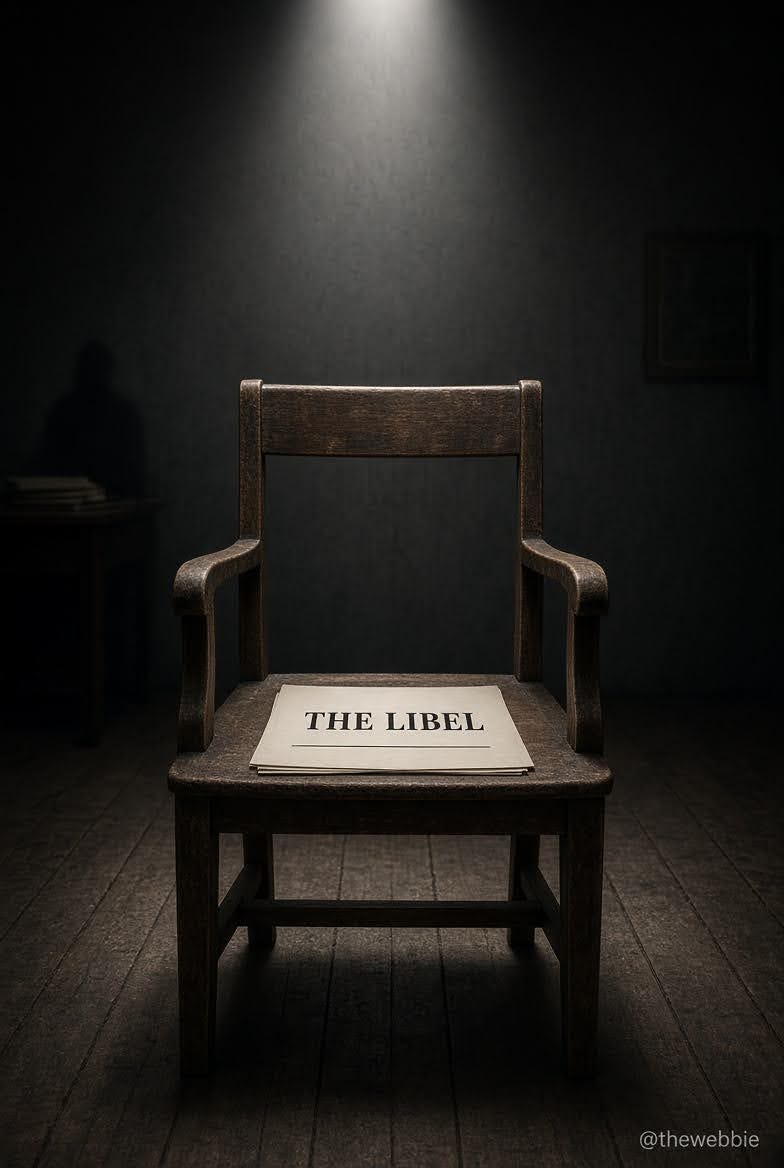
So put the libel in the chair.
Name it.
Trace it.
Expose what it does.
Then watch what the person does once they know.
If they put it down, you reached someone.
If they keep carrying it after they know what it is, stop wondering what to call them.
They just told you.
-----
If you want to understand this framework more deeply, I strongly recommend the Stop Antizionism training developed by Dr. Naya Lekht. It teaches you how antizionist libels are built, how they spread, how institutions give them legitimacy, and how to dismantle them in real conversations. If you spend time arguing about Israel, antisemitism, or antizionism, this is training worth doing.
Learn more at:
https://stopaz.org/
Comments
Nothing yet. Say the first thing.
Sign in to join the conversation.