
Forged in Fire: Israel’s Greatest Generation and the Launch of a Golden Age
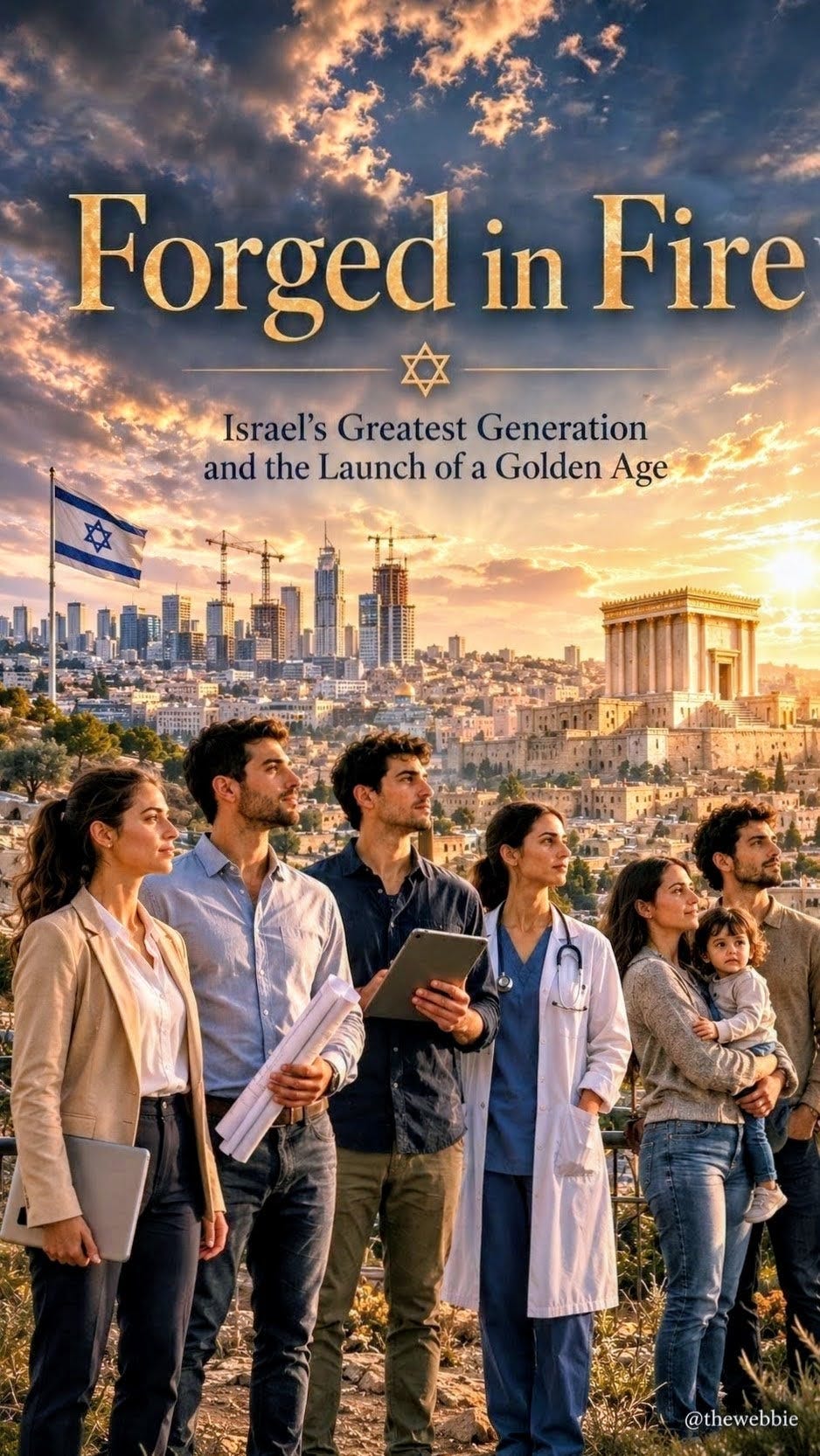
Something remarkable happened in Israel in the second quarter of 2026.
The economy grew at an annualized rate of 15.4 percent.
That number needs context. Israel was rebounding from a first-quarter contraction caused largely by the war with Iran, and nobody should pretend 15.4 percent is a sustainable annual growth rate. What matters is how broad the rebound was. Business output surged, private consumption jumped, exports accelerated sharply, and fixed investment rose across the first half of the year.
This is not proof of a Golden Age.
It is the first economic tremor of one.
Israel is entering a period that will eventually be understood as one of the most important transformations in the country’s history. Not because the wars that began on October 7, 2023 were good. They were catastrophic. Thousands of families have paid prices that cannot be captured in GDP figures, military communiqués, or speeches about resilience.
But history has an uncomfortable habit of forging extraordinary generations through terrible circumstances.
America had one. Israel has one now.
How a Generation Becomes Greatest
The Americans who came of age during the Great Depression and World War II did not begin as legends.
They became legendary because history demanded things of them that their childhoods had not prepared them to expect. They endured economic collapse, uncertainty, mass mobilization, separation, death, and a world war fought simultaneously across Europe and the Pacific.
Then they came home. And built.
That final part matters.
America’s Greatest Generation was not great merely because it defeated Nazi Germany and Imperial Japan. Its historical significance came from what happened afterward. Veterans became engineers, scientists, business owners, teachers, political leaders, doctors, managers, and institution builders.
They built highways, companies, universities, laboratories, aircraft, computers and eventually spacecraft. They helped construct an international order backed by American military power, industrial capacity and scientific leadership.
The war had taught them something peacetime never could have.
They knew catastrophe was possible, institutions could fail, and free societies were not self-sustaining.
Most importantly, they had discovered that enormous problems were still solvable.
A generation that had landed men on beaches under machine-gun fire was not easily intimidated by building an interstate highway system. A generation that had mobilized millions did not assume large projects were impossible simply because they were difficult.
War had given them a terrible education in agency.
Israel’s young men and women have received the same education.
October 7 Changed the Israelis Who Survived It
October 7, 2023 was not simply another terrorist attack or another round in an old Middle Eastern conflict.
It was a civilizational shock.
For Israelis, it carried the military surprise of Pearl Harbor while touching something much older and darker in Jewish memory. Jews were murdered in their homes. Families were burned. Young people were hunted at a music festival. Israelis were dragged across the border as hostages.
The fundamental promise of Jewish sovereignty had been violated: never again would Jews have to wait helplessly for somebody else to decide whether they deserved protection.
And then Israel responded.
Within 48 hours, the IDF had called approximately 300,000 reservists.
Think about what that means in a country Israel’s size. People disappeared from offices, universities, construction sites, hospitals and technology companies. Parents left children. Business owners left companies. Doctors treated the wounded while colleagues were called into uniform. Families reorganized themselves around reserve schedules that eventually became measured not in days, but in months and years.
The generation outsiders had dismissed with all the usual clichés about smartphones, social media and supposedly soft young people suddenly discovered that history had other plans for it.
Then the war kept going.
Gaza.
Lebanon.
Iran’s regional network.
Direct confrontation with Iran itself.
Missile attacks. Drones. Reserve call-ups. Funerals. Displacement. Interrupted careers. Interrupted marriages. Interrupted childhoods.
Hundreds of thousands of Israelis learned that national survival was not something outsourced to an abstract institution called the IDF.
It depended on them.
America’s Greatest Generation was formed in depression, mobilization and world war.
Israel’s was formed at Be’eri and Kfar Aza, in Gaza and Lebanon, in bomb shelters, reserve units and the skies over Iran.
Something fundamental changed.
The End of the Luxury of Illusion
Before October 7, Israelis could argue endlessly about what kind of country Israel should become.
After October 7, an older question returned:
Will there be an Israel capable of remaining Israel?
The generation now coming into adulthood has learned that national security is not an abstract portfolio handed to generals and politicians. Jewish sovereignty is not self-executing. Borders do not defend themselves. Missile-defense batteries do not magically refill themselves. Intelligence services can fail. Alliances matter, but allies cannot substitute for national capability.
They have also learned that normalcy is fragile.
That is not pessimism.
It is seriousness.
There is a profound difference between a society obsessed with danger and a society that understands danger. The first becomes paralyzed by fear. The second builds capacity.
Israel is becoming the second.
The religious soldier and secular programmer may still disagree bitterly about politics. Left and right have not disappeared. Ashkenazi and Mizrahi differences have not vanished. Nor should they.
National unity is not unanimity.
What changed is the hierarchy.
Arguments that once seemed existential were demoted by an actual existential threat.
When rockets arrive, nobody asks which ideological camp operates the interceptor. When a unit is under fire, nobody cares how the soldier beside him voted. When communities need supplies, medical treatment and reconstruction, competence becomes more important than signaling membership in the correct political tribe.
That change in hierarchy will be one of October 7’s most consequential legacies.
Israel’s Greatest Resource Is Its People
Israel has never possessed the advantages normally associated with great powers.
It does not have America’s continental scale, Russia’s geographic depth, China’s population or the Gulf states’ enormous petroleum reserves.
What Israel has is its people.
That has always been its greatest resource, and the years since October 7 have demonstrated just how valuable that resource is.
Not only soldiers.
Engineers.
Doctors.
Entrepreneurs.
Scientists.
Farmers.
Teachers.
Parents.
Immigrants.
Reservists who leave their jobs for months and then somehow return to them.
Families who keep households functioning while one parent is at war.
Communities that organize food, housing, transportation and childcare before government bureaucracy has even figured out where to send the forms.
The war exposed something that already existed inside Israeli society: an unusual density of people accustomed to improvising, adapting and taking responsibility.
Battlefield requirements compressed development cycles. Defense companies, engineers, reservists, civilian volunteers, cyber specialists, medical teams and logistics networks adapted under pressure because failure carried immediate consequences.
And the commercial base underneath that wartime innovation was already extraordinary.
The Israel Innovation Authority reported that Israeli high-tech produced roughly $85 billion in exports in 2025, accounting for 58 percent of the country’s exports. Israeli technology companies raised approximately $14.6 billion, up 30 percent from 2024. Israel ranked as the world’s fourth-largest startup fundraising hub and the largest outside the United States. Roughly 775 new startups were founded during the year, reversing a long decline in company formation.
Defense technology tells an equally important story.
Israeli defense exports reached a record $19.2 billion in 2025, the fifth consecutive annual record. The figure had more than doubled in five years and quadrupled in a decade, with missile, rocket and air-defense systems representing the largest category.
These are not predictions about what Israel might someday become.
They are evidence of what Israel is already capable of while fighting a multi-front war.
Israel was the Start-Up Nation before October 7.
Now take a generation of Israelis who spent their twenties and thirties learning that impossible problems still have to be solved because nobody is coming to solve them for you.
Then give them thirty years.
They will run companies, build laboratories, found startups, command institutions, teach students, raise families, develop medicines and create the next generation of missile defense, cyber systems, water technology, agricultural technology and artificial intelligence.
But the technology is not the resource.
The people are.
Technology is what happens when you give those people a problem.
Pressure did not create Israel’s human capacity. It revealed it.
And now an entire generation knows what it is capable of.
Political dysfunction, a heavy security burden, competition for talent and the temptation to return to old divisions are real problems. They are not arguments against the trajectory.
They are the terrain this generation will master.
America’s Greatest Generation did not inherit a clean slate either.
It built anyway.
From Regional Survivor to Strategic Power
The military transformation may be even more significant than the economic one.
For decades, Iran attempted to surround Israel with a “ring of fire,” supporting armed organizations in Gaza, Lebanon, Syria, Iraq and Yemen while developing its own missile and nuclear capabilities.
Israel spent years managing that architecture.
That era is ending.
Hamas was devastated as an organized military force. Hezbollah’s leadership and military infrastructure suffered enormous losses. Syria ceased to function as the same Iranian strategic corridor it had been. Iran’s air defenses, missile infrastructure and military capabilities came under direct Israeli attack.
The significance is larger than any individual operation.
Israel changed the doctrine.
For much of its history, Israel was forced into a reactive posture. Someone built tunnels, Israel found the tunnels. Someone constructed a missile network, Israel built interceptors. Someone surrounded Israel with proxies, Israel managed the proxies.
The emerging doctrine is different.
Shape the environment.
Destroy capabilities before they mature.
Make aggression expensive.
Use intelligence, airpower, cyber capabilities, alliances and technological superiority together.
Stop merely pruning the branches.
Attack the architecture.
That is what regional power looks like.
Iran remains dangerous.
But Israel has demonstrated that it can reach not only the proxies, but the architects behind them.
That changes calculations from Tehran to Riyadh, from Beirut to Washington.
It also changes the logic of regional diplomacy.
The Abraham Accords were built on a simple recognition: many Arab states and Israel have overlapping interests stronger than the ideological assumptions that once demanded permanent hostility.
A more capable Israel strengthens that logic.
States do not build durable relationships out of affection. They do so because relationships serve their interests.
A country capable of defending shared airspace, providing advanced technology, delivering intelligence, countering Iranian power, producing water and agricultural solutions and integrating into global innovation networks becomes increasingly difficult for its neighbors to ignore.
The Abraham Accords will be remembered not as the culmination of Israel’s regional acceptance, but as its beginning.
A Different Kind of Superpower
Calling Israel a future “superpower” requires some explanation.
Israel is not going to become the United States or China.
It will not have hundreds of millions of people. It will not control continents. It will not dominate global manufacturing.
That is not the kind of superpower I mean.
Israel is becoming something the 21st century increasingly rewards:
a superpower of capability.
A state whose importance is wildly disproportionate to its physical size.
A country other states need because it possesses technologies, intelligence, weapons, scientific knowledge and problem-solving capacity they cannot easily reproduce themselves.
Missile defense matters when missiles threaten cities.
Cybersecurity matters when entire economies depend on vulnerable networks.
Desalination and water management matter in a drying world.
Agricultural technology matters when populations must produce more food from less land.
Medical innovation matters everywhere.
Artificial intelligence, autonomous systems, quantum computing and defense technologies will shape the balance of power for the rest of this century.
Israel already operates near the front edge of many of these fields.
This generation will move it much further.
And here is the part that matters most to me:
for good.
Israelis are not saints, and sovereignty does not make a country immune to the temptations of power.
But the existence of a powerful Jewish state carries a moral meaning that extends far beyond Israel’s borders.
For two thousand years, Jewish history was largely written inside civilizations controlled by somebody else.
Kings decided.
Popes decided.
Sultans decided.
Governments decided.
Neighbors decided.
Movements decided.
Jews adapted.
They negotiated.
They pleaded.
They fled.
Sometimes they survived. Sometimes they did not.
Israel changed the grammar of Jewish history.
The Jews decide.
That is the revolution.
A Jewish state capable not merely of surviving but of becoming extraordinarily powerful completes something that began in 1948. It proves that the Jewish return to sovereignty was not a desperate temporary refuge constructed after catastrophe.
It was the reentry of an ancient people into history as an agent.
The Jew is no longer merely the object of somebody else’s politics.
Jewish safety is no longer dependent entirely on somebody else’s tolerance.
Jewish history is no longer written exclusively by the people powerful enough to act upon Jews.
The Jews decide.
They defend.
They build.
They choose allies.
They make mistakes.
They correct them.
They carry responsibility for the consequences.
That is sovereignty.
And that lesson travels far beyond the Jewish people.
A people can suffer catastrophe without making victimhood its permanent identity.
A civilization can recover agency.
A minority can refuse dissolution.
A nation can choose life without asking permission.
That is power for good.
Israel’s Greatest Generation
We will not know the full significance of this generation for decades.
The soldier coming home from reserve duty today may run a major company in 2045. The young engineer solving an impossible wartime problem may build an industry nobody has imagined yet. The physician treating blast injuries may create a medical technology used around the world. The intelligence officer analyzing Iranian weapons networks may later build the next breakthrough in cybersecurity.
And through all of it, Israelis kept creating life.
Children were born.
Couples married.
Businesses opened.
Companies raised money.
Universities taught.
Scientists conducted research.
Farmers planted.
Reservists came home, showered, slept, kissed their children and returned to work.
In the middle of a war meant to break Jewish life, Israelis continued creating Jewish life.
That is a civilizational instinct.
Build anyway.
Marry anyway.
Have children anyway.
Start the company anyway.
Plant the tree anyway.
The people trying to kill you do not get a veto over your future.
The generation of October 7 understands that in its bones.
The Golden Age Is Not Peace
A Golden Age does not begin when every enemy disappears and everybody gets to relax.
America’s postwar ascendancy was born directly into the Cold War.
Israel’s Golden Age may begin in an equally dangerous world.
Iran will remain a threat in some form. Jihadist movements will not disappear. Great-power competition will intensify. Antisemitism will not dissolve because Israel becomes stronger. New weapons will create new vulnerabilities.
So what?
The objective cannot be to return to October 6, 2023.
That world is gone.
America did not emerge from World War II determined to restore 1939. The generation that fought the war understood that victory meant building something larger than the world that had existed before it.
Israel faces the same choice.
It can spend the next generation trying to recover the comfortable assumptions destroyed on October 7.
Or it can build the country those assumptions prevented it from imagining.
More powerful.
More technologically dominant.
More economically independent.
More strategically confident.
More Jewish.
More capable of defending itself.
More useful to its allies.
Less interested in apologizing for its existence.
The 15.4 percent GDP surge will disappear from the headlines quickly. Quarterly economic statistics always do.
But remember this one.
Not because Israel will grow 15.4 percent forever.
It will not.
Remember it because after years of war, mobilization, missiles, funerals, displacement, political chaos and predictions of collapse, Israelis did something they have been doing for a very long time.
They got back to work.
America’s Greatest Generation did not create the American century because the war had been easy.
It created it because after surviving something terrible, it refused to confuse survival with achievement.
Israel’s Greatest Generation has been forged.
The dangers remain. The losses are permanent. Nothing about the future is automatic.
But the ingredients are already here.
The people.
The competence.
The technological engine.
The strategic position.
The national memory.
The hard-earned clarity.
For most of Israel’s existence, the question hanging over the Jewish state was whether it would survive.
That is no longer the most interesting question.
The question for the next fifty years is:
How far will this generation take it?
Comments
Nothing yet. Say the first thing.
Sign in to join the conversation.