
A Jewish Messenger Does Not Launder a Libel
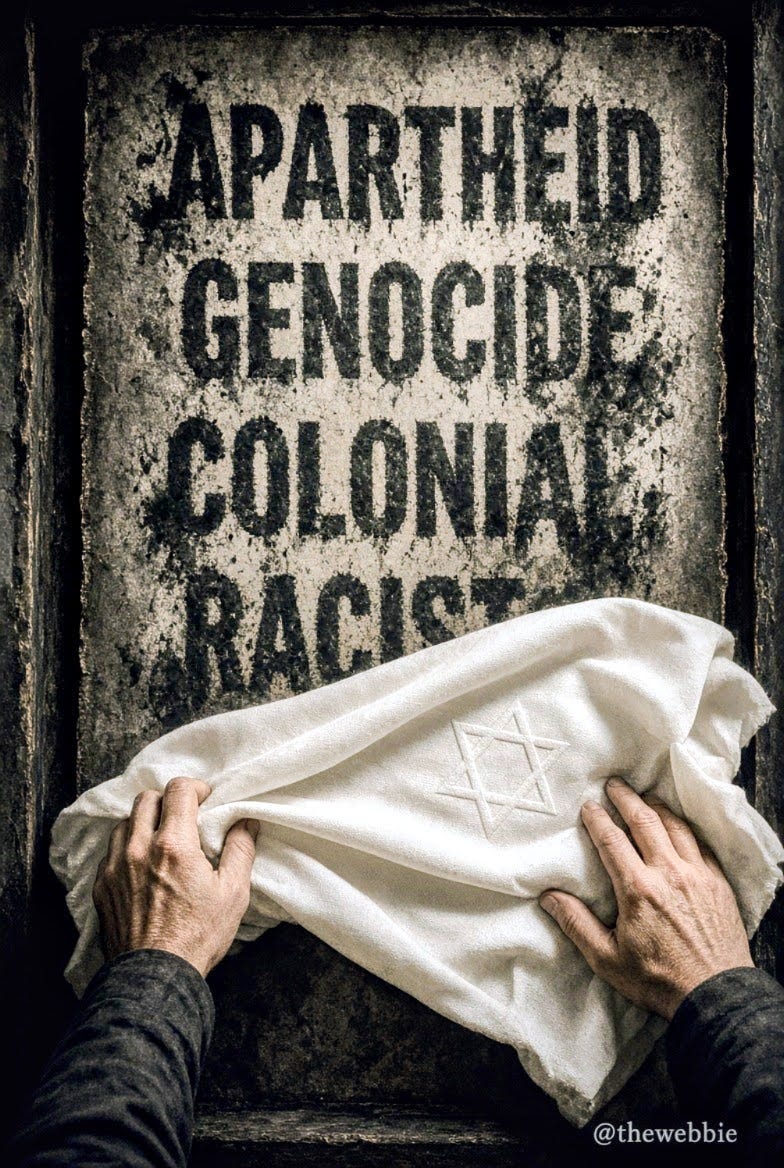
How Jewish participation helps make antizionism respectable
There is a sentence from Dr. Naya Lekht’s Antizionism 101 training that I have not been able to shake:
“A Jewish messenger does not launder a libel.”
It is a deceptively simple sentence because one of the most effective defenses of antizionism today is also one of the laziest: But Jews say it too.
A Jewish professor calls Zionism racist. A Jewish student calls Israel a settler-colonial state. A Jewish organization describes Israel as apartheid. A Jewish activist accuses Israel of genocide and then appears at the front of the protest as evidence that none of this can possibly be Jew-hatred.
Look. A Jew agrees.
Apparently Jewish identity now comes with a built-in fact-checking service.
The problem should be obvious. Jews are human beings. We can be brilliant, stupid, perceptive, deluded, courageous, cowardly, informed, ignorant, principled and fashionable. Sometimes several of those before breakfast. Jewishness does not confer historical omniscience, and it certainly does not turn an accusation into a fact.
But Jewish participation in antizionism does matter, just not in the way antizionists think it does. Its importance is not primarily numerical. It is rhetorical. The Jewish antizionist can function as ethos, lending credibility and moral insulation to an accusation that would receive far more scrutiny if it came from someone outside the group.
That is a much more useful thing to understand than spending another afternoon arguing over whether someone is a “self-hating Jew.”
THE NUMBERS ARE MESSIER THAN THE SLOGAN
So how many Jews are actually antizionists?
There is no intellectually honest single number because pollsters ask different questions. Do you call yourself a Zionist? Do you feel attached to Israel? Is Israel important to your Jewish identity? Do you support the Israeli government? Do you believe particular accusations against Israel? Those are not interchangeable questions.
Recent polling nevertheless shows a real fracture inside American Jewry, particularly by age, religiosity and political orientation. Significant numbers of Jews reject the Zionist label or accept some of the harshest accusations now directed at Israel, even while American Jews overwhelmingly recognize that antisemitism itself has become a serious and growing problem.
That contradiction is more interesting than any single percentage. Many Jews can correctly sense that something is happening to us while failing to recognize antizionism as one of the primary languages through which contemporary Jew-hatred now travels.
There is also an organized Jewish antizionist infrastructure. Jewish Voice for Peace does not hide what it is. It openly describes itself as an anti-Zionist Jewish organization and explicitly organizes Jews against Zionism and against American institutional support for Israel.
One phenomenon is Jewish alienation from Zionism. Another is the active use of Jewish identity to provide credibility to an ideological campaign against Zionism. They overlap, but they are not the same thing.
JEWISH ANTI-ZIONISM DID NOT BEGIN ON CAMPUS
It would be historically illiterate to pretend Jewish opposition to Zionism suddenly appeared at a Students for Justice in Palestine meeting. Jews were arguing about Zionism before Herzl had finished arguing with other Zionists.
Some early Reform Jews rejected Jewish nationalism because they understood Judaism primarily as a religion and wanted full integration into the countries where they lived. Jewish socialists such as the Bund rejected Zionism from a different direction, arguing that Jews should build political and cultural life where they already lived. Certain ultra-Orthodox groups opposed Zionism for theological reasons, believing that Jewish sovereignty could not legitimately be restored through secular nationalism before divine redemption.
These were not the same arguments. An assimilationist American Reform Jew, a Bundist socialist and an anti-Zionist Haredi rabbi may all have opposed Zionism, but they arrived there through completely different understandings of Judaism, nationhood, modernity and redemption.
That history matters because I am not interested in pretending that every Jewish objection to Zionism throughout history is identical. It plainly is not.
The question here is narrower: What happens when Jews adopt and transmit the libels through which modern antizionism portrays Israel, the collective Jew, as a uniquely evil political actor?
THE JEWISH ANTIZIONIST AS ETHOS
A libel is not simply a lie.
A successful libel usually attaches itself to something real. A war happened. Someone died. Jews migrated. A government adopted a policy. Soldiers carried out an operation. That fragment becomes logos, the piece of reality on which the accusation hangs.
Then comes ethos. Someone with authority tells you what that fragment supposedly means: a priest, a king, a government, a newspaper, a professor, an NGO, an international institution. Then comes pathos, where the target is assigned moral ugliness. Jews are not merely mistaken or politically wrong. They become sinister, diseased, cruel, racist, colonial, genocidal.
That is the rhetorical triangle at the center of Lekht’s Decoding Libels framework: logos supplies apparent evidence, ethos supplies legitimacy, and pathos supplies moral revulsion.
Now place a Jewish antizionist into the ethos position.
Compare these two sentences:
“Zionism is a racist ideology.”
“I am Jewish, and Zionism is a racist ideology.”
Nothing has been added to the evidence, nothing has been proven, and no historical proposition has changed. But rhetorically, something enormous has happened.
The second speaker has supplied a credential. The implication is clear: You do not need to worry that this accusation might be hostile to Jews. A Jew has authorized it.
We see this constantly in institutional politics. A campus coalition is accused of excluding Zionist Jews, and the response is not necessarily to examine whether Jews are being subjected to an ideological loyalty test. Instead, a small number of anti-Zionist Jewish students are presented as proof that no anti-Jewish exclusion could possibly be occurring.
The Jews who object become suspect. The Jews who validate the movement become evidence.
That is ethos in action.
Social psychology gives us another useful way to understand the mechanism. Research on what is called the intergroup sensitivity effect has found that criticism is often received differently depending on whether it comes from someone inside or outside the group. An outsider’s attack can trigger suspicion, while an insider’s criticism is more likely to be granted standing.
The research is not specifically about Jews or Zionism, but the mechanism is easy to recognize. An outsider making an accusation can sound hostile. An insider making the same accusation can sound like confession.
And confession is powerful.
“EVEN THE JEWS ADMIT IT”
This is where the Jewish antizionist becomes especially valuable to a broader movement. He does not merely participate. He authenticates.
When Jews object that a movement is demonizing them, another Jew can announce that no demonization is taking place. When Jewish students say they are being excluded as Zionists, another group of Jewish students can be produced as proof that the exclusion is merely political. When Jewish organizations object to Holocaust inversion, colonizer rhetoric or collective blame, a Jewish activist can dismiss the concern as another attempt to silence criticism.
The Jew becomes the validator, and once the validator appears, people stop examining the accusation.
That is the trick.
“But Jews say it too” answers a question nobody should have asked. The question was never whether a Jewish person could repeat the claim. Obviously we can.
The question is whether the claim is true. Where did it come from? What fragment of reality is being used? What meaning has been imposed on it? Who gave that meaning authority? What moral character does the accusation assign to Jews or Israel?
Those questions do not disappear because the person holding the microphone had a bar mitzvah.
THE PROGRESSIVE MORAL VOCABULARY PROBLEM
This becomes easier to understand through the three-era framework of Jew-hatred. The language changes because the surrounding morality changes.
In a Christian society centered on salvation, Jews became enemies of Christ. In a racial-nationalist society obsessed with biological purity and national vitality, Jews became racial contaminants, conspirators and disloyal outsiders.
Our era uses a different sacred vocabulary. Racism is evil. Colonialism is evil. Apartheid is evil. Genocide is evil. Human-rights abuses are evil. So Israel, the collective Jew among the nations, is increasingly described through exactly those categories.
This helps explain Jewish participation far better than the phrase “self-hating Jew” ever could.
Imagine a Jew whose deepest political and moral formation comes primarily from the ideological vocabulary of the contemporary progressive West. He has been taught that colonialism, racism and white supremacy are among the defining evils of the age. Then he is handed a framework in which Zionism is colonialism, Israel is racial supremacy, Jewish sovereignty is apartheid and Israeli warfare is genocide.
What does righteousness now require?
Opposition to Zionism.
Not despite his morality. Because of it.
This is why simply calling him antisemitic often gets you nowhere. Inside his moral universe, he believes he is doing the opposite. He is demonstrating that he will not allow tribal loyalty to interfere with universal justice. He may sincerely believe that his antizionism proves his commitment to Jewish ethics.
That does not make the accusation true. It does explain why it can be held with such moral certainty.
THE GOOD JEW AND THE BAD JEW
Once that distinction takes hold, it can become a social division between acceptable and unacceptable Jews.
You can be Jewish. Just not that kind of Jewish.
Bring the challah. Light the candles. Quote Heschel. Talk about your grandmother. Put Hebrew lettering on the protest sign. But Jewish peoplehood, Jewish national history, Jewish sovereignty or attachment to Israel? Now we may have a problem.
The acceptable Jew becomes the Jew whose Jewishness never conflicts with the political morality of the surrounding movement. The unacceptable Jew is the Zionist.
This is where code-switching matters. Jew-hatred has repeatedly updated its vocabulary to fit the moral language of the age while preserving the basic structure of the accusation. Christ-killer becomes racial contaminant. Racial contaminant becomes colonizer, racist, apartheid supporter or genocidaire.
The word “Jew” does not always have to be spoken for the social target to remain remarkably recognizable.
This does not require the stupid claim that everyone who says “Zionist” secretly means “Jew.” We do not need to crawl inside anyone’s head. Watch what happens instead.
If synagogues are targeted because of Israel, Jewish organizations excluded because they are Zionist, Jewish students required to disclaim Zionism before being accepted into coalitions, and Jewish institutions treated as politically contaminated because of their relationship with Israel, then the linguistic distinction between Jew and Zionist remains intact while the practical distinction begins to collapse.
The word is “Zionist.” The people repeatedly being asked to prove they are one of the good ones are Jews.
WE HAVE SEEN JEWISH PARTICIPATION BEFORE
History also gives us very little reason to believe that Jewish participation automatically makes a political movement benign toward Jews.
The Soviet Yevsektsiya is one obvious example. These were the Jewish sections of the Communist Party, staffed substantially by Jews who sincerely believed in the Bolshevik project. They fought Zionist organizations, Hebrew culture, Jewish religious institutions and traditional communal structures because they regarded them as remnants of nationalism, religion and bourgeois society.
They were Jews, and they also participated in suppressing Jewish communal life. There is no contradiction between those facts.
The lesson is not that every modern Jewish antizionist is a Bolshevik, nor that Jewish Voice for Peace is Stalinism with better graphic design.
The lesson is simpler.
Jewish participation proves Jewish participation.
Nothing more.
Jews can believe universal ideologies more strongly than they believe Jewish solidarity. Jews can participate in campaigns against other Jewish institutions. Jews can sincerely believe that weakening one form of Jewish collective identity will liberate another.
The historical record gives us no basis for assuming that a campaign becomes harmless to Jews simply because some Jews volunteer to help lead it.
Lekht’s training calls this the “token Jews” pattern and makes the point sharply: Jewish individuals and groups have lent their names to anti-Jewish campaigns in different eras, and their participation did not change the campaign’s target or eventual outcome.
I would add one qualification to the word token: sometimes a token is cynically used. Sometimes he volunteers enthusiastically.
STOP PSYCHOANALYZING THEM
This is why I increasingly think “self-hating Jew” is a strategically useless response.
Maybe the person hates himself. Maybe he loves himself immensely. Maybe she sincerely thinks she is saving Judaism from nationalism. Maybe he wants approval from his political tribe. Maybe somebody traumatized him at Hebrew school in 1987 and he has been litigating it ever since.
I do not know. Neither do you. More importantly, we do not need to know.
Stop trying to diagnose the messenger. Make them defend the message.
If a Jew calls Zionism settler-colonialism, his Jewishness does not answer the historical argument. If a Jew compares Israelis to Nazis, her family history does not make Holocaust inversion intellectually sound. If a Jewish organization declares Zionism inherently racist, the ancestry of its board members does not substitute for evidence.
Name the accusation. Trace its genealogy. Identify the fragment of truth being manipulated. Ask who gave the accusation prestige. Identify the moral ugliness being assigned. Then ask what follows once enough people accept the verdict.
That is a far stronger strategy than arguing over whether the speaker is a good Jew, a bad Jew, a confused Jew or a Jew who needs therapy.
The instant you shout, “You’re a self-hating Jew,” the conversation becomes about whether you insulted him unfairly. The instant you say, “Fine. You are Jewish. Now explain why that makes the accusation true,” the credential stops doing the work.
JEWISHNESS IS NOT A FACT-CHECK
There is a strange infantilization of Jews buried inside the argument that Jewish participation settles the question. It assumes Jews are somehow incapable of participating in bad ideas about Jews.
Why would we be?
Members of every community can internalize ideas hostile to their own community. They can prioritize political ideology over communal solidarity. They can misunderstand their own history, seek approval, act courageously, act foolishly, or sincerely believe things that are spectacularly wrong.
Jews are not magical exceptions to ordinary human behavior.
The adult position is that Jews have agency. That means giving Jews credit when they are courageous, and it also means holding Jews responsible when they help spread destructive ideas.
This is where our current moment becomes especially painful. Many Jews know something is happening to us. They see synagogues attacked, Jewish students harassed, Jewish institutions targeted, Jewish businesses boycotted and Jews increasingly asked to answer for Israel before being permitted to participate in ordinary public life.
Some recognize the relationship between that environment and the relentless demonization of Israel. Some do not. Some are helping provide that demonization with its most useful defense.
A JEW CAN BE SINCERE AND STILL BE WRONG
Jewish antizionists should not be treated as uniquely sinister. They should be treated as uniquely important.
Their identity can give accusations credibility that an outside speaker might struggle to obtain. Their presence allows institutions to claim Jewish inclusion while marginalizing Zionist Jews. Their testimony can transform something that looks hostile to Jews into something that looks like an internal Jewish moral reckoning.
Sometimes that is exactly what the Jewish speaker sincerely believes it is. That still does not settle the argument.
A Jewish messenger can be sincere, have impeccable intentions and believe he is saving Judaism from itself. A Jewish messenger can also spread a libel. Those things can all be true at once.
So when somebody responds to an accusation of antizionist Jew-hatred by saying, “But Jews are saying this too,” my answer is increasingly simple.
I know.
Now tell me whether it is true.
Tell me where the accusation came from. Tell me why the Jewish identity of the speaker is supposed to substitute for evidence. Tell me what fragment of truth is being twisted. Tell me who gave the accusation prestige. Tell me what moral character it assigns to Jews or Israel.
And tell me what happens after enough people believe it.
Because Jewishness is not a fact-check.
A Jewish messenger does not launder a libel.
Sometimes the Jewish messenger is precisely why the libel gets through the door.
-----
If you want to understand this framework more deeply, I strongly recommend the Stop Antizionism training developed by Dr. Naya Lekht. It teaches you how antizionist libels are built, how they spread, how institutions give them legitimacy, and how to dismantle them in real conversations. If you spend time arguing about Israel, antisemitism, or antizionism, this is training worth doing.
Learn more at:
No posts
Comments
Nothing yet. Say the first thing.
Sign in to join the conversation.