
Bloom’s Taxonomy: Six Elements of Learning
We’re continuing our short series on personal and professional development. This week we’re moving away from the usual 2x2 grid, so beloved of my Monday messages, and looking instead at Bloom’s Taxonomy - a model with six elements.
It’s often represented as a pyramid, but I’ve never been particularly fond of that. A pyramid implies a hierarchy, where each level is built upon the one below it. That isn’t quite right.
The reason this is called a taxonomy is because all six elements have interplay with one another. They iteratively benefit each other, reinforce each other and build on each other. That becomes much more obvious once you look at what the six elements actually are.
This is a way of thinking about learning, and it’s surprisingly practical. Once you break learning down into these six elements, you can start asking yourself, or your learner, much better questions. That helps to accelerate learning, deepen understanding and get to the end goal much more quickly.
The six elements can broadly be divided into three lower-order learning skills and three higher-order learning skills.
The lower-order skills are recollection, understanding and application.
Recollection is about remembering what you’re learning. If you can’t remember it, you’re probably not learning it.
Understanding is about grasping what it means. Interestingly, the more you understand something, the more likely you are to remember it.
Application is where the real experiential learning happens. We learn best by doing. Putting ideas into practice reinforces both our understanding and our recollection. Those three elements continually strengthen one another.
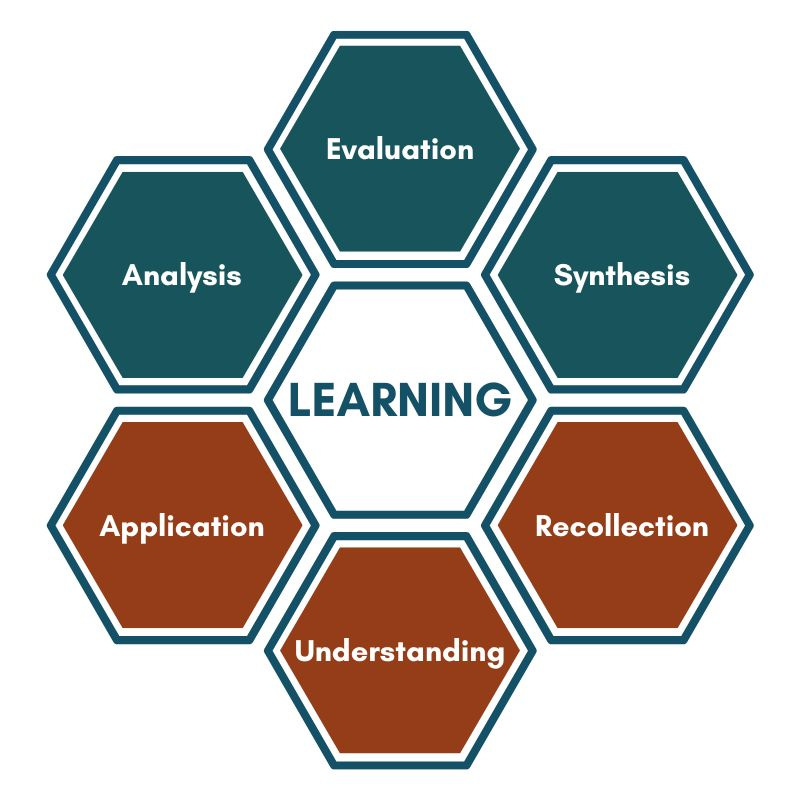
The higher-order learning skills are analysis, evaluation and synthesis.
Analysis is where you break something down into its component parts. You begin to understand how it all fits together and how the different pieces interact.
Evaluation is where you weigh it against what you already know. You compare it with your own experience and judge how effective it is in practice.
Finally, there’s synthesis. This is where you know something so well, and are so comfortable with it, that you’ve almost built it into your muscle memory. You can combine it with other things you know, apply it creatively and use it to solve entirely new problems.
For me, that’s the ultimate test of learning. Not simply knowing something, but knowing it so well that you have it at your disposal whenever you need it, whether that’s to solve a problem, teach it to someone else, or create something new.
Comments
Nothing yet. Say the first thing.
Sign in to join the conversation.