
This week I’m starting a short series on personal and professional development.
In many ways, that’s the whole reason these Monday Messages exist. It’s certainly the work I do every day as a coach, helping professionals, lawyers, business owners and leaders get better at the things they’re already good at, become competent in the things they’re not, and develop entirely new skills, capabilities and areas of expertise.
But first, let’s address the elephant in the room.
Before you get good at anything, you must start out bad at it.
That can be an uncomfortable truth, but it’s one we all need to embrace. You don’t develop nuance, judgement or expertise overnight. There isn’t a magic pill.
Think back to when you first learnt to walk.
You didn’t pull yourself up and immediately start running marathons. You tottered around. You lost your balance. You face-planted more than once.
But after the first fall, you didn’t lie there on the rug thinking, “Well, I suppose I’m just not one of life’s walkers.”
Of course not.
You got back up, held onto the sofa, found your balance and tried again.
Learning works exactly the same way.
Imagine our familiar 2x2 grid, the Boston Box. This time the vertical axis represents consciousness, and the horizontal axis represents competence.
We all begin in the bottom-left corner: unconsciously incompetent. We don’t know what we don’t know. That’s perfectly normal, but it is also a blind spot. And the trouble with blind spots is that, by definition, we can’t see them.
As we begin to learn, we move into the top-left quadrant: consciously incompetent. We become aware of the gaps. We start to see what we didn’t previously know existed.
It’s not always comfortable, but it’s real progress.
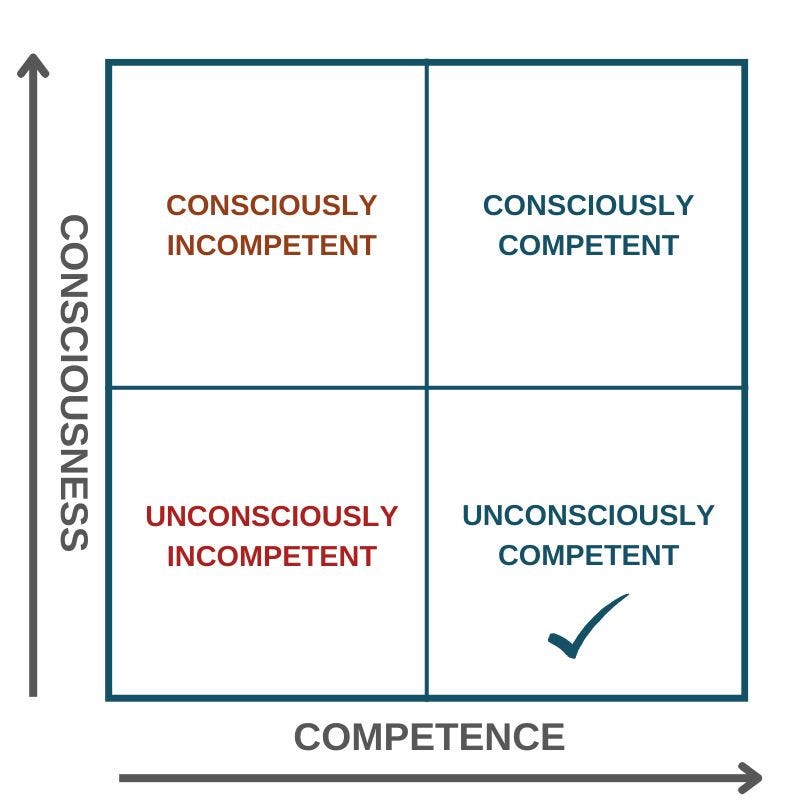
With deliberate practice, reflection and feedback, we move into the top-right quadrant: consciously competent. We’re now capable, but we still have to think about what we’re doing.
Finally, after enough repetition and experience, we arrive in the bottom-right quadrant: unconsciously competent. The skill becomes part of us. It’s no longer something we do; it’s simply how we operate.
I often think of the musician who practises a piece until they can play it ‘right’ versus the musician who practises until they can’t get it wrong.
Over the coming weeks we’ll explore what helps us move through these stages, what gets in the way, and how we can accelerate our own development.
Until then, remember: if you’re feeling awkward, clumsy or uncomfortable while learning something new, you’re probably making progress.
Comments
Nothing yet. Say the first thing.
Sign in to join the conversation.